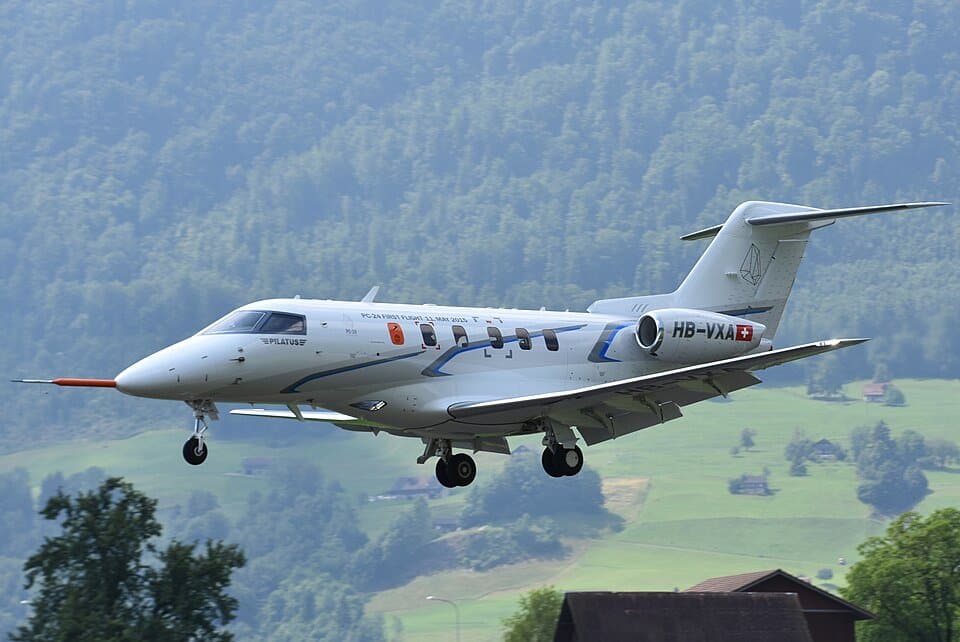

Credit
Stephan Widmer · CC BY-SA 2.0 · Resized · CC BY-SA 2.0 · Source ↗ · Modified


Preparing your view.

At a glance
Measured figures
Length
Single source16.85 m (55 ft 3 in)[source]
Wilga 35A · Length
Single sourceConfiguration
| Specification | Pilatus PC-24 | PZL-104 Wilga |
|---|---|---|
| Type | Light business jet[source] | Utility aircraft[source] |
| National origin | Switzerland[source] | Poland[source] |
| Manufacturer | Pilatus Aircraft[source] | PZL Warszawa-Okęcie[source] |
| Status | In production[source] | Production Ended |
8.10 m (26 ft 6 in)[source]
Empty; Empty weight
Single sourceMaximum take-off; Max ramp weight
Single sourceMaximum take-off; Max takeoff weight
Single source5,244 kg (11,561 lb)[source]
8,500 kg (18,739 lb) Max ramp weight: 8,545 kg (18,839 lb)[source]
Empty; Wilga 35A · Empty weight
Single sourceGross; Wilga 35A · Gross weight
Single sourceWilga 35A · 1 × Ivchenko AI-14 RA air-cooled 9-cylinder radial piston engine
Single source1 × Ivchenko AI-14 RA air-cooled 9-cylinder radial piston engine , 194 kW (260 hp)[source]
2 × Williams FJ44-4A turbofans thrust each
Single source2 × Williams FJ44-4A turbofans , 15 kN (3,400 lbf) thrust each[source]
Maximum payload
Single source1,406 kg (3,100 lb)[source]
Bars compare reported quantities only. A larger figure does not make a system better; configurations and test conditions differ.
| Primary users | Qatar Emiri Air Force PlaneSense Royal Flying Doctor Service[source] | — |
|---|
| Number built | 212 (Q1 2024)[source] | 1,000+[source] |
|---|
| Manufactured | 2015–present[source] | 1962-2006[source] |
|---|
| Introduction date | 1 April 2018[source] | — |
|---|
| First flight | 11 May 2015[source] | 24 April 1962[source] |
|---|
| Capacity | 10 passengers[source] |
|---|
| Aspect ratio | 9.35[source] | — |
|---|
| Fuel capacity | 2,705 kg (5,964 lb), 888.5 US gal (3,363 L)[source] | — |
|---|
| Cabin | 7.01 m × 1.69 m × 1.55 m long × wide × high ( 23 ft 0 in × 5 ft 7 in × 5 ft 1 in)[source] | — |
|---|
| Cabin altitude | 2,438 m at 13,716 m (8,000 ft at 45,000 ft), 8.78 psi (0.605 bar)[source] | — |
|---|
| Stall speed | 154 km/h (96 mph, 83 kn)[source] | — |
|---|
| Time to altitude | 45,000 ft (14,000 m) 27.1 mins[source] | — |
|---|
| Wing loading | 259 kg/m 2 (53 lb/sq ft)[source] | — |
|---|
| Fuel consumption | 0.58 kg/km (2.1 lb/mi) Mach 0.72/416 kn (770 km/h) cruise, 15,375 lb (6,974 kg) weight, FL 450, ISA+3C[source] | — |
|---|
| Thrust/weight | 0.36[source] | — |
|---|
| Take-off | 942 m; 3,091 ft (MTOW, ISA, sea level, dry paved runway)[source] | — |
|---|
| Landing | 734 m; 2,408 ft (Over 50 ft obstacle, MLW, ISA, sea level, dry paved runway)[source] | — |
|---|
| Primary user | — | Polish military and civilian aviation[source] |
|---|
| Role | — | Polish short-takeoff-and-landing (STOL) civil aviation utility aircraft[source] |
|---|
| Source measurement | — | The PZL-104 was designed for robust use in sports and civil aviation, with a strong emphasis on glider -towing and parachute training. On 24 April 1962, the prototype of the initial Wilga Mark 1 variant made the type's first flight, powered by an existing Polish 220 hp (160 kW) horizontally-opposed engine , the PZL WN-6RB. The subsequent flight test programme with the prototype exposed a number of design faults, the most serious of which was the airframe's excessive weight and a rear view restriction that prevented the crew from easily seeing a towed glider. Accordingly, an airframe review was performed by the design team that resulted in the thorough redevelopment of the aircraft, led by Polish aeronautical engineers Bronisław Żurakowski and Andrzej Frydrychewicz .[source]PZL-104 Wilga · Development / Origins; only the objects and conditions stated in this passage On 1 August 1963, the revised aircraft, which was designated as the PZL-104 Wilga Mark 2 , conducted its first flight. While testing validated the qualities of the Wilga 2's airframe and had proved the aircraft to be a successful design, the WN-6RB engine that powered the model was not fully developed and thus, the aircraft did not enter serial production. In response, the decision was taken to convert the assembly line to instead manufacture the improved Wilga C and Wilga Mark 3 configurations instead. On 30 December 1963, the Wilga C (or Wilga Mark 2 Subvariant C ) made its first flight; this variant which was a dedicated export model of the type for Indonesia powered by the imported North American -certified 225 hp (168 kW) horizontally opposed Continental O-470 engine.[source]PZL-104 Wilga · Development / Origins; only the objects and conditions stated in this passage To address the immaturity of the original WN-6RB engine, the design team decided to adopt an in-production radial engine , the 260 hp (190 kW) Ivchenko AI-14 R; furnished with this engine, the aircraft became the PZL-104 Wilga Mark 3 variant, which first flew on 31 December 1965. The new engine was more powerful but it spoilt the previously clean and aerodynamic fuselage lines, originally designed for a flat engine; nonetheless, the new variant was successful. Due in combination to the power of the AI-14R engine and the STOL capability of the airframe, an extraordinary high rate of climb of 11 m/s (2,165 fpm) (maximum) under minimal load was possible. One of a few remaining flaws was that the engine was relatively uneconomical to operate.[source]PZL-104 Wilga · Development / Origins; only the objects and conditions stated in this passage The Wilga 32 was an improved small-series export variant of the type, powered by a Continental flat engine, which was also locally produced in Indonesia as the "Gelatik". After completing an initial batch of 13 Wilga 3s, there were some improvements made to the model, most notably the landing gear base being increased from 2.12 to 2.83 m (7.0 to 9.3 ft) to improve stability during takeoff runs. On 29 June 1967, an improved model, designated as the PZL-104 Wilga 35 , made its first flight, it subsequently entered mass production as well. The most numerous variant of Wilga 35 was the utility plane Wilga 35A, while most others were built in small numbers or remained as prototypes alone.[source]PZL-104 Wilga · Development / Further development; only the objects and conditions stated in this passage In 1996, it was announced that PZL had developed an improved version of the aircraft, known as the PZL-104MA Wilga 2000 . The Wilga 2000 family benefitted from various improvements, it adopted an American Lycoming O-540 engine, capable of generating a maximum of 225 kW (300 hp), along with an AlliedSignal - Bendix avionics suite and a new wing, the latter of which offered increased fuel capacity and endurance, as well with aerodynamic refinements, such as fairings around the undercarriage. In May 2004, Canadian-based company Sealand Aviation demonstrated an amphibious version of the Wilga 2000 in Anchorage .[source]PZL-104 Wilga · Development / Further development; only the objects and conditions stated in this passage Early aircraft were typically powered by the Soviet-designed Ivchenko AI-14 R radial engine , which was capable of generating up to 260 hp (190 kW); notably, the engine rotates in the opposite direction to North American standards. The Al-14R would normally drive a two-bladed composite wooden propeller, which was strengthened with bonded metal sections fitted along their leading edges . The newest models of the Wilga have been furnished with fully metal propellers and are powered by the North American Continental O-470 engine, which rotate in the opposite direction to the earlier Soviet engine. Other engines from other manufacturers have also been adapted to power the type. Regardless of the engine fitted, fuel is primarily housed within a pair of 195 L (43 imp gal; 52 US gal) fuel tanks, which were located within the aircraft's wings.[source]PZL-104 Wilga · Design; only the objects and conditions stated in this passage Wilga 3 with Continental O-470 engine for Indonesia. 6 aircraft built in Poland, 18 in Indonesia under the name Gelatik . Some were fitted as agricultural aircraft .[source]PZL-104 Wilga · Variants; only the objects and conditions stated in this passage Wilga 35H[source]PZL-104 Wilga · Variants; only the objects and conditions stated in this passage Wilga 80/1400 (80H)[source]PZL-104 Wilga · Variants; only the objects and conditions stated in this passage Export floatplane variant of 1982 built in cooperation with Canada, powered by PZL AI-14RD (206 kW /280 HP) engine.[source]PZL-104 Wilga · Variants; only the objects and conditions stated in this passage PZL-104M Wilga 2000[source]PZL-104 Wilga · Variants; only the objects and conditions stated in this passage PZL-104MW Wilga 2000 Hydro[source]PZL-104 Wilga · Variants; only the objects and conditions stated in this passage Last variant of Wilga 2000 made in 2005, with improved aerodynamics and winglets , powered by Lycoming I0-540 300 hp engine. No longer in production.[source]PZL-104 Wilga · Variants; only the objects and conditions stated in this passage Polish Border Guard operates some (5 in 2005) PZL-104MF Wilgas 2000 as patrol aircraft.[source]PZL-104 Wilga · Operators / Military operators; only the objects and conditions stated in this passage On 12 Jan 1996, a PZL-104 (VH-PZS) crashed on North Stradbroke Island near Brisbane . The pilot and his three passengers were killed.[source]PZL-104 Wilga · Accidents and incidents; only the objects and conditions stated in this passage On 16 September 2019, a PZL-104 2000 (N123T, popularly known as Draco ) was attempting to takeoff from Reno Stead Airport in a crosswind with 38 knot gusts with a subsequent ground loop and crashed beside the runway. The three occupants got out uninjured.[source]PZL-104 Wilga · Accidents and incidents; only the objects and conditions stated in this passage Length: 8.10 m (26 ft 6 in)[source]PZL-104 Wilga · Specifications (Wilga 35A); only the objects and conditions stated in this passage Wingspan: 11.12 m (36 ft 5 in)[source]PZL-104 Wilga · Specifications (Wilga 35A); only the objects and conditions stated in this passage Height: 2.96 m (9 ft 6 in)[source]PZL-104 Wilga · Specifications (Wilga 35A); only the objects and conditions stated in this passage Wing area: 15.50 m 2 (166.85 sq ft)[source]PZL-104 Wilga · Specifications (Wilga 35A); only the objects and conditions stated in this passage Empty weight: 900 kg (1,984 lb)[source]PZL-104 Wilga · Specifications (Wilga 35A); only the objects and conditions stated in this passage Gross weight: 1,300 kg (2,868 lb)[source]PZL-104 Wilga · Specifications (Wilga 35A); only the objects and conditions stated in this passage Powerplant: 1 × Ivchenko AI-14 RA air-cooled 9-cylinder radial piston engine , 194 kW (260 hp)[source]PZL-104 Wilga · Specifications (Wilga 35A); only the objects and conditions stated in this passage Maximum speed: 195 km/h (121 mph, 105 kn)[source]PZL-104 Wilga · Specifications (Wilga 35A); only the objects and conditions stated in this passage Range: 670 km (416 mi, 361 nmi)[source]PZL-104 Wilga · Specifications (Wilga 35A); only the objects and conditions stated in this passage Service ceiling: 4,040 m (13,250 ft)[source]PZL-104 Wilga · Specifications (Wilga 35A); only the objects and conditions stated in this passage Rate of climb: 5.5 m/s (1,082 ft/min)[source]PZL-104 Wilga · Specifications (Wilga 35A); only the objects and conditions stated in this passage |
|---|
| Country of origin | — | Poland[source]Inventory Origin column; table 1, row 41, cell 2; revision 1360230767; retrieved 2026-10-02 |
|---|