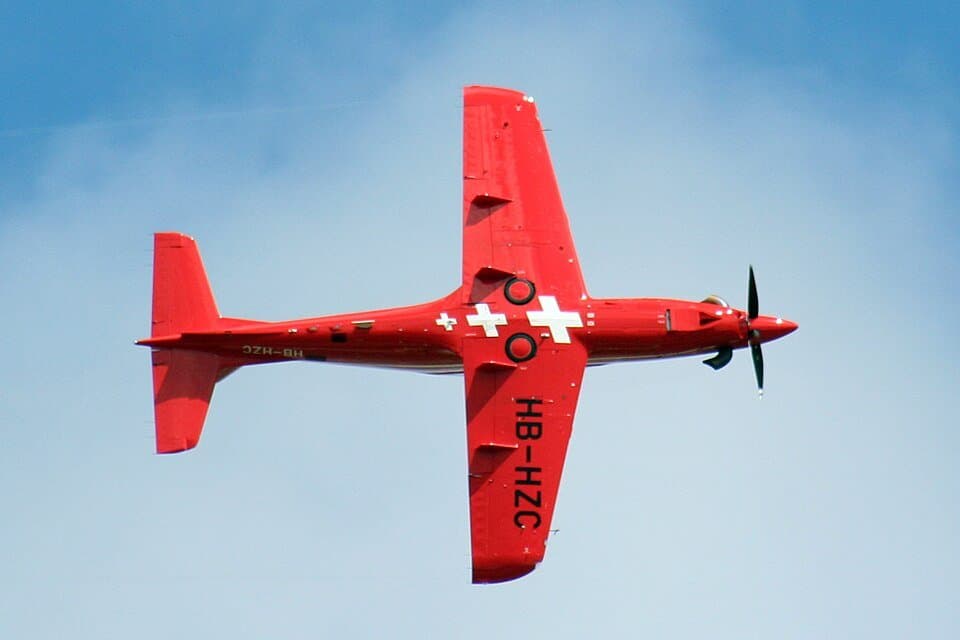

Credit
Carlos Menendez San Juan · CC BY-SA 2.0 · Resized · CC BY-SA 2.0 · Source ↗ · Modified


Preparing your view.
At a glance
True scale
Side by side. From every angle. A human reference for perspective.
3.10 MB · Loads when you open it| Model | Length | Width / span | Height |
|---|---|---|---|
| Pilatus PC-21 | ≈ 11.23 m | ≈ 9.11 m (Wingspan) | ≈ 3.74 m |
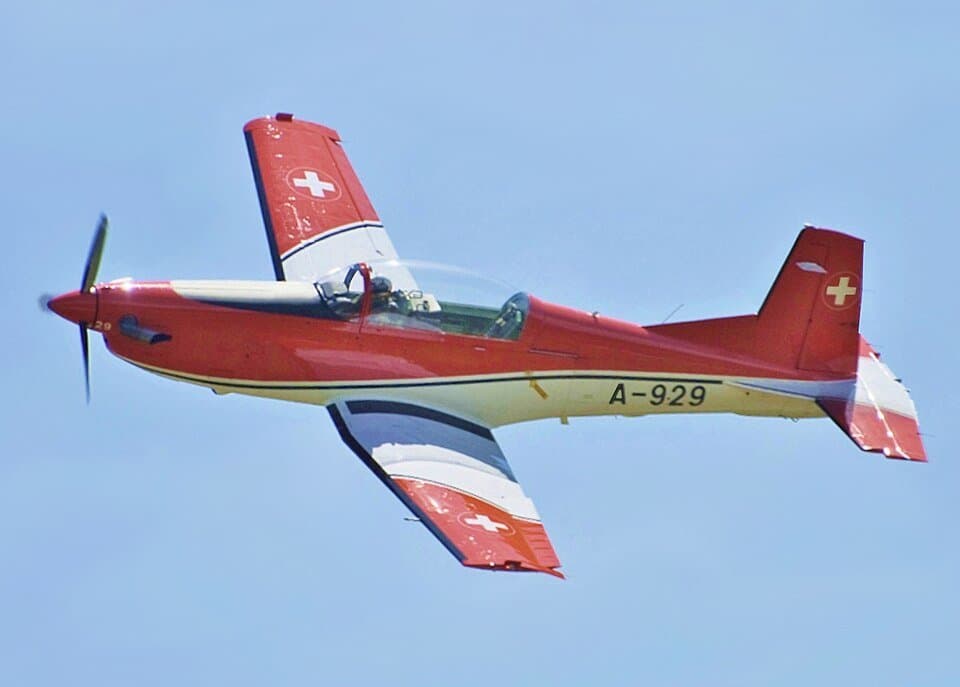
| Pilatus PC-7 | ≈ 9.78 m | ≈ 10.4 m (Wingspan) | ≈ 3.48 m |
Scaled uniformly to the sourced length of 11.233 m. The height was fitted to the sourced 3.74 m; the width was fitted to the sourced 9.108 m wingspan. Not an official model or a measured survey.
ForceTally · All rights reserved
Scaled uniformly to the sourced length of 9.78 m. The width was fitted to the sourced 10.4 m wingspan. Not an official model or a measured survey.
ForceTally · All rights reserved
The human reference is a generic 1.75 m figure. Models describe external size, not combat performance.
Measured figures
PC-21 · Length
Single source11.233 m (36 ft 10 in)[source]
Configuration
| Specification | Pilatus PC-21 | Pilatus PC-7 |
|---|---|---|
| Type | Advanced trainer aircraft[source] | Trainer aircraft[source] |
| Manufacturer | Pilatus Aircraft[source] | Pilatus Aircraft[source] |
| Designer | Pilatus Aircraft[source] | — |
| Status | Active service[source] | In service[source] |
| Primary users | Swiss Air Force Royal Australian Air Force Spanish Air and Space Force Royal Saudi Air Force French Air and Space Force |
PC-7 · Length
9.78 m (32 ft 1 in)[source]
Empty; PC-21 · Empty weight
Single sourceGross; PC-21 · maximum ramp mass
Single sourceMaximum take-off; PC-21 · aerobatic
Single source2,270 kg (5,004 lb)[source]
3,120 kg (6,878 lb) (maximum ramp mass)[source]
3,100 kg (6,834 lb) aerobatic[source]
Empty; PC-7 · Empty weight
Single sourceMaximum take-off; PC-7 · Max takeoff weight
Single sourceCruise; PC-21 · at 10,000 ft (3,048 m)
Single sourceMaximum; PC-21 · at sea level
Single source685 km/h (426 mph, 370 kn) at sea level[source]
620 km/h (390 mph, 330 kn) at 10,000 ft (3,048 m)[source]
Cruise; PC-7 · (econ. cruise at 6,095 m (19,997 ft))
Single sourceMaximum; PC-7 · (max cruise at 6,095 m (19,997 ft))
Single sourcePC-21 · Range
Single source1,333 km (828 mi, 720 nmi)[source]
Ferry; PC-7 · Ferry range
Single sourcePC-7 · standard range without external drop tanks, ferry range with external drop tanks, (cruise power, at 5,000 m (16,000 ft) - 20 min reserves)
Single source1,200 km (750 mi, 650 nmi) standard range without external drop tanks, ferry range with external drop tanks, (cruise power, at 5,000 m (16,000 ft) - 20 min reserves)[source]
2,630 km (1,630 mi, 1,420 nmi)[source]
PC-21 · 1 × Pratt & Whitney Canada PT6A-68B turboprop engine
Single source1 × Pratt & Whitney Canada PT6A-68B turboprop engine, 1,200 kW (1,600 hp)[source]
PC-7 · 1 × Pratt & Whitney Canada PT6A -25A turboprop derated from
Single sourcePC-7 · 650 shp
Single source1 × Pratt & Whitney Canada PT6A -25A turboprop , 410 kW (550 hp)(derated from 485 kW (650 shp))[source]
PC-21 · (3,999.4 ft/min) sea level
Single source20.317 m/s (3,999.4 ft/min) sea level[source]
PC-7 · (2,150 ft/min) climb to 5,000 m in 9 min 0 sec take-off run 780 m at max take-off weight, landing run 505 m at max landing weight
Single source10.9 m/s (2,150 ft/min) climb to 5,000 m in 9 min 0 sec take-off run 780 m at max take-off weight, landing run 505 m at max landing weight[source]
PC-21 · Hardpoints : Provisions provided for 4× under-wing and 1× centerline external store stations, capable of mounting up to of payload of air-to-ground weapons to operate in the counter-insurgency role
Single sourceHardpoints : Provisions provided for 4× under-wing and 1× centerline external store stations, capable of mounting up to 1,150 kg (2,540 lb) of payload of air-to-ground weapons to operate in the counter-insurgency role.[source]
PC-7 · Endurance
Single source4 hr 22 min[source]
Bars compare reported quantities only. A larger figure does not make a system better; configurations and test conditions differ.
Mexican Air Force Indian Air Force South African Air Force Royal Malaysian Air Force[source] |
| Number built | 211 (312 ordered in total)[source] | >618[source] |
|---|
| Manufactured | 2002–present[source] | 1966–present[source] |
|---|
| Introduction date | April 2008[source] | PC-7 : 1978 PC-7 Mk.II M : 1994 PC-7 MKX : 2021[source] |
|---|
| First flight | 1 July 2002[source] | PC-7 : 12 April 1966 ( 1966-04-12 ) (prototype) 18 August 1978 ( 1978-08-18 ) (production) PC-7 Mk.II M : 28 September 1992 ( 1992-09-28 )[source] |
|---|
| Hardpoints | Provisions provided for 4× under-wing and 1× centerline external store stations, capable of mounting up to 1,150 kg (2,540 lb) of payload of air-to-ground weapons to operate in the counter-insurgency role.[source] | 6 × underwing hardpoints for bombs and rockets with a capacity of 1,040 kg (2,294 lb)[source] |
|---|
| Propellers | 5-bladed constant-speed propeller, 2.39 m (7 ft 10 in) diameter[source] | 3-bladed Hartzell HC-B3TN-2 / T10173C-8 constant-speed propeller , 2.36 m (7 ft 9 in) diameter[source] |
|---|
| Stall speed | 170 km/h (110 mph, 92 kn) gear and flaps up (20 km/h (12 mph; 11 kn) less with flaps and gear down)[source] | 119 km/h (74 mph, 64 kn) (flaps and gear down, power off)[source] |
|---|
| g limits | Aerobatic: + 8.0 – 4.0 aerobatic / with underwing stores: + 5.0 to – 2.5[source] | -3 / +6[source] |
|---|
| Roll rate | 200°/s at 10,000 ft (3,048 m)[source] | — |
|---|
| Wing loading | 208 kg/m 2 (43 lb/sq ft)[source] | — |
|---|
| Power/mass | 0.39 kW/kg (0.24 hp/lb)[source] | — |
|---|
| Country of origin | Schweiz[source]Country of design · Entwurfsland | Switzerland[source] |
|---|
| Developed from | — | Pilatus P-3[source] |
|---|
| Developed into | — | Pilatus PC-9[source] |
|---|
| Capacity | — | two[source] |
|---|
| Fuel capacity | — | 474 L (104 imp gal; 125 US gal) usable internal fuel, 2x 240 L (53 imp gal; 63 US gal) external fuel drop tanks • Max landing weight: 2,565 kg[source] |
|---|
| Aspect ratio | — | 6.5:1[source] |
|---|
| Airfoil | — | NACA 64 2 A-415 at root, 64 1 A-612 at tip[source] |
|---|
| Never exceed speed | — | 500 km/h (310 mph, 270 kn) EAS[source] |
|---|
| Alternative designation | — | Pilatus PC-7 Turbo Trainer[source] |
|---|