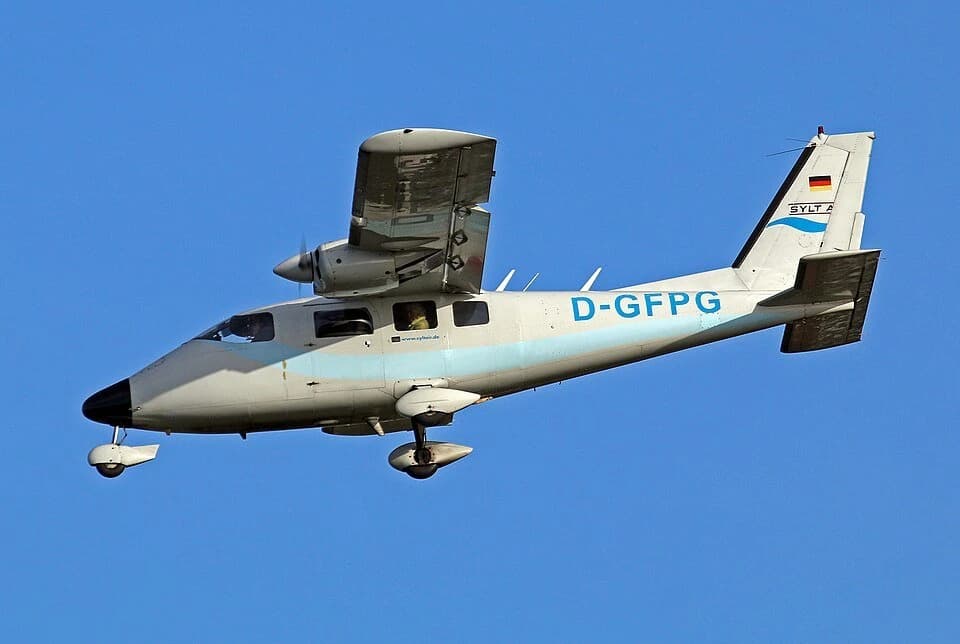

Credit
wiltshirespotter · CC BY-SA 2.0 · Resized / converted to WebP · CC BY-SA 2.0 · Source ↗ · Modified


Preparing your view.
At a glance
Measured figures
P.68C · Length
Single source31 ft 0 in (9.55 m)[source]
Configuration
| Specification | Partenavia P.68 | Piaggio P.180 Avanti |
|---|---|---|
| Type | Light transport[source] | Executive transport[source] |
| Manufacturer | Partenavia Vulcanair[source] | Piaggio Aero[source] |
| Designer | Luigi Pascale[source] | — |
| Status | In service[source] | In production[source] |
P180 Avanti EVO · Length
14.4 m (47.3 ft)[source]
Empty; P.68C · Empty weight
Single sourceMaximum take-off; P.68C · Max takeoff weight
Single source3,130 lb (1,420 kg)[source]
4,594 lb (2,084 kg)[source]
Empty; P180 Avanti EVO · Empty weight
Single sourceMaximum take-off; P180 Avanti EVO · Max takeoff weight
Single sourceCruise; P.68C · at 10,000 ft (3,050 m) (econ cruise)
Single source160 kn (187 mph, 301 km/h) at 10,000 ft (3,050 m) (econ cruise)[source]
P.68C · econ cruise, standard fuel
Single source1,103 nmi (1,269 mi, 2,043 km) (econ cruise, standard fuel)[source]
P.68C · 2 × Lycoming IO-360 -A1B6 air-cooled horizontally-opposed engine each
Single source2 × Lycoming IO-360 -A1B6 air-cooled horizontally-opposed engine, 200 hp (150 kW) each[source]
P180 Avanti EVO · 2 × Pratt & Whitney Canada PT6 A-66B turboprop (850 shp) each ISA+28C Flat Rated
Single source2 × Pratt & Whitney Canada PT6 A-66B turboprop , 630 kW (850 shp) each ISA+28C Flat Rated[source]
P.68C · 1,100 ft/min (
Single source1,100 ft/min (6.0 m/s)[source]
P180 Avanti EVO · Wing area
Single source15.99 m 2 (172.1 sq ft)[source]
Bars compare reported quantities only. A larger figure does not make a system better; configurations and test conditions differ.
| Number built |
|---|
431+[source] |
246 (Dec 2020)[source] |
| Manufactured | 1970-present[source] | 1986–present[source] |
|---|
| First flight | 25 May 1970[source] | 23 September 1986[source] |
|---|
| Capacity | plus five passengers[source] | 7–9[source] |
|---|
| Fuel capacity | 177 US gal (147 imp gal; 670 L)[source] | 1,271 kg (2,802 lb)[source] |
|---|
| Propellers | 2-bladed[source] | — |
|---|
| Stall speed | 57 kn (66 mph, 106 km/h) (flaps down, power off)[source] | — |
|---|
| Role | light aircraft[source] | executive/VIP light transport aircraft ,[source] |
|---|
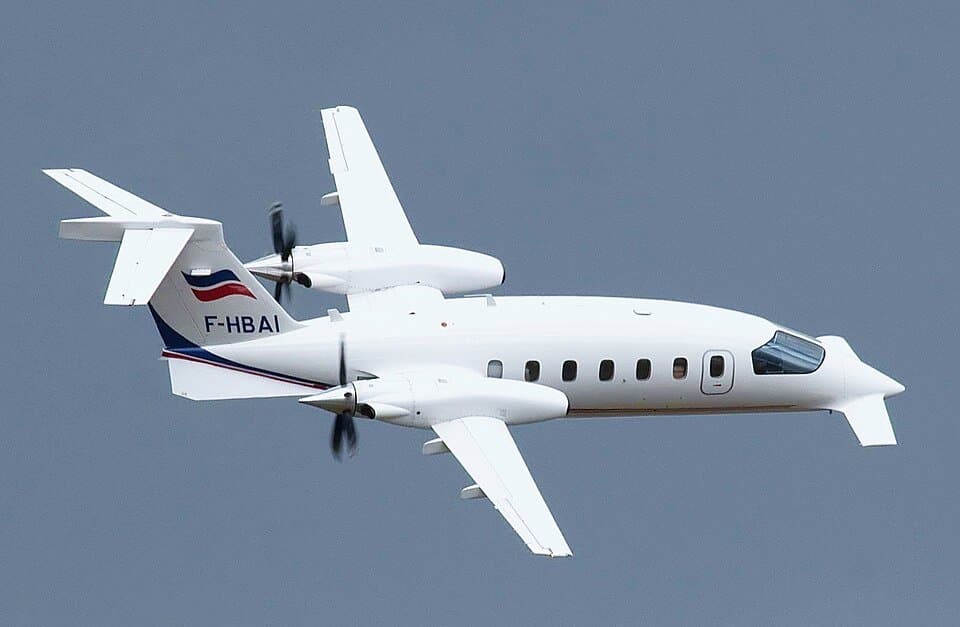
| Source measurement | The type certification for the P.68 Victor , a twin piston engine, high wing monoplane with fixed tricycle landing gear was applied for on 22 January 1969. The Partenavia P.68 was designed as a six-seat light transport and trainer powered by two 200 hp (149 kW) Lycoming IO-360 engines, it made its first flight on 25 May 1970 at Naples . The type certification for the 9.20 m (30.18 ft) long P.68 was granted by the Italian Civil Aviation Authority on 17 November 1971 for an 1860 kg (4100 lb) MTOW . It was approved by the FAA on 7 December 1971. After 300 h of flight tests , production was to start in May 1972 in a new plant at Naples Capodichino Airport at a rate of three aircraft per month. The prototype was built at Arzano , Italy, production began with 14 pre-production aircraft at new facilities in Casoria , Italy.[source]Partenavia P.68 · Development / Partenavia P.68 Victor; only the objects and conditions stated in this passage The longer, 9.35 m (30.68 ft) P.68B Victor certification was applied for on 18 October 1973 and granted on 24 May 1974 for a 1960 kg (4321 lb) MTOW. Its unit cost was US$ 82,000 in 1974 (US$535000 today). Its fuselage was lengthened to create more space in the cockpit.[source]Partenavia P.68 · Development / Partenavia P.68 Victor; only the objects and conditions stated in this passage Both derived from the P.68B and 9.55 m (31.33 ft) long, the P.68R Victor has a retractable landing gear and was certified on 31 July 1978 while the P.68C has a nose allowing a weather radar , larger fuel tanks and increased weights, and was certified on 23 July 1979 with a 1990 kg (4387 lb) MTOW. The P.68C-TC , certified on 29 April 1980, has turbocharged, 210 hp (157 kW) Lycoming TIO-360 -C1A6D engines. In 2021, the equipped price of the P.68C was US$1.25M, US$1.5M for the P.68R and US$1.55M for the P.68C-TC.[source]Partenavia P.68 · Development / Partenavia P.68 Victor; only the objects and conditions stated in this passage The 9.43 m (30.94 ft) long P.68 Observer , derived from the P.68B with a transparent fuselage nose, adapted systems and larger fuel tanks, was certified on 12 June 1980. The observation aircraft for law enforcement were initially conversions of existing aircraft by German Sportavia-Putzer .[source]Partenavia P.68 · Development / Partenavia P.68 Observer; only the objects and conditions stated in this passage The 9.15 m (30.02 ft) long P.68TC Observer , a P.68 "Observer" with turbocharged engines, was certified on 18 June 1985.[source]Partenavia P.68 · Development / Partenavia P.68 Observer; only the objects and conditions stated in this passage The 9.54 m (31.30 ft) long P.68 "Observer 2 is a P.68 "Observer", with increased weights, upturned wing tips and modified systems, and was certified on 30 November 1989 for a 2084 kg (4594 lb) MTOW.[source]Partenavia P.68 · Development / Partenavia P.68 Observer; only the objects and conditions stated in this passage The 10.89-11.27 m (35.73-36.97 ft) long, retractable gear AP68TP-600 "Viator" , with two 328 hp (245 kW) Allison 250 -B17C turboprops, has a 2850–3000 kg (6283-6614 lb) MTOW and was certified on 16 October 1986. In 2023, its equipped price was $3.5M.[source]Partenavia P.68 · Development / Partenavia AP68TP-600 Viator; only the objects and conditions stated in this passage The 9.90 m (32.48 ft) long, fixed gear AP68TP-300 Spartacus was certified on 10 December 1983 with two 328 hp (245 kW) Allison 250 -B17C turboprops and a 2600 kg (5732 lb) MTOW . The nine-seater development was helped by Aeritalia . The prototype first flew in 1978 with a retractable undercarriage.[source]Partenavia P.68 · Development / Partenavia AP68TP-300 Spartacus; only the objects and conditions stated in this passage September 11, 1983: A P.68C, N29561, performing an aerobatic display broke up in flight during an airshow in Plainview, Texas . The NTSB report revealed that analysis of the video showed the aircraft performed a fly-by over the runway, exceeding its Vne (Velocity, never-exceed) speed by 27 knots. The pilot then executed a sharp nose-up pitch change of about 8 degrees, which spiked the aircraft's dynamic load factor to 8.3Gs and caused both wings to fail in the main spar just outside both engine nacelles then separate from the aircraft, which then began rotating, causing the rear fuselage to twist along its length between its cabin and empennage . The aircraft then plummeted 250 feet down just beyond the group of spectators.[source]Partenavia P.68 · Incidents and accidents; only the objects and conditions stated in this passage Capacity: plus five passengers[source]Partenavia P.68 · Specifications (P.68C); only the objects and conditions stated in this passage Length: 31 ft 0 in (9.55 m)[source]Partenavia P.68 · Specifications (P.68C); only the objects and conditions stated in this passage Wingspan: 39 ft 4 in (12 m)[source]Partenavia P.68 · Specifications (P.68C); only the objects and conditions stated in this passage Height: 12 ft 3 in (3.40 m)[source]Partenavia P.68 · Specifications (P.68C); only the objects and conditions stated in this passage Empty weight: 3,130 lb (1,420 kg)[source]Partenavia P.68 · Specifications (P.68C); only the objects and conditions stated in this passage Max takeoff weight: 4,594 lb (2,084 kg)[source]Partenavia P.68 · Specifications (P.68C); only the objects and conditions stated in this passage Powerplant: 2 × Lycoming IO-360 -A1B6 air-cooled horizontally-opposed engine, 200 hp (150 kW) each[source]Partenavia P.68 · Specifications (P.68C); only the objects and conditions stated in this passage Cruise speed: 160 kn (187 mph, 301 km/h) at 10,000 ft (3,050 m) (econ cruise)[source]Partenavia P.68 · Specifications (P.68C); only the objects and conditions stated in this passage Stall speed: 57 kn (66 mph, 106 km/h) (flaps down, power off)[source]Partenavia P.68 · Specifications (P.68C); only the objects and conditions stated in this passage Range: 1,103 nmi (1,269 mi, 2,043 km) (econ cruise, standard fuel)[source]Partenavia P.68 · Specifications (P.68C); only the objects and conditions stated in this passage Service ceiling: 18,000 ft (5,490 m)[source]Partenavia P.68 · Specifications (P.68C); only the objects and conditions stated in this passage Rate of climb: 1,100 ft/min (6.0 m/s)[source]Partenavia P.68 · Specifications (P.68C); only the objects and conditions stated in this passage | The Piaggio P.180 Avanti is an executive/VIP light transport aircraft , designed by Piaggio Aero and built in Italy . It features twin, wing-mounted turboprop engines, in a pusher configuration . The Avanti seats up to nine people in a pressurized cabin and may be flown by one or two pilots . The design is of three-surface configuration, having both a small forward canard wing and a conventional tailplane, as well as its main wing, with the main wing spars passing behind the passenger cabin area. The FAI lists it as the fastest propeller-driven aircraft with speed of 927.4 km/h (576.3 mph; 500.8 kn).[source]Piaggio P.180 Avanti · Lead; only the objects and conditions stated in this passage An improved Avanti II obtained European and U.S. certification in November 2005. Six months later, 70 planes had been ordered, including 36 by Avantair . Avanti II received type approval for Russia in 2011. The Avanti II featured uprated Pratt & Whitney Canada PT6A-66B turboprop engines and flies about 18 km/h (11 mph) faster, with better fuel economy; and an all-new " glass panel " avionics suite from Rockwell Collins reduced cockpit clutter. In addition to heading, attitude and navigation information, flat panel color liquid crystal displays add collision avoidance ( TCAS ), ground proximity ( TAWS ) and real-time graphic weather depiction.[source]Piaggio P.180 Avanti · Development; only the objects and conditions stated in this passage The Avanti is marketed as being faster than other turboprops and many midsized jets, with cost efficiency as much as 40 percent better than market-competing jets, as a result of less drag and a lower fuel burn rate. Powered by the same Pratt & Whitney Canada PT6A-66 engines as the Beech Super King Air 200 , the Avanti II is 100 knots (190 km/h) faster than that model. Flying magazine judged the Avanti to be the "Fastest Civilian Turboprop Twin" in 2014, saying "Avanti's speed is pretty much on par with Cessna's M2 , while providing more space and a lower operating cost."[source]Piaggio P.180 Avanti · Development; only the objects and conditions stated in this passage First flown in 2013, the P.1HH UAV prototype crashed off Sicily in May 2016 after 100 hours of flight tests; a second prototype flew in July 2017 before two others joined. The first Avanti EVO manufactured at the new $150 million factory at Albenga Airport was delivered in 2016, one year after moving production from its previous Genoa Cristoforo Colombo Airport plant. |
|---|
| Country of origin | Italy[source]Inventory Origin column; table 2, row 6, cell 2; revision 1343823935 | — |
|---|
| National origin | — | Italy[source] |
|---|
| Primary users | — | Italian Air Force Italian Army Italian Navy Avantair (historical)[source] |
|---|
| Introduction date | — | 30 September 1990[source] |
|---|
| Aspect ratio | — | 12.3[source] |
|---|
| Airfoil | — | PE 1300G (root), PE 1491G/1332G (tip)[source] |
|---|
| Max landing weight | — | 5,216 kg (11,500 lb)[source] |
|---|
| Max zero-fuel weight | — | 4,445 kg (9,800 lb)[source] |
|---|
| Cabin | — | 17.5 feet (5.3 m) long, 5.8 feet (1.8 m) high, 6.1 feet (1.9 m) wide (3.5 ft floor)[source] |
|---|
| Foreplane area | — | 2.19 m² (23.59 ft²)[source] |
|---|
| Horizontal stabilizer area | — | 3.83 m² (41.27 ft²)[source] |
|---|
| Minimum control speed | — | 190 km/h (120 mph, 100 kn)[source] |
|---|
| Time to altitude | — | 10 min to FL 250[source] |
|---|
| Wing loading | — | 343 kg/m 2 (70.3 lb/sq ft)[source] |
|---|
| Fuel consumption | — | 0.220 kg/km (0.779 lb/mi)[source] |
|---|
| Power/mass | — | 230 W/kg (0.14 hp/lb)[source] |
|---|
| Takeoff (SL, ISA) | — | 994 m (3,262 ft)[source] |
|---|
On 22 November 2018, Piaggio Aerospace entered receivership after declaring itself insolvent as its restructuring plan failed. After the 2008 financial crisis , a key US fractional customer went bankrupt and P.180 Evo sales dropped from a 2008 peak of 30 deliveries to just three in 2018. By November 2018, no P.1HHs were delivered to the UAE and the Italian Ministry of Defence €766 million support for the P.2HH program was frozen as populist coalition partner Five Star Movement prioritized social programmes over defence spending.[source]Piaggio P.180 Avanti · Development; only the objects and conditions stated in this passage
By December 2020, the fleet surpassed one million flight hours. 246 aircraft have been produced, of which 213 are in service: 96 in Europe, 95 in the Americas, 18 in Asia-Pacific, and four in Africa and the Middle East.[source]Piaggio P.180 Avanti · Development; only the objects and conditions stated in this passage
The Piaggio P.180 Avanti has a sea-level standard-day maximum-gross-weight takeoff distance of 869 m (2,851 ft) and a landing roll of 872 m (2,861 ft).[source]Piaggio P.180 Avanti · Design; only the objects and conditions stated in this passage
Deliveries were at a high of 30 in 2008, but only two in 2013.[source]Piaggio P.180 Avanti · Design; only the objects and conditions stated in this passage
In 2014 Piaggio announced development of an updated version, named EVO. It uses new Hartzell composite propellers, with blades of scimitar configuration. Its wings carry new winglets; aerodynamic improvements have been incorporated, and an additional 60-gallon (400 lb) fuel tank option to increase range to 1,770 nautical miles (3,280 kilometres; 2,040 miles). The company predicts improved climb performance, 250 nmi greater range, and 3% reduction in fuel usage. The revised propeller shape, combined with a lower engine speed, promises a 68% reduction in external noise. Avanti EVO type certification was granted by EASA on 28 November 2014, and by the FAA on 6 July 2015. Projected purchase price was $7.4 million in 2014. By 2021 the equipped price was $7.695 million. The first EVO was delivered in April 2015, with five more to follow the same year.[source]Piaggio P.180 Avanti · Design; only the objects and conditions stated in this passage
Medium-altitude long-endurance unmanned aerial vehicle based on the Avanti II airframe , with an increased wingspan and the ability to carry up to 1,100 pounds (500 kg) of weapons. The P.1HH HammerHead Mission Management System is based on the Selex ES (now Leonardo S.p.A. ) skyISTAR solution. The vehicle's first flight took place in December 2013 from Trapani–Birgi Italian Air Force base .[source]Piaggio P.180 Avanti · Variants; only the objects and conditions stated in this passage
The Italian Air Force signed an agreement with Piaggio Aerospace to buy three Unmanned Aerial System P.1HH HammerHead (six aircraft and three ground control stations) with delivery starting from the early months of 2016. United Arab Emirates Air Force ordered eight P.1HH aircraft. On 31 May 2016 the first P.1HH prototype crashed off the Sicilian coast, delaying flight testing for thirteen months during construction of a second prototype. Piaggio flew the second prototype at Trapani–Birgi military airport on 5 July 2017 The UAE was to take delivery of six P.1HHs in 2018 and the remaining two in 2019, however by November 2018, no P.1HHs had been delivered and Piaggio Aerospace requested to be placed into receivership .[source]Piaggio P.180 Avanti · Variants; only the objects and conditions stated in this passage
Piaggio develops with Leonardo, the Italian and UAE Armed Forces a P.1HH successor for 2023, with a new wing, more composite materials , and re-thought systems. With a larger wing and airframe, maximum endurance rose to 30 h, but following the 2018 Italian election , the country's €766 million program for 20 aircraft and 10 control stations was suspended.[source]Piaggio P.180 Avanti · Variants; only the objects and conditions stated in this passage
In May 2017, 220 aircraft were in operation around the world, with 89 being first-generation Avanti, 126 second-generation Avanti II and 6 Avanti EVO models.[source]Piaggio P.180 Avanti · Operators / Civil; only the objects and conditions stated in this passage
A Piaggio Avanti San Diego -to- Charleston flight in 2003, piloted by Joe Ritchie with co-pilot Steve Fossett , set National Aeronautic Association and Fédération Aéronautique Internationale transcontinental speed records with an average speed of 475.2 knots (880.1 km/h; 546.9 mph), breaking the previous Los Angeles to New York turboprop record of 395.21 knots set by Chuck Yeager in 1986 in a Piper Cheyenne 400LS . Elapsed time for the Avanti's coast-to-coast trip was 3:51:52.[source]Piaggio P.180 Avanti · Operators / Civil; only the objects and conditions stated in this passage
Length: 14.4 m (47.3 ft)[source]Piaggio P.180 Avanti · Specifications (P180 Avanti EVO); only the objects and conditions stated in this passage
Wingspan: 14 m (46 ft)[source]Piaggio P.180 Avanti · Specifications (P180 Avanti EVO); only the objects and conditions stated in this passage
Height: 4.0 m (13 ft)[source]Piaggio P.180 Avanti · Specifications (P180 Avanti EVO); only the objects and conditions stated in this passage
Wing area: 15.99 m 2 (172.1 sq ft)[source]Piaggio P.180 Avanti · Specifications (P180 Avanti EVO); only the objects and conditions stated in this passage
Airfoil : PE 1300G (root), PE 1491G/1332G (tip)[source]Piaggio P.180 Avanti · Specifications (P180 Avanti EVO); only the objects and conditions stated in this passage
Empty weight: 3,799 kg (8,375 lb)[source]Piaggio P.180 Avanti · Specifications (P180 Avanti EVO); only the objects and conditions stated in this passage
Max takeoff weight: 5,488 kg (12,100 lb)[source]Piaggio P.180 Avanti · Specifications (P180 Avanti EVO); only the objects and conditions stated in this passage
Fuel capacity: 1,271 kg (2,802 lb)[source]Piaggio P.180 Avanti · Specifications (P180 Avanti EVO); only the objects and conditions stated in this passage
Max landing weight: 5,216 kg (11,500 lb)[source]Piaggio P.180 Avanti · Specifications (P180 Avanti EVO); only the objects and conditions stated in this passage
Max zero-fuel weight: 4,445 kg (9,800 lb)[source]Piaggio P.180 Avanti · Specifications (P180 Avanti EVO); only the objects and conditions stated in this passage
Cabin: 17.5 feet (5.3 m) long, 5.8 feet (1.8 m) high, 6.1 feet (1.9 m) wide (3.5 ft floor)[source]Piaggio P.180 Avanti · Specifications (P180 Avanti EVO); only the objects and conditions stated in this passage
Foreplane area: 2.19 m² (23.59 ft²)[source]Piaggio P.180 Avanti · Specifications (P180 Avanti EVO); only the objects and conditions stated in this passage
Horizontal stabilizer area: 3.83 m² (41.27 ft²)[source]Piaggio P.180 Avanti · Specifications (P180 Avanti EVO); only the objects and conditions stated in this passage
Powerplant: 2 × Pratt & Whitney Canada PT6 A-66B turboprop , 630 kW (850 shp) each ISA+28C Flat Rated[source]Piaggio P.180 Avanti · Specifications (P180 Avanti EVO); only the objects and conditions stated in this passage
Maximum speed: 740 km/h (460 mph, 400 kn) FL310 high speed cruise[source]Piaggio P.180 Avanti · Specifications (P180 Avanti EVO); only the objects and conditions stated in this passage
Cruise speed: 589 km/h (366 mph, 318 kn) FL410 long range cruise[source]Piaggio P.180 Avanti · Specifications (P180 Avanti EVO); only the objects and conditions stated in this passage
Minimum control speed : 190 km/h (120 mph, 100 kn)[source]Piaggio P.180 Avanti · Specifications (P180 Avanti EVO); only the objects and conditions stated in this passage
Range: 2,800 km (1,740 mi, 1,510 nmi) 4 passengers, NBAA IFR, 100-nm alternate[source]Piaggio P.180 Avanti · Specifications (P180 Avanti EVO); only the objects and conditions stated in this passage
Ferry range: 2,830 km (1,760 mi, 1,530 nmi)[source]Piaggio P.180 Avanti · Specifications (P180 Avanti EVO); only the objects and conditions stated in this passage
Service ceiling: 12,000 m (41,000 ft)[source]Piaggio P.180 Avanti · Specifications (P180 Avanti EVO); only the objects and conditions stated in this passage
Takeoff (SL, ISA): 994 m (3,262 ft)[source]Piaggio P.180 Avanti · Specifications (P180 Avanti EVO); only the objects and conditions stated in this passage