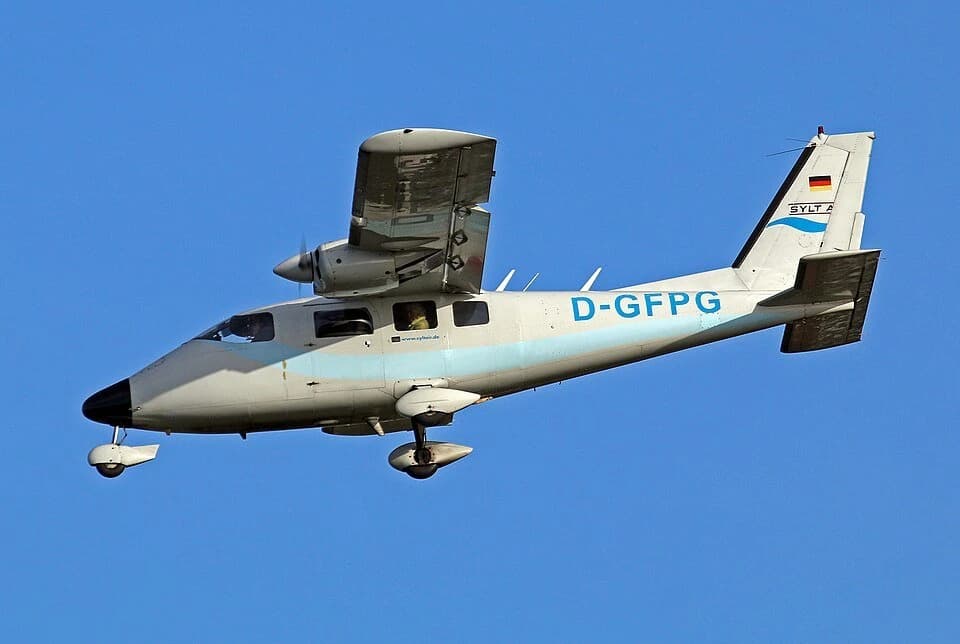

Credit
wiltshirespotter · CC BY-SA 2.0 · Resized / converted to WebP · CC BY-SA 2.0 · Source ↗ · Modified


Preparing your view.

At a glance
True scale
Side by side. From every angle. A human reference for perspective.
3.30 MB · Loads when you open it| Model | Length | Width / span | Height |
|---|---|---|---|
| P-68 | ≈ 9.55 m | ≈ 12 m (Width) | ≈ 3.4 m |
| Technoavia SM92 Finist | ≈ 9.13 m | ≈ 14.6 m (Width) | ≈ 2.9 m |
Scaled uniformly to the sourced length of 9.55 m. The shape was turned square to the axes; the height was fitted to the sourced 3.4 m; the width was fitted to the sourced 12 m. Not an official model or a measured survey.
ForceTally · All rights reserved
Scaled uniformly to the sourced length of 9.13 m. The shape was turned square to the axes; the width was fitted to the sourced 14.6 m. Not an official model or a measured survey.
ForceTally · All rights reserved
The human reference is a generic 1.75 m figure. Models describe external size, not combat performance.
Measured figures
P.68C · Length
Single source31 ft 0 in (9.55 m)[source]
SM92 · Length
Single sourceConfiguration
| Specification | P-68 | Technoavia SM92 Finist |
|---|---|---|
| Type | Light transport[source] | Light utility transport[source] |
| Manufacturer | Partenavia Vulcanair[source] | Technoavia[source] |
| Designer | Luigi Pascale[source] | — |
| Status | In service[source] | Production[source] |
9.13 m (29 ft 11 in)[source]
Cruise; P.68C · at 10,000 ft (3,050 m) (econ cruise)
Single source160 kn (187 mph, 301 km/h) at 10,000 ft (3,050 m) (econ cruise)[source]
P.68C · 2 × Lycoming IO-360 -A1B6 air-cooled horizontally-opposed engine each
Single source2 × Lycoming IO-360 -A1B6 air-cooled horizontally-opposed engine, 200 hp (150 kW) each[source]
SM92 · 1 × Vedeneyev M14P 9-cylinder air-cooled radial piston engine
Single source1 × Vedeneyev M14P 9-cylinder air-cooled radial piston engine, 269 kW (361 hp)[source]
SM92 · Wing area
Single source20.44 m 2 (220.0 sq ft)[source]
Bars compare reported quantities only. A larger figure does not make a system better; configurations and test conditions differ.
| Number built |
|---|
431+[source] |
about 30[source] |
| Manufactured | 1970-present[source] | — |
|---|
| First flight | 25 May 1970[source] | 28 December 1993[source] |
|---|
| Capacity | plus five passengers[source] | 6 passengers or 2 stretchers plus attendant 600 kg (1,323 lb) cargo[source] |
|---|
| Fuel capacity | 177 US gal (147 imp gal; 670 L)[source] | — |
|---|
| Propellers | 2-bladed[source] | 3-bladed constant-speed propeller[source] |
|---|
| Stall speed | 57 kn (66 mph, 106 km/h) (flaps down, power off)[source] | 100 km/h (62 mph, 54 kn) flaps down[source] |
|---|
| Role | light aircraft[source] | — |
|---|
| Source measurement | The type certification for the P.68 Victor , a twin piston engine, high wing monoplane with fixed tricycle landing gear was applied for on 22 January 1969. The Partenavia P.68 was designed as a six-seat light transport and trainer powered by two 200 hp (149 kW) Lycoming IO-360 engines, it made its first flight on 25 May 1970 at Naples . The type certification for the 9.20 m (30.18 ft) long P.68 was granted by the Italian Civil Aviation Authority on 17 November 1971 for an 1860 kg (4100 lb) MTOW . It was approved by the FAA on 7 December 1971. After 300 h of flight tests , production was to start in May 1972 in a new plant at Naples Capodichino Airport at a rate of three aircraft per month. The prototype was built at Arzano , Italy, production began with 14 pre-production aircraft at new facilities in Casoria , Italy.[source]Partenavia P.68 · Development / Partenavia P.68 Victor; only the objects and conditions stated in this passage The longer, 9.35 m (30.68 ft) P.68B Victor certification was applied for on 18 October 1973 and granted on 24 May 1974 for a 1960 kg (4321 lb) MTOW. Its unit cost was US$ 82,000 in 1974 (US$535000 today). Its fuselage was lengthened to create more space in the cockpit.[source]Partenavia P.68 · Development / Partenavia P.68 Victor; only the objects and conditions stated in this passage Both derived from the P.68B and 9.55 m (31.33 ft) long, the P.68R Victor has a retractable landing gear and was certified on 31 July 1978 while the P.68C has a nose allowing a weather radar , larger fuel tanks and increased weights, and was certified on 23 July 1979 with a 1990 kg (4387 lb) MTOW. The P.68C-TC , certified on 29 April 1980, has turbocharged, 210 hp (157 kW) Lycoming TIO-360 -C1A6D engines. In 2021, the equipped price of the P.68C was US$1.25M, US$1.5M for the P.68R and US$1.55M for the P.68C-TC.[source]Partenavia P.68 · Development / Partenavia P.68 Victor; only the objects and conditions stated in this passage The 9.43 m (30.94 ft) long P.68 Observer , derived from the P.68B with a transparent fuselage nose, adapted systems and larger fuel tanks, was certified on 12 June 1980. The observation aircraft for law enforcement were initially conversions of existing aircraft by German Sportavia-Putzer .[source]Partenavia P.68 · Development / Partenavia P.68 Observer; only the objects and conditions stated in this passage The 9.15 m (30.02 ft) long P.68TC Observer , a P.68 "Observer" with turbocharged engines, was certified on 18 June 1985.[source]Partenavia P.68 · Development / Partenavia P.68 Observer; only the objects and conditions stated in this passage The 9.54 m (31.30 ft) long P.68 "Observer 2 is a P.68 "Observer", with increased weights, upturned wing tips and modified systems, and was certified on 30 November 1989 for a 2084 kg (4594 lb) MTOW.[source]Partenavia P.68 · Development / Partenavia P.68 Observer; only the objects and conditions stated in this passage The 10.89-11.27 m (35.73-36.97 ft) long, retractable gear AP68TP-600 "Viator" , with two 328 hp (245 kW) Allison 250 -B17C turboprops, has a 2850–3000 kg (6283-6614 lb) MTOW and was certified on 16 October 1986. In 2023, its equipped price was $3.5M.[source]Partenavia P.68 · Development / Partenavia AP68TP-600 Viator; only the objects and conditions stated in this passage The 9.90 m (32.48 ft) long, fixed gear AP68TP-300 Spartacus was certified on 10 December 1983 with two 328 hp (245 kW) Allison 250 -B17C turboprops and a 2600 kg (5732 lb) MTOW . The nine-seater development was helped by Aeritalia . The prototype first flew in 1978 with a retractable undercarriage.[source]Partenavia P.68 · Development / Partenavia AP68TP-300 Spartacus; only the objects and conditions stated in this passage September 11, 1983: A P.68C, N29561, performing an aerobatic display broke up in flight during an airshow in Plainview, Texas . The NTSB report revealed that analysis of the video showed the aircraft performed a fly-by over the runway, exceeding its Vne (Velocity, never-exceed) speed by 27 knots. The pilot then executed a sharp nose-up pitch change of about 8 degrees, which spiked the aircraft's dynamic load factor to 8.3Gs and caused both wings to fail in the main spar just outside both engine nacelles then separate from the aircraft, which then began rotating, causing the rear fuselage to twist along its length between its cabin and empennage . The aircraft then plummeted 250 feet down just beyond the group of spectators.[source]Partenavia P.68 · Incidents and accidents; only the objects and conditions stated in this passage Capacity: plus five passengers[source]Partenavia P.68 · Specifications (P.68C); only the objects and conditions stated in this passage Length: 31 ft 0 in (9.55 m)[source]Partenavia P.68 · Specifications (P.68C); only the objects and conditions stated in this passage Wingspan: 39 ft 4 in (12 m)[source]Partenavia P.68 · Specifications (P.68C); only the objects and conditions stated in this passage Height: 12 ft 3 in (3.40 m)[source]Partenavia P.68 · Specifications (P.68C); only the objects and conditions stated in this passage Empty weight: 3,130 lb (1,420 kg)[source]Partenavia P.68 · Specifications (P.68C); only the objects and conditions stated in this passage Max takeoff weight: 4,594 lb (2,084 kg)[source]Partenavia P.68 · Specifications (P.68C); only the objects and conditions stated in this passage Powerplant: 2 × Lycoming IO-360 -A1B6 air-cooled horizontally-opposed engine, 200 hp (150 kW) each[source]Partenavia P.68 · Specifications (P.68C); only the objects and conditions stated in this passage Cruise speed: 160 kn (187 mph, 301 km/h) at 10,000 ft (3,050 m) (econ cruise)[source]Partenavia P.68 · Specifications (P.68C); only the objects and conditions stated in this passage Stall speed: 57 kn (66 mph, 106 km/h) (flaps down, power off)[source]Partenavia P.68 · Specifications (P.68C); only the objects and conditions stated in this passage Range: 1,103 nmi (1,269 mi, 2,043 km) (econ cruise, standard fuel)[source]Partenavia P.68 · Specifications (P.68C); only the objects and conditions stated in this passage Service ceiling: 18,000 ft (5,490 m)[source]Partenavia P.68 · Specifications (P.68C); only the objects and conditions stated in this passage Rate of climb: 1,100 ft/min (6.0 m/s)[source]Partenavia P.68 · Specifications (P.68C); only the objects and conditions stated in this passage | — |
|---|
| Country of origin | Italy[source]Inventory Origin column; table 2, row 6, cell 2; revision 1343823935 | — |
|---|
| National origin | — | Russia[source] |
|---|
| Never exceed speed | — | 290 km/h (180 mph, 160 kn)[source] |
|---|