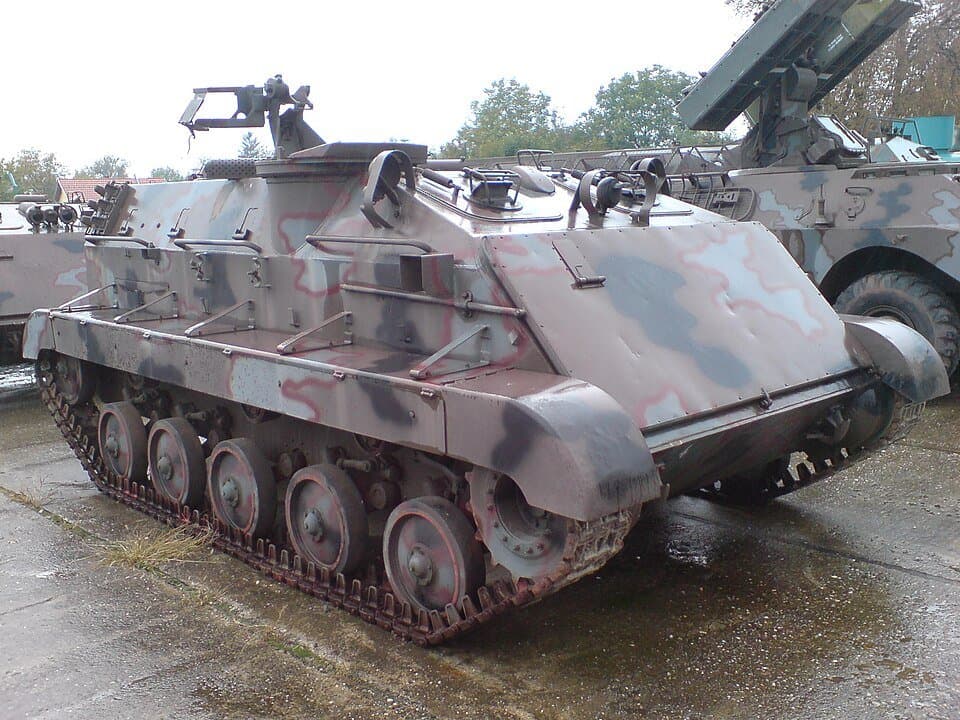
Credit
Toca · CC BY-SA 3.0 · Resized · CC BY-SA 3.0 · Source ↗ · Modified


Preparing your view.

At a glance
OT M-60larger figure on 1 of 2
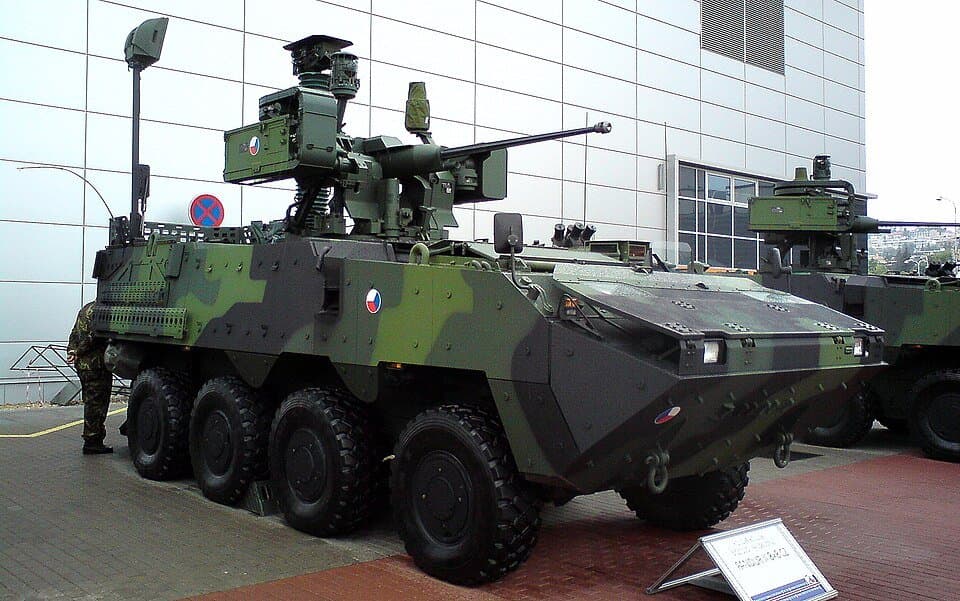
Pandur II (8×8)larger figure on 1 of 2
Counts only measures both sources give with the same scope. A larger figure is not a better system.
Measured figures
Length
Single source5.02 meters[source]
Length
Single sourceConfiguration
| Specification | OT M-60 | Pandur II (8×8) |
|---|---|---|
| Type | Armoured personnel carrier[source] | Armoured personnel carrier[source] |
| Place of origin | Yugoslavia[source] | Austria[source] |
| In service | 1962–2004[source] | 2001–present[source] |
| Used by | See Former operators[source] | See Operators |
7,350 mm (289 in)[source]
Mass
Single source11,000 kg[source]
amphibious limit
Single source(with additional protection) *turret not included
Single source(with minimal protection) or
Single source17.3 t (38,000 lb) (with minimal protection) or 22 t (49,000 lb) (with additional protection) *turret not included 20.1 t (44,000 lb) (amphibious limit)[source]
Maximum; in water
Single sourceMaximum; on land
Single source45 km/h on land 8 km/h in water[source]
Maximum; (road) ≤
Single sourceMaximum; water
Single sourceBars compare reported quantities only. A larger figure does not make a system better; configurations and test conditions differ.
| Wars | Iran–Iraq War Yugoslav Wars[source] | See Variants[source] |
|---|
| Designer | Military Technical Institute[source] | — |
|---|
| Armor | 10–25 mm[source] | — |
|---|
| Main armament | 12.7 mm M2 HB Browning heavy machine gun[source] | 30 mm Mk44 Bushmaster II gun or TOW anti-tank guided missile or 105 mm Cockerill high-pressure gun or 7.62 mm FN MAG machine gun or 0.50 in (12.7 mm) M2 Browning heavy machine gun[source] |
|---|
| Secondary armament | coaxial 7.92 M53 machine-gun 2,000 rounds[source] | 7.62 mm FN MAG machine gun or 0.50 in (12.7 mm) M2 Browning heavy machine gun or Spike LR anti-tank guided missile[source] |
|---|
| Power/weight | 17,3 hp/tonne[source] | — |
|---|
| Suspension | torsion bar[source] | — |
|---|
| Role | Yugoslav armoured personnel carrier[source] | — |
|---|
| Source measurement | The OT ( Oklopni transporter - armoured personnel carrier ) M-60 was the first Yugoslav armored vehicle to enter serial production. Research and development began in 1956, and the first prototype was produced in June 1958. Prior to the commencement of serial production, the new armored personnel carrier was known as Objekat M-590 . Serial production started in 1962. The M-60 first appeared in public in that year's Victory Day parade. The quality of the vehicles did not satisfy the requirements of the Yugoslav People's Army (JNA), so FAMOS began development of an upgraded model, OT M-60P (P – poboljšani – "improved") which was introduced in 1970. From 1962 to 1979, around 790 vehicles were produced, of which 190 were exported. An anti-tank variant with two 82 mm M60 recoilless guns was introduced in 1973.[source]OT M-60 · Development; only the objects and conditions stated in this passage Most M-60s were used in the JNA's armored and mechanized brigades, while a number were used by the Federal Police, being painted in a characteristic blue color. During the Iran–Iraq War , the M-60 was criticised for its low firepower and weak armor. During the Yugoslav Wars , the M-60 suffered serious losses, and its firepower deficiencies were once again noted. Later during the war, the M-60 was used as armoured personnel carrier (APC) for transporting ammunition to the front line and the evacuation of infantrymen and wounded combatants. The M-60 was used by almost all armies created as a result of the breakup of Yugoslavia . The Army of Serbia and Montenegro withdrew its last 121 M-60Ps from service in 2004 due to the Agreement on Sub-Regional Arms Control of 1996.[source]OT M-60 · Development; only the objects and conditions stated in this passage The driver sat to the front left, his hatch having a day sight which could be replaced with an infrared sight for night driving. To his right sat the radio operator, who was able to fire through a machine gun port located on the upper front plate. The commander sat behind the driver, while behind the radio operator sat the gunner. The vehicle was equipped with a 12.7 mm M-2 HB PAM machine-gun mounted on the cupola, allowing for anti-aircraft use.[source]OT M-60 · Characteristics; only the objects and conditions stated in this passage The vehicle is powered by a six-cylinder diesel engine, which generates 140 hp, giving a top road speed of 45 km/h. The vehicle is an all welded steel construction, which gives protection against small arms. It has no NBC protection system.[source]OT M-60 · Characteristics; only the objects and conditions stated in this passage The rear compartment allows for 10 troops to be carried. These sit on benches back-to-back so that they can fire their personal weapons through side ports (three on either side), and they depart the vehicle via two doors set in the rear.[source]OT M-60 · Characteristics; only the objects and conditions stated in this passage M-60PB – Anti-tank variant with twin 82 mm M - 60 recoilless rifles mounted on the top left or top right of hull at rear.[source]OT M-60 · Variants; only the objects and conditions stated in this passage Iraq – 190 M-60P armoured personnel carriers ordered and delivered before 1990. Withdrawn from service.[source]OT M-60 · Former operators; only the objects and conditions stated in this passage | — |
|---|
| Manufacturer | ФАМОС[source] | Steyr-Daimler-Puch and Czechoslovak Group (licensed production for Central and Eastern Europe + Asia)[source] |
|---|
| Developed from | — | Pandur I (6×6)[source] |
|---|
| Produced | — | 2001–present[source] |
|---|
| Passengers | — | 11 (APC version)[source] |
|---|
| Payload capacity | — | 8.5 t (19,000 lb)[source] |
|---|
| Transmission | — | ZF 6HP602 S PLUS (6 forward, 1 reverse gears) Steyr VG 1400 transfer case[source] |
|---|
105 km/h (65 mph) (road) ≤11 km/h (6.8 mph) (water)[source]