FORCETALLY
Loading the evidence…
Preparing your view.


Preparing your view.


At a glance
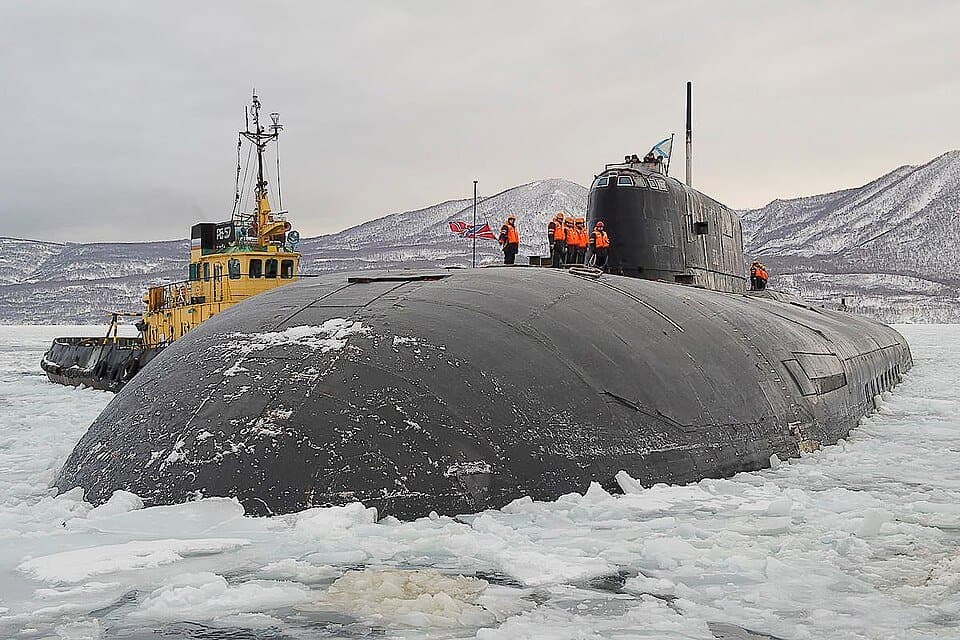
Oscar-class submarinelarger figure on 1 of 1
Sea Pole-class bathyscaphelarger figure on 0 of 1
Counts only measures both sources give with the same scope. A larger figure is not a better system.
Measured figures
maximum
Single source155 m (508 ft 6 in) maximum[source]
Length
Single sourceConfiguration
| Specification | Oscar-class submarine | Sea Pole-class bathyscaphe |
|---|---|---|
| Mass | — | 24 tons in air[source] Mass: 24 tons[source]Sea Pole-class bathyscaphe · Specifications · Mass: 24 tons in air |
| Range | — | 12 hr[source] |
| Power | 2 × pressurized water cooled reactors, HEU ≤ 45%[source] 2 × steam turbines delivering 73,070 kW (97,990 shp) to two shafts[source] | — |
| Name | Oscar II class[source] | Sea Pole |
8.2 m (27 ft)[source]
Length: 8.2 meters[source]Sea Pole-class bathyscaphe · Specifications · Length: 8.2 meters
Submerged · source measurement 3
Single sourceSubmerged · source measurement 4
Single sourceSurfaced · source measurement 1
Single sourceSurfaced · source measurement 2
Single source12,500/14,700 tonnes surfaced 16,500/19,400 tonnes submerged[source]
in air
Single source24 t in air[source]
Maximum; Submerged
Single sourceMaximum; Surfaced
Single source15 knots (28 km/h; 17 mph) surfaced 32 knots (59 km/h; 37 mph) submerged[source]
Cruise; Cruise speed
Single sourceMaximum; Maximum speed
Single sourceBars compare reported quantities only. A larger figure does not make a system better; configurations and test conditions differ.
| Builders | Sevmash[source] | — |
|---|
| Operators | Soviet Navy Russian Navy[source] | — |
|---|
| Preceded by | Papa class Charlie class[source] | — |
|---|
| Succeeded by | Yasen class[source] | — |
|---|
| Built | 1975–2022, may be restarted[source] | — |
|---|
| In commission | 1980–present[source] | — |
|---|
| Planned | 20 (2 949, 18 949A)[source] | — |
|---|
| Completed | 14 (2 949, 11 949A, 1 09852)[source] | 2008[source] |
|---|
| Canceled | 6 (2 incomplete, 4 never laid down)[source] | — |
|---|
| Active | 6 (modernization of some boats to 949AM)[source] | — |
|---|
| Laid up | — |
|---|
| Lost | — |
|---|
| Retired | 5?[source] | — |
|---|
| Type | Nuclear-powered cruise missile submarine[source] | bathyscaphe[source] |
|---|
| Test depth | 600 m[source] | 7,000 m (23,000 ft)[source] |
|---|
| Armament | 4 × 533 mm (21.0 in) and 2 × 650 mm (26 in) torpedo tubes in bow 28 × 533 mm and 650 mm weapons, including RPK-2 Vyuga (SS-N-15 Starfish) anti-submarine missiles with 15 kt nuclear warheads and RPK-6 Vodopad/RPK-7 Veter (SS-N-16) anti-submarine missiles with 200 kt nuclear warhead or Type 40 anti-submarine torpedo or 32 ground mines 24 × P-700 Granit (SS-N-19 Shipwreck) cruise missiles with 750 kilograms (1,650 lb) HE or 6 × 100 Mt Poseidon nuclear-powered, nuclear-armed drones[source] | — |
|---|
| Alternative designation | Oscar II[source] | — |
|---|
| Country of origin | Soviet Union[source] | People's Republic of China[source] |
|---|
| Ordered | — |
|---|
| Awarded | — |
|---|
| Cost | — | 180 million ¥[source] |
|---|
| Sponsored by | — | People's Republic of China[source] |
|---|
| Acquired | — | 2009[source] |
|---|
| Commissioned | — | 2009[source] |
|---|
| Maiden voyage | — | 2008[source] |
|---|
| In service | — | 2009[source] |
|---|
| Status | — | Project ends[source] |
|---|
| Propulsion | — | electrical[source] |
|---|
| Sensors & processing systems | — | sonar & search lights[source] |
|---|
| Source measurement | — | The Sea Pole (Hai Ji, or Chinese : 海极 ) class bathyscaphe is a class of bathyscaphe of the People's Republic of China (PRC). They are capable of diving up to 7,000 meters, covering 99.8% of the oceanic floor of the world. Two units of this class are planned, with derivatives to follow and are used by both the civilian and military establishments in China.[source]Sea Pole-class bathyscaphe · Lead; only the objects and conditions stated in this passage Sea Pole class bathyscaphe is designed by the 702nd Research Institute of China Shipbuilding Industry Corporation . The general designer is Mr. Xu Huangnan ( Chinese : 徐芑南 ), a professor of School of Naval Architecture, Ocean and Civil Engineering Archived 2009-04-27 at the Wayback Machine ( Chinese : 船舶与海洋工程学院 ) of Shanghai Jiao Tong University (SHJTU), who also designed many other Chinese submersibles and unmanned underwater vehicles. The first deputy general designer is Mr. Cui Weicheng ( Chinese : 崔维成 ), and the deputy general designer was Mr. Zhu Weiqing ( Chinese : 朱维庆 ), all of the three are academicians of the Chinese Academy of Sciences . There are two mechanical arms with associated tools that enable the bathyscaphe to perform a various tasks at its maximum operational depth, and this pair of mechanical arms with 7 degrees of freedom (7-DOF) are mounted on the right and left sides of the vehicle, which is powered by 110 kWh (110 V, 800 Ah) silver oxide – zinc batteries.[source]Sea Pole-class bathyscaphe · Design; only the objects and conditions stated in this passage The pressure hull is built of titanium alloy, and the manufacturing method for the pressure hull involves producing two hemispherical parts by tungsten inert gas (TIG) welding six-side plates to a top plate, followed by heat treatments and polishing by machining; the two halves are then TIG welded together to form a complete sphere. The plate thickness is 76 – 78 mm, with deviations of ±4 mm in the completed radius, and sphericity is 0.4% or less. Pressure testing of the pressure hull was performed in Russia, and included a one-hour test at a water pressure equivalent to 7,700 meters, or a 10% greater depth than the vessel's, 7,000 m maximum operational depth, a continuous hour-long test at water pressure equivalent to 7,000 m, and a test simulating 0 to 7,000 m ascent/descent of the submersible, which was repeated six times. There were no problems reported in any of these tests, and the pressure hull passed with flying colors.[source]Sea Pole-class bathyscaphe · Design; only the objects and conditions stated in this passage All viewports of Sea Pole class bathyscaphe have a circular truncated cone shape. There is a large viewport with diameter of 20 cm mounted in the bow, and this central view port is the same type of that of Russian Mir class bathyscaphe. The two additional smaller side viewports of 12 cm diameter are mounted on portside and starboard side, closer to the front than other bathyscaphes. The advantage of this arrangement is that it enables navigation while both the pilot and the scientists simultaneously observe an objective in front of the vehicle. However, the side views have limited field of vision. There are two onboard life supporting system based on that of Shenzhou 6 spacecraft, and additionally, there are two onboard oxygen generating systems independent of life supporting system for additional safety. The pressure hull is built of titanium.[source]Sea Pole-class bathyscaphe · Design; only the objects and conditions stated in this passage Length: 8.2 meters[source]Sea Pole-class bathyscaphe · Specifications; only the objects and conditions stated in this passage Width: 3 meters[source]Sea Pole-class bathyscaphe · Specifications; only the objects and conditions stated in this passage Height: 3.4 meters[source]Sea Pole-class bathyscaphe · Specifications; only the objects and conditions stated in this passage Inner diameter of the pressure hull: 2.1 meters[source]Sea Pole-class bathyscaphe · Specifications; only the objects and conditions stated in this passage Mass: 24 tons in air[source]Sea Pole-class bathyscaphe · Specifications; only the objects and conditions stated in this passage Payload: 220 kg[source]Sea Pole-class bathyscaphe · Specifications; only the objects and conditions stated in this passage Endurance: 12 hr[source]Sea Pole-class bathyscaphe · Specifications; only the objects and conditions stated in this passage Maximum operating depth: 7,000 meters[source]Sea Pole-class bathyscaphe · Specifications; only the objects and conditions stated in this passage Never to exceed depth: 7,100 meters[source]Sea Pole-class bathyscaphe · Specifications; only the objects and conditions stated in this passage Crash depth: 7,700 meter[source]Sea Pole-class bathyscaphe · Specifications; only the objects and conditions stated in this passage Life support: 3 x 12 hr[source]Sea Pole-class bathyscaphe · Specifications; only the objects and conditions stated in this passage Designed by the 702nd Research Institute of the China Shipbuilding Industry Corporation , Dragon class bathyscaphe is slightly smaller than its predecessor, with overall length slightly reduced to 8 meter from the original 8.2 meter of Sea Pole class.[source]Sea Pole-class bathyscaphe · Dragon class bathyscaphe; only the objects and conditions stated in this passage Meanwhile, the first unit completed a 300-meter dive test on Sept 20th 2009.[source]Sea Pole-class bathyscaphe · Deployment; only the objects and conditions stated in this passage In early Oct 2009, they reached a depth of 1109 meters during a test dive.[source]Sea Pole-class bathyscaphe · Deployment; only the objects and conditions stated in this passage On May 31, 2010, 3000 meter dive tests began, and concluded on Jul 18, 2010, with a test dive reaching a depth of 3757 meters on Jul 9th 2010.[source]Sea Pole-class bathyscaphe · Deployment; only the objects and conditions stated in this passage |
|---|
| Manufacturer | — | CSIC[source] |
|---|
Maximum; Speed
Single source