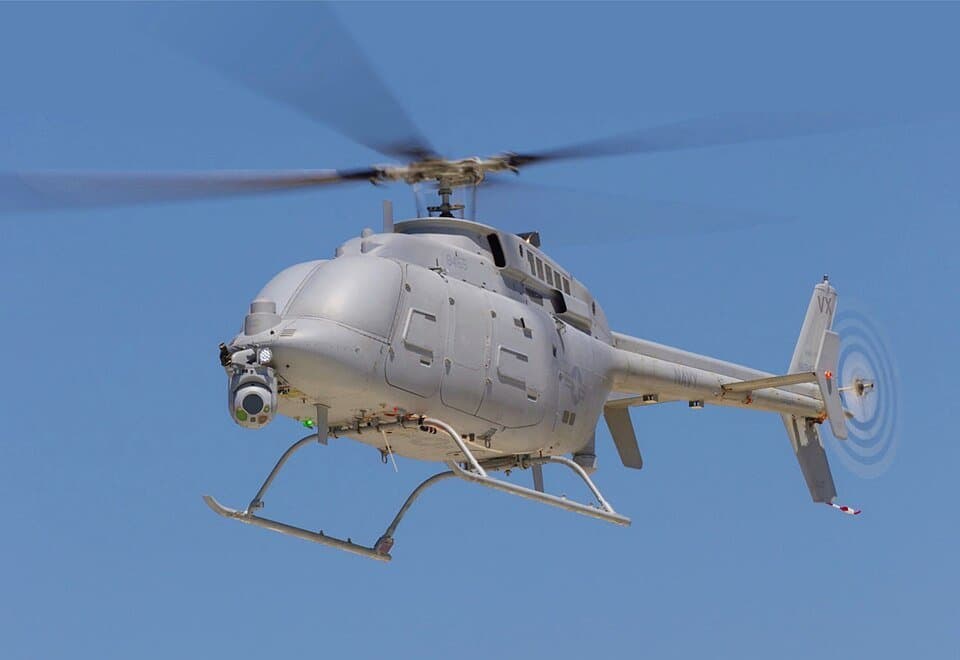


Credit
U.S. Navy · Public domain · Resized · Public domain · Source ↗ · Modified


Preparing your view.

At a glance
Northrop Grumman MQ-8C Fire Scoutlarger figure on 1 of 6
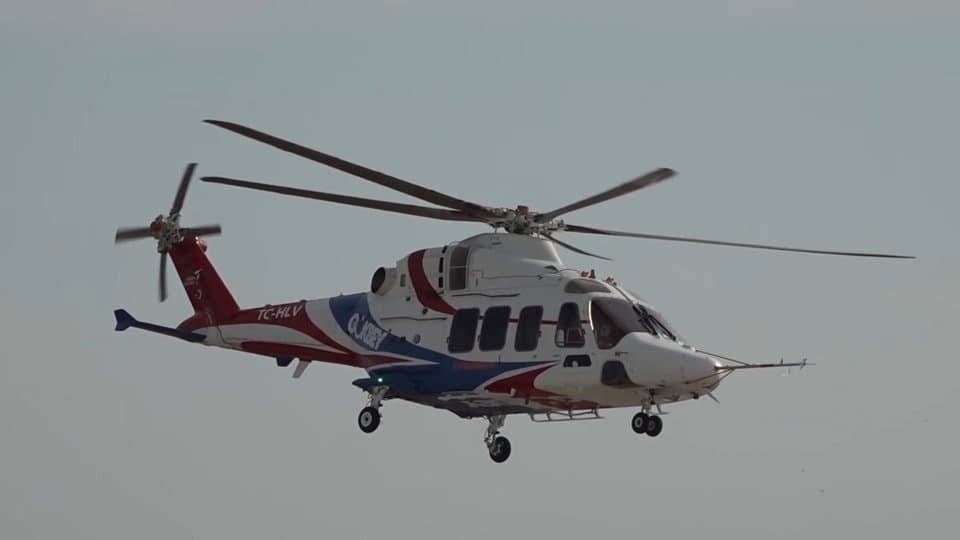
TAI T625 Gökbeylarger figure on 5 of 6
Measured figures
Configuration
| Specification | Northrop Grumman MQ-8C Fire Scout | TAI T625 Gökbey |
|---|---|---|
| Type | UAV helicopter[source] | Utility helicopter[source] |
| Manufacturer | Northrop Grumman Bell Helicopter[source] | Turkish Aerospace Industries[source] |
| Status | Development testing[source] | In service[source] |
| Primary user | United States Navy[source] | — |
Counts only measures both sources give with the same scope. A larger figure is not a better system.
Length
Single source15.87 m (52 ft 1 in)[source]
1 × Rolls-Royce 250-C47B , 813 shp (
Single source1 × Rolls-Royce 250-C47B , 813 shp (606 kW)[source]
2 × LHTEC CTS800-4A , ( TEI TS1400 - undergoing testing / scheduled for 2027) turboshaft engine each
Single source2 × LHTEC CTS800-4A , ( TEI TS1400 - undergoing testing / scheduled for 2027) turboshaft engine, 1,024 kW (1,373 hp) each[source]
Bars compare reported quantities only. A larger figure does not make a system better; configurations and test conditions differ.
| Number built | 38[source] | 4 prototypes built for tests + 7 Delivered to Turkish Armed Forces[source] |
|---|
| Introduction date | 2019[source] | 29 October 2024[source] |
|---|
| First flight | 2013[source] | 6 September 2018[source] |
|---|
| Developed from | Bell 407 Northrop Grumman MQ-8 Fire Scout[source] | — |
|---|
| Capacity | 2,950 lb (1,338 kg)[source] | 12 passengers(Included Crew)[source] |
|---|
| Role | unmanned helicopter[source] | twin-engined light transport/utility helicopter[source] |
|---|
| Source measurement | In March 2013, the Navy incorporated the Rolls-Royce 250-C47E engine into the MQ-8C for a 5 percent increase in hot and high power, 2 percent reduced fuel consumption, 8 percent increase in rated takeoff power, and better reliability. The Bell 407-based MQ-8C has an endurance of 12 hours, a range of 150 nmi (170 mi; 280 km), and a payload capacity of about 318 kg (701 lb). It has twice the endurance and three times the payload as the MQ-8B.[source]Northrop Grumman MQ-8C Fire Scout · Design and development; only the objects and conditions stated in this passage In September 2013, the MQ-8C Fire-X delivered to the Navy turned on its engines for 10 minutes in preparation for first flight. First flight was scheduled for early to mid-October, although the exact date was not determined, as such tests are often delayed by minor system problems. The MQ-8C flight test regime was for six months.[source]Northrop Grumman MQ-8C Fire Scout · Design and development; only the objects and conditions stated in this passage The MQ-8C Fire Scout first flew on 31 October 2013. It flew for 7 minutes in restricted airspace using autonomous controls at Naval Base Ventura County . It flew a second time hours later that day to an altitude of 500 ft. The MQ-8C was jointly operated by Northrop Grumman and the Navy. Northrop Grumman delivered the second MQ-8C in November 2013. They were under contract to build 14 helicopters.[source]Northrop Grumman MQ-8C Fire Scout · Design and development; only the objects and conditions stated in this passage In December 2014, the MQ-8C began testing aboard the destroyer Jason Dunham , executing 22 landings and recoveries in less than four hours. Testing was completed on 19 December, executing 32 takeoffs and recoveries over three flights. The MQ-8C will be ready to perform surface warfare missions in 2018 and mine countermeasure missions in 2020. The aircraft's first deployment is expected for 2016 to give Littoral Combat Ships a 50 nmi (58 mi; 93 km)-radius ISR capability.[source]Northrop Grumman MQ-8C Fire Scout · Design and development; only the objects and conditions stated in this passage In May 2016, NAVAIR signed a contract for the Osprey 30 lightweight AESA radar for the MQ-8C, the first system of its type to offer full spherical coverage with no moving parts. The 360-degree, 50 kg (110 lb) airborne radar uses fixed panels distributed around the body of aircraft, mounting antennas weighing just over 11 kg (24 lb) each. The radar is classified as the AN/ZPY-8 and will be retrofitted onto the Navy's MQ-8C's.[source]Northrop Grumman MQ-8C Fire Scout · Design and development; only the objects and conditions stated in this passage In December 2014, the first operational MQ-8C was delivered to the US Navy. Its final developmental flight was completed in April 2015, after 450 hours completed in 327 flights. In August 2015, Northrop Grumman demonstrated the MQ-8C's endurance with an 11-hour flight. In November 2015, the MQ-8C completed a 3-week operational assessment period to assess system performance, endurance, and reliability of the unmanned helicopter over 83.4 hours in 11 flights. To date, the aircraft logged 730 flight hours over 427 flights. Ship-based testing is expected to begin in 2017. In July 2018, Air Test and Evaluation Squadron 1 concluded the initial operational test and evaluation of the MQ-8C, conducted aboard the USS Coronado .[source]Northrop Grumman MQ-8C Fire Scout · Design and development; only the objects and conditions stated in this passage Capacity: 2,950 lb (1,338 kg)[source]Northrop Grumman MQ-8C Fire Scout · Specifications; only the objects and conditions stated in this passage Length: 34 ft 8 in (10.6 m)[source]Northrop Grumman MQ-8C Fire Scout · Specifications; only the objects and conditions stated in this passage Height: 10 ft 11 in (3.3 m)[source]Northrop Grumman MQ-8C Fire Scout · Specifications; only the objects and conditions stated in this passage Max takeoff weight: 6,000 lb (2,721 kg)[source]Northrop Grumman MQ-8C Fire Scout · Specifications; only the objects and conditions stated in this passage Powerplant: 1 × Rolls-Royce 250-C47B , 813 shp (606 kW)[source]Northrop Grumman MQ-8C Fire Scout · Specifications; only the objects and conditions stated in this passage Main rotor diameter: 36 ft 7 in (11.2 m)[source]Northrop Grumman MQ-8C Fire Scout · Specifications; only the objects and conditions stated in this passage Maximum speed: 140 kn (160 mph, 260 km/h)[source]Northrop Grumman MQ-8C Fire Scout · Specifications; only the objects and conditions stated in this passage Endurance: 15 hours maximum[source]Northrop Grumman MQ-8C Fire Scout · Specifications; only the objects and conditions stated in this passage Service ceiling: 20,000 ft (6,100 m)[source]Northrop Grumman MQ-8C Fire Scout · Specifications; only the objects and conditions stated in this passage | Turkish Aerospace Industries launched preliminary design studies in 2010. The project commenced in 2013 when Undersecretariat for Defence Industries signed a contract with the Turkish Aerospace Industries to develop a 6-ton class multi-role helicopter for land operations. Alp Aviation is responsible for production and assembly of landing gear, gearbox and dynamic components, while Spanish CESA was selected to supply hydraulic systems.[source]TAI T625 Gökbey · Design and development; only the objects and conditions stated in this passage The T625 is expected to weigh 5 tonnes and is in the interim powered by two LHTEC CTS800 engines. The CTS800 was chosen due to commonality with the TAI/AgustaWestland T129 . TUSAS Engine Industries has developed a next-generation indigenous powerplant for the T625 named the TEI TS1400 . The first delivery of TEI TS1400 happened on December 5, 2020.[source]TAI T625 Gökbey · Design and development; only the objects and conditions stated in this passage Turkish Land Forces - 1 in service, 15 on order[source]TAI T625 Gökbey · Operators / Military/Police operators; only the objects and conditions stated in this passage Gendarmerie General Command - 5 in service. 22[source]TAI T625 Gökbey · Operators / Military/Police operators; only the objects and conditions stated in this passage General Directorate of Security - 1 in service, 2 on order[source]TAI T625 Gökbey · Operators / Military/Police operators; only the objects and conditions stated in this passage |
|---|
| Country of origin | Canada, United States[source] Canada[source] United States[source] | — |
|---|
| National origin | — | Türkiye[source] |
|---|
| Designer | — | Aselsan Turkish Aerospace Industries[source] |
|---|
| Primary users | — | Turkish Armed Forces Gendarmerie General Command[source] |
|---|
Capacity: 12 passengers(Included Crew)[source]TAI T625 Gökbey · Specifications; only the objects and conditions stated in this passage
Length: 15.87 m (52 ft 1 in)[source]TAI T625 Gökbey · Specifications; only the objects and conditions stated in this passage
Max takeoff weight: 6,050 kg (13,338 lb)[source]TAI T625 Gökbey · Specifications; only the objects and conditions stated in this passage
Powerplant: 2 × LHTEC CTS800-4A , ( TEI TS1400 - undergoing testing / scheduled for 2027) turboshaft engine, 1,024 kW (1,373 hp) each[source]TAI T625 Gökbey · Specifications; only the objects and conditions stated in this passage
Main rotor diameter: 13.2 m (43 ft 4 in)[source]TAI T625 Gökbey · Specifications; only the objects and conditions stated in this passage
Maximum speed: 306 km/h (190 mph, 165 kn)[source]TAI T625 Gökbey · Specifications; only the objects and conditions stated in this passage
Cruise speed: 278 km/h (173 mph, 150 kn)[source]TAI T625 Gökbey · Specifications; only the objects and conditions stated in this passage
Range: 740 km (460 mi, 400 nmi) +[source]TAI T625 Gökbey · Specifications; only the objects and conditions stated in this passage
Endurance: 3 hours 48 minutes[source]TAI T625 Gökbey · Specifications; only the objects and conditions stated in this passage
Service ceiling: 6,096 m (20,000 ft)[source]TAI T625 Gökbey · Specifications; only the objects and conditions stated in this passage