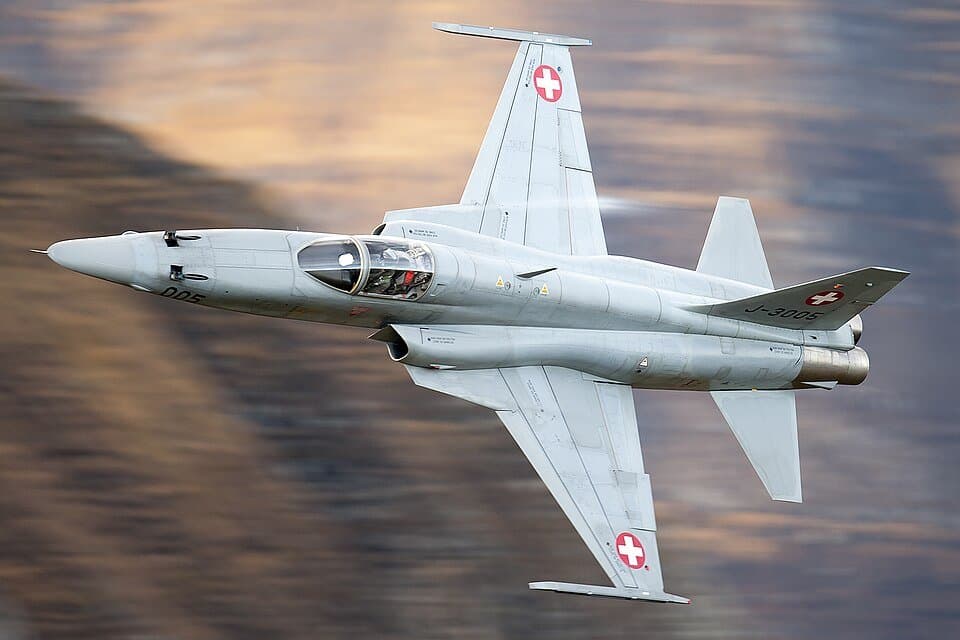

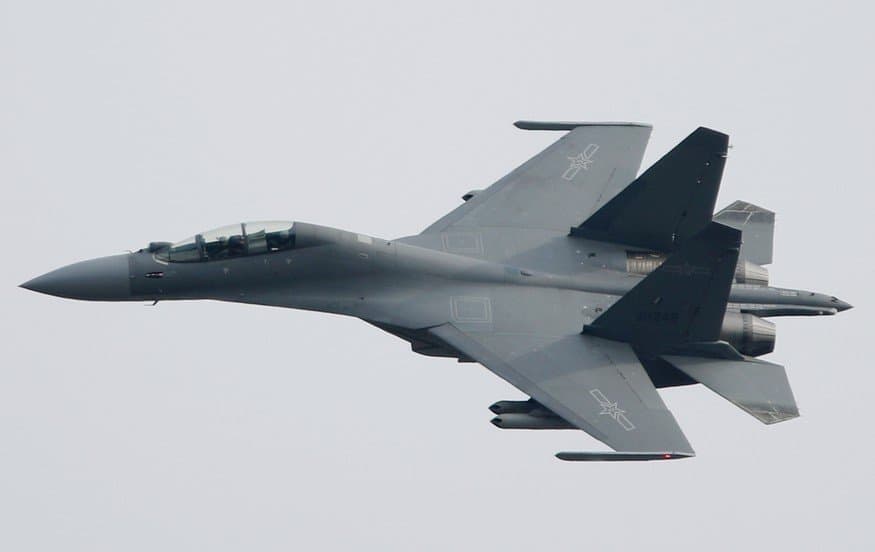
Credit
Peng Chen · CC BY-SA 2.0 · Resized · CC BY-SA 2.0 · Source ↗ · Modified


Preparing your view.

At a glance
Measured figures
F-5E Tiger II · Length
Single source48 ft 2.25 in (14.6876 m)[source]
Length
Single sourceConfiguration
| Specification | Northrop F-5 | Shenyang J-16 |
|---|---|---|
| Type | Light fighter[source] | — |
| National origin | United States[source] | People's Republic of China[source] |
| Manufacturer | Northrop Corporation[source] | Shenyang Aircraft Corporation[source] |
| Status | In service[source] | In service[source] |
21.9 m (71 ft 10 in)[source]
Empty; F-5E Tiger II · Empty weight
Single sourceGross; F-5E Tiger II · clean
Single sourceMaximum take-off; F-5E Tiger II · Max takeoff weight
Single source9,583 lb (4,347 kg)[source]
15,745 lb (7,142 kg) clean[source]
24,675 lb (11,192 kg)[source]
Empty; Empty weight
Single sourceMaximum take-off; Max takeoff weight
Single sourceF-5E Tiger II · 2 × General Electric J85-GE-21 afterburning turbojet engines thrust each dry
Single sourceF-5E Tiger II · with afterburner
Single source2 × General Electric J85-GE-21 afterburning turbojet engines, 3,500 lbf (16 kN) thrust each dry, 5,000 lbf (22 kN) with afterburner[source]
2 × Shenyang WS-10B afterburning turbofans with afterburner
Single source2 × Shenyang WS-10B afterburning turbofans , 135 kN (30,000 lbf) with afterburner[source]
Bars compare reported quantities only. A larger figure does not make a system better; configurations and test conditions differ.
| Primary users | United States Navy Republic of China Air Force (historical) Republic of Korea Air Force Islamic Republic of Iran Air Force[source] | — |
|---|
| Number built | A/B/C/D: 1,204 E/F: 1,399[source] | ~ 470 - ~ 500 (As of 2026 )[source] |
|---|
| Manufactured | 1959–1987[source] | 2017–present[source] |
|---|
| Introduction date | 1964[source] | 2015–16[source] |
|---|
| First flight | F-5A: 30 July 1959 F-5E: 11 August 1972[source] | — |
|---|
| Developed from | Northrop T-38 Talon[source] | Shenyang J-11 Su-30MKK[source] |
|---|
| Variants | Canadair CF-5 Shaped Sonic Boom Demonstration[source] | — |
|---|
| Developed into | Northrop YF-17 Northrop F-20 Tigershark HESA Azarakhsh HESA Saeqeh HESA Kowsar[source] | — |
|---|
| Aspect ratio | 3.86[source] | — |
|---|
| Airfoil | NACA 65A004.8[source] | — |
|---|
| Fuel capacity | Internal fuel: 677 US gal (564 imp gal; 2,560 L) External fuel: up to 3x 275 US gal (229 imp gal; 1,040 L) drop-tanks[source] | — |
|---|
| Internal fuel mass | 677 US gal (564 imp gal; 2,560 L)[source] | — |
|---|
| External fuel | up to 3x 275 US gal (229 imp gal; 1,040 L) drop-tanks[source] | — |
|---|
| Lift-to-drag ratio | 10.0[source] | — |
|---|
| Zero-lift drag coefficient | C D 0.0200[source] | — |
|---|
| Frontal area | 3.4 sq ft (0.32 m 2 )[source] | — |
|---|
| Maximum cruise speed | Mach 0.98 (1,050 km/h; 650 mph) at 36,000 ft (11,000 m)[source] | — |
|---|
| Economical cruise speed | Mach 0.8 (850 km/h; 530 mph) at 36,000 ft (11,000 m)[source] | — |
|---|
| Stall speed | 124 kn (143 mph, 230 km/h) 50% internal fuel, flaps and wheels extended[source] | — |
|---|
| Never exceed speed | 710 kn (820 mph, 1,310 km/h) IAS[source] | — |
|---|
| Combat radius (20 min reserve) | 120 nmi (140 mi; 220 km) with 2x Sidewinders + 5,200 lb (2,400 kg) ordnance, with 5 minutes combat at max power at sea level[source] | — |
|---|
| Ferry range (20 min reserve) | 1,385 nmi (1,594 mi; 2,565 km) drop tanks retained[source] | — |
|---|
| Service ceiling one engine out | 41,000 ft (12,000 m)[source] | — |
|---|
| Lift-to-drag | 10:1[source] | — |
|---|
| Wing loading | 133 lb/sq ft (650 kg/m 2 ) maximum[source] | — |
|---|
| Thrust/weight | 0.4 for take-off thrust at maximum take-off weight[source] | — |
|---|
| Take-off run | 2,000 ft (610 m) with two Sidewinders at 15,745 lb (7,142 kg)[source] | — |
|---|
| Take-off run to 50 ft (15 m) | 2,900 ft (884 m) with two Sidewinders at 15,745 lb (7,142 kg)[source] | — |
|---|
| Landing run from 50 ft (15 m) | 3,701 ft (1,128 m) without brake-chute[source] | — |
|---|
| Guns | 2× 20 mm (0.787 in) M39A2 Revolver cannon in the nose, 280 rounds/gun[source] | — |
|---|
| Hardpoints | 7 total (only pylon stations 3, 4 and 5 are wet-plumbed): 2× wing-tip AAM launch rails, 4× under-wing & 1× under-fuselage pylon stations with a capacity of 7,000 pounds (3,200 kg ), with provisions to carry combinations of:[source] | Munitions on 12 external hardpoints, including:[source] |
|---|
| Rockets | 2× LAU-61/LAU-68 rocket pods (each with 19× /7× Hydra 70 mm rockets, respectively); or 2× LAU-5003 rocket pods (each with 19× CRV7 70 mm rockets); or 2× LAU-10 rocket pods (each with 4× Zuni 127 mm rockets); or 2× Matra rocket pods (each with 18× SNEB 68 mm rockets)[source] | — |
|---|
| Missiles | 2× AIM-9 Sidewinder air-to-air missile on wingtips (initial F-5E Tiger II loadout) 4× AIM-9 Sidewinder or 4× AIM-120 AMRAAM air-to-air missile (F-5S and modernized F-5E) 4× AGM-65 Maverick air-to-surface missiles (on upgraded F-5 after 1995) R-60 , R-27 , R-73 and other Russian/Chinese AAMs (Iranian ver.)[source] | — |
|---|
| Bombs | A variety of air-to-ground ordnance such as the Mark 80 series of unguided bombs (including 3 kg and 14 kg practice bombs), CBU-24 /49/52/58 cluster bomb munitions, napalm bomb canisters and M129 Leaflet bomb, and laser-guided bombs of Paveway family.[source] | — |
|---|
| Other | up to 3× 150 / 275 US gallons (570 / 1,040 L; 125 / 229 imp gal) Sargent Fletcher drop tanks for ferry flight or extended range/loitering time. 1× GPU-5/A 30mm cannon pods on the centreline station (fitted only on Thai F-5s)[source] | — |
|---|
| Role | family of supersonic light fighter aircraft initially[source] | Multirole strike fighter[source] |
|---|
| Source measurement | The N-156T was quickly selected by the United States Air Force as a replacement for the T-33 in July 1956. On 10 April 1959, the first prototype aircraft, which was subsequently designated as YT-38 Talon , performed its first flight. By the time production had ended in January 1972, a total of 1,189 Talons had been produced. Development of the N-156F continued at a lower priority as a private venture by Northrop; on 25 February 1958, an order for three prototypes was issued for a prospective low-cost fighter that could be supplied under the Military Assistance Program for distribution to less-developed nations. The first N-156F flew at Edwards Air Force Base on 30 July 1959, exceeding the speed of sound on its first flight.[source]Northrop F-5 · Design and development / Into production; only the objects and conditions stated in this passage In 1970, Northrop won the International Fighter Aircraft (IFA) competition to replace the F-5A, with better air-to-air performance against aircraft like the Soviet MiG-21 . The resulting aircraft, initially known as F-5A-21, subsequently became the F-5E. It had two more powerful GE J85-21 engines, each with 3,600 lbf (16 kN) dry thrust and 5,000 lbf (22 kN) in afterburner, and had a lengthened and enlarged fuselage to accommodate more fuel. Its wings were fitted with enlarged leading edge extensions , giving an increased wing area and improved maneuverability. The aircraft's avionics were more sophisticated, crucially including a radar (initially the Emerson Electric AN/APQ-153 ) (F-5A and B had no radar). It retained the gun armament of two M39 cannons , one on either side of the nose of the F-5A. Various specific avionics fits could be accommodated at a customer's request, including an inertial navigation system , TACAN and ECM equipment. Additionally the two position nose landing gear from the Canadian CF-5 was incorporated to reduce takeoff distance.[source]Northrop F-5 · Design and development / F-5E and F-5F Tiger II; only the objects and conditions stated in this passage The first F-5E flew on 11 August 1972. A two-seat combat-capable trainer, the F-5F, was offered, first flying on 25 September 1974, at Edwards Air Force Base, with a new nose, that was three feet longer, which, unlike the F-5B that did not mount a gun, allowed it to retain a single M39 cannon, albeit with a reduced ammunition capacity. The two-seater was equipped with the Emerson AN/APQ-157 radar, which is a derivative of the AN/APQ-153 radar, with dual control and display systems to accommodate the two-men crew, and the radar has the same range of AN/APQ-153, around 10 nmi . On 6 April 1973, the 425th TFS at Williams Air Force Base, Arizona, received the first F-5E Tiger II.[source]Northrop F-5 · Design and development / F-5E and F-5F Tiger II; only the objects and conditions stated in this passage The F-5E eventually received the official name Tiger II; 792 F-5Es, 146 F-5Fs and 12 RF-5Es were eventually built by Northrop. More were built under license overseas: 91 F-5Es and F-5Fs in Switzerland, 68 by Korean Air in South Korea, and 308 in Taiwan .[source]Northrop F-5 · Design and development / F-5E and F-5F Tiger II; only the objects and conditions stated in this passage The F-5E proved to be a successful combat aircraft in service with US allies, but had no combat service with the US Air Force, though the F-5A with modifications, designated F-5C, was flown by the US in Vietnam. The F-5E evolved into the single-engine F-5G, which was rebranded the F-20 Tigershark . It lost out on export sales to the F-16 Fighting Falcon in the 1980s.[source]Northrop F-5 · Design and development / F-5E and F-5F Tiger II; only the objects and conditions stated in this passage Similar programs have been carried out in Chile and Brazil with the help of Elbit . The Chilean upgrade, called the F-5 Tiger III Plus, incorporated a new Elta EL/M-2032 radar and other improvements. The Brazilian program, re-designated as F-5M, adds a new Grifo-F radar along with several avionics and cockpit refurbishments, including the Dash helmet. The F-5M has been equipped with new weapon systems such as the Beyond Visual Range Derby missile, Python IV short-range air-to-air missile, SMKB "smart" bombs, and several other weapons.[source]Northrop F-5 · Design and development / Upgrades; only the objects and conditions stated in this passage In June 1967, the surviving aircraft of the 10th Fighter Squadron, Commando, were transferred to the Republic of Vietnam Air Force (RVNAF). In view of the performance, agility and size of the F-5, it might have appeared to be a good match against the similar MiG-21 in air combat; however, US doctrine was to use heavy, faster and longer-range aircraft like the Republic F-105 Thunderchief and McDonnell Douglas F-4 Phantom II over North Vietnam.[source]Northrop F-5 · Operational history / United States; only the objects and conditions stated in this passage Externally, the new aircraft features a larger nose cone that accommodates the larger radar equipment. The first F-5EM was handed over on 21 September 2005. On 7 July 2003, four Rafael Litening III targeting pods were ordered at a cost of US$13 million, to be used on F-5M together with three Rafael Sky Shield jamming pods ordered on 5 July 2006 at a cost of US$42 million.[source]Northrop F-5 · Operational history / Brazil; only the objects and conditions stated in this passage Units that used the F-5 in Greek service:[source]Northrop F-5 · Operational history / Greece; only the objects and conditions stated in this passage Five F-5Es and one F-5F were lost in the accident with three fatalities (2 pilots in E (1983 & 1995) and 1 in F (1986), all crashed into the sea).[source]Northrop F-5 · Operational history / Malaysia; only the objects and conditions stated in this passage The Royal Moroccan Air Force received 22 F-5As, two F-5Bs and two RF-5As from the United States between 1966 and 1974. These entered service with the 1st Fighter Squadron. Two additional F-5As were donated by Iran in 1974, and six F-5As were acquired from Jordan in 1976. Three F-5As were involved in the failed 1972 Moroccan coup attempt , attacking King Hassan II of Morocco 's Boeing 727 in mid-air, before strafing and bombing a military airfield and the royal palace. After the failure of the attempted coup, nearly all F-5 pilots were arrested, and most of them disappeared. Another consequence of the failed coup was that the designation system of Moroccan air force units changed from numerical designations to names. From then on, the F-5A squadron was known as the Borak squadron.[source]Northrop F-5 · Operational history / Morocco; only the objects and conditions stated in this passage In October 2011 five F-5A single seaters were given to aircraft maintenance schools around the country; including the Skedsmo, Sola, Bodø, and Bardufoss high schools, and the Royal Norwegian Air Force's training center at Kristiansand Airport, Kjevik . The aircraft were disassembled at Moss Airport, Rygge , before delivery to the schools. Of the ten remaining Norwegian F-5s, eight F-5B two-seaters were still for sale as of 2011, six of which were stored in Norway and two in the United States. The two aircraft in the United States had been approved for sale to the American businessman Ross Perot Jr. , in 2008, but the deal was blocked by the US government initially. However, in 2015, Perot Jr. got permission and subsequently bought the aircraft for significantly below market price, which caused controversy and public criticism of the government of Norway. Three survivors are exhibited at the Norwegian Armed Forces Aircraft Collection , two at Norsk Luftfartsmuseum in Bodø and one at Flyhistorisk Museum, Sola , near Stavanger .[source]Northrop F-5 · Operational history / Norway; only the objects and conditions stated in this passage In addition, the starboard M39 20 mm cannon mounted in the nose was removed to make way for additional avionics (the sole cannon on the two-seaters was removed because of this), and to improve maneuverability, upgraded aircraft received larger leading edge root extensions (LERX). The process began in March 1996 and was completed by 2001, receiving the new designation of F-5S/T . In 1998, the eight RF-5Es also received the upgrades (except for the radar) and were redesignated as RF-5S . Each F-5S/T upgraded reportedly cost SGD$6 million .[source]Northrop F-5 · Operational history / Singapore; only the objects and conditions stated in this passage By end of 2009, the type had accumulated more than 170,000 hours of flight time in Singapore service with only two F-5Es being lost in separate accidents (in 1984 and 1991, respectively). 144 Squadron, the last squadron operating F-5Es, disbanded in September 2015 after the F-5S was retired.[source]Northrop F-5 · Operational history / Singapore; only the objects and conditions stated in this passage On 11 January 1965, Spain announced the choice of the F-5 to replace their T-33 and F-86 aircraft. During the evaluation phase, an F-5B crashed near Torrejón Air Base , killing both occupants, a Northrop pilot and a pilot from the Ejército del Aire . The contract included 70 units, 8 of which being manufactured by Northrop, 2 disassembled and assembled in Spain, and the remaining 6 in the form of components and structures ready construction. The remaining 62 would be built under license by CASA in the factory at Getafe . The first of this Spanish built batch would take off on 22 May 1968 from the Getafe Air Base flown by a Northrop test pilot. The first delivery to the Ejército del Aire was on 19 June 1969, being 2 F-5B for the 202 Escuadrón , based at Morón de la Frontera . The first delivery consisted of all F-5Bs, with the single-seat F-5A and RF-5A aircraft delivered at a later date. The last of the 70 airframes was received on 11 April 1972.[source]Northrop F-5 · Operational history / Spain; only the objects and conditions stated in this passage The F-5B was assigned to the Ala 73 at Talavera la Real Air Base , dedicated to training. In addition to the aforementioned Escuadrón 202, the Escuadrón 204 received RF-5A airframes. This unit would later become the Ala 21 in 1971.[source]Northrop F-5 · Operational history / Spain; only the objects and conditions stated in this passage With the increasing tension with Morocco during the later phase of the Francoist government , the Spanish CASA/Northrop F-5A saw action during the conflict in the Spanish Sahara , being deployed at the Gando Air Base , flying upwards of 500 combat missions. This deployment became permanent from 1974 onwards, being formalized in 1976. Two F-5B and all F-5A with even registration were ascribed to Ala 46 in the Escuadrón 464 at the Gando Air Base, until their replacement in 1982 by the newly acquired Dassault-Breguet F1EE , with the F-5s being sent back to Morón de la Frontera.[source]Northrop F-5 · Operational history / Spain; only the objects and conditions stated in this passage In 1989, an F-5B crashed due to a structural failure of a wing. The entire F-5 fleet was grounded while crews conducted searches for signs of material fatigue, and as a result of this, many F-5s were retired. The remaining single-seaters (F-5A and RF-5A) were transferred in 1995 to the Ala 23 in Talavera la Real, together with some of the retired airframes, which were used for spare parts.[source]Northrop F-5 · Operational history / Spain; only the objects and conditions stated in this passage The Swiss Air Force flies a total of 22 F-5E and 4 F-5F aircraft, down from a peak of 98 and 12 in 1981. They were chosen chiefly because of their performance, suitability for the unique Swiss Air Force mission, and their relatively low maintenance cost per flight hour.[source]Northrop F-5 · Operational history / Switzerland; only the objects and conditions stated in this passage With the introduction of 150 F-16s, 60 Mirage 2000-5s and 130 F-CK-1s in the mid-to-late-1990s, the F-5E/F series became second line fighters in ROCAF service and mostly are now withdrawn from service as squadrons converted to new fighters entering ROCAF service. Seven low airframe hours F-5Es were sent to ST Aerospace to convert them to RF-5E Tigergazer standard to fulfill a reconnaissance role previously undertaken by the retiring Lockheed RF-104G in ROCAF service. As of 2009, only about 40 ROCAF F-5E/Fs still remain in service in training roles with about 90–100 F-5E/Fs held in reserve. The other retired F-5E/F are either scrapped, or used as decoys painted in colors representing the main front line F-16, Mirage 2000-5 or F-CK-1 fighters, and deployed around major air bases.[source]Northrop F-5 · Operational history / Taiwan; only the objects and conditions stated in this passage In 1979, after several upgrades to the fleet's communication, navigation and approximation equipment, the aircraft were renamed VF-5s, designating the CF-5As as VF-5As and the CF-5Ds as VF-5Ds. Venezuelan F-5s could also carry weaponry such as the AIM-9 Sidewinder missile, Mk.82 and M117 bombs, and 70mm rocket launchers.[source]Northrop F-5 · Operational history / Venezuela; only the objects and conditions stated in this passage Twelve F-5A Freedom Fighters were tested by the US Air Force for four and a half months in Vietnam. Modified at Palmdale plant by adding removable, non retractable air-refueling probe on the left side, 90 lb of external armor plates under the cockpit and engine, and jettisonable stores pylons.[source]Northrop F-5 · Variants / Single-seat versions; only the objects and conditions stated in this passage F-5G[source]Northrop F-5 · Variants / Single-seat versions; only the objects and conditions stated in this passage Formerly known as the F-5T Tigris before being officially redesignated. An upgraded version of the F-5E of Royal Thai Air Force by Israel's Elbit Systems and Thai's RV Connex, it has a new glass cockpit and head-up display upgrade and equipped with EL/M-2032 radar, RTAF-developed Link-T/TH tactical datalink , Sky Shield jamming pod and are capable of firing the AIM-9M , IRIS-T , Python-4 and beyond visual range air-to-air Derby missile .[source]Northrop F-5 · Variants / Single-seat versions; only the objects and conditions stated in this passage Two-seat trainer version in use by the Spanish Air and Space Force for air combat training. The modernized F-5BM is designated SF-5M (AE.9).[source]Northrop F-5 · Variants / Two-seat versions; only the objects and conditions stated in this passage Spanish designation of the Northrop F-5BM and SF-5M.[source]Northrop F-5 · Variants / Two-seat versions; only the objects and conditions stated in this passage The F-5G, later renamed the F-20 Tigershark, aimed to correct these weaknesses while maintaining a small size and low cost to produce a competitive fighter.[source]Northrop F-5 · Variants / Derivatives / F-20 Tigershark; only the objects and conditions stated in this passage The Northrop YF-17's main design elements date from the F-5 based internal Northrop project N-300. The N-300 featured a longer fuselage, small leading-edge root extensions (LERX), and more powerful GE15-J1A1 turbojets. The wing was moved higher on the fuselage to increase ordnance flexibility. The N-300 further evolved into the P-530 Cobra. The P-530's wing planform and nose section was similar to the F-5, with a trapezoidal shape formed by a sweep of 20° at the quarter-chord line, and an unswept trailing edge, but was over double the area. While the YF-17 lost its bid for the USAF lightweight fighter, it would be developed into the larger McDonnell Douglas F/A-18 Hornet .[source]Northrop F-5 · Variants / Derivatives / Northrop YF-17; only the objects and conditions stated in this passage Royal Netherlands Air Force : received 75 Canadair-built NF-5A (single-seat fighter version) and 30 NF-5B (two-seat training version) between 7 October 1969 and 20 March 1972. After the aircraft were phased out and replaced by the F-16 Fighting Falcon , the aircraft were initially stored at Gilze-Rijen Air Base and Woensdrecht Air Base, until 60 aircraft were sold to Turkey, 11 to Greece and 7 to Venezuela. Several of the remaining aircraft can be found in aviation museums and technical schools. No. 313 Squadron; Twenthe Air Base. Formed September 1972, transitioned to F-16 in 1987. No. 314 Squadron; Eindhoven Air Base. Converted from F-84F from June 1970, and was fully equipped in November that year. The squadron transitioned to the F-16 in April 1990. No. 315 Squadron, Operation Conversion Unit (OCU); Twenthe Air Base (transitioned to F-16 in 1986) No. 316 Squadron; Gilze-Rijen Air Base (transitioned to F-16 in 1991) Field Technic Training Unit NF-5 (1971–1984); Twenthe Air Base[source]Northrop F-5 · Operators / Former operators; only the objects and conditions stated in this passage Royal Norwegian Air Force : received a total of 108 F-5A, F-5B and RF-5A from 1966 to 1971. No. 332 Squadron; Rygge Air Station. No. 334 Squadron; Bodø Air Station. Transitioned to F-16 in 1982. No. 336 Squadron; Rygge Air Station. Operated F-5 until 2000. No. 338 Squadron; Ørland Air Station. Primary air-to-ground missions. Transitioned to F-16 in 1985. No. 717 Squadron; Rygge Air Station. Reconnaissance squadron. Operated RF-5A until 1979. No. 718 Squadron; Sola Air Station.[source]Northrop F-5 · Operators / Former operators; only the objects and conditions stated in this passage Length: 48 ft 2.25 in (14.6876 m)[source]Northrop F-5 · Specifications (F-5E Tiger II); only the objects and conditions stated in this passage Wingspan: 26 ft 8 in (8.13 m)[source]Northrop F-5 · Specifications (F-5E Tiger II); only the objects and conditions stated in this passage 27 ft 11.875 in (8.53123 m) with wing-tip missiles[source]Northrop F-5 · Specifications (F-5E Tiger II); only the objects and conditions stated in this passage Height: 13 ft 4.5 in (4.077 m)[source]Northrop F-5 · Specifications (F-5E Tiger II); only the objects and conditions stated in this passage Wing area: 186 sq ft (17.3 m 2 )[source]Northrop F-5 · Specifications (F-5E Tiger II); only the objects and conditions stated in this passage Empty weight: 9,583 lb (4,347 kg)[source]Northrop F-5 · Specifications (F-5E Tiger II); only the objects and conditions stated in this passage Gross weight: 15,745 lb (7,142 kg) clean[source]Northrop F-5 · Specifications (F-5E Tiger II); only the objects and conditions stated in this passage Max takeoff weight: 24,675 lb (11,192 kg)[source]Northrop F-5 · Specifications (F-5E Tiger II); only the objects and conditions stated in this passage Frontal area : 3.4 sq ft (0.32 m 2 )[source]Northrop F-5 · Specifications (F-5E Tiger II); only the objects and conditions stated in this passage Powerplant: 2 × General Electric J85-GE-21 afterburning turbojet engines, 3,500 lbf (16 kN) thrust each dry, 5,000 lbf (22 kN) with afterburner[source]Northrop F-5 · Specifications (F-5E Tiger II); only the objects and conditions stated in this passage Maximum speed: Mach 1.63 (1,739 km/h; 1,080 mph) at 36,000 ft (11,000 m)[source]Northrop F-5 · Specifications (F-5E Tiger II); only the objects and conditions stated in this passage Maximum cruise speed: Mach 0.98 (1,050 km/h; 650 mph) at 36,000 ft (11,000 m)[source]Northrop F-5 · Specifications (F-5E Tiger II); only the objects and conditions stated in this passage Economical cruise speed: Mach 0.8 (850 km/h; 530 mph) at 36,000 ft (11,000 m)[source]Northrop F-5 · Specifications (F-5E Tiger II); only the objects and conditions stated in this passage Stall speed: 124 kn (143 mph, 230 km/h) 50% internal fuel, flaps and wheels extended[source]Northrop F-5 · Specifications (F-5E Tiger II); only the objects and conditions stated in this passage Never exceed speed : 710 kn (820 mph, 1,310 km/h) IAS[source]Northrop F-5 · Specifications (F-5E Tiger II); only the objects and conditions stated in this passage Range: 481 nmi (554 mi, 891 km) clean[source]Northrop F-5 · Specifications (F-5E Tiger II); only the objects and conditions stated in this passage Combat radius (20 min reserve): 120 nmi (140 mi; 220 km) with 2x Sidewinders + 5,200 lb (2,400 kg) ordnance, with 5 minutes combat at max power at sea level[source]Northrop F-5 · Specifications (F-5E Tiger II); only the objects and conditions stated in this passage Ferry range: 2,010 nmi (2,310 mi, 3,720 km)[source]Northrop F-5 · Specifications (F-5E Tiger II); only the objects and conditions stated in this passage Ferry range (20 min reserve): 1,385 nmi (1,594 mi; 2,565 km) drop tanks retained[source]Northrop F-5 · Specifications (F-5E Tiger II); only the objects and conditions stated in this passage Ferry range (20 min reserve): 1,590 nmi (1,830 mi; 2,940 km) drop tanks jettisoned[source]Northrop F-5 · Specifications (F-5E Tiger II); only the objects and conditions stated in this passage Service ceiling: 51,800 ft (15,800 m)[source]Northrop F-5 · Specifications (F-5E Tiger II); only the objects and conditions stated in this passage Service ceiling one engine out: 41,000 ft (12,000 m)[source]Northrop F-5 · Specifications (F-5E Tiger II); only the objects and conditions stated in this passage Rate of climb: 34,500 ft/min (175 m/s)[source]Northrop F-5 · Specifications (F-5E Tiger II); only the objects and conditions stated in this passage Take-off run: 2,000 ft (610 m) with two Sidewinders at 15,745 lb (7,142 kg)[source]Northrop F-5 · Specifications (F-5E Tiger II); only the objects and conditions stated in this passage Take-off run to 50 ft (15 m): 2,900 ft (884 m) with two Sidewinders at 15,745 lb (7,142 kg)[source]Northrop F-5 · Specifications (F-5E Tiger II); only the objects and conditions stated in this passage Landing run from 50 ft (15 m): 3,701 ft (1,128 m) without brake-chute[source]Northrop F-5 · Specifications (F-5E Tiger II); only the objects and conditions stated in this passage Landing run from 50 ft (15 m): 2,500 ft (762 m) with brake-chute[source]Northrop F-5 · Specifications (F-5E Tiger II); only the objects and conditions stated in this passage Guns: 2× 20 mm (0.787 in) M39A2 Revolver cannon in the nose, 280 rounds/gun[source]Northrop F-5 · Specifications (F-5E Tiger II); only the objects and conditions stated in this passage Hardpoints: 7 total (only pylon stations 3, 4 and 5 are wet-plumbed): 2× wing-tip AAM launch rails, 4× under-wing & 1× under-fuselage pylon stations with a capacity of 7,000 pounds (3,200 kg ), with provisions to carry combinations of: Rockets: 2× LAU-61/LAU-68 rocket pods (each with 19× /7× Hydra 70 mm rockets, respectively); or 2× LAU-5003 rocket pods (each with 19× CRV7 70 mm rockets); or 2× LAU-10 rocket pods (each with 4× Zuni 127 mm rockets); or 2× Matra rocket pods (each with 18× SNEB 68 mm rockets) Missiles: 2× AIM-9 Sidewinder air-to-air missile on wingtips (initial F-5E Tiger II loadout) 4× AIM-9 Sidewinder or 4× AIM-120 AMRAAM air-to-air missile (F-5S and modernized F-5E) 4× AGM-65 Maverick air-to-surface missiles (on upgraded F-5 after 1995) R-60 , R-27 , R-73 and other Russian/Chinese AAMs (Iranian ver.) Bombs: A variety of air-to-ground ordnance such as the Mark 80 series of unguided bombs (including 3 kg and 14 kg practice bombs), CBU-24 /49/52/58 cluster bomb munitions, napalm bomb canisters and M129 Leaflet bomb, and laser-guided bombs of Paveway family.[source]Northrop F-5 · Specifications (F-5E Tiger II); only the objects and conditions stated in this passage Other: up to 3× 150 / 275 US gallons (570 / 1,040 L; 125 / 229 imp gal) Sargent Fletcher drop tanks for ferry flight or extended range/loitering time. 1× GPU-5/A 30mm cannon pods on the centreline station (fitted only on Thai F-5s)[source]Northrop F-5 · Specifications (F-5E Tiger II); only the objects and conditions stated in this passage | — |
|---|
| Country of origin | United States[source]Inventory Origin column; table 2, row 23, cell 2; revision 1365938801; retrieved 2026-10-01 | — |
|---|
| Primary user | — | People's Liberation Army Air Force[source] |
|---|
| g limits | — | +9[source] |
|---|
4,000 km (2,500 mi, 2,200 nmi)[source]