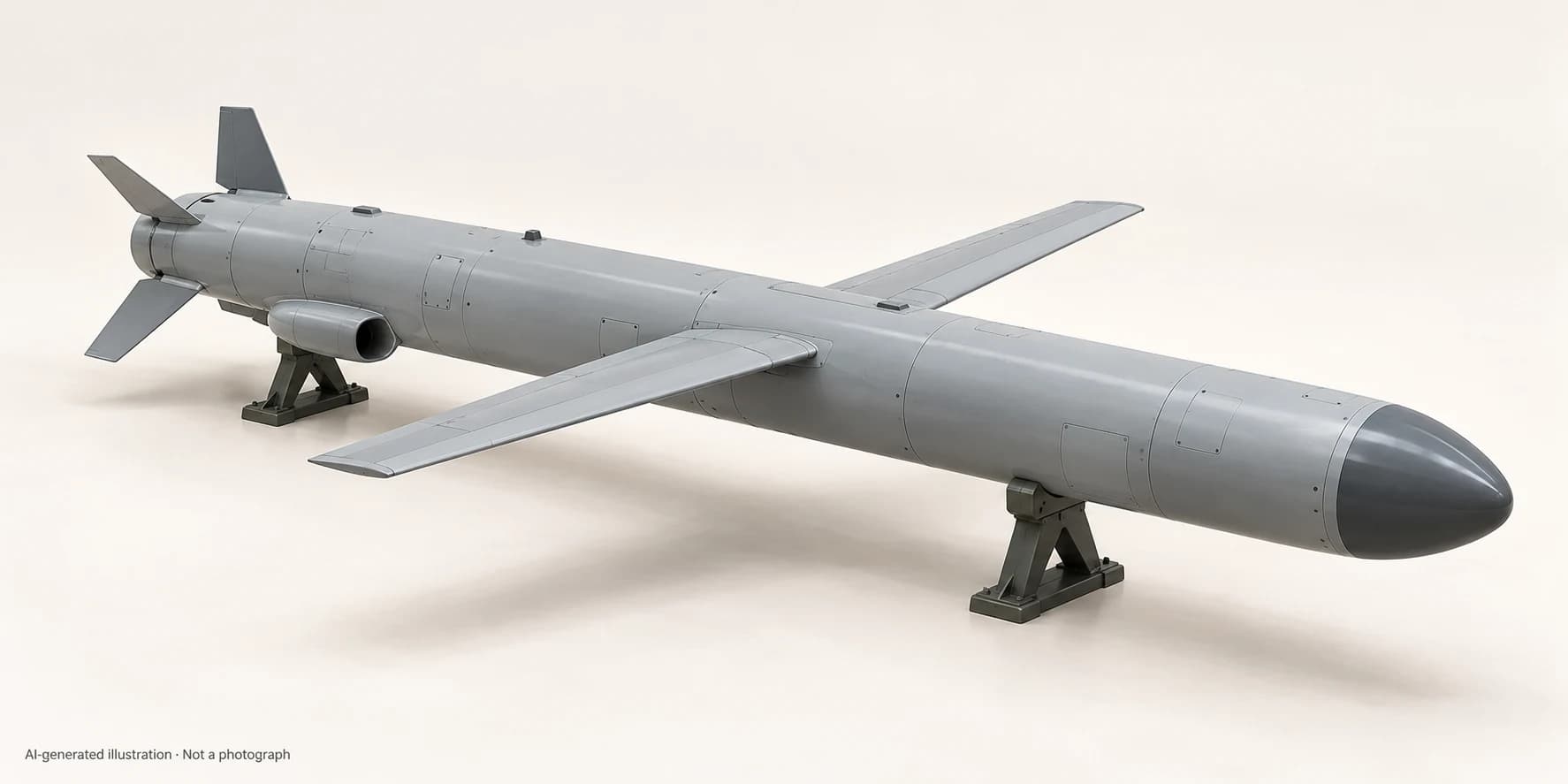
| Source measurement | The missile has a length of 6 metres, width of 0.52 metres, a wing span of 2.7 metres and weighs about 1500 kg.[source]Nirbhay · Design; only the objects and conditions stated in this passage It has a range of about 1500 km and is capable of delivering 24 different types of warheads depending on mission requirements between 200 and 300 kg.[source]Nirbhay · Design; only the objects and conditions stated in this passage With two side wings, the missile is capable of flying at different altitudes ranging from 50 m to 4 km above the ground and can also fly at low altitudes (like low tree level) to avoid detection by enemy radar.[source]Nirbhay · Design; only the objects and conditions stated in this passage It will eventually supplement the role played by the BrahMos missile for the Indian Armed Forces by delivering warheads farther than the 450 km range.[source]Nirbhay · Design; only the objects and conditions stated in this passage After the design was finalized, the technology required for the missile was developed. It was integrated by Research and Development Establishment (Engineers), a specialized arm of DRDO. Tata Motors has built the vehicle that is the carrier/launcher for the Nirbhay system and is based on a "high mobility, all-terrain and all-wheel drive Tata LPTA 5252 -12×12 vehicle", developed in partnership with DRDO. The aerodynamic characterization research was conducted at the National Aerospace Laboratories ' 1.2m Trisonic Wind Tunnel Facility.[source]Nirbhay · Design; only the objects and conditions stated in this passage DRDO intends to increase the range to 2,500 kilometers.[source]Nirbhay · Design / Further development; only the objects and conditions stated in this passage The Long Range–Land Attack Cruise Missile , abbreviated as the LR–LACM , is a longer range variant of the Nirbhay with a range up to 1,500 km. As its primary user, the Indian Navy is collaborating with the Indian Air Force in design, development, and acquisition of LR-LACM systems and associated equipment. Upon completion of development, both branches of the military would operate this missile. It would be compatible with the Universal Vertical Launch Module (UVLM) cells used for BrahMos used by the Navy on frontline waships. It will weigh about one tonne, have a length of 6 m and diameter of 0.52 m. The missile is designed to have two tapering-chord fold-out wings with a span of 2.7 m. The missile would be equipped with Manik engine , upgraded radio frequency (RF) seekers, and other subsystems.[source]Nirbhay · Variants / LR–LACM; only the objects and conditions stated in this passage The Submarine Launched Cruise Missile , abbreviated as SLCM , is the submarine-launched variant designed to launch from torpedo tubes of submarines. It is a compact version of Nirbhay missile. It has a stated range of 500 km, with a length of 5.6 meter, diameter of 505 mm (19.9 in), all up weight of 975 kg and Mach 0.7 speed. It would feature INS/GPS navigation, with an RF seeker for terminal guidance. There are plans to extend the missile's range to 800 km. During flight, SLCMs follow a low altitude trajectory. They skim close to the surface to stay out of the radar systems' altitude range. It comes with two variants: a Land attack cruise missile (LACM) and Anti-Ship Cruise Missile (ASCM) . The warhead weight is reported to be around 250 kg (550 lb).[source]Nirbhay · Variants / SLCM; only the objects and conditions stated in this passage | Sea Killer is an Italian anti-ship missile family. The latest development of the system is known as Marte . Marte is a sea skimming , subsonic , anti-ship missile carrying a 70 kilograms (150 lb) semi-armour piercing warhead. It has been built in several versions, with differing guidance systems, and is suitable for launching from ships or aircraft.[source]Sea Killer / Marte · Lead; only the objects and conditions stated in this passage Contraves Italiana, an Italian subsidiary of the Swiss armaments company Oerlikon Contraves , began development of a short-ranged - 10 kilometres (6.2 mi) - ship-based anti-ship missile system, named Nettuno in 1963. Guidance of Nettuno was by beam riding for course control, with altitude controlled automatically by an onboard radar altimeter , allowing the missile to carry out sea-skimming attacks. Command guidance was an alternative guidance method if jamming made the beam-riding method unusable. In 1965, Contraves Italiana began work on an improved missile, Vulcano , which used the same guidance system, but included a two-stage (booster + sustainer) rocket motor to give a longer (25 kilometres (16 mi)) range. Both missiles could be fired from a five-round trainable launcher.[source]Sea Killer / Marte · Development and design; only the objects and conditions stated in this passage Testing of Nettuno began in 1966, with a trial installation being made on the Freccia-class patrol boat Saetta of the Italian navy, with the five-round launcher replacing a Bofors 40 mm gun. Testing of Vulcano began in 1969.[source]Sea Killer / Marte · Development and design; only the objects and conditions stated in this passage The Marte ER, an improvement on the missile family, replaced the rocket motor with Williams WJ-24-8G turbojet propulsion and added a new ISO -caliber cylinder cell, which made it shorter in length but extended its range to over 100 km (62 mi; 54 nmi). Fitting trials of the Marte-ER onto the NH90 helicopter, which can carry two missiles, occurred in June 2014; a larger anti-ship missile like the Exocet was rejected for integration as physically too long and heavy.[source]Sea Killer / Marte · Development and design; only the objects and conditions stated in this passage In November 2015, a Eurofighter Typhoon was fit-tested for a fixed-wing version of the missile called the Marte-ERP, which does not feature folding fins and sheds the booster for a larger 120 kg (265 lb) warhead with penetrating and sector-blast properties; though smaller than other options like the Harpoon and RBS-15 , a fighter like Eurofighter Typhoon can carry six Marte-ERPs (or four with fuel tanks) compared to two or three larger missiles.[source]Sea Killer / Marte · Development and design; only the objects and conditions stated in this passage Short-range beam riding ship-launched anti-ship missile. 10 km range, 35 kilograms (77 lb) warhead. Also designated Nettuno .[source]Sea Killer / Marte · Variants; only the objects and conditions stated in this passage Increased range beam-riding ship-launched anti-ship missile with improved two stage rocket. 25+ km range, 70 kilograms (150 lb) warhead. Also designated Vulcano .[source]Sea Killer / Marte · Variants; only the objects and conditions stated in this passage Marte ER is a sea-skimming, high subsonic anti-ship and land attack missile. Turbojet engine Williams WR WJ-24-8G extends range to over 100 km, total weight of 340 kilograms, first tested in 9 November 2018. The missile is fire-and-forget capable and designed to operates in all weather conditions. The Eurofighter Typhoon can carry up to 6 Marte ER anti-ship missiles.[source]Sea Killer / Marte · Variants; only the objects and conditions stated in this passage (25) Sea Killer/Marte Mk2/N at least 25 delivered for Dearsan 33m FAC[source]Sea Killer / Marte · Operators; only the objects and conditions stated in this passage |
|---|