
Credit
Bunkerfunker · CC BY-SA 3.0 · Resized · CC BY-SA 3.0 · Source ↗ · Modified


Preparing your view.
At a glance
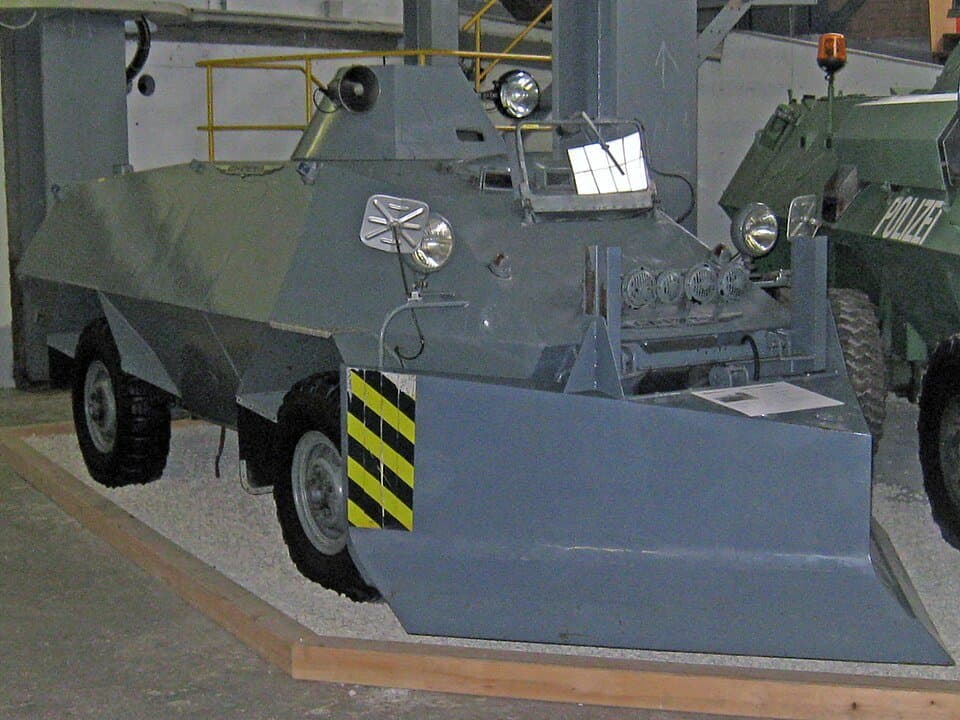
MOWAG Rolandlarger figure on 0 of 3
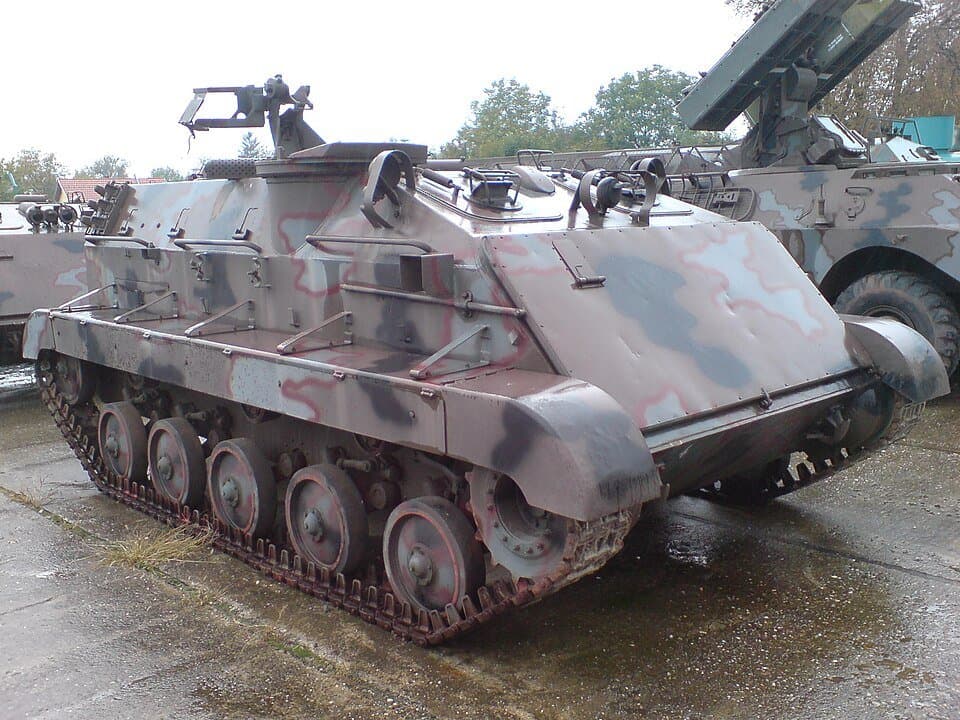
OT M-60larger figure on 3 of 3
Measured figures
Length
Single source4.73 m (186 in)[source]
Length
Single sourceConfiguration
| Specification | MOWAG Roland | OT M-60 |
|---|---|---|
| Place of origin | Switzerland[source] | Yugoslavia[source] |
| Used by | Switzerland , Germany , Mexico , Peru , Argentina , Bolivia , Chile , Greece , Iraq[source] | See Former operators[source] |
| Manufacturer | MOWAG[source] | ФАМОС[source] |
| Produced | 1964–1980[source] |
Counts only measures both sources give with the same scope. A larger figure is not a better system.
5.02 meters[source]
MOWAG Roland 4x4 LAV; road range; exact Mexico handbook equipment-recognition card · MOWAG Roland 4x4 LAV
Single source550 km[source]MOWAG Roland 4x4 LAV; road range; exact Mexico handbook equipment-recognition card
Operational; Off-road
Single sourceOperational; On road
Single sourceBars compare reported quantities only. A larger figure does not make a system better; configurations and test conditions differ.
| — |
| No. built | > 500[source] | — |
|---|
| Variants | Military version, Police Version[source] | — |
|---|
| Main armament | Customer Specific machine guns[source] | 12.7 mm M2 HB Browning heavy machine gun[source] |
|---|
| Secondary armament | modification with unguided rockets[source] | coaxial 7.92 M53 machine-gun 2,000 rounds[source] |
|---|
| Transmission | NP 435 mechanical gears 4 forward gears 1 reverse[source] | — |
|---|
| Suspension | 4x4 wheeled[source] | torsion bar[source] |
|---|
| Role | armoured personnel carrier of Swiss origin[source] | Yugoslav armoured personnel carrier[source] |
|---|
| Source measurement | 25 APC Ordered in 1976, with a turret equipped with a FN MAG 7.62×51mm NATO[source]MOWAG Roland · Operators / Operators list; only the objects and conditions stated in this passage | The OT ( Oklopni transporter - armoured personnel carrier ) M-60 was the first Yugoslav armored vehicle to enter serial production. Research and development began in 1956, and the first prototype was produced in June 1958. Prior to the commencement of serial production, the new armored personnel carrier was known as Objekat M-590 . Serial production started in 1962. The M-60 first appeared in public in that year's Victory Day parade. The quality of the vehicles did not satisfy the requirements of the Yugoslav People's Army (JNA), so FAMOS began development of an upgraded model, OT M-60P (P – poboljšani – "improved") which was introduced in 1970. From 1962 to 1979, around 790 vehicles were produced, of which 190 were exported. An anti-tank variant with two 82 mm M60 recoilless guns was introduced in 1973.[source]OT M-60 · Development; only the objects and conditions stated in this passage Most M-60s were used in the JNA's armored and mechanized brigades, while a number were used by the Federal Police, being painted in a characteristic blue color. During the Iran–Iraq War , the M-60 was criticised for its low firepower and weak armor. During the Yugoslav Wars , the M-60 suffered serious losses, and its firepower deficiencies were once again noted. Later during the war, the M-60 was used as armoured personnel carrier (APC) for transporting ammunition to the front line and the evacuation of infantrymen and wounded combatants. The M-60 was used by almost all armies created as a result of the breakup of Yugoslavia . The Army of Serbia and Montenegro withdrew its last 121 M-60Ps from service in 2004 due to the Agreement on Sub-Regional Arms Control of 1996.[source]OT M-60 · Development; only the objects and conditions stated in this passage The driver sat to the front left, his hatch having a day sight which could be replaced with an infrared sight for night driving. To his right sat the radio operator, who was able to fire through a machine gun port located on the upper front plate. The commander sat behind the driver, while behind the radio operator sat the gunner. The vehicle was equipped with a 12.7 mm M-2 HB PAM machine-gun mounted on the cupola, allowing for anti-aircraft use.[source]OT M-60 · Characteristics; only the objects and conditions stated in this passage The vehicle is powered by a six-cylinder diesel engine, which generates 140 hp, giving a top road speed of 45 km/h. The vehicle is an all welded steel construction, which gives protection against small arms. It has no NBC protection system.[source]OT M-60 · Characteristics; only the objects and conditions stated in this passage The rear compartment allows for 10 troops to be carried. These sit on benches back-to-back so that they can fire their personal weapons through side ports (three on either side), and they depart the vehicle via two doors set in the rear.[source]OT M-60 · Characteristics; only the objects and conditions stated in this passage M-60PB – Anti-tank variant with twin 82 mm M - 60 recoilless rifles mounted on the top left or top right of hull at rear.[source]OT M-60 · Variants; only the objects and conditions stated in this passage Iraq – 190 M-60P armoured personnel carriers ordered and delivered before 1990. Withdrawn from service.[source]OT M-60 · Former operators; only the objects and conditions stated in this passage |
|---|
| Armament | Remote controlled 7.62- or 12.7-mm machinegun[source] | — |
|---|
| Type | — | Armoured personnel carrier[source] |
|---|
| In service | — | 1962–2004[source] |
|---|
| Wars | — | Iran–Iraq War Yugoslav Wars[source] |
|---|
| Designer | — | Military Technical Institute[source] |
|---|
| Armor | — | 10–25 mm[source] |
|---|
| Power/weight | — | 17,3 hp/tonne[source] |
|---|
45 km/h on land 8 km/h in water[source]
400 km on road 250 km off road[source]