

Credit
Derek Webster · Public domain · Resized · Public domain · Source ↗ · Modified


Preparing your view.
At a glance
True scale
Side by side. From every angle. A human reference for perspective.
3.24 MB · Loads when you open it| Model | Length | Width / span | Height |
|---|---|---|---|
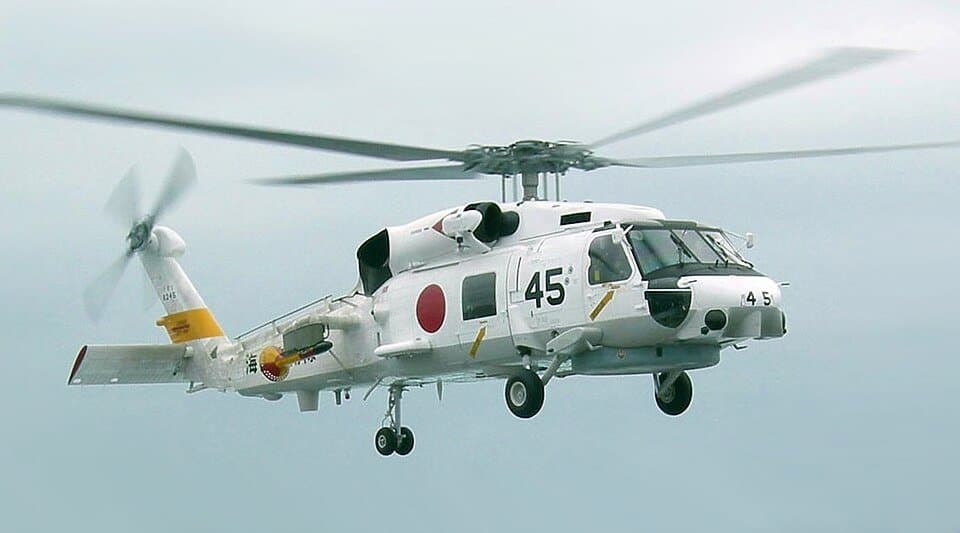
| Mitsubishi H-60 | ≈ 19.8 m | ≈ 16.66 m (Width) | ≈ 6.75 m |
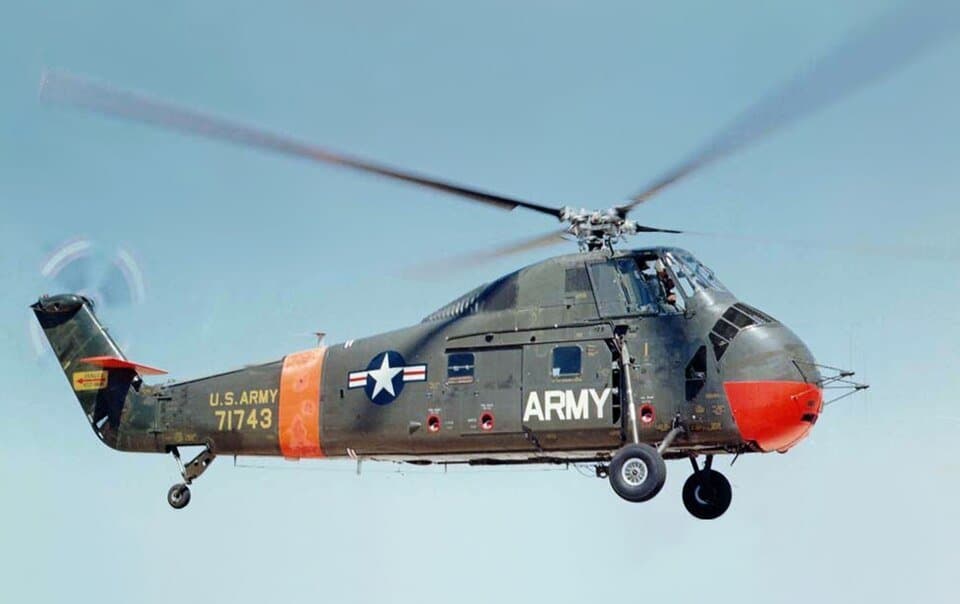
| Sikorsky H-34 | ≈ 15.07 m | ≈ 12.67 m (Width) | ≈ 4.36 m |
Scaled uniformly to the sourced length of 19.8 m. Not an official model or a measured survey.
ForceTally · All rights reserved
Scaled uniformly so that the fuselage matches the sourced 14.38 m h-34 choctaw · fuselage length. The shape was turned square to the axes; the height was fitted to the sourced 4.356 m. Not an official model or a measured survey.
ForceTally · All rights reserved
The human reference is a generic 1.75 m figure. Models describe external size, not combat performance.
Measured figures
SH-60J · including rotor
Single source19.8 m (65 ft 0 in) including rotor[source]
Configuration
| Specification | Mitsubishi H-60 | Sikorsky H-34 |
|---|---|---|
| Type | ASW / SAR helicopter[source] | Helicopter[source] |
| National origin | Japan United States[source] | United States[source] |
| Manufacturer | Sikorsky Aircraft Mitsubishi Heavy Industries[source] | Sikorsky Aircraft[source] |
| Status | In service[source] | In service |
H-34 Choctaw · fuselage
47 ft 2 in (14.38 m) fuselage[source]
Maximum take-off; SH-60J · Max takeoff weight
Single source9,750 kg (21,495 lb)[source]
SH-60J · 2 × IHI Corporation-General Electric T700-IHI-401C turboshaft engines each
Single source2 × IHI Corporation-General Electric T700-IHI-401C turboshaft engines, 1,342 kW (1,800 hp) each[source]
H-34 Choctaw · 1 × Wright R-1820-84 Cyclone for take-off
Single source1 × Wright R-1820-84 Cyclone , 1,525 hp (1,137 kW) for take-off[source]
H-34 Choctaw · 1,500 ft/min ( ) at sea level
Single source1,500 ft/min (7.6 m/s) at sea level[source]
Bars compare reported quantities only. A larger figure does not make a system better; configurations and test conditions differ.
| Primary user | Japan Self-Defense Forces[source] | — |
|---|
| Number built | Over 250[source] | 2,340[source] |
|---|
| Introduction date | 1991[source] | 1954[source] |
|---|
| First flight | 31 August 1987[source] | 8 March 1954[source] |
|---|
| Developed from | Sikorsky SH-60 Seahawk Sikorsky UH-60 Black Hawk[source] | Sikorsky H-19 Chickasaw[source] |
|---|
| Main rotor area | 211.26 m 2 (2,274.0 sq ft)[source] | 2,463 sq ft (228.8 m 2 ) * Blade section: – NACA 0012[source] |
|---|
| Blade section | root: SC1095/SC1095R8; tip: Sikorsky SC1095[source] | — |
|---|
| Primary users | — | United States Army United States Navy United States Marine Corps[source] |
|---|
| Manufactured | — | 1954–1970 (Foreign production of derivatives and sub-types continued under license after the Sikorsky production ended.)[source] |
|---|
| Variant | — | Westland Wessex[source] |
|---|
| Capacity | — | 12 troops (H-34A) / 18 troops (H-34C) / 8 stretchers[source] |
|---|
| Fuel capacity | — | 198–307 US gal (165–256 imp gal; 750–1,160 L)[source] |
|---|
| Hover ceiling IGE | — | 9,600 ft (2,926 m) ( H-34A )[source] |
|---|
| Hover ceiling OGE | — | 5,500 ft (1,676 m) ( H-34A )[source] |
|---|
| Vertical rate of climb | — | 600 ft/min (3.05 m/s) at sea level[source] |
|---|