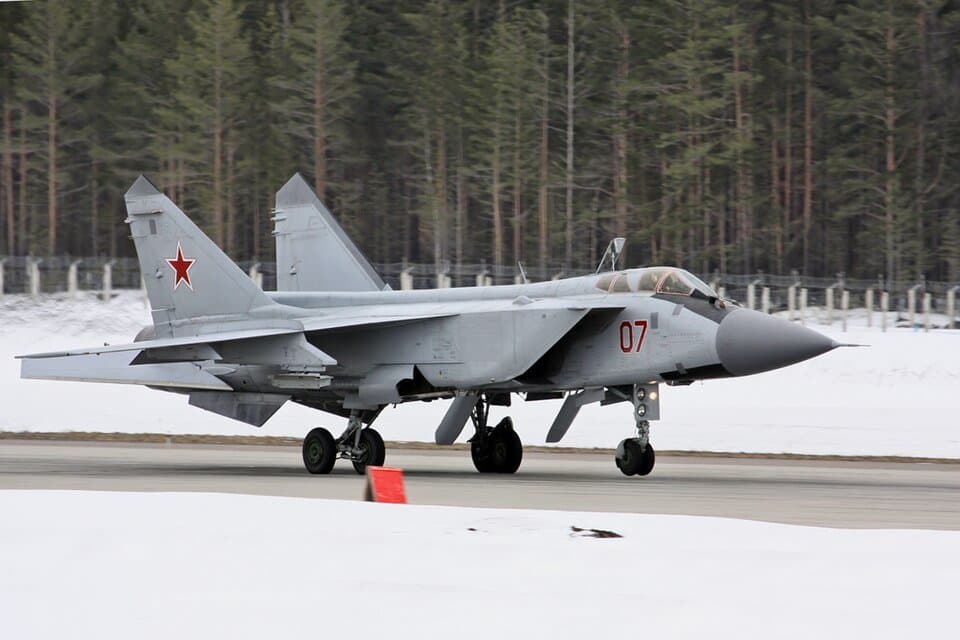
Credit
Vitaly Kuzmin · CC BY-SA 3.0 · Resized · CC BY-SA 3.0 · Source ↗ · Modified


Preparing your view.

At a glance
True scale
Side by side. From every angle. A human reference for perspective.
3.20 MB · Loads when you open it| Model | Length | Width / span | Height |
|---|---|---|---|
| Mikoyan MiG-31 | ≈ 22.62 m | ≈ 13.46 m (Wingspan) | ≈ 6.46 m |
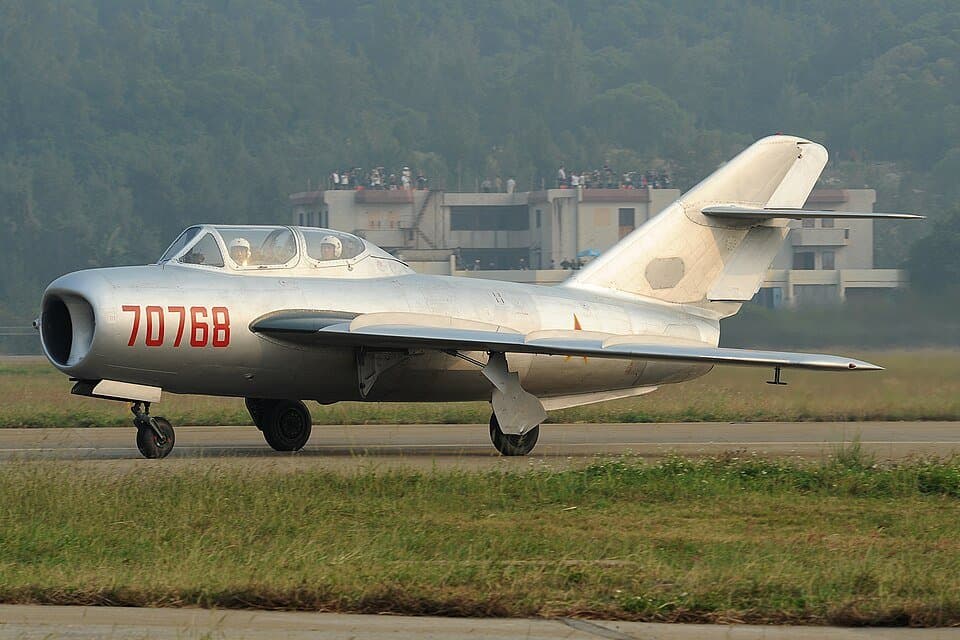
| Shenyang J-5 | ≈ 11.09 m | ≈ 9.63 m (Wingspan) | ≈ 3.8 m |
Scaled uniformly to the sourced length of 22.62 m. The shape was turned square to the axes; the height was fitted to the sourced 6.456 m; the width was fitted to the sourced 13.456 m wingspan. Not an official model or a measured survey.
ForceTally · All rights reserved
Scaled uniformly to the sourced length of 11.09 m. The shape was turned square to the axes; the height was fitted to the sourced 3.8 m; the width was fitted to the sourced 9.628 m wingspan. Not an official model or a measured survey.
ForceTally · All rights reserved
The human reference is a generic 1.75 m figure. Models describe external size, not combat performance.
Measured figures
MiG-31 · Length
Single source22.62 m (74 ft 3 in)[source]
Configuration
| Specification | Mikoyan MiG-31 | Shenyang J-5 |
|---|---|---|
| Type | Interceptor aircraft , strike fighter[source] | Fighter aircraft[source] |
| National origin | Soviet Union[source] | People's Republic of China[source] |
| Manufacturer | Mikoyan-Gurevich/Mikoyan[source] | Shenyang Aircraft Corporation[source] |
| Status | In service with the Russian Air Force[source] | In service with North Korea |
J-5A · Length · source measurement 1
J-5A · Length · source measurement 2
Single source11.09 m (36 ft 5 in) 11.36 m (37.3 ft)[source]
Empty; MiG-31 · Empty weight
Single sourceGross; MiG-31 · Gross weight
Single sourceMaximum take-off; MiG-31 · Max takeoff weight
Single source21,820 kg (48,105 lb)[source]
41,000 kg (90,390 lb)[source]
46,200 kg (101,854 lb)[source]
Empty; J-5A · Empty weight · source measurement 1
Single sourceEmpty; J-5A · Empty weight · source measurement 2
Single sourceCruise; MiG-31 · / Mach 2.35
Single sourceMaximum; MiG-31 · / Mach 2.83 at 21,500 m (70,500 ft)
Single source3,000 km/h (1,900 mph, 1,600 kn) / Mach 2.83 at 21,500 m (70,500 ft)[source]
2,500 km/h (1,600 mph, 1,300 kn) / Mach 2.35[source]
Maximum; J-5A · at 5,000 m (16,000 ft)
Single sourceMaximum; J-5A · Maximum speed
Single sourceMiG-31 · with 4 × R-33E and 2 drop tanks
Single source3,000 km (1,900 mi, 1,600 nmi) with 4 × R-33E and 2 drop tanks[source]
J-5A · Range
Single sourceJ-5A · with drop tanks at 10,000 m (33,000 ft)
Single source1,424 km (885 mi, 769 nmi) with drop tanks at 10,000 m (33,000 ft): 1,730 km (1,070 mi; 930 nmi)[source]
MiG-31 · at Mach 0.8 and
Single sourceMiG-31 · Combat range
Single source1,450 km (900 mi, 780 nmi) at Mach 0.8 and 10,000 m (33,000 ft)[source]
MiG-31 · 2 × Soloviev D-30 F6 afterburning turbofan engines thrust each dry
Single sourceMiG-31 · with afterburner
Single source2 × Soloviev D-30 F6 afterburning turbofan engines, 93 kN (21,000 lbf) thrust each dry, 152 kN (34,000 lbf) with afterburner[source]
J-5A · 1 × Wopen WP-5 turbojet engine thrust
Single sourceJ-5A · with afterburning
Single sourceBars compare reported quantities only. A larger figure does not make a system better; configurations and test conditions differ.
| Primary users | Russian Aerospace Forces Kazakh Air Defense Forces (historical)[source] | People's Liberation Army Air Force (historical) Korean People's Army Air Force Pakistan Air Force (historical) Vietnam People's Air Force (historical)[source] |
|---|
| Number built | 519[source] | 1,820+[source] |
|---|
| Manufactured | 1975–1994[source] | 1956–1969[source] |
|---|
| Introduction date | 6 May 1981[source] | 1957[source] |
|---|
| First flight | 16 September 1975 ( 1975-09-16 )[source] | 19 July 1956[source] |
|---|
| Retired | 2023 (Kazakh Air Force)[source] | 1992 (China)[source] |
|---|
| Developed from | Mikoyan-Gurevich MiG-25[source] | Mikoyan-Gurevich MiG-17[source] |
|---|
| Fuel capacity | 35,550 lb (16,130 kg) internals, plus optional external fuel tanks[source] | — |
|---|
| Guns | 1 × 23 mm Gryazev-Shipunov GSh-6-23 M rotary cannon with 260 rounds.[source] | 3 x Type 23-1 23 mm (0.906 in) aircraft cannon[source] |
|---|
| Hardpoints | 4 × semi-recessed under the fuselage and 4 × underwing pylons with capacity of up to 9,000 kg (20,000 lb) of ordnance , with provisions to carry combinations of: Missiles: Air-to-air missiles : 4 × R-33 2 × R-40 RD/TD 4 × R-60 MK 4 × R-73 4 × R-77 4 × R-37 M (MiG-31BM only) 4 × R-77 M (MiG-31BM only)[source] | — |
|---|
| g limits | 5+[source] | — |
|---|
| Wing loading | 665 kg/m 2 (136 lb/sq ft)[source] | — |
|---|
| Thrust/weight | 0.85[source] | — |
|---|
| Missiles | Air-to-air missiles :[source] | — |
|---|
| Role | — | Chinese -built single-seat jet interceptor and fighter aircraft derived[source] |
|---|
| Source measurement | — | The Shenyang J-5 ( Chinese : 歼-5) ( NATO reporting name Fresco ) is a Chinese -built single-seat jet interceptor and fighter aircraft derived from the Soviet Mikoyan-Gurevich MiG-17 . The J-5 was exported as the F-5 and was originally designated Dongfeng-101 (East Wind-101) and also Type 56 before being designated J-5 in 1964.[source]Shenyang J-5 · Lead; only the objects and conditions stated in this passage The MiG-17 was license-built in China and Poland into the 1960s. The People's Liberation Army Air Force (PLAAF) obtained a number of Soviet-built MiG-17 Fresco-A day fighters, designated J-4 in the early 1950s. To introduce modern production methods to Chinese industry the PLAAF obtained plans for the MiG-17F Fresco-C day fighter in 1955, along with two completed pattern aircraft, 15 knockdown kits, and parts for ten aircraft. The first Chinese-built MiG-17F, (serialed Zhong 0101 ), produced by the Shenyang factory, performed its initial flight on 19 July 1956 with test pilot Wu Keming at the controls.[source]Shenyang J-5 · Development; only the objects and conditions stated in this passage The Chinese also built a two-seat trainer version of the MiG-17, designated the Chengdu JJ-5 (Jianjiji Jiaolianji - Fighter Trainer - FT-5), from 1968, by combining the two-seat cockpit of the MiG-15UTI, the VK-1A engine of the J-5, and the fuselage of the J-5A. All internal armament was deleted and a single Nudelman-Richter NR-23 23 mm cannon was carried in a ventral pack. Production of the JJ-5 reached 1,061 when it ceased in 1986, with the type exported to a number of countries.[source]Shenyang J-5 · Development; only the objects and conditions stated in this passage Albanian Air Force — Twelve F-5s and eight FT-5s were delivered, with an additional 58 F-5s subsequently acquired. Shenyang J-5 jets were among the first Chinese military aid to Albania . However, their deployment against the Yugoslav air incursions was relatively unsuccessful due to their subsonic speed, and the aircraft were soon reassigned once Shenyang J-6s became available. Remaining J-5s are retired and in storage. All J-5s have been retired from Albanian Air Force service.[source]Shenyang J-5 · Operators / Former operators; only the objects and conditions stated in this passage Pakistan Air Force — Retired 5 January 2012. The PAF's No. 1 Fighter Conversion Unit (FCU) operated more than 25 FT-5 trainers from 1975 to 2012, replaced in service by Pakistani-built K-8P Karakorums .[source]Shenyang J-5 · Operators / Former operators; only the objects and conditions stated in this passage Sudanese Air Force — 16 F-5s and FT-5s were delivered in 1969. Another FT-5 was received around 1983. Lastly, two FT-5s might have been ordered in 2001. Sudanese Air Force F-5s might have been used for ground attack missions against members of the Ansar movement in 1970.[source]Shenyang J-5 · Operators / Former operators; only the objects and conditions stated in this passage Tanzanian Air Force — Up to 22 FT-5 trainers delivered, starting in 1973.[source]Shenyang J-5 · Operators / Former operators; only the objects and conditions stated in this passage Air Force of Zimbabwe — Two FT-5s leased by China as trainers for Chengdu F-7s around 1986. They were later replaced by two twin-seat FT-7BZs, and returned to China by the mid-1990s.[source]Shenyang J-5 · Operators / Former operators; only the objects and conditions stated in this passage Length: 11.09 m (36 ft 5 in) 11.36 m (37.3 ft)[source]Shenyang J-5 · Specifications (J-5A); only the objects and conditions stated in this passage Wingspan: 9.628 m (31 ft 7 in)[source]Shenyang J-5 · Specifications (J-5A); only the objects and conditions stated in this passage Height: 3.8 m (12 ft 6 in)[source]Shenyang J-5 · Specifications (J-5A); only the objects and conditions stated in this passage Wing area: 22.6 m 2 (243 sq ft)[source]Shenyang J-5 · Specifications (J-5A); only the objects and conditions stated in this passage Empty weight: 3,939 kg (8,684 lb) 4,151 kg (9,151 lb)[source]Shenyang J-5 · Specifications (J-5A); only the objects and conditions stated in this passage Gross weight: 6,000 kg (13,228 lb) 6,125 kg (13,503 lb)[source]Shenyang J-5 · Specifications (J-5A); only the objects and conditions stated in this passage Powerplant: 1 × Wopen WP-5 turbojet engine, 25.5 kN (5,700 lbf) thrust 33.8 kN (7,600 lbf) with afterburning[source]Shenyang J-5 · Specifications (J-5A); only the objects and conditions stated in this passage Maximum speed: 1,130 km/h (700 mph, 610 kn) at 5,000 m (16,000 ft): 1,145 km/h (711 mph; 618 kn)[source]Shenyang J-5 · Specifications (J-5A); only the objects and conditions stated in this passage Range: 1,424 km (885 mi, 769 nmi) with drop tanks at 10,000 m (33,000 ft): 1,730 km (1,070 mi; 930 nmi)[source]Shenyang J-5 · Specifications (J-5A); only the objects and conditions stated in this passage Service ceiling: 16,500 m (54,100 ft) 16,600 m (54,500 ft)[source]Shenyang J-5 · Specifications (J-5A); only the objects and conditions stated in this passage Rate of climb: 65 m/s (12,800 ft/min) at 5,000 m (16,000 ft): 27 m/s (5,300 ft/min)[source]Shenyang J-5 · Specifications (J-5A); only the objects and conditions stated in this passage Guns: 3 x Type 23-1 23 mm (0.906 in) aircraft cannon[source]Shenyang J-5 · Specifications (J-5A); only the objects and conditions stated in this passage |
|---|
Gross; J-5A · Gross weight · source measurement 1
Single sourceGross; J-5A · Gross weight · source measurement 2
Single source3,939 kg (8,684 lb) 4,151 kg (9,151 lb)[source]
6,000 kg (13,228 lb) 6,125 kg (13,503 lb)[source]
6000千克[source]歼-5 · 最大起飞重量
1,130 km/h (700 mph, 610 kn) at 5,000 m (16,000 ft): 1,145 km/h (711 mph; 618 kn)[source]
1 × Wopen WP-5 turbojet engine, 25.5 kN (5,700 lbf) thrust 33.8 kN (7,600 lbf) with afterburning[source]