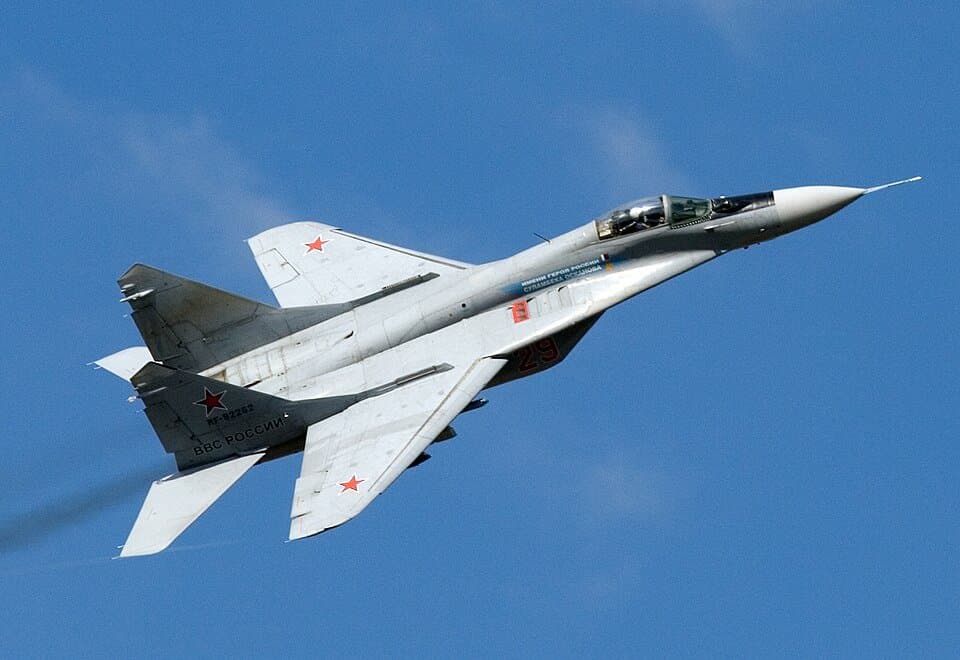
Credit
Artem Katranzhi from Bakashikha, Russia · CC BY-SA 2.0 · Resized · CC BY-SA 2.0 · Source ↗ · Modified


Preparing your view.
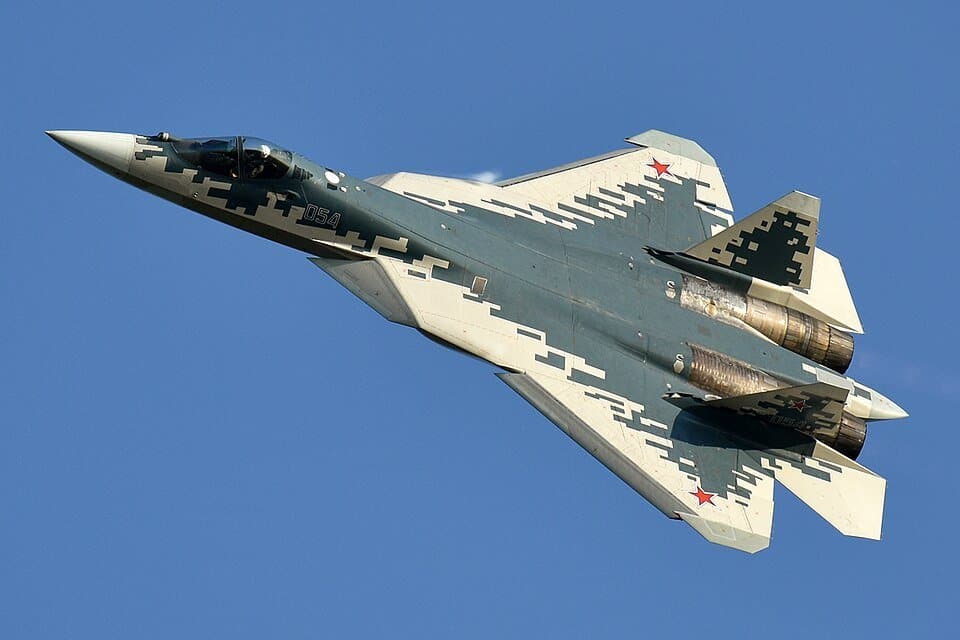
At a glance
Measured figures
Empty; MiG-29 · Empty weight
Single sourceGross; MiG-29 · Gross weight
Single sourceMaximum take-off; MiG-29 · Max takeoff weight
Single source11,000 kg (24,251 lb)[source]
14,900 kg (32,849 lb)[source]
18,000 kg (39,683 lb)[source]
Empty; Su-57E · Empty weight
Single sourceGross; Su-57E · at full load
Single sourceGross; Su-57E · normal takeoff weight
Single sourceMaximum take-off; Su-57E · Max takeoff weight
Single source18,500 kg (40,786 lb)[source]
26,700 kg (58,863 lb) normal takeoff weight, 29,800 kg (65,700 lb) at full load[source]
34,000 kg (74,957 lb)[source]
Maximum; MiG-29 · at high altitude
Single source2,450 km/h (1,520 mph, 1,320 kn) at high altitude[source]
Maximum; Su-57E · at sea level
Single sourceMaximum; Su-57E · Mach 2.0 at high altitude Mach 1.1
Single sourceMach 2.0, 2,135 km/h (1,153 kn; 1,327 mph) at high altitude Mach 1.1, 1,350 km/h (729 kn; 839 mph) at sea level[source]
MiG-29 · 2 × Klimov RD-33 afterburning turbofan engines thrust each dry
Single sourceMiG-29 · with afterburner
Single source2 × Klimov RD-33 afterburning turbofan engines, 49.42 kN (11,110 lbf) thrust each dry, 81.58 kN (18,340 lbf) with afterburner[source]
Su-57E · 2 × Saturn AL-41F-1 afterburning turbofan thrust each dry
Single sourceSu-57E · in emergency power
Single sourceSu-57E · with afterburner
Single source2 × Saturn AL-41F-1 afterburning turbofan , 88.3 kN (19,900 lbf) thrust each dry, 142.2 kN (32,000 lbf) with afterburner, 147.1 kN (33,100 lbf) in emergency power[source]
MiG-29 · 65,000 ft/min
Single source330 m/s (65,000 ft/min)[source]
Su-57E · Hardpoints: 12 hardpoints (6 × internal, 6 × external) with a capacity of maximum payload
Single sourceHardpoints: 12 hardpoints (6 × internal, 6 × external) with a capacity of 7,500 kilograms (16,500 lb) maximum payload[source]
Bars compare reported quantities only. A larger figure does not make a system better; configurations and test conditions differ.
Configuration
| Specification | Mikoyan MiG-29 | Sukhoi Su-57 |
|---|---|---|
| Type | Air superiority fighter , multirole fighter[source] | Stealth multirole fighter[source] |
| National origin | Soviet Union[source] | Russia[source] |
| Designer | Mikoyan[source] | Sukhoi[source] |
| Status | In service[source] | In production[source] |
| Primary users | Russian Aerospace Forces Indian Air Force Algerian Air Force Ukrainian Air Force[source] | Russian Aerospace Forces Algerian Air Force[source] |
| Number built | 1,600+[source] | 44+ as of 2026 (including 10 test aircraft)[source] |
| Manufactured | 1981–2019[source] | 2019–present[source] |
| Introduction date | August 1983[source] | 2020[source] |
| First flight | 6 October 1977[source] | 29 January 2010 ( 2010-01-29 )[source] |
| Variants | Mikoyan MiG-29M Mikoyan MiG-29K Mikoyan MiG-35[source] | — |
| Fuel capacity | 3,500 kg (7,716 lb) internal[source] | 9,700 kg (21,385 lb) internal, 12,900 kg (28,440 lb) with 2× PTB-2000 2,000 L (528 US gal) drop tanks[source] |
| g limits | + 9[source] | +9.0[source] |
| Wing loading | 403 kg/m 2 (83 lb/sq ft)[source] | 371 kg/m 2 (76 lb/sq ft) normal takeoff weight[source] |
| Thrust/weight | 1.09[source] | 1.09 at normal takeoff weight (0.97 at loaded weight with full fuel)[source] |
| Guns | 1 × 30 mm Gryazev-Shipunov GSh-30-1 autocannon . Originally held 150 rounds, reduced to 100 on later variants.[source] | 1 × 30 mm Gryazev-Shipunov GSh-30-1 autocannon[source] |
| Hardpoints | 7 × hardpoints (6 × underwing, 1 × fuselage) with a capacity of up to 4,000 kg (8,800 lb) of stores, with provisions to carry combinations of:[source] | 12 hardpoints (6 × internal, 6 × external) with a capacity of 7,500 kilograms (16,500 lb) maximum payload[source] |
| Rockets | S-5 S-8 S-24[source] | — |
| Missiles | 2-4 × R-27 R/ER/T/ET/P/EP air-to-air missiles 6 × R-60 / R-60M AAMs 6 × R-73 AAMs (later variants also carry the R-73M, R-74 and R-74M) 4 × Astra ( Indian Air Force ) Rampage ( Indian Air Force ) AGM-88 HARM (Integration by Ukrainian Air Force during the 2022 Russian invasion of Ukraine ) 2 × Kh-29 T/TE (MiG-29SMT, MiG-29M/M2, MiG-29K/KR and MiG-35 only) 6 × R-77 (MiG-29S, MiG-29M/M2 & MiG-29K only) 2 × CM-400 ( Serbian Air Force MiG-29SM)[source] | Air-to-air missiles : R-77 M R-74M2 R-37 (missile) Air-to-surface missiles : 4 × Kh-38 M 4 × Kh-69 S-71K Kovyor Anti-ship missiles : 2 × Kh-35 U 2 × Kh-31 Anti-radiation missiles : 4 × Kh-58 UShK[source] |
| Bombs | 6 × 665 kg (1,466 lb) bombs 4 × FAB-500 -M62 500kg general purpose bomb 4 × FAB-250 -M62 250kg general purpose bomb 4 × BETAB-500 500kg concrete piercing bomb 4 × KMGU -AO2/PTAB munitions dispenser 4 × RBK-500 -PTAB/255-PTAB 500kg cluster bomb 4 × RBK-250 -PTAB/275-AO 250kg cluster bomb 4 x LS-6 precision-guided bomb kit ( Serbian Air Force MiG-29SM) Smart Anti-Airfield Weapon (Indian MiG-29s)[source] | KAB-250 guided bomb KAB-500 guided bomb "Drill" anti-tank 500 kg cluster bomb with active homing[source] |
| Other | 1 × 1400 L external drop tank 2 × 1100 L external drop tank[source] | — |
| Role | twin-engine fighter aircraft[source] | — |
| Status (MiG-29s) | MiG-29s were retired from active Kazakh service in 2023, when around 23 were still believed to be active and have since been offered for sale by the government.[source]MiG-29s · source-literal variant status | — |
| Source measurement | While originally oriented towards combat against any enemy aircraft, many MiG-29s have been furnished as multirole fighters capable of performing a number of different operations, and are commonly outfitted to use a range of air-to-surface armaments and precision munitions . The MiG-29 has been manufactured in several major variants, including the multirole Mikoyan MiG-29M and the navalised Mikoyan MiG-29K ; the most advanced member of the family to date is the Mikoyan MiG-35 . Later models frequently feature improved engines, glass cockpits with HOTAS ("hands-on-throttle-and-stick")-compatible flight controls, modern radar and infrared search and track (IRST) sensors, and considerably increased fuel capacity; some aircraft have also been equipped for aerial refueling .[source]Mikoyan MiG-29 · Lead; only the objects and conditions stated in this passage In the mid-1960s, the United States Air Force (USAF) encountered difficulties over the skies of Vietnam. Supersonic fighter bombers that had been optimized for low altitude bombing, like the F-105 Thunderchief , were found to be vulnerable to older MiG-17s and more advanced MiGs which were much more maneuverable. In order to regain limited air superiority, the US refocused on air combat using the F-4 Phantom multirole fighter, while the Soviet Union developed the MiG-23 in response. Towards the end of the 1960s, the USAF started the "F-X" program to produce a fighter dedicated to air superiority, which led to the McDonnell Douglas F-15 Eagle being ordered for production in late 1969.[source]Mikoyan MiG-29 · Development / Origins; only the objects and conditions stated in this passage The workload split between TPFI and LPFI became more apparent as the MiG-29 filtered into frontline service with the Soviet Air Forces (Russian: Voenno-Vozdushnye Sily [VVS]) in the mid-1980s. While the heavy, long range Su-27 was tasked with the more exotic and dangerous role of deep air-to-air sweeps of NATO high-value assets, the smaller MiG-29 directly replaced the MiG-23 in the frontal aviation role.[source]Mikoyan MiG-29 · Development / Origins; only the objects and conditions stated in this passage In the 1980s, Mikoyan developed the improved MiG-29S to use longer range R-27E air-to-air missiles. It added a dorsal 'hump' to the upper fuselage to house a jamming system and some additional fuel capacity. The weapons load was increased to 4,000 kg (8,800 lb) with airframe strengthening. These features were included in new-built fighters and upgrades to older MiG-29s.[source]Mikoyan MiG-29 · Development / Introduction and improvements; only the objects and conditions stated in this passage Refined versions of the MiG-29 with improved avionics were fielded by the Soviet Union, but Mikoyan's multirole variants, including a carrier-based version designated MiG-29K , were never produced in large numbers. Development of the MiG-29K version for use in aircraft carriers , was suspended for over a decade before being resumed. The type went into service with the Indian Navy 's INS Vikramaditya , INS Vikrant , and Russian Navy 's Kuznetsov class aircraft carriers. Mikoyan also developed improved versions MiG-29M and MiG-29SMT .[source]Mikoyan MiG-29 · Development / Introduction and improvements; only the objects and conditions stated in this passage Sharing its origins in the original PFI requirements issued by TsAGI , the MiG-29 has broad aerodynamic similarities to the Sukhoi Su-27 , but with some notable differences. The MiG-29 has a mid-mounted swept wing with blended leading-edge root extensions (LERXs) swept at around 40°; there are swept tailplanes and two vertical fins, mounted on booms outboard of the engines. Automatic slats are mounted on the leading edges of the wings; they are four-segment on early models and five-segment on some later variants. On the trailing edge , there are maneuvering flaps and wingtip ailerons .[source]Mikoyan MiG-29 · Design; only the objects and conditions stated in this passage The MiG-29 has hydraulic controls and a SAU-451 three-axis autopilot but, unlike the Su-27, no fly-by-wire control system. Nonetheless, it is very agile, with excellent instantaneous and sustained turn performance, high-alpha capability, and a general resistance to spins. The airframe consists primarily of aluminum with some composite materials, and is stressed for up to 9 g (88 m/s²) maneuvers. The controls have "soft" limiters to prevent the pilot from exceeding g and alpha limits, but the limiters can be disabled manually.[source]Mikoyan MiG-29 · Design; only the objects and conditions stated in this passage The MiG-29 has a ferry range of 1,500 km (930 mi) without external fuel tanks, and 2,100 km (1,300 mi) with external tanks. The internal fuel capacity of the original MiG-29 (Fulcrum-A) is 4,300 L (950 imp gal; 1,100 US gal) distributed between six internal fuel tanks , four in the fuselage and one in each wing. The internal fuel capacity of the MiG-29 (Fulcrum-C) is 4,540 L (1,000 imp gal; 1,200 US gal) due to a larger #1 fuselage tank. For longer flights, this can be supplemented by a 1,500 L (330 imp gal; 400 US gal) centreline drop tank on the Fulcrum-A and two 1,150 L (250 imp gal; 300 US gal) underwing drop tanks on later production batches. In addition, newer models have been fitted with port-side inflight refueling probes, allowing much longer flight times by using a probe-and-drogue system .[source]Mikoyan MiG-29 · Design / Powerplant, performance and range; only the objects and conditions stated in this passage Accordingly, the N019 was originally intended to have a flat planar array antenna and full digital signal processing , for a detection and tracking range of at least 100 km (62 mi) against a fighter-sized target.[source]Mikoyan MiG-29 · Design / Sensors; only the objects and conditions stated in this passage The N019 was further compromised by Phazotron designer Adolf Tolkachev 's betrayal of the radar to the CIA , for which he was executed in 1986. In response to all of these problems, the Soviets hastily developed a modified N019M Topaz radar for the upgraded MiG-29S aircraft. However, VVS was reportedly still not satisfied with the performance of the system and demanded another upgrade. The latest upgraded aircraft, MiG-29M, offered the N010 Zhuk-M , which has a planar array antenna rather than a dish, improving range, and a much superior processing ability, with multiple-target engagement capability and compatibility with the Vympel R-77 (or RVV-AE).[source]Mikoyan MiG-29 · Design / Sensors; only the objects and conditions stated in this passage Armament for the MiG-29 includes a single GSh-30-1 30 mm (1.18 in) cannon in the port wing root. This originally had a 150-round magazine, which was reduced to 100 rounds in later variants, which only allows a few seconds of firing before running out of ammo. Original production MiG-29 aircraft cannot fire the cannon when carrying a centerline fuel tank as it blocks the shell ejection port. This was corrected in the MiG-29S and later versions.[source]Mikoyan MiG-29 · Design / Armament; only the objects and conditions stated in this passage Three pylons are provided under each wing (four in some variants), for a total of six (or eight). The inboard pylons can carry either a 1,150 L (250 imp gal; 300 US gal) fuel tank, one Vympel R-27 (AA-10 "Alamo") medium-range air-to-air missile, or unguided bombs or rockets. Some Soviet aircraft could carry a single nuclear bomb on the port inboard station. The outer pylons usually carry R-73 (AA-11 "Archer") dogfight air to air missiles, although some users still retain the older R-60 (AA-8 "Aphid"). A single 1,500 L (330 imp gal; 400 US gal) tank can be fitted to the centerline, between the engines.[source]Mikoyan MiG-29 · Design / Armament; only the objects and conditions stated in this passage The only claimed combat service of the MiG-29 in Soviet service was in 1987 and 1988, where they were deployed the 115th GvIAP to Termez Airfield in Turkmenistan in 1987 to cover for Soviet forces in Afghanistan, especially Kabul . This apparently proved effective as - sources disagree about whether it was in August or September - four SU-22M3s of the DRAAF defected and attempted to bomb the capital but were all shot down within minutes of each other by the Fulcrums, though this incident is heavily disputed. The Fulcrums of the 115th GvIAP were however, used to overfly and interrupt two unidentified Afghans who had crossed the Soviet border and were constructing a hut on an islet in the Pyandzh River. Following the disintegration of the Soviet Union, most of the MiG-29s entered service with the newly formed Russian Air Force .[source]Mikoyan MiG-29 · Operational history / Soviet Union and successor states / Soviet service; only the objects and conditions stated in this passage Following a second crash with a MiG-29 in east Siberia in December 2008, Russian officials admitted that most MiG-29 fighters in the Russian Air Force were incapable of performing combat duties due to poor maintenance.[source]Mikoyan MiG-29 · Operational history / Soviet Union and successor states / Russia; only the objects and conditions stated in this passage After Russia shared the finding with India, which emerged after the crash of a Russian Air Force MiG-29 in December 2008, a repair and maintenance program was put in place to resolve the issue.[source]Mikoyan MiG-29 · Operational history / Export / India; only the objects and conditions stated in this passage By September 2019, the fleet of 69 IAF MiG-29s were upgraded to UPG standard. The upgrade project involved 6 aircraft being upgraded in Russia and the remaining fleet at the 11th Base Repair and Depot facilities at Ojhar , which have been increasingly used to maintain the IAF's fleet of MiG-29s and Su-30MKIs . In 2020, India planned an additional order of 21 MiG-29s, which would be manufactured from airframes built in late 1980s but never assembled, and upgraded before delivery to the Indian Air Force. On 7 August 2024, IAF issued a request for proposal to upgrade 24 MiG-29s to integrate High Speed Low Drag Bombs with a range of 180 km (110 mi). The upgrade would include installation of hardware such as bomb racks on external hardpoints , and necessary software for the aircraft, with the entire MiG-29 fleet to be modified in phases.[source]Mikoyan MiG-29 · Operational history / Export / India; only the objects and conditions stated in this passage East Germany bought 24 MiG-29s (20 MiG-29As, four MiG-29UBs), which entered service in 1988–1989 in 1./JG3 " Wladimir Komarow " in Preschen in Brandenburg . After the fall of the Berlin Wall in November 1989 and reunification of Germany in October 1990, the MiG-29s and other aircraft of the East German Air Forces of the National People's Army were integrated into the West German Luftwaffe . Initially the 1./JG3 kept its designation. In April 1991 both 1./JG3's MiG-29 squadrons were reorganised into the MiG-29 test wing (" Erprobungsgeschwader MiG-29 "), which became JG73 " Steinhoff " and was transferred to Laage near Rostock in June 1993.[source]Mikoyan MiG-29 · Operational history / Export / Germany; only the objects and conditions stated in this passage The HMS was a great help, allowing the Germans to achieve a lock on any target the pilot could see within the missile field of view, including those almost 45 degrees off boresight .[source]Mikoyan MiG-29 · Operational history / Export / Germany; only the objects and conditions stated in this passage Beginning in 1993, the German MiGs were stationed with JG73 " Steinhoff " in Laage near Rostock . During the service in the German Air Force, one MiG-29 ("29+09") was destroyed in an accident on 25 June 1996 due to pilot error. By 2003, German Air Force pilots had flown over 30,000 hours in the MiG-29. In September 2003, 22 of the 23 remaining machines were sold to the Polish Air Force for the symbolic price of €1 per item. The last aircraft were transferred in August 2004. The 23rd MiG-29 ("29+03") was put on display at Laage.[source]Mikoyan MiG-29 · Operational history / Export / Germany; only the objects and conditions stated in this passage There have been unconfirmed reports that Poland has at one point leased a MiG-29 from its own inventory to Israel for evaluation and the aircraft has since been returned to Poland, as suggested by photographs of a MiG-29 in Israeli use. Three Polish MiG-29As were reported in Israel for evaluation between April and May 1997 in the Negev Desert . On 7 September 2011, the Polish Air Force awarded a contract to the WZL 2 company to modernise its MiG-29 fleet to be compatible with Polish F-16s.[source]Mikoyan MiG-29 · Operational history / Export / Poland; only the objects and conditions stated in this passage Iran has used MiG-29s continuously since their induction, but has lost some in incidents. During their delivery flight, one MiG-29A crashed when its Soviet pilot got lost flying the aircraft to Iran and was forced to eject. Another MiG-29A was lost shortly after when a MiG-29A flown by an Iranian pilot crashed while flying low with the Iranians claiming mechanical failure but a MiG inquiry concluded that the pilot experienced disorientation and flew into a mountain. A single attiration replacement was delivered at some point in the 1990s. More recent incidents include one in 2016 and another in December 2019 due to a crash in the Sabalan Mountains .[source]Mikoyan MiG-29 · Operational history / Export / Iran; only the objects and conditions stated in this passage After warnings on the international distress frequency were ignored, one F-15 shot down the lead MiG-29 with a Python Mk.IV missile, while the second MiG, attempting to retreat, was destroyed by a close-range AIM-9M Sidewinder, both crashing into the Mediterranean and the pilots were retrieved.[source]Mikoyan MiG-29 · Operational history / Export / Syria / Syrian - Israeli skirmishes; only the objects and conditions stated in this passage Malaysian MiG-29s would participate in Exercise Jagukh in the Spring of 1996, and with the SEATO members in their largest exercise up to that time, Exercise Flying Fish '97 on 12–30 April 1997 involving over 12,000 personnel in the South China Sea, where the MiGs were especially praised, and they participated alongside Malaysia's F-5Es . They also received technical assistance from MAPO MiG personnel on the ground at this time with 14 of the 16 single seat aircraft ready at this time. One MIG-29, M43-05 was displayed at an airshow in Jakarta , Indonesia between 22 and 30 June 1996.[source]Mikoyan MiG-29 · Operational history / Export / Malaysia; only the objects and conditions stated in this passage The Korean People's Air Force is believed to operate about 18 MiG-29s which are assigned to the 55th Air Regiment based at Sunchon Air Base . In addition to 13 MiG-29 (9.12B) Fulcrum As and 2 Fulcrum B trainers that were delivered in 1987, North Korea also became the only Cold War export customer and licensed manufacturer of the Fulcrum-C. Called the MiG-29S-13 (9.13B) Fulcrum-C, they were delivered to North Korea from the USSR/Russia between 1991 and 1992 in knock down parts. Only three S-13s were completed due to Russia refusing to supply more parts to North Korea. The first locally built Fulcrum-C flew on 15 April 1993. These were first encountered and photographed by the US Air Force in March 2003 when a pair of KPAF MiG-29s intercepted a RC-135S Cobra Ball reconnaissance aircraft .[source]Mikoyan MiG-29 · Operational history / Export / North Korea; only the objects and conditions stated in this passage There have been occasional claims regarding the use of Sudanese Air Force MiG-29s against insurgent forces in Darfur . However, whereas Mi-24 combat helicopters as well as Nanchang A-5 or, more recently, Su-25 ground-attack aircraft have been spotted and photographed on Darfurian airfields, no MiG-29s have been observed. On 10 May 2008, a Darfur rebel group, the Justice and Equality Movement (JEM) mounted an assault on the Sudanese capital. During this action, the JEM shot down a Sudanese Air Force MiG-29 with 12.7 and 14.5 mm (0.500 and 0.571 in) heavy machine gun fire while it was attacking a convoy of vehicles in the Khartoum suburb of Omdurman . The aircraft was piloted by a Russian mercenary. He was killed in action as his parachute did not open after ejecting.[source]Mikoyan MiG-29 · Operational history / Export / Sudan / Darfur War; only the objects and conditions stated in this passage During the February 1999 Eritrean - Ethiopian Aerial Clashes , Eritrean MiG-29s engaged Ethiopian Su-27s for the first time on February 21, resulting in damage to one MiG-29 and further engagements occurred later in the same month on 25 and 26 February. Each of these engagements resulted in the loss of one Eritrean MiG-29 in each encounter, both pilots were lost. Ethiopia claims between five and seven MiG-29s throughout 1999–2000 by their Su-27s, but only the two lost in February 1999 can be confirmed. Up to 29 R-27 missiles were fired in these engagements, and represented the first such long range combat between fourth Generation fighters.[source]Mikoyan MiG-29 · Operational history / Export / Eritrea / Ethiopian - Eritrean (Badme) War; only the objects and conditions stated in this passage Bangladesh first ordered its MiG-29s in 1999 under a deal worth between $115 and $125 Million with Russia, including airframes and ground support, the support of 12 Russian personnel in Bangladesh, and initial training for 10 pilots and 70 technicians, which proved politically contentious. The aircraft were split as six MiG-29SEs (Project 9.12SE) and two UB trainers (Project 9.51). The first four were delivered in December 1999 (two on the 25th and two on the 28th) with the remaining four in February 2000, assigned to the 5th Squadron "Supersonics" at Bashar Airbase (Tejgoan Airfield) near Dhaka, officially entering service in March 2000. They are now operated by the 8th Squadron "Vigilants" at BAF base Bir Uttom Khandaker , near Dhaka. Of the six MiG-29SEs delivered to the Bangladeshis (serialed 36100, 36501–507), one (36501) was an ex-MAPO demonstrator (the 999 "Silver" demonstrator). The two UBs were given the serials 28264 and 28375.[source]Mikoyan MiG-29 · Operational history / Export / Bangladesh; only the objects and conditions stated in this passage They were ordered to replace the ageing MiG-21s and F-6s then in service, though, due to their low numbers, modernized Chinese J-7s were also ordered later. As of 2022 , Jane's Information Group reported the Bangladesh Air Force (BAF) operated 8 MiG-29s (Six MiG-29Bs & two MiG-29UBs) though they have a low serviceability rate. Four of the eight aircraft in service were overhauled in 2019 with their time before overhaul validity till 2030, with the remaining four to be overhauled in JSC 558 in Belarus, which were to be delivered back in October 2025. Bangladeshi Sources state that six of the 20 delivered jet engines are operational and a deal was proposed by the Airforce in 2025 to overhaul 12 more engines under a $30.6 Million dollar commitment to be paid over four years with JSC NASC. Previous attempts to overhaul the engines had been hampered by the Russo-Ukrainian War.[source]Mikoyan MiG-29 · Operational history / Export / Bangladesh; only the objects and conditions stated in this passage The MiG-29S was an update of the original 9.13 model retaining the NATO reporting code "Fulcrum-C" and featured flight control system improvements; a total of four new computers provided better stability augmentation and controllability with an increase of 2° in angle of attack (AoA).[source]Mikoyan MiG-29 · Variants / Original Soviet variants; only the objects and conditions stated in this passage The inboard underwing hardpoints allow a tandem pylon arrangement for carrying a larger payload of 4,000 kg (8,800 lb).[source]Mikoyan MiG-29 · Variants / Original Soviet variants; only the objects and conditions stated in this passage Overall maximum gross weight was raised to 20,000 kg (44,000 lb).[source]Mikoyan MiG-29 · Variants / Original Soviet variants; only the objects and conditions stated in this passage Export variant of the 9.13S with slightly downgraded N-019ME radar with multiple target tracking ability and RVV-AE (R-77 missile) compatibility. The first export model MiG-29 with underwing drop tanks; the inner underwing pylons can carry over 500 kg (1,100 lb) bombs in side by side tandem pairs. Its weapons mix includes R-27T1, R-27ER1 and R-27ET1 medium-range missiles. The aircraft can be fitted with active ECM systems, weapons guidance aids, improved built-in check and training systems. The MiG-29SE can simultaneously engage two air targets.[source]Mikoyan MiG-29 · Variants / Upgraded variants based on original airframe; only the objects and conditions stated in this passage MiG-29SM (Product 9.13M) 'Fulcrum-C'[source]Mikoyan MiG-29 · Variants / Upgraded variants based on original airframe; only the objects and conditions stated in this passage Upgrade planned for the Romanian Air Force by DASA , Aerostar and Elbit . DASA was responsible for program management, technical support and the test flight program (together with Elbit), Elbit was responsible for developing the avionics package, while Aerostar implemented the upgrades on the aircraft. The first flight occurred on 5 May 2000. The upgrades included the installation of a new modular multirole computer based on the MIL-STD-1553 B data bus, upgraded Western avionics, new radio stations, hybrid navigation system composed of an inertial navigation system and coupled with GPS receiver, identification system, two 152 mm × 203 mm (6.0 in × 8.0 in) MFCDs, a Head-Up Display equipped with UFCP front control panel, new RWR , new HOTAS and new ADC. The addition of a new radar and the integration of Western weapons while maintaining Russian ones were also expected. The program halted due to various reasons, along with the retiring of Romanian MiG-29A/UB in 2003, the Romanian Government deciding to further invest in the MiG-21 LanceR program.[source]Mikoyan MiG-29 · Variants / Upgraded variants based on original airframe; only the objects and conditions stated in this passage The MiG-29SMT is an upgrade of first-generation MiG-29s (9.12 to 9.13) using enhancements on the MiG-29M. Additional fuel tanks in a further enlarged spine provide a maximum internal flight range of 2,100 km (1,300 mi). The cockpit has an enhanced HOTAS design, two 152 mm × 203 mm (6.0 in × 8.0 in) colour liquid crystal MFDs and two smaller monochrome LCDs. The MiG-29A lacked an advanced air-to-ground capability, thus the SMT upgrade adds the upgraded Zhuk-ME radar with air-to-ground radar detection and integrates air-to-ground guided weapons. It also has upgraded RD-33 ser.3 engines with afterburning thrust rated at 81 kN (18,000 lbf) each. The weapons load was increased to 4,500 kg (9,900 lb) on six underwing and one ventral hardpoints, with similar weapon choices to the MiG-29M. It can also accommodate non-Russian origin avionics and weapons.[source]Mikoyan MiG-29 · Variants / Upgraded variants based on original airframe; only the objects and conditions stated in this passage MiG-29M / MiG-33 (Product 9.15)[source]Mikoyan MiG-29 · Variants / Second-generation variants with modified airframe; only the objects and conditions stated in this passage Two-seat training variant of the MiG-29M. Never built. Effectively continued under the designation 'MiG-29M2'.[source]Mikoyan MiG-29 · Variants / Second-generation variants with modified airframe; only the objects and conditions stated in this passage Two-seat version of MiG-29M . Identical characteristics to MiG-29M, with a slightly reduced ferry range of 1,800 km (1,100 mi). RAC MiG presented in various air shows, including Fifth China International Aviation and Aerospace Exhibition (CIAAE 2004), Aero India 2005 , MAKS 2005. It was once given designation MiG-29MRCA for marketing purpose and now evolved into the current MiG-35.[source]Mikoyan MiG-29 · Variants / Second-generation variants with modified airframe; only the objects and conditions stated in this passage The aircraft is one of the six pre-built MiG-29Ms before 1991, later received thrust vectoring engine and fly-by-wire technology. It served as a thrust-vectoring engine testbed and technology demonstrator in various air shows to show future improvement in the MiG-29M. It has identical avionics to the MiG-29M. The only difference in the cockpit layout is an additional switch to turn on vector thrust function. The two RD-133 thrust-vectoring engines, each features unique 3D rotating nozzles which can provide thrust vector deflection in all directions. However, despite its thrust-vectoring, other specifications were not officially emphasized. It is usually used as an aerobatic demonstrator and has been demonstrated along with the MiG-29M2 in various air shows around the world for potential export.[source]Mikoyan MiG-29 · Variants / Second-generation variants with modified airframe; only the objects and conditions stated in this passage Naval variant based on MiG-29M, the letter "K" stands for "Korabelnogo bazirovaniya" (deck-based). It features folding wings, arrestor gear, and reinforced landing gear. Originally intended for the Admiral Kuznetsov class aircraft carriers, it had received series production approval from the Russian Ministry of Defence but was grounded in 1992 due to shift in military doctrine and financial difficulties. The MiG Corporation restarted the program in 1999. On 20 January 2004, the Indian Navy signed a contract of 12 single-seat MiG-29K and four two-seat MiG-29KUB. Modifications were made for the Indian Navy requirement. Production MiG-29K and MiG-29KUB share a two-seater size canopy. The MiG-29K has radar absorbing coatings to reduce radar signature . Cockpit displays consist of wide HUD and three (seven on MiG-29KUB) colour LCD MFDs with a Topsight E helmet-mounted targeting system. It has a full range of weapons compatible with the MiG-29M and MiG-29SMT. NATO reporting code is "Fulcrum-D".[source]Mikoyan MiG-29 · Variants / Second-generation variants with modified airframe; only the objects and conditions stated in this passage Russian Aerospace Forces – 87 total consisting of 70 MiG-29/MiG-29UB, 15 MiG-29SMT and 2 MiG-29UBT in service as of 2022. At least 256 MiG-29 in service according to World Air Forces as of 2025. As of 2026. , the Russian Aerospace Forces and Naval Aviation operates 278 MiG-29s.[source]Mikoyan MiG-29 · Operators / Current; only the objects and conditions stated in this passage Yemeni Air Force – 24 in service as of January 2017. . All grounded because of civil war. Many were destroyed on the ground during the Saudi-led Operation Decisive Storm in 2015. 23 reported available in 2023.[source]Mikoyan MiG-29 · Operators / Current; only the objects and conditions stated in this passage Czech Air Force – Inherited nine MiG-29 and one MiG-29UB. All sold to Poland in 1995 in exchange for 11 W-3A Sokol helicopters. Replaced with Saab JAS 39 Gripen .[source]Mikoyan MiG-29 · Operators / Former; only the objects and conditions stated in this passage Hungarian Air Force – 28 in inventory as of January 2011. Reportedly stored outside. The last fighter was retired in December 2010, at which point only 4 aircraft were still in operational condition. In 2011 the Hungarian government intended to sell six MiG-29 9.12 and two MiG-29UB aircraft. Replaced with JAS 39 Gripen but kept in reserve if needed. In October 2017, the Hungarian Air Force announced that 23 MiG-29s were to be auctioned off including engines and spare parts in November. The online auction had a reservation price of €8.7 million and failed to attract any bidders. This might have been because of an agreement between Hungary and Russia requiring the manufacturer's (Russia's) approval to transfer ownership of the aircraft.[source]Mikoyan MiG-29 · Operators / Former; only the objects and conditions stated in this passage 29+03 – MiG-29G on display at the Luftwaffenmuseum der Bundeswehr in Berlin . This airframe is the only remaining German MiG-29 in Germany. It was previously on display in Laage before being moved to the Luftwaffenmuseum der Bundeswehr in 2006 as part of the exhibition "50 Jahre Luftwaffe".[source]Mikoyan MiG-29 · Preserved aircraft / Aircraft on display; only the objects and conditions stated in this passage MiG-29G on display at the Muzeum Wojska Polskiego in Warsaw .[source]Mikoyan MiG-29 · Preserved aircraft / Aircraft on display; only the objects and conditions stated in this passage Length: 17.32 m (56 ft 10 in)[source]Mikoyan MiG-29 · Specifications (MiG-29); only the objects and conditions stated in this passage Wingspan: 11.36 m (37 ft 3 in)[source]Mikoyan MiG-29 · Specifications (MiG-29); only the objects and conditions stated in this passage Height: 4.73 m (15 ft 6 in)[source]Mikoyan MiG-29 · Specifications (MiG-29); only the objects and conditions stated in this passage Wing area: 38 m 2 (410 sq ft)[source]Mikoyan MiG-29 · Specifications (MiG-29); only the objects and conditions stated in this passage Empty weight: 11,000 kg (24,251 lb)[source]Mikoyan MiG-29 · Specifications (MiG-29); only the objects and conditions stated in this passage Gross weight: 14,900 kg (32,849 lb)[source]Mikoyan MiG-29 · Specifications (MiG-29); only the objects and conditions stated in this passage Max takeoff weight: 18,000 kg (39,683 lb)[source]Mikoyan MiG-29 · Specifications (MiG-29); only the objects and conditions stated in this passage Fuel capacity: 3,500 kg (7,716 lb) internal[source]Mikoyan MiG-29 · Specifications (MiG-29); only the objects and conditions stated in this passage Powerplant: 2 × Klimov RD-33 afterburning turbofan engines, 49.42 kN (11,110 lbf) thrust each dry, 81.58 kN (18,340 lbf) with afterburner[source]Mikoyan MiG-29 · Specifications (MiG-29); only the objects and conditions stated in this passage Maximum speed: 2,450 km/h (1,520 mph, 1,320 kn) at high altitude[source]Mikoyan MiG-29 · Specifications (MiG-29); only the objects and conditions stated in this passage Range: 1,430 km (890 mi, 770 nmi) with maximum internal fuel[source]Mikoyan MiG-29 · Specifications (MiG-29); only the objects and conditions stated in this passage Combat range: 700–900 km (430–560 mi, 380–490 nmi) with 2 x R-27s, 4 x R-73s at high altitude[source]Mikoyan MiG-29 · Specifications (MiG-29); only the objects and conditions stated in this passage Ferry range: 2,100 km (1,300 mi, 1,100 nmi) with 1× drop tank[source]Mikoyan MiG-29 · Specifications (MiG-29); only the objects and conditions stated in this passage Service ceiling: 18,000 m (59,000 ft)[source]Mikoyan MiG-29 · Specifications (MiG-29); only the objects and conditions stated in this passage Rate of climb: 330 m/s (65,000 ft/min)[source]Mikoyan MiG-29 · Specifications (MiG-29); only the objects and conditions stated in this passage Guns: 1 × 30 mm Gryazev-Shipunov GSh-30-1 autocannon . Originally held 150 rounds, reduced to 100 on later variants.[source]Mikoyan MiG-29 · Specifications (MiG-29); only the objects and conditions stated in this passage | — |
| Manufacturer | Russian Aircraft Corporation MiG, Dux Factory, Sokol[source] | United Aircraft Corporation[source] |
| Origin reported by inventory | USSR[source]Inventory Origin column; table 12, row 3, cell 3; revision 1367546664; retrieved 2026-10-02 Soviet Union[source]Inventory Origin column; table 1, row 29, cell 2; revision 1375224446; retrieved 2026-10-01 | — |
| Built by | — | Komsomolsk-on-Amur Aircraft Plant[source] |
| Variant | — | Sukhoi/HAL FGFA (cancelled)[source] |
| Supercruise | — | Mach 1.3, 1,400 km/h (756 kn; 870 mph) supercruise at high altitude[source] |