FORCETALLY
Loading the evidence…
Preparing your view.


Preparing your view.

At a glance
Measured figures
Length
Single source1,220 mm (48 in)[source]
Remington Model 870 · Length · Length
Single sourceConfiguration
| Specification | MG 42 | Remington Model 870 |
|---|---|---|
| Type | General-purpose machine gun[source] | Pump-action shotgun[source]Remington Model 870 · Type |
| Place of origin | Nazi Germany[source] | United States[source]Remington Model 870 · Place of origin |
| In service | 1942–present[source] | 1950–present[source]Remington Model 870 · In service |
| Used by | See Users[source] |
26.3 in (670 mm) to 50.5 in (1,280 mm)[source]Remington Model 870 · Length
Barrel length
Single source530 mm (20.9 in)[source]
Remington 870 · 410 Turkey TSS · Barrel length
Single sourceRemington 870 · Fieldmaster · 28, 26, 21, 18.75, 26 and 711, 660, 533, 476, 660 and
Single sourceRemington 870 · Fieldmaster · Barrel length
Single sourceRemington 870 · FieldMaster Deer · Barrel length
Single sourceRemington 870 · Fieldmaster Fully Rifled Cantilever · Barrel length
Single sourceRemington 870 · Fieldmaster Synthetic · 28, 26, 21, 21 and 710, 660, 530, 530 and
Single sourceRemington 870 · Fieldmaster Synthetic · Barrel length
Single sourceRemington 870 · Special Purpose Marine Magnum · Barrel length
Single sourceRemington 870 · SPS Super Mag Turkey Predator · Barrel length
Single sourceRemington 870 · SPS Superslug · Barrel length
Single sourceRemington 870 · Super Magnum Flyaway · Barrel length
Single sourceRemington 870 · Super Magnum Turkey/Waterfowl Camo · Barrel length
Single sourceRemington 870 · Turkey Camo · Barrel length
Single sourceRemington 870 · Wingmaster · Barrel length
Single sourceRemington Model 870 · Barrel length · Barrel length
Single source14 in (360 mm) to 30 in (760 mm)[source]Remington Model 870 · Barrel length
20 in (510 mm)[source]Remington 870 · FieldMaster Deer
25 in (640 mm)[source]Remington 870 · 410 Turkey TSS
21 in (530 mm)[source]Remington 870 · Turkey Camo
25 + 1 ⁄ 2 in (650 mm)[source]Remington 870 · SPS Superslug
28, 26, 21, 18.75, 26 and 20 in (711, 660, 533, 476, 660 and 508 mm)[source]Remington 870 · Fieldmaster
28, 26, 21, 21 and 20 in (710, 660, 530, 530 and 510 mm)[source]Remington 870 · Fieldmaster Synthetic
18 + 1 ⁄ 2 in (470 mm)[source]
Practical Fully-automatic only
Single sourcevaried between
Single sourcewith different bolts
Single source1,200 rounds/min (varied between 900–1,500 rounds/min with different bolts) Practical: 153 rounds/min Fully-automatic only[source]
s.S. Patrone
Single source740 m/s (2,428 ft/s) ( s.S. Patrone )[source]
Bars compare reported quantities only. A larger figure does not make a system better; configurations and test conditions differ.
See Users[source]Remington Model 870 · Used by |
| Wars | World War II Guerrilla war in the Baltic states Greek Civil War 1948 Arab–Israeli War 1958 Lebanon crisis Algerian War Bizerte crisis Bangladesh Liberation War Portuguese Colonial War East Timorese civil war Indonesian invasion of East Timor Lebanese Civil War Nicaraguan Revolution Yugoslav Wars First Congo War Syrian Civil War[source] | Vietnam War Rhodesian Bush War Lebanese Civil War War in Afghanistan Iraq War[source]Remington Model 870 · Wars |
|---|
| Designer | Werner Gruner[source] | L.Ray Crittendon, Phillip Haskell, Ellis Hailston, G.E. Pinckney[source]Remington Model 870 · Designer |
|---|
| Designed | 1942[source] | 1950[source]Remington Model 870 · Designed |
|---|
| Manufacturer | Großfuß AG Mauser Werke AG Wilhelm Gustloff Stiftung Steyr-Daimler-Puch MAGET (Maschinenbau und Gerätebau GmbH, Berlin-Tegel)[source] | Remington Arms[source]Remington Model 870 · Manufacturer |
|---|
| Unit cost | 75 man-hours 250 ℛ︁ℳ︁ (1944) (equivalent to €52 in 2021)[source] | $ 350[source]Remington Model 870 · Unit cost |
|---|
| Produced | 1942–1945 (Nazi Germany)[source] | 1951–present[source]Remington Model 870 · Produced |
|---|
| No. built | 423,600[source] | 11,000,000+[source]Remington Model 870 · No. built |
|---|
| Variants | MG 45/MG 42V MG 1 MG 2 Rheinmetall MG 3 M53 MG 74[source] | See Variants[source]Remington Model 870 · Variants |
|---|
| Cartridge | 7.92×57mm Mauser[source] | 12 gauge , 16 gauge , 20 gauge , 28 gauge , or .410 bore[source]Remington Model 870 · Cartridge 12-gauge[source]Remington 870 · FieldMaster Deer .410-bore[source]Remington 870 · 410 Turkey TSS 12-gauge[source]Remington 870 · Turkey Camo 12-gauge[source]Remington 870 · SPS Superslug 12-gauge, 20-gauge[source]Remington 870 · Fieldmaster 12-gauge, 20-gauge[source]Remington 870 · Fieldmaster Synthetic 12-gauge[source]Remington 870 · Special Purpose Marine Magnum 12-gauge ( 2 + 3 ⁄ 4 ", 3" and 3 + 1 ⁄ 2 ")[source]Remington 870 · SPS Super Mag Turkey Predator 12-gauge ( 2 + 3 ⁄ 4 ", 3" and 3 + 1 ⁄ 2 ")[source]Remington 870 · Super Magnum Flyaway 12-gauge ( 2 + 3 ⁄ 4 ", 3" and 3 + 1 ⁄ 2 ")[source]Remington 870 · Super Magnum Turkey/Waterfowl Camo 12-gauge ( 2 + 3 ⁄ 4 " and 3"), 20-gauge, and .410-bore[source]Remington 870 · Wingmaster 12-gauge[source]Remington 870 · Fieldmaster Fully Rifled Cantilever |
|---|
| Action | Recoil-operated , roller-locked[source] | Pump-action[source]Remington Model 870 · Action |
|---|
| Feed system | 50 or 250-round Patronengurt 33, 34, or 34/41 model belt 50-round belt drum[source] | 3+1, 4+1, 5+1, 6+1, or 7+1 round internal tube magazine , or an external 6+1 box magazine[source]Remington Model 870 · Feed system |
|---|
| Sights | Iron sights , anti aircraft sight or telescopic sights[source] | Bead, twin bead, adjustable open sights, or ghost ring (all iron sights ). Also cantilever and receiver-mounts for scopes[source]Remington Model 870 · Sights |
|---|
| Role | German recoil-operated air-cooled general-purpose machine gun[source] | — |
|---|
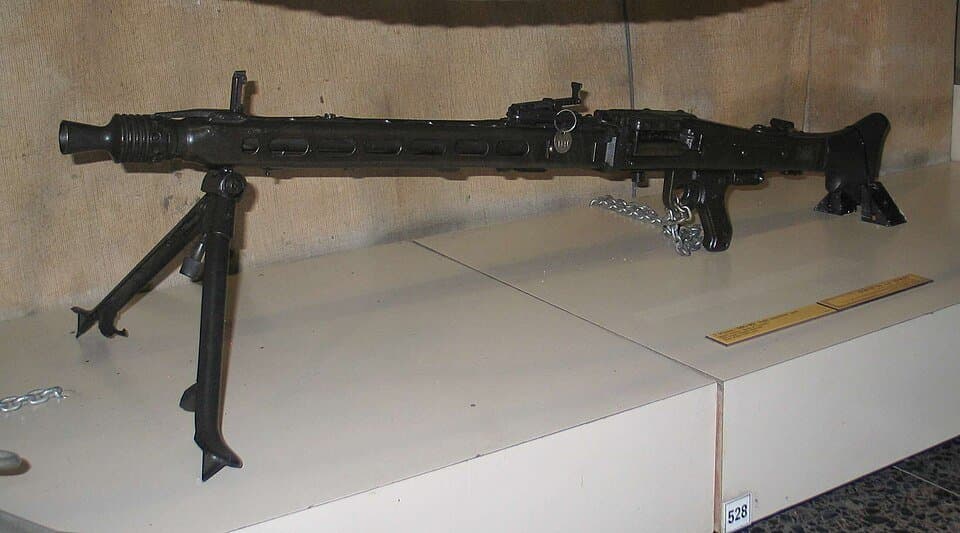
| Source measurement | Designed to use the standard German fully-powered 7.92×57mm Mauser rifle round and to be cheaper and easier to manufacture, the MG 42 proved to be highly reliable and easy to operate. It is most notable for its very high cyclic rate for a gun using full-power service cartridges: it averaged about 1,200 rounds per minute, compared to around 850 for the MG 34, and 450 to 600 for other common machine guns like the M1919 Browning , FM 24/29 , or Bren gun . This made it extremely effective in providing suppressive fire . Its unique sound led to it being nicknamed "Hitler's buzzsaw".[source]MG 42 · Lead; only the objects and conditions stated in this passage The MG 42 was adopted by several armed organizations after the war, and was both copied and built under licence . The MG 42's lineage continued past Nazi Germany's defeat, forming the basis for the nearly identical MG1 (MG 42/59), chambered in 7.62×51mm NATO , which subsequently evolved into the MG1A3, and later the Bundeswehr 's MG 3 , Italian MG 42/59 , and Austrian MG 74 . In Yugoslavia , an unlicensed, near-identical copy was produced as the Zastava M53 .[source]MG 42 · Lead; only the objects and conditions stated in this passage The MG 42 lent many design elements to the Swiss MG 51 and SIG MG 710-3 , French AA-52 , American M60 , the Belgian MAG general-purpose machine guns, and the Spanish 5.56×45mm NATO Ameli light machine gun .[source]MG 42 · Lead; only the objects and conditions stated in this passage Even before World War I , the German military was already looking forward to replacing the heavy machine guns which proved to be such a success in that war. The MG13 was one of the first developments toward a goal of producing a weapon that could perform multiple roles, rather than just one. The MG13 was the result of reengineering the Dreyse Water-cooled machine gun to fit the new requirement. The twin-barreled Gast gun was developed with the goal of providing a high cyclic rate of fire weapon for anti-aircraft use which was reported to have reached cyclic rates of fire as high as 1,600 rounds per minute.[source]MG 42 · History / Before World War I; only the objects and conditions stated in this passage It was developed to use the standard German 7.92×57mm Mauser full-power rifle round.[source]MG 42 · History / 1930s; only the objects and conditions stated in this passage Being made largely out of pressed and stamped appropriately hardened carbon steel metal, only the most important parts were elaborately milled from solid steel, and using spot welding and riveting to connect parts the new design required considerably less machining and fewer high grade steel alloys containing metals that became scarce in Germany during World War II. It was much simpler to build than other machine guns – it took 75 man hours to complete the new gun as opposed to 150 man hours for the MG 34 (a 50% reduction), 27.5 kg (61 lb) of raw materials as opposed to 49 kg (108 lb) for the MG 34 (a 44% reduction) – and cost 250 RM as opposed to 327 RM (a 24% reduction).[source]MG 42 · History / Development of the MG 42; only the objects and conditions stated in this passage In early 1942 the final model of the weapon was officially accepted, and manufacturing of the mass-production model began, as the MG 42 , contracts going to Großfuß , Mauser-Werke , Gustloff-Werke , Steyr and others. The MG 42 was first deployed in May 1942 by the Deutsches Afrikakorps (German Africa Corps expeditionary force in Africa) and introduced by mid-1942 on all fronts. Production during the war amounted to over 400,000 units (17,915 units in 1942, 116,725 in 1943, 211,806 in 1944, and 61,877 in 1945).[source]MG 42 · History / Adoption of the MG 42; only the objects and conditions stated in this passage Operating crews could lay down a barrage of fire, pausing only to reload or to replace the barrel, which could be done in less than 10 seconds. This allowed the MG 42 to tie up larger numbers of enemy troops than was otherwise possible. The Americans and the British trained their troops to take cover from the fire of an MG 42, and assault the position during barrel replacement. The (slower) rapid firing rate used in emergency/final defensive line situations of the MG 42 was up to 500 rounds per minute.[source]MG 42 · Small arms doctrine; only the objects and conditions stated in this passage The Allied nations ' infantry doctrines of World War II based a squad's/rifle section's firepower on the rifleman and a magazine-fed light machine gun (BAR, Bren, DP-27/DPM, FM 24/29) whose cyclic fire rates were typically 450 to 600 rounds per minute. The Allied nations had machine guns with similar rates of fire, but mounted them almost exclusively in aircraft, where the fleeting opportunities for firing made such high rates necessary. Weapons such as the M1919 Browning machine gun and the Vickers K machine gun, were only issued to infantry in specialized circumstances.[source]MG 42 · Small arms doctrine; only the objects and conditions stated in this passage The optimum operating crew of an MG 42 in its medium machine gun role was six men: the squad leader, the machine gunner who carried and fired the gun, the assistant gunner/loader who carried the tripod, and three riflemen who carried 1,800 rounds of ammunition between them, spare barrels, entrenching tools, and other items.[source]MG 42 · Small arms doctrine / Medium machine gun fire support role; only the objects and conditions stated in this passage One of the Einheitsmaschinengewehr (Universal machine gun) roles was to provide low-level anti-aircraft coverage. A high cyclic rate of fire is advantageous for use against targets that are exposed to a general-purpose machine gun for a limited time span, like aircraft or targets that minimize their exposure time by quickly moving from cover to cover. For targets that can be fired on by a general-purpose machine gun for longer periods than just a few seconds, the cyclic firing rate becomes less important. As a consequence, one of the MG 42's most notable features was its high cyclic rate of fire of about 1,200 to 1,500 rounds per minute, twice the rate of the Vickers and Browning machine guns, which fired at a rate of about 600 rounds per minute. The ear could not easily discern the sound of individual shots being fired, hearing a sound described as like "ripping cloth" or a buzzsaw.[source]MG 42 · Operation; only the objects and conditions stated in this passage The German military instructed that sustained fire must be avoided at all costs. They ruled that the results of sustained fire were disappointing and that the expenditure of ammunition involved was "intolerable." In the bipod-mounted light machine gun role, MG 42 users were trained to fire short bursts of 3 to 7 rounds and strive to optimize their aim between bursts fired in succession. According to comparative tests by the US military under battle conditions, 5 to 7 round bursts with 22 bursts in a minute were most effective. For its medium machine gun role, the MG 42 was matched to the newly developed Lafette 42 tripod. In this role, MG 42 users were trained to fire short bursts and bursts of 20 to 50 rounds and strive to optimize their aim between bursts fired in succession. As a consequence of factors like the time spent reloading, aiming, changing hot barrels if necessary to allow for cooling, the MG 42's practical effective rate of fire was 154 rounds per minute, versus 150 rounds per minute for the MG 34, a 2.3% increase.[source]MG 42 · Operation; only the objects and conditions stated in this passage The MG 42 is a 7.92×57mm Mauser , air-cooled, belt fed , open bolt , recoil-operated machine gun with a quick change barrel.[source]MG 42 · Design details; only the objects and conditions stated in this passage Its parts are attached to a 2.5 mm (0.1 in) thick stamped sheet metal housing that functions as the receiver and barrel sleeve.[source]MG 42 · Design details; only the objects and conditions stated in this passage It weighed 11.57 kg in the light machine gun role with the bipod , lighter than the MG 34 and easily portable. The underfolding bipod, the same one used on the MG 34, could be mounted to the front near the muzzle to minimize shot dispersion or the center of the gun near the balance point offering more flexibility depending on how and where it was being used.[source]MG 42 · Design details; only the objects and conditions stated in this passage Upon firing, rearward force from the recoil of the cartridge ignition combined with the additional rearward force generated by the muzzle booster start to move the barrel and bolt assembly rearwards for a total distance of 21 mm (0.8 in).[source]MG 42 · Design details / Operating mechanism; only the objects and conditions stated in this passage These two parts start the unlocking sequence after the barrel and bolt assembly have moved 7 mm (0.3 in) rearwards when the parts have moved far back enough that the rollers start the rest on angled/oblique surfaces and allow the rollers to move inwards, controlled by the wedge-shaped front of the striker sleeve, back to their previous position, unlocking the bolt head and allowing the bolt assembly to further recoil rearwards, extracting the spent cartridge case and ejecting it downwards through an ejection port normally covered by a spring-loaded dust cover at the bottom of the receiver, just in front of the trigger group.[source]MG 42 · Design details / Operating mechanism; only the objects and conditions stated in this passage After investigation using high-speed photography , the rollers in the bolt were found to "bounce" back and forth or oscillate up to 1 mm (0.04 in) when lock up is proceeding and then they settle into full lock up.[source]MG 42 · Design details / Operating mechanism; only the objects and conditions stated in this passage The cyclic firing rate of the MG 42 can be altered by installing different bolts and return springs. A heavier bolt uses more recoil energy to overcome inertia, thus slowing the cyclic rate of the machine gun. Heavy bolts also were used along with stiffer return springs . The standard MG 42 bolt weight for a 1,500 rounds per minute cyclic rate of fire is 505 g (17.81 oz).[source]MG 42 · Design details / Operating mechanism; only the objects and conditions stated in this passage The open-type iron sighting line has a relatively short 430 millimeters (16.9 in) radius and consists of a "∧-type" height adjustable front sight on a folding post and a leaf rear sight with an open V-notch sliding on a ramp, graduated from 200 to 2,000 meters (219 to 2,187 yd) in 100 meters (109 yd) increments.[source]MG 42 · Design details / Sights; only the objects and conditions stated in this passage An active infrared device, intended primarily for night use, and consisting of a specialized mount, active 300 millimeters (11.8 in) infrared spotlight and accompanying infrared image converter was developed that could be used with the MG 42 and MG 34. In the later stages of World War II the bulky Fahr- und Zielgerät FG 1250 (driving and aiming device FG 1250 ) active infrared unit was paired on Sd.Kfz. 251/1 Falke half-track armored personnel carriers to some MG 42 and MG 34 machine guns.[source]MG 42 · Design details / Sights; only the objects and conditions stated in this passage According to Infantry Journal in 1947, the operating momentum driven MG 42 feed system will not function reliably under a cyclic firing rate of 850 rounds per minute.[source]MG 42 · Design details / Feeding; only the objects and conditions stated in this passage During World War II the Gurt 34/41 -belt family was introduced. Gurt 34/41 belt links and wire spirals were made of thinner material — the Gurt 34 links were made of 0.7 mm (0.028 in) and Gurt 34/41 links of 0.5 mm (0.020 in) thick stamped steel sheet metal — that saved ⅓ of metal and counterintuitively yielded improved performance. Belts were supplied in a fixed length of 50 rounds, but could be linked up to make longer belts for sustained firing. Ammunition boxes contained 250 rounds in five 50-round belts. A 250-round Patronengurt 33 belt was also issued to machine guns installed in fixed emplacements such as bunkers. Patronenkasten 34 and Patronenkasten 41 ammunition boxes could hold up to 300 belted rounds and were used in more static non-highly mobile situations. The Patronenkasten could contain an Einführstück belt starter-segment.[source]MG 42 · Design details / Feeding; only the objects and conditions stated in this passage The 530 millimeters (20.9 in) long barrel and its prong type barrel extension used for lock up, made up the barrel unit of the MG 42. It could be quickly changed by the machine gun crew and weighed 1.75 kg (3.9 lb) including the locking piece. The barrels could have traditional rifling or polygonal rifling . Polygonal rifling was an outgrowth of a cold-hammer forging process developed by German engineers before World War II. The process addressed the need to produce more durable machine gun barrels in less time than those produced with traditional methods. Later produced barrel bores featured hard-chrome plating to make them more durable. The different versions meant that the service life of an MG 42 barrel varied between 3,500 and 8,000 rounds assuming the barrel was used according to the regulations, which prohibited rapid fire beyond 150 rounds. Excessive overheating caused by rapid firing about 500 rounds through a barrel resulted in unacceptable wear of the bore rendering the barrel useless.[source]MG 42 · Design details / Barrel; only the objects and conditions stated in this passage Fitting such an optical sight enabled the machine gun to deliver direct fire out to 3,000 m (3,281 yd).[source]MG 42 · Design details / Lafette 42 tripod; only the objects and conditions stated in this passage The Lafette 42 weighed 20.5 kg (45.2 lb) on its own and was a simplified version of the Lafette 34 used for the MG 34, as the MG 42 could be operated more easily from a Lafette and featured no semi-automatic firing mode.[source]MG 42 · Design details / Lafette 42 tripod; only the objects and conditions stated in this passage Mounted to the Lafette and aimed through the MG Z 34 or MG Z 40 telescopic sight, the effective range of the MG 42 could be extended out to 3,500 m (3,828 yd) when fired indirectly.[source]MG 42 · Design details / Lafette 42 tripod; only the objects and conditions stated in this passage Patrone useful maximum range, that is defined by the maximum range of a small-arms projectile while still maintaining the minimum kinetic energy required to put unprotected personnel out of action, which is generally believed to be 15 kilogram-meters (147 J / 108 ft⋅lbf).[source]MG 42 · Design details / Lafette 42 tripod; only the objects and conditions stated in this passage E.g., being unsure whether the real distance was 2,000 or 2,300 m (2,187 or 2,515 yd), the gunner could make the mount do an automatic sweep between the elevations for 1,900 to 2,400 m (2,078 to 2,625 yd) and back.[source]MG 42 · Design details / Lafette 42 tripod; only the objects and conditions stated in this passage In the later stages of World War II ballistic correction directions were added for overshooting friendly forces with S.m.E. - Spitzgeschoß mit Eisenkern (spitzer with iron core) ammunition of which the external ballistic behaviour started to significantly deviate from 1,500 m (1,640 yd) upwards compared to the s.S.[source]MG 42 · Design details / Lafette 42 tripod; only the objects and conditions stated in this passage In 1944, the material shortages in Nazi Germany led to the development of a newer version, the MG 45 (or MG 42V ), which had a different operating mechanism that used roller-delayed blowback as opposed to roller locking. For this reason, the MG 45 is considered a different type of firearm, as the mechanisms of these two guns are different. It used steel of lesser quality, which reduced weight to 9 kilograms (20 lb), while retaining the horizontal cocking handle. First tests were undertaken in June 1944, but development dragged on and eventually only ten were built. The tested MG 45 fired 120,000 rounds in succession at a cyclic rate of fire around 1,350 to 1,800 rounds per minute.[source]MG 42 · Variants and developments / MG 45; only the objects and conditions stated in this passage Saginaw Steering Gear Division of General Motors received a contract to construct two working converted MG 42 prototypes designated as the T24 machine gun. It could also be used on an M2 Tripod . The gun was made as an almost exact copy of the MG 42 which was chambered in 7.92×57mm Mauser. Some engineering changes were to use a barrel chambered for the .30-06 Springfield service round and an extremely increased weight 47 oz (1,332 g) bolt and stiffer return spring in an effort to reduce the cyclic rate consistent with US rate requirements. Saginaw Steering Gear did not adjust the prototypes for the 6.35 mm (0.25 in) longer .30-06 Springfield (7.62×63mm) cartridge case.[source]MG 42 · Variants and developments / T24 machine gun; only the objects and conditions stated in this passage When one of the two T24 machine gun prototypes was fired at Aberdeen Proving Ground , it fired only one shot and failed to eject the cartridge. A second attempt had the same result. The other prototype was plagued with excessive ejection failures and to a lesser extent failures to feed. The average cyclic rate of fire of the tested weapon was 614 rounds per minute. From January to February 1944, testing at Aberdeen Proving Ground were unsatisfactory. Firings were discontinued in February 1944 after 51 malfunctions and firing a total of 1,583 rounds by authorization of Major C. Balleisen, O.C.O. In March 1944 the US military concluded that functioning of the T24 machine gun prototype was unsatisfactory and recommended that further development was required before this weapon be subjected to the lengthy and severe standard light machine gun test.[source]MG 42 · Variants and developments / T24 machine gun; only the objects and conditions stated in this passage The Swiss MG 51 or 7.5 mm Maschinengewehr 1951 was based on the design of the MG 42 chambered for 7.5×55mm Swiss GP 11 . The final design, which appeared in 1950, was in most respects still similar to the MG 42, although many components were produced by machining instead of stamping, which increased the weight, the stability and the production costs of the machine gun. To prevent short shots Waffenfabrik Bern changed the locking system from roller to flapper locking . These locking methods are similar in concept. The resulting weapon had a cyclic rate of fire of 1,000 rounds per minute, was in the light machine gun role 4.4 kg (9.70 lb) heavier than the German MG 42, and much more finely made and finished.[source]MG 42 · Variants and developments / MG 51; only the objects and conditions stated in this passage In Yugoslavia , this MG 42 variant was built by the state-owned arms manufacturer Crvena Zastava as the Zastava M53 using original German machinery and retaining the 7.92×57mm Mauser chambering. By doing so, the Yugoslavs retained the original weapon's design features, making the M53 a near exact copy of the German MG 42. The only major differences were a slower 950 rounds per minute cyclic rate of fire and no anti-aircraft sight mount. The aiming range of the M53 is 2,000 m (2,187 yd), and the terminal range of the bullet is 5,000 m (5,468 yd), the same as the MG 42. The MG 42s captured in Yugoslavia at the end of World War II were put into reserve of Yugoslav People's Army as M53/42s . The last military use of M53s in Yugoslavia was in 1999. Some quantities of M53s were exported to Iraq in the 1980s and saw extensive action during both Gulf wars . The M53 was known under the nicknames Шарац ( Šarac ) and Garonja.[source]MG 42 · Variants and developments / M53; only the objects and conditions stated in this passage At the end of World War II the original technical drawings and data for the MG 42 were captured by the Soviets. These would eventually find their way to Czechoslovakia and Yugoslavia. This forced Rheinmetall to reverse engineer the MG 42 for the development of the MG 3 (originally the MG 1 launched in 1958), which uses the MG 42 design but was rechambered to 7.62×51mm NATO . It remained a primary general-purpose machine gun of the modern German armed forces ( Bundeswehr ) until it was replaced by the Heckler & Koch MG5 during the 2020s. The MG 3 has been used by more than 40 countries around the world, and it remains in widespread service today.[source]MG 42 · Variants and developments / MG 3; only the objects and conditions stated in this passage The MG 3 and its preceding variants all share a high level of parts interchangeability with the original MG 42. Like the MG 42, the MG 3 cyclic rates of fire can be altered by exchanging the standard weight (about 650 g (22.93 oz)) bolt used for the standard 1,100–1,300 rounds per minute rate of fire for an extra weight (about 900 g (31.75 oz)) bolt for a reduced 800–950 rounds per minute rate of fire. Those bolts also are used along with different recoil springs.[source]MG 42 · Variants and developments / MG 3; only the objects and conditions stated in this passage The Italian MG 42/59 licensed MG 3 variant produced by Beretta, Whitehead Motofides and Franchi since 1959, features an extremely heavy 1,200 g (42.33 oz) bolt which reduces the cyclic rate of fire to around 800 rounds per minute.[source]MG 42 · Variants and developments / MG 3; only the objects and conditions stated in this passage After its founding in 1955, the Austrian army was temporarily equipped with old guns out of U.S. stocks. Starting in 1959 these Browning M1919s were largely replaced by the MG 42 with modified barrel and bolt for the new 7.62×51mm NATO. To introduce a modern weapon of its own production the Office of Defence Technology, in cooperation with Steyr Mannlicher and Beretta developed a gun specifically for the Austrian Army. The German MG 42/59 that was introduced in 1959 with the Bundeswehr to replace the U.S. machine guns, served as the basis, which was similar to the Austrian 7.62 mm MG 42. Targets were to reduce, among other things, the cyclic rate of fire and weight and have more versatile sights and mount. The development of the weapon was completed in 1974. It replaced from this year the MG 42 as the MG 74 of the Austrian Federal Army.[source]MG 42 · Variants and developments / MG 74; only the objects and conditions stated in this passage The modifications to the basic MG 42 design include an extra heavy bolt (950 g (33.51 oz) vs. the 675 g (23.81 oz) MG 3 bolt) which reduces the cyclic rate of fire to around 850 rounds per minute. The rate of fire can be varied up to cyclic rate of fire of around 1,150 rounds per minute, if necessary, by changing the bolt and return spring. In addition, a select fire trigger group was added to allow semi-automatic fire (single shot) compared to the traditional fully automatic only fire capability of the original MG 42 design. The MG 74 also has a modern polymer stock and handgrips (usually colored green) to save weight, adjustable rear sight (35° horizontal, vertical 15°) and additional anti-aircraft sight or (low light) optical sights can be mounted optional.[source]MG 42 · Variants and developments / MG 74; only the objects and conditions stated in this passage The Swiss SIG MG 710-3 general-purpose machine gun was based on the design of the MG 45 using a slight modification of the roller-delayed action and chambered for 7.62×51mm NATO. Its cyclic rate of fire is 900 rounds per minute. The first version looks very much like the MG 42.[source]MG 42 · Variants and developments / SIG MG710; only the objects and conditions stated in this passage | — |
|---|
| Barrel type | — | Fully rifled[source]Remington 870 · FieldMaster Deer Vent Rib, Rem Choke[source]Remington 870 · 410 Turkey TSS Vent Rib, Rem Choke[source]Remington 870 · Turkey Camo Fully rifled extra heavy (fluted)[source]Remington 870 · SPS Superslug Vent rib Rem Choke and fully rifled[source]Remington 870 · Fieldmaster Vent rib Rem Choke and fully rifled[source]Remington 870 · Fieldmaster Synthetic Cylinder choke[source]Remington 870 · Special Purpose Marine Magnum Rem Choke[source]Remington 870 · SPS Super Mag Turkey Predator Vent rib, Rem Choke[source]Remington 870 · Super Magnum Flyaway Vent rib, Rem Choke[source]Remington 870 · Super Magnum Turkey/Waterfowl Camo Vent Rib, Rem Choke[source]Remington 870 · Wingmaster Fully rifled[source]Remington 870 · Fieldmaster Fully Rifled Cantilever |
|---|
| Reported operators |
| — |
|---|
20 in (510 mm)[source]Remington 870 · SPS Super Mag Turkey Predator
28 in (710 mm)[source]Remington 870 · Super Magnum Flyaway
26 in (660 mm)[source]Remington 870 · Super Magnum Turkey/Waterfowl Camo
25–28 in (640–710 mm)[source]Remington 870 · Wingmaster
20 in (510 mm)[source]Remington 870 · Fieldmaster Fully Rifled Cantilever