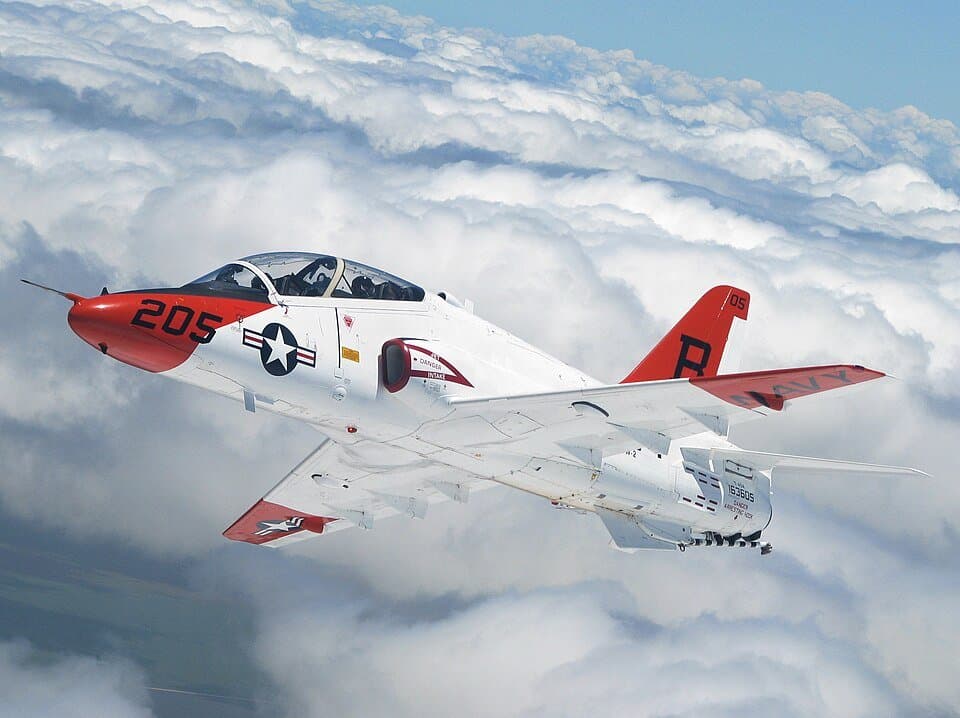


Credit
Lt. j.g. John A. Ivancic · Public domain · Resized · Public domain · Source ↗ · Modified


Preparing your view.
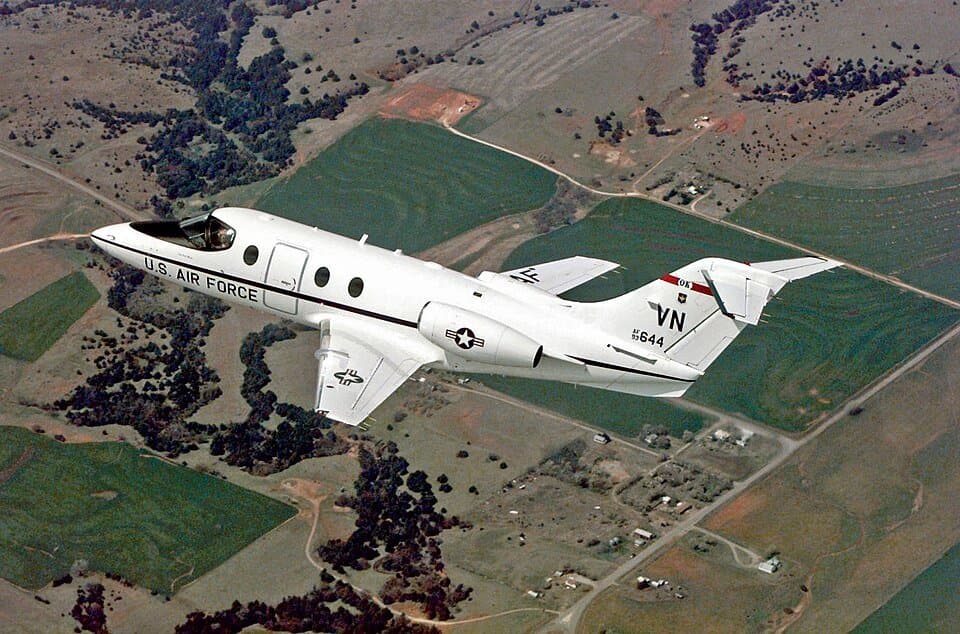
At a glance
True scale
Side by side. From every angle. A human reference for perspective.
3.19 MB · Loads when you open it| Model | Length | Width / span | Height |
|---|---|---|---|
| McDonnell Douglas T-45 Goshawk | ≈ 11.99 m | ≈ 9.39 m (Wingspan) | ≈ 4.11 m |
| Raytheon T-1 Jayhawk | ≈ 14.76 m | ≈ 13.26 m (Wingspan) | ≈ 4.24 m |
Scaled uniformly to the sourced length of 11.99 m. The shape was turned square to the axes; the height was fitted to the sourced 4.11 m; the width was fitted to the sourced 9.3917 m wingspan. Not an official model or a measured survey.
ForceTally · All rights reserved
Scaled uniformly to the sourced length of 14.76 m. The shape was turned square to the axes; the height was fitted to the sourced 4.24 m; the width was fitted to the sourced 13.26 m wingspan. Not an official model or a measured survey.
ForceTally · All rights reserved
The human reference is a generic 1.75 m figure. Models describe external size, not combat performance.
Measured figures
T-45A · Length
Single source39 ft 4 in (11.99 m)[source]
Configuration
| Specification | McDonnell Douglas T-45 Goshawk | Raytheon T-1 Jayhawk |
|---|---|---|
| Type | Naval trainer aircraft[source] | Trainer aircraft[source] |
| National origin | United Kingdom/United States[source] | — |
| Manufacturer | McDonnell Douglas / British Aerospace Boeing / BAE Systems[source] | Raytheon Hawker Beechcraft[source] |
| Status | In service[source] | Active service[source] |
T-1A · Length
48 ft 5 in (14.76 m)[source]
Empty; T-45A · Empty weight
Single sourceGross; T-45A · Gross weight
Single sourceMaximum take-off; T-45A · Max takeoff weight
Single source9,394 lb (4,261 kg)[source]
12,750 lb (5,783 kg)[source]
13,500 lb (6,123 kg)[source]
Empty; T-1A · Empty weight
Single sourceMaximum take-off; T-1A · Max takeoff weight
Single sourceMaximum; T-45A · at 8,000 ft (2,400 m)
Single source543 kn (625 mph, 1,006 km/h) at 8,000 ft (2,400 m)[source]
T-45A · 1 × Rolls-Royce Turbomeca F405-RR-401 turbofan engine thrust de-rated (nominal thrust
Single sourceT-45A · 25,999.86 N
Single source1 × Rolls-Royce Turbomeca F405-RR-401 turbofan engine, 5,527 lbf (24.59 kN) thrust de-rated (nominal thrust 5,845 lbf (25,999.86 N))[source]
T-1A · 2 × Pratt & Whitney Canada JT15D -5B turbofan thrust each
Single source2 × Pratt & Whitney Canada JT15D -5B turbofan , 2,900 lbf (13 kN) thrust each[source]
T-45A · 8,000 ft/min ( ) at sea level
Single source8,000 ft/min (41 m/s) at sea level[source]
Bars compare reported quantities only. A larger figure does not make a system better; configurations and test conditions differ.
| Primary user | United States Navy[source] | — |
|---|
| Number built | 221[source] | 180[source] |
|---|
| Manufactured | 1988–2009[source] | 1992–1997[source] |
|---|
| Introduction date | 1991[source] | 17 January 1992[source] |
|---|
| First flight | 16 April 1988[source] | 5 July 1991[source] |
|---|
| Developed from | BAE Systems Hawk[source] | Beechjet/Hawker 400A[source] |
|---|
| Fuel capacity | 432 US gal (360 imp gal; 1,640 L) / 3,159 lb (1,433 kg) internal fuel (2,893 lb (1,312 kg) - early production aircraft), with provision for 2 × 156 US gal (130 imp gal; 590 L) drop tanks underwing[source] | — |
|---|
| Airfoil | root: Hawker 10.9%; tip: Hawker 9%[source] | Mitsubishi MAC510[source] |
|---|
| Carrier launch speed | 121 kn (139 mph; 224 km/h)[source] | — |
|---|
| Approach speed | 125 kn (144 mph; 232 km/h)[source] | — |
|---|
| Never exceed speed | 575 kn (662 mph, 1,065 km/h) / M1.04 design dive limit at 10,000 ft (3,000 m)[source] | — |
|---|
| g limits | + 7.33 - 3[source] | — |
|---|
| Time to altitude | 30,000 ft (9,100 m) in 7 minutes 40 seconds[source] | — |
|---|
| Wing loading | 67.1 lb/sq ft (328 kg/m 2 )[source] | — |
|---|
| Thrust/weight | 0.41[source] | — |
|---|
| Take-off distance to 50 ft (15 m) | 3,610 ft (1,100 m)[source] | — |
|---|
| Landing distance from 50 ft (15 m) | 3,310 ft (1,010 m)[source] | — |
|---|
| Hardpoints | Usually none: One hardpoint under each wing can be used to carry practice bomb racks (can carry up to 12 Mk-76 practice bombs), rocket pods, or fuel tanks. A centerline hardpoint can carry a cargo pod for crew baggage.[source] | — |
|---|
| Primary users | — | United States Air Force Japan Air Self-Defense Force[source] |
|---|
| Capacity | — | 4 passengers[source] |
|---|
| Aspect ratio | — | 7.5:1[source] |
|---|
| Stall speed | — | 93 kn (107 mph, 172 km/h) CAS[source] |
|---|
| Country of origin | — | Vereinigte Staaten[source]Country of design · Entwurfsland |
|---|