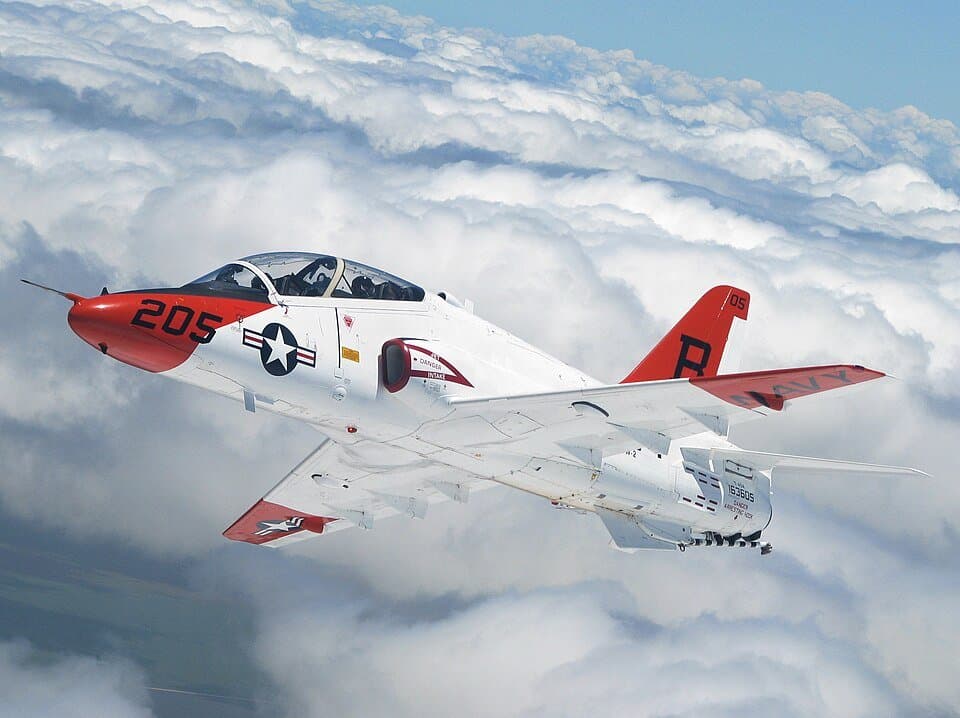


Credit
Lt. j.g. John A. Ivancic · Public domain · Resized · Public domain · Source ↗ · Modified


Preparing your view.

At a glance
True scale
Side by side. From every angle. A human reference for perspective.
3.16 MB · Loads when you open it| Model | Length | Width / span | Height |
|---|---|---|---|
| McDonnell Douglas T-45 Goshawk | ≈ 11.99 m | ≈ 9.39 m (Wingspan) | ≈ 4.11 m |
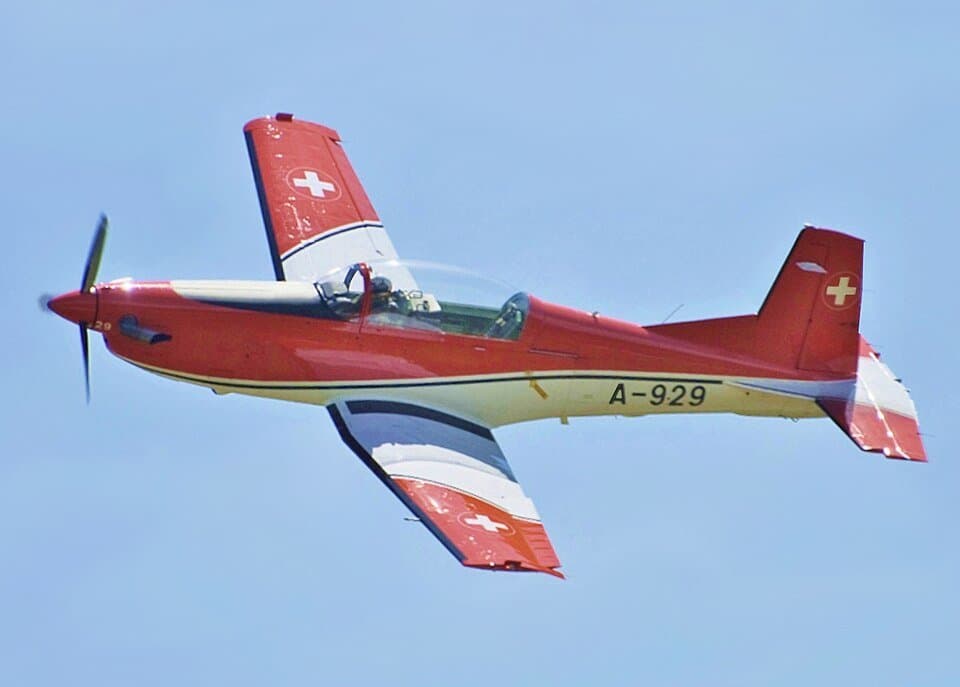
| Pilatus PC-7 | ≈ 9.78 m | ≈ 10.4 m (Wingspan) | ≈ 3.48 m |
Scaled uniformly to the sourced length of 11.99 m. The shape was turned square to the axes; the height was fitted to the sourced 4.11 m; the width was fitted to the sourced 9.3917 m wingspan. Not an official model or a measured survey.
ForceTally · All rights reserved
Scaled uniformly to the sourced length of 9.78 m. The width was fitted to the sourced 10.4 m wingspan. Not an official model or a measured survey.
ForceTally · All rights reserved
The human reference is a generic 1.75 m figure. Models describe external size, not combat performance.
Measured figures
T-45A · Length
Single source39 ft 4 in (11.99 m)[source]
Configuration
| Specification | McDonnell Douglas T-45 Goshawk | Pilatus PC-7 |
|---|---|---|
| Type | Naval trainer aircraft[source] | Trainer aircraft[source] |
| National origin | United Kingdom/United States[source] | — |
| Manufacturer | McDonnell Douglas / British Aerospace Boeing / BAE Systems[source] | Pilatus Aircraft[source] |
| Status | In service[source] | In service[source] |
PC-7 · Length
9.78 m (32 ft 1 in)[source]
Empty; T-45A · Empty weight
Single sourceGross; T-45A · Gross weight
Single sourceMaximum take-off; T-45A · Max takeoff weight
Single source9,394 lb (4,261 kg)[source]
12,750 lb (5,783 kg)[source]
13,500 lb (6,123 kg)[source]
Empty; PC-7 · Empty weight
Single sourceMaximum take-off; PC-7 · Max takeoff weight
Single sourceMaximum; T-45A · at 8,000 ft (2,400 m)
Single source543 kn (625 mph, 1,006 km/h) at 8,000 ft (2,400 m)[source]
Ferry; T-45A · Ferry range
Single sourceT-45A · Range
Single source700 nmi (810 mi, 1,300 km)[source]
700 nmi (810 mi, 1,300 km)[source]
Ferry; PC-7 · Ferry range
Single sourcePC-7 · standard range without external drop tanks, ferry range with external drop tanks, (cruise power, at 5,000 m (16,000 ft) - 20 min reserves)
Single sourcePC-7 · 1 × Pratt & Whitney Canada PT6A -25A turboprop derated from
Single sourcePC-7 · 650 shp
Single source1 × Pratt & Whitney Canada PT6A -25A turboprop , 410 kW (550 hp)(derated from 485 kW (650 shp))[source]
T-45A · 1 × Rolls-Royce Turbomeca F405-RR-401 turbofan engine thrust de-rated (nominal thrust
Single sourceT-45A · 25,999.86 N
Single source1 × Rolls-Royce Turbomeca F405-RR-401 turbofan engine, 5,527 lbf (24.59 kN) thrust de-rated (nominal thrust 5,845 lbf (25,999.86 N))[source]
T-45A · 8,000 ft/min ( ) at sea level
Single source8,000 ft/min (41 m/s) at sea level[source]
PC-7 · (2,150 ft/min) climb to 5,000 m in 9 min 0 sec take-off run 780 m at max take-off weight, landing run 505 m at max landing weight
Single source10.9 m/s (2,150 ft/min) climb to 5,000 m in 9 min 0 sec take-off run 780 m at max take-off weight, landing run 505 m at max landing weight[source]
PC-7 · Endurance
Single source4 hr 22 min[source]
Bars compare reported quantities only. A larger figure does not make a system better; configurations and test conditions differ.
| Primary user | United States Navy[source] | — |
|---|
| Number built | 221[source] | >618[source] |
|---|
| Manufactured | 1988–2009[source] | 1966–present[source] |
|---|
| Introduction date | 1991[source] | PC-7 : 1978 PC-7 Mk.II M : 1994 PC-7 MKX : 2021[source] |
|---|
| First flight | 16 April 1988[source] | PC-7 : 12 April 1966 ( 1966-04-12 ) (prototype) 18 August 1978 ( 1978-08-18 ) (production) PC-7 Mk.II M : 28 September 1992 ( 1992-09-28 )[source] |
|---|
| Developed from | BAE Systems Hawk[source] | Pilatus P-3[source] |
|---|
| Fuel capacity | 432 US gal (360 imp gal; 1,640 L) / 3,159 lb (1,433 kg) internal fuel (2,893 lb (1,312 kg) - early production aircraft), with provision for 2 × 156 US gal (130 imp gal; 590 L) drop tanks underwing[source] | 474 L (104 imp gal; 125 US gal) usable internal fuel, 2x 240 L (53 imp gal; 63 US gal) external fuel drop tanks • Max landing weight: 2,565 kg[source] |
|---|
| Airfoil | root: Hawker 10.9%; tip: Hawker 9%[source] | NACA 64 2 A-415 at root, 64 1 A-612 at tip[source] |
|---|
| Carrier launch speed | 121 kn (139 mph; 224 km/h)[source] | — |
|---|
| Approach speed | 125 kn (144 mph; 232 km/h)[source] | — |
|---|
| Never exceed speed | 575 kn (662 mph, 1,065 km/h) / M1.04 design dive limit at 10,000 ft (3,000 m)[source] | 500 km/h (310 mph, 270 kn) EAS[source] |
|---|
| g limits | + 7.33 - 3[source] | -3 / +6[source] |
|---|
| Time to altitude | 30,000 ft (9,100 m) in 7 minutes 40 seconds[source] | — |
|---|
| Wing loading | 67.1 lb/sq ft (328 kg/m 2 )[source] | — |
|---|
| Thrust/weight | 0.41[source] | — |
|---|
| Take-off distance to 50 ft (15 m) | 3,610 ft (1,100 m)[source] | — |
|---|
| Landing distance from 50 ft (15 m) | 3,310 ft (1,010 m)[source] | — |
|---|
| Hardpoints | Usually none: One hardpoint under each wing can be used to carry practice bomb racks (can carry up to 12 Mk-76 practice bombs), rocket pods, or fuel tanks. A centerline hardpoint can carry a cargo pod for crew baggage.[source] | 6 × underwing hardpoints for bombs and rockets with a capacity of 1,040 kg (2,294 lb)[source] |
|---|
| Primary users | — | Mexican Air Force Indian Air Force South African Air Force Royal Malaysian Air Force[source] |
|---|
| Developed into | — | Pilatus PC-9[source] |
|---|
| Capacity | — | two[source] |
|---|
| Aspect ratio | — | 6.5:1[source] |
|---|
| Propellers | — | 3-bladed Hartzell HC-B3TN-2 / T10173C-8 constant-speed propeller , 2.36 m (7 ft 9 in) diameter[source] |
|---|
| Stall speed | — | 119 km/h (74 mph, 64 kn) (flaps and gear down, power off)[source] |
|---|
| Alternative designation | — | Pilatus PC-7 Turbo Trainer[source] |
|---|
| Country of origin | — | Switzerland[source] |
|---|