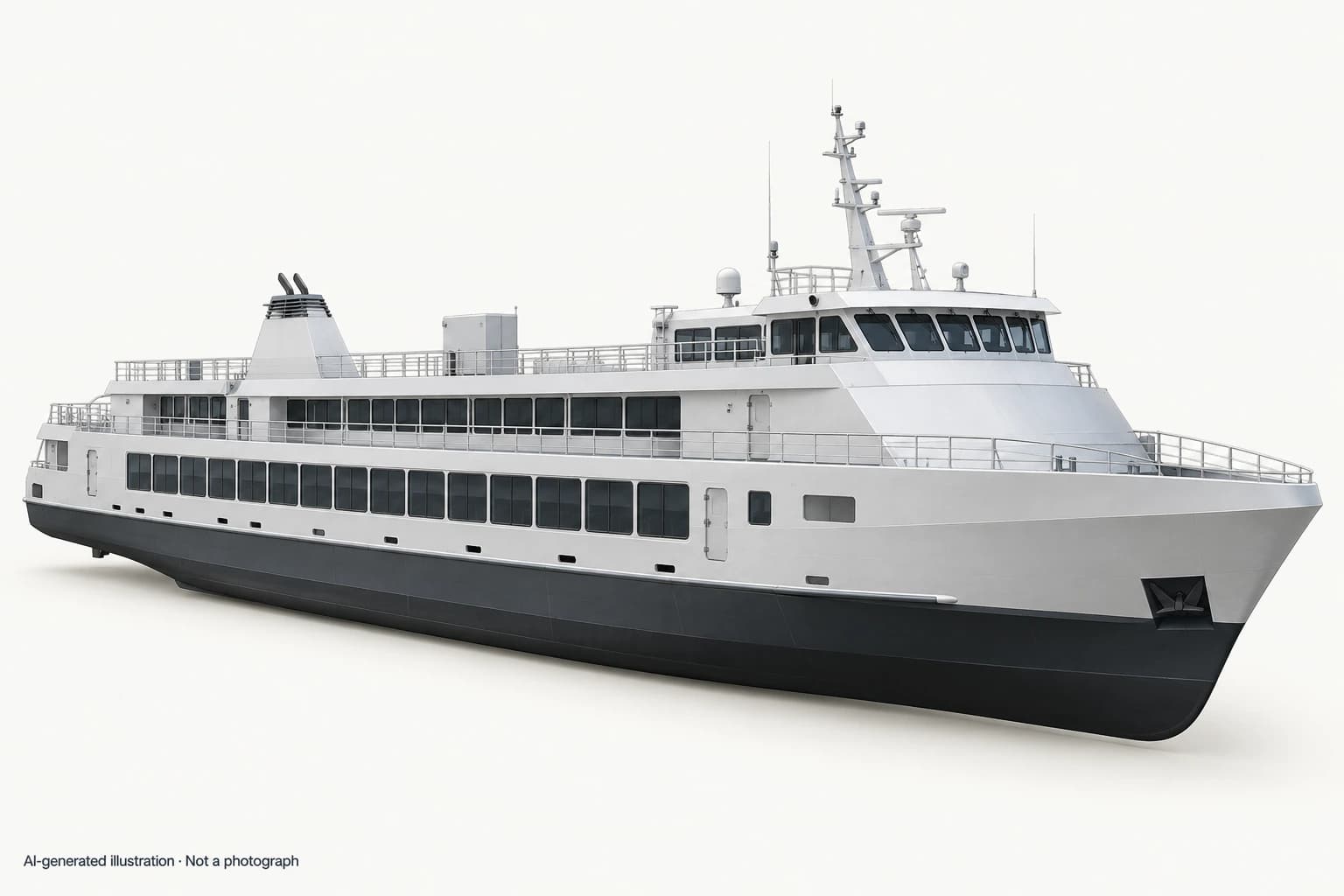

AI-generated illustration · Not a photograph
Credit
ForceTally · AI-generated illustration · Not a photograph · AI-generated · OpenAI output terms · Source ↗ · Modified


Preparing your view.
At a glance
Measured figures
Length
Single source62.1 m (203 ft 9 in)[source]
Length · source measurement 1
Single sourceConfiguration
| Specification | Manoram-class ferry | Sea-class workboat |
|---|---|---|
| Power | 1,044 kW (1,400 hp) Cummings India Ltd 2 x 150 kW (200 hp) 415 V 50 Hz AC generator[source] | — |
| Name | Manoram class[source] | Sea class[source] |
| Operators | Indian Navy[source] | Royal Navy[source] |
| Planned | — | |
| Completed |
Length · source measurement 2
Single sourceLength · source measurement 3
Single sourceLength · source measurement 4
Single source11 m (36 ft 1 in) 13.8 m (45 ft 3 in) 15 m (49 ft 3 in) 18 m (59 ft 1 in)[source]
berths (11 m variants), 4 berths (13.8 & 15 m variants), up to 9 crew (HMS Magpie ); up to 36 passengers (13.8 m variant); up to 12 cadets (15 m officer training variants)
Single source2 berths (11 m variants), 4 berths (13.8 & 15 m variants), up to 9 crew (HMS Magpie ); up to 36 passengers (13.8 m variant); up to 12 cadets (15 m officer training variants)[source]
Bars compare reported quantities only. A larger figure does not make a system better; configurations and test conditions differ.
35 + 7 (Arcims-class) minehunting variants[source] |
| Active | 35 + 7[source] |
|---|
| Type | Ferry[source] | Workboat/training/diver support/survey/minehunting vessels[source] |
|---|
| Capacity | 250 passengers[source] | — |
|---|
| Source manufacturer statement | The Manoram -class ferry are series of watercraft built by Inland Marine Works Pvt Ltd Port Blair , at its Chanch Shipyard, Gujarat for Indian Navy .[source]Only the subject, component or variant named in this passage; unresolved names do not create a manufacturer identity | — |
|---|
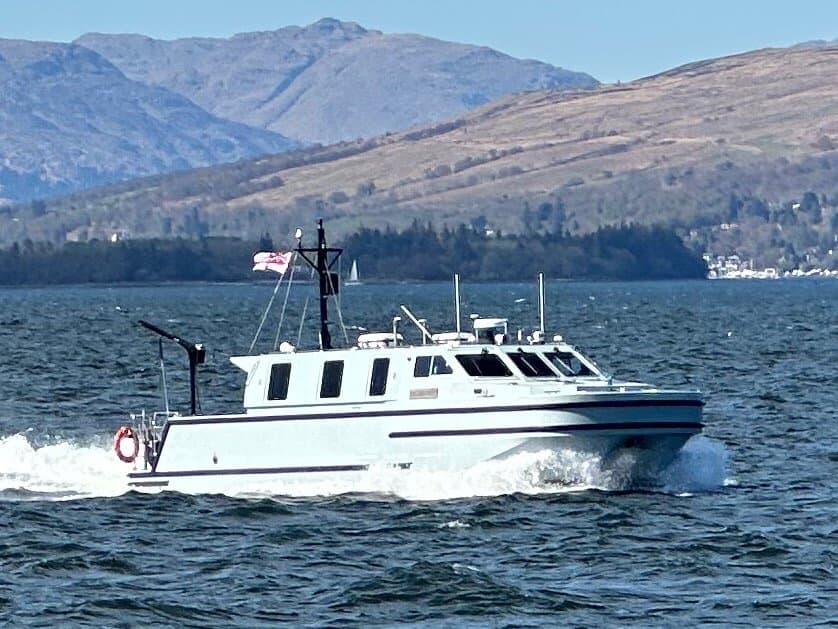
| Source measurement | The Manoram -class ferry are series of watercraft built by Inland Marine Works Pvt Ltd Port Blair , at its Chanch Shipyard, Gujarat for Indian Navy . They are fully air-conditioned craft and are fitted with modern navigational aids and can ferry 250 passengers.[source]Manoram-class ferry · Lead; only the objects and conditions stated in this passage | A procurement contract for £48M was awarded to Atlas Elektronik UK (AEUK) in September 2017 for the delivery of up to 38 vessels under the programme. Thirty-five vessels were ultimately built, with deliveries beginning in 2018 and completing in 2024. Only HMS Magpie (the largest boat in the series) is formally a commissioned warship of the Navy. The remaining boats are not technically commissioned warships.[source]Sea-class workboat · Lead; only the objects and conditions stated in this passage Remote controlled minesweeping was not a new idea; in 2003 during Operation Telic in Iraq . Atlas Elektronik UK Ltd developed their ARCIMS (Atlas Remote Capability Integrated Mission Suite) mission system which has several coil auxiliary boats (CABs), to emit signals detonating mines, towed behind an autonomous unmanned surface vessel (USV). The system was demonstrated successfully at DSEI 2013, using a purpose built 11 metre USV (which was later named Hussar ) and two systems were exported to an overseas navy. In May 2015 Atlas were awarded a £13 million MOD contract to supply this autonomous minesweeping capability, including four USVs, to the Royal Navy, in partnership with Babcock, to be integrated by BAE SYSTEMS with their NAUTIS command system.[source]Sea-class workboat · Development; only the objects and conditions stated in this passage The navy planned Project Vahana to replace small vessels with a unified system, and in September 2017 announced that Atlas Elektronik UK (AEUK) had won this £48M contract for up to 38 SEA class vessels, fully fitted out with a standard hull form (derived from the ARCIMS design) in 11m, 13m, and 15m lengths, and mission equipment modu[es, which can be interchanged. In addition, the 18m launch HMS Magpie was built by another shipyard to a proven design, then fitted out by Atlas with survey modules. Atlas Elektronik delivered the ARCIMS system together with the first tested autonomous vessel, RNMB Hussar , and a manned version named RNMB Hazard . After successful trials off Dorset, they were handed over to the Royal Navy at the start of May 2018, as was HMS Magpie .[source]Sea-class workboat · Development; only the objects and conditions stated in this passage 10 × 11 m standard workboats for transport and logistics tasks;[source]Sea-class workboat · Vessel types and roles; only the objects and conditions stated in this passage 3 × 11 m small survey modules assigned to the Hydrographic Exploitation Group based out of HMNB Devonport;[source]Sea-class workboat · Vessel types and roles; only the objects and conditions stated in this passage 3 × 13.8 m passenger transfer modules (assigned to HMS Prince of Wales);[source]Sea-class workboat · Vessel types and roles; only the objects and conditions stated in this passage 18 × 15 m workboats for officer training, diver training/support and survey/hydrography duties; and,[source]Sea-class workboat · Vessel types and roles; only the objects and conditions stated in this passage 1 × 18 m inshore survey unit (HMS Magpie ).[source]Sea-class workboat · Vessel types and roles; only the objects and conditions stated in this passage Eight 15-metre officer training vessels are assigned to the Britannia Royal Naval College , while the six 15-metre diver training and support vessels are assigned to HMNB Portsmouth (three units), HMNB Devonport , HMNB Clyde and to the Royal Navy's Gibraltar Squadron (one unit each). Three of the 15-metre vessels are configured for survey/hydrographic work, with one of the vessels ( Salamander ) being based with the Hydrographic Exploitation Group in HMNB Devonport.[source]Sea-class workboat · Vessel types and roles; only the objects and conditions stated in this passage Six 11-metre variants of the type (RNMBs Hussar , Hazard , Halcyon , Harrier , Hellcat and Hydra ) were acquired by the Royal Navy and assigned to the Mine Threat and Exploitation Group at HMNB Clyde.[source]Sea-class workboat · Vessel types and roles / Autonomous minehunting/sweeping; only the objects and conditions stated in this passage The 11 m boats can be transported on either the RAF's A400M or C-17 transport aircraft .[source]Sea-class workboat · Vessel types and roles / Autonomous minehunting/sweeping; only the objects and conditions stated in this passage An additional 15-metre minehunting variant (RNMB Hebe ) was also procured and similarly assigned to the Clyde naval base. The greater size of Hebe permits her to accommodate a Portable Operations Centre Afloat that allows her to control her sister vessels while also coordinating autonomous operations.[source]Sea-class workboat · Vessel types and roles / Autonomous minehunting/sweeping; only the objects and conditions stated in this passage |
|---|
| Country of origin | India[source] India[source] India[source]Inventory Origin column; table 17, row 3, cell 6; revision 1376895978; retrieved 2026-10-02 | — |
|---|
| Built | — | 2017–2024[source] |
|---|
| In service | — | 2018–present[source] |
|---|
| Propulsion | — | Yanmar diesels; twin waterjets[source] |
|---|
| Boats & landing craft carried | — | Remus UUV (11, 15 & 18 m survey modules); SeaCat UUVs (Arcims-class variants)[source] |
|---|