
Credit
Articseahorse · CC BY-SA 4.0 · Resized · CC BY-SA 4.0 · Source ↗ · Modified


Preparing your view.

At a glance
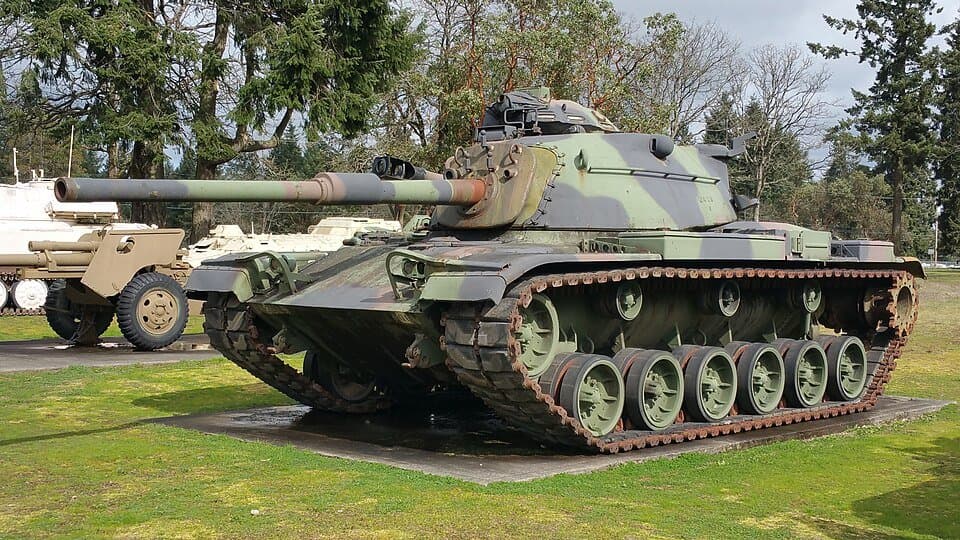
M60 tanklarger figure on 3 of 4
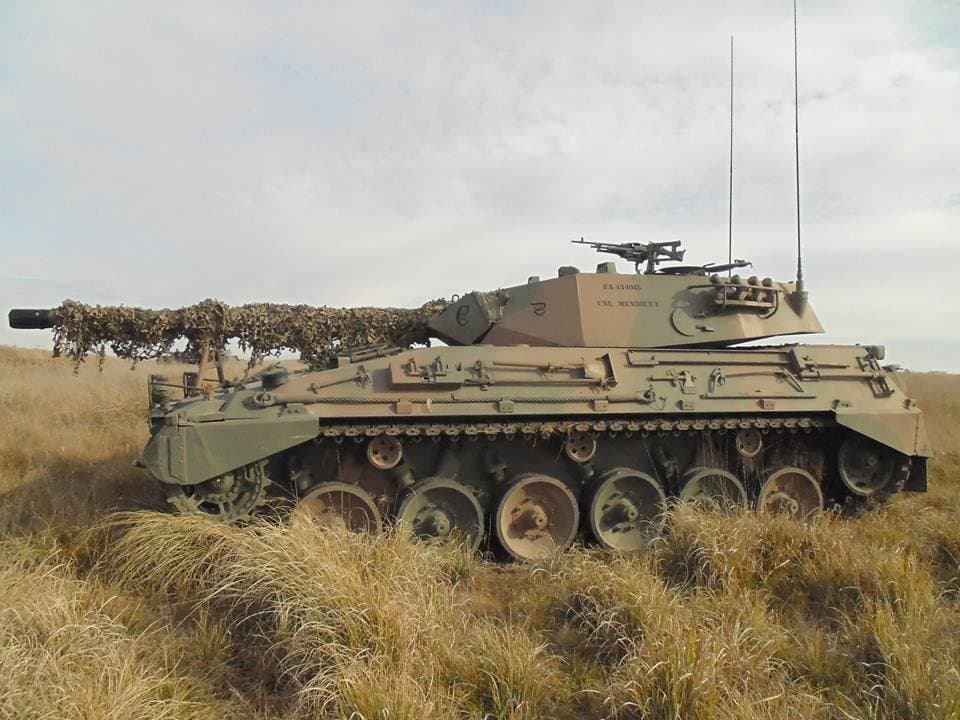
Tanque Argentino Medianolarger figure on 1 of 4
Measured figures
Gun forward
Single sourceHull
Single sourceConfiguration
| Specification | M60 tank | Tanque Argentino Mediano |
|---|---|---|
| Type | Main battle tank[source] | Light main battle tank / Medium tank[source] |
| Place of origin | United States[source] | Argentina / West Germany[source] |
| In service | 1959–present[source] | 1983–present[source] |
| Used by | See Operators[source] |
Counts only measures both sources give with the same scope. A larger figure is not a better system.
6.946 m (22 ft 9.5 in) (hull), 9.309 m (30 ft 6.5 in) (gun forward)[source]
Length
Single source6.75 m (22 ft 2 in)[source]
Continental AVDS-1790-2 V12 , air-cooled twin-turbo diesel engine
Single sourceContinental AVDS-1790-2 V12 , air-cooled twin-turbo diesel engine 750 bhp (560 kW)[source]
MTU -MB 833 Ka-500 6-cylinder 22.4 L (1,370 cu in) diesel
Single sourceMTU -MB 833 Ka-500 6-cylinder 22.4 L (1,370 cu in) diesel 540 kW (720 hp)[source]
Bars compare reported quantities only. A larger figure does not make a system better; configurations and test conditions differ.
Argentina[source]
| Wars | Cold War Yom Kippur War Western Sahara War Ogaden War Iran–Iraq War Invasion of Grenada Lebanese Civil War 1982 Lebanon War Multinational Force in Lebanon Persian Gulf War Operation Desert Shield Operation Desert Storm Yemeni Civil War (1994) 2011 Bahraini uprising Houthi insurgency in Yemen Kurdish–Turkish conflict 2008–2011 Cambodia–Thailand border crisis Sinai insurgency Turkish military intervention in the Syrian Civil War Yemeni Civil War Saudi Arabian-led intervention in Yemen Turkish military intervention in the Second Libyan Civil War Sudanese civil war (2023–present) 2025 Cambodia‒Thailand conflict[source] | — |
|---|
| Designer | Chrysler Defense Engineering[source] | — |
|---|
| Designed | 1957[source] | — |
|---|
| Manufacturer | Chrysler Corporation Delaware Defense Plant (1959; initial low-rate production) Detroit Arsenal Tank Plant (1960–1983)[source] | Tanque Argentino Mediano Sociedad del Estado[source]TAM family · TAMSE production |
|---|
| Developed from | M48 Patton[source] | — |
|---|
| Unit cost | M60 : $481,911 (1962) M60A1RISE : $703,278 (1976) M60A2 : $726,712 (1974) M60A3TTS : $1.292 million (1990)[source] | 1,500,000 USD (1983 export price)[source] |
|---|
| Produced | M60 : 1959–1962 M60A1 : 1962–1980 M60A2 : 1973–1975 M60A3 : 1978–1983[source] | 1979–1991, 1994–1995[source] |
|---|
| No. built | Over 15,000 (all variants)[source] | 280[source] |
|---|
| Variants | See Variants[source] | — |
|---|
| Armor | Upper glacis: 4.29 in (109 mm) at 65° 10.15 in (258 mm) LoS Turret front: equals 10 in (250 mm)[source] | 50 mm (hull front and sides) 50 mm (turret front)[source] |
|---|
| Main armament | M68 105 mm (4.1 in)[source] | 105 mm (4.13 in) FM K.4 Modelo 1L[source] |
|---|
| Secondary armament | .50 BMG (12.7×99mm) M85 machine gun on commanders cupola[source] | 2×7.62 mm (0.30 in) machine gun[source] |
|---|
| Power/weight | 15.08 bhp/st (12.4 kW/tonne)[source] | 24 hp/tonne[source] |
|---|
| Transmission | General Motors , cross-drive , single-stage with 2 forward and 1 reverse ranges[source] | — |
|---|
| Suspension | Torsion bar suspension[source] | Torsion-bar[source] |
|---|
| Ground clearance | 1 foot 6.2 inches (0.463 m)[source] | — |
|---|
| Fuel capacity | 385 US gal (1,457 L)[source] | — |
|---|
| Former operator · Argentina | Argentina[source] | — |
|---|
| Former operator · Austria | Austria[source] | — |
|---|
| Former operator · Ethiopia | Ethiopia[source] | — |
|---|
| Former operator · West Germany | West Germany[source] | — |
|---|
| Former operator · Greece | Greece[source] | — |
|---|
| Former operator · Iraq | Iraq[source] | — |
|---|
| Former operator · Italy | Italy[source] | — |
|---|
| Former operator · Portugal | Portugal[source] | — |
|---|
| Former operator · US Army Reserve | US Army Reserve[source] | — |
|---|
| Role | American second-generation main battle tank (MBT)[source] | family of armoured vehicles[source] |
|---|
| Status (M728 Combat Engineer Vehicle) | The M728 Combat Engineer Vehicle was retired from combat use in 2000. 262 M728s were in service with the US Army Reserve and Army National Guard as of 2007.[source]M728 Combat Engineer Vehicle · source-literal variant status | — |
|---|
| Source measurement | The M60 is an American second-generation main battle tank (MBT). It was officially standardized as the Tank, Combat, Full Tracked: 105-mm Gun, M60 in March 1959. Although developed from the M48 Patton , the M60 tank series was never officially christened as a Patton tank . It has been called a "product-improved descendant" of the Patton tank's design. The design similarities are evident comparing the original version of the M60 and the M48A2. The United States fully committed to the MBT doctrine in 1963, when the Marine Corps retired the last ( M103 ) heavy tank battalion. The M60 tank series became the American primary main battle tank during the Cold War , reaching a production total of 15,000 M60s. Hull production ended in 1983, but 5,400 older models were converted to the M60A3 variant ending in 1990.[source]M60 tank · Lead; only the objects and conditions stated in this passage The M47 Patton entered production in 1951 and was used by the United States Army and Marine Corps but ongoing technical and production problems kept it from serving in the Korean War. The M48 Patton tank entered US service in 1952 but its early designs were deemed unsatisfactory by Army Field Forces (AFF). The improvements to the M48 focused on improving the 90 mm main gun and fire control systems while simultaneously exploring the development of silicas glass composite armor and autoloader systems. The tank continued further development through 1955 in conjunction with its simultaneous mass production. The course of its development during the mid-1950s was the source of widespread debate among Congressional Budget Oversight committees.[source]M60 tank · Development / Impetus; only the objects and conditions stated in this passage The T95 program , which began in 1955 was intended to supersede the M48, featured a host of innovative and experimental components such as its 90mm smoothbore T208 cannon rigidly affixed to its turret, experimental X-shaped engine design using a vapor-cycle power plant fueled by hydrocarbons , composite armor and infrared rangefinder. The burden of developing them, however, slowed the overall program to a crawl.[source]M60 tank · Development / Impetus; only the objects and conditions stated in this passage After a brief examination of this tank's armor by British military attaché Lt Col Noel Cowley, it was concluded that the 84 mm 67 caliber long QF 20-pounder of the Centurion tank was apparently incapable of consistently defeating its frontal armor with either High-Explosive Anti-Tank (HEAT) or Armor-Piercing Capped (APC) ammunition.[source]M60 tank · Development / Impetus; only the objects and conditions stated in this passage Its 100 mm gun was a significant advancement over the weapon of the T-44 .[source]M60 tank · Development / Impetus; only the objects and conditions stated in this passage There were also rumors of an even larger 115 mm gun in the works.[source]M60 tank · Development / Impetus; only the objects and conditions stated in this passage These events spurred the United Kingdom to begin upgrading existing tanks with a 105 mm high-velocity rifled gun in 1958, the Royal Ordnance L7 to keep the Centurion viable against this new Soviet tank design.[source]M60 tank · Development / Impetus; only the objects and conditions stated in this passage An M48A2C was fitted with the 90 mm M41 and tested with the new T300E53 HEAT round. A smoothbore version of the 90 mm, the T208E9, was mounted on the T95E1 tank and tested the T320E62 Armour-Piercing Discarding Sabot (APDS) round. An American variant of the British Royal Ordnance L7 tank gun, under the US designation 105 mm T254E1 , was mounted on the T95E2 and tested with British APDS ammunition. Finally, two versions of the 120 mm gun from the M103 were trialed, the existing M58 model and a lightened variant known as T123E6 which was mounted on the T95E4.[source]M60 tank · Development / Choice of components / M68 105 mm main gun; only the objects and conditions stated in this passage The T123E6 was preferred by the Ordnance Department because its ammunition, the same as that for the M58 gun, was already at an advanced state of development. However, the ammunition was in two parts, shell and propellant bag, which required significant time to load. In the M103 this was addressed by adding a second loader, but a medium tank would not have the internal space needed for another crewmember and the firing rate would suffer as a result. In testing it demonstrated a maximum rate of four rounds per minute vs. the seven rounds per minute for the T254.[source]M60 tank · Development / Choice of components / M68 105 mm main gun; only the objects and conditions stated in this passage Based on these tests, the 105 mm T254E1 was selected, modified to the T254E2, and standardized as the "Cannon, 105 mm Gun, M68". It used a vertical drop breechblock instead of the T254E1's horizontal sliding breechblock. Until American-made barrels could be obtained with comparable accuracy, British barrels were to be used. US built XM24/L52 barrels - 218.5 in (5,550 mm) in length - fitted with an eccentric bore evacuator were used for the M60-series starting in June 1959 but retained interchangeability with the British X15/L52 barrel.[source]M60 tank · Development / Choice of components / M68 105 mm main gun; only the objects and conditions stated in this passage There were two versions of hulls used for the M60-series. The M60 hull had a straight slope and beak compared to the earlier M48's rounded one. The hull bottom had a strong boat-like appearance with a pronounced recess between the upper tracks and external suspension arms and one shock absorber on the first roadwheel pair. The armor was improved, at 6 inches (155 mm) on the front glacis and mantle of solid rolled homogeneous armor , while it was 4.3 inches (110 mm) on the M48. The first prototype hulls did not have shock absorbers and were briefly named M68 in late 1958 before the Ordnance Department renamed it the M60 in March 1959. This hull version was used only on the original M60 variant and early M728 Combat Engineer Vehicles (CEVs) and M60 Armored Vehicle Launched Bridges (AVLBs) . This hull model was in production from 1959 to 1962.[source]M60 tank · Development / Choice of components / Armor; only the objects and conditions stated in this passage A redesigned full vision cupola was envisioned for the commander's station. It had 7 tiltable vision blocks arranged to give the commander a 360 degree field of view with overlapping vision between adjacent vision blocks. The front vision block could be replaced with a dual power M34 7×50 binocular day sight or an M19E1 Infrared (IR) periscope. A special feature was that the cupola body could be raised up to 3.5 in (89 mm), providing the commander a direct field of vision while remaining under armor protection.[source]M60 tank · Development / Choice of components / M19 commander's cupola; only the objects and conditions stated in this passage Access was through a hatch cover on the roof and a .50 caliber (12.7 mm) M2 machine gun was pedestal mounted on the forward part of the cupola. It could be aimed and fired with the cupola closed. Also there was an 11 in (280 mm) long port on the left side allowing spent cartridge cases to be ejected.[source]M60 tank · Development / Choice of components / M19 commander's cupola; only the objects and conditions stated in this passage The first generation consists of the medium tanks designed and produced directly after World War II that were later redefined as main battle tanks. These were exemplified by the M47 and M48 Pattons armed with a 90 mm main gun already in widespread US service. The original variant of the M60 series also fulfilled the definition of a late first generation MBT sometimes being referred to as an intermediate second generation design. The Soviet T-54 and T-55 as well as the original configuration of the T-62 A tank designs are also regarded as first generation MBTs.[source]M60 tank · Development / Choice of components / Main battle tank designation; only the objects and conditions stated in this passage The second generation had enhanced night-fighting capabilities and in most cases nuclear, biological and chemical (NBC) protection. Most western tanks of this generation were armed with the 105 mm Royal Ordnance L7 tank gun or derivatives of it. Notable are the 120-mm armed British Chieftain and German Leopard 1 . The United States fully committed to the MBT doctrine in 1963 when the Marine Corps deactivated its last M103 heavy tank battalion.[source]M60 tank · Development / Choice of components / Main battle tank designation; only the objects and conditions stated in this passage The first concept was armed with the 120mm gun T123E6 in the long nosed T95E6 turret. This was the design preferred by the Ordnance Department. It was fitted with a mock-up of the new designed full-vision commander's cupola. A full sized prototype of this turret was constructed before this concept was dropped, mainly due to its slow rate of fire. The second carried the 105mm rifled T254E1 main gun in the T95E5 type turret and the T9 cupola style of the M48A2. The T254 guns used British X15/L52 barrels with a concentric bore evacuator on the barrel.[source]M60 tank · Production versions / XM60 development; only the objects and conditions stated in this passage The Army Ordnance Technical Committee chose this design for production in August 1958. The third concept was to mount the 90mm T208 smooth-bore main gun and the T95E6 turret with the T6 cupola of the T95 tank. It never progressed beyond design drawings. The fourth used the T95E1 turret and the T208 main gun. A mock-up was built using the new vision cupola. All of these conceptual designs were referred to as the XM60. A contract was awarded to Chrysler Engineering in September 1958 for the advanced production engineering (APE) of the XM60 concept #2.[source]M60 tank · Production versions / XM60 development; only the objects and conditions stated in this passage The T95 hull was considered however its one-piece front casting was too difficult and expensive to produce in quantity. Some existing T95 hulls were re-fitted with the AVDS-1790 engine and used from 1960 to 1964 to develop the T118E1 prototyping of the M728 Combat Engineer Vehicle. Instead the decision was made to use modified M48A2 hulls. The hulls had 3 return rollers and 6 steel roadwheel pairs per side with no shock absorbers, using only bumper springs on the first and sixth roadwheel arms along with a widened turret well and ring, and a flat wedge-shaped glacis. The T254E2 gun was chosen to be the main weapon of the tank in August 1958 being standardized as the M68 105mm gun. After a briefing on 11 December 1958, General Maxwell Taylor ordered the XM60 into production because of the improvements it offered in firepower, protection, and cruising range.[source]M60 tank · Production versions / XM60 development; only the objects and conditions stated in this passage The OTCM (Ordnance Technical Committee Minutes) #37002 officially standardized the type as the Tank, Combat, Full Tracked: 105-mm Gun, M60 on 16 March 1959. The production contract was approved April 1959 with the low rate initial production starting in June at the Chrysler Corporation Delaware Defense Plant in Newark Delaware. Production pilot 1 was completed at Chrysler Defense Engineering on 2 July with an initial production total of 45 tanks in July 1959. These tanks were sent to the Aberdeen Proving Ground for survivability testing and final design modifications. This batch of tanks did not have the M19 cupola due to its initial production problems.[source]M60 tank · Production versions / M60 series; only the objects and conditions stated in this passage The original variant of the M60 series ultimately was produced as a quick fix engineering (QFE) upgrade of the M48 due to the Soviet Union's tank advancements of the late 1950s and the delays from developing the silicas armor and an improved turret design. The M60 mounted a 105 mm M68 main gun with the bore evacuator mounted towards the middle of the tube carrying 57 rounds in the clamshell shaped turret style of the M48. Nine rounds were stowed in the left side of the turret bustle behind the loader.[source]M60 tank · Production versions / M60 series; only the objects and conditions stated in this passage The remaining rounds were stored inside safe containers on the hull floor. A new short receiver coaxial machine gun was designed for the M60 tank. This was the 7.62mm M73/T197E2 which replaced the .30 caliber M37 used on the M48A2. It had 2,000 rounds of ammunition. They had a reputation for jamming. After working to correct this, they were redesignated as the M73A1 in 1970.[source]M60 tank · Production versions / M60 series; only the objects and conditions stated in this passage The electrical package on the M60 was essentially the same as used on the M48A2C including an improved turret control system and an all-metric measurement M16 Fire Control System (FCS), The M16 FCS consists of a new M10 ballistic drive and mechanical M16E1 gun data computer which integrated barrel temperature data with an M17 coincidence range finder used as the ranging device of the gunner's primary direct sighting and fire control system. The gunner is provided with an M31E1 day periscope with a magnification of x8 and an M105D day telescopic sight with a magnification of x8 and a field of view of 7.5 degrees.[source]M60 tank · Production versions / M60 series; only the objects and conditions stated in this passage The hull bottom had a strong boat-like appearance with a pronounced recess between the upper tracks and external suspension arms with cast aluminum roadwheels and return rollers along with a single shock absorber on the first roadwheel pair. Cast aluminum road wheels were used to save weight. The armor was improved, at 6 inches (155 mm) on the front glacis and mantle of solid rolled homogeneous armor, while it was 4.3 inches (110 mm) on the M48. Power was provided by the AVDS-1790-2A engine, CD-850-5 cross drive transmission and the T97E2 track assembly as used on the M48A3.[source]M60 tank · Production versions / M60 series; only the objects and conditions stated in this passage The program to develop the M60A1 was approved in early 1960 in conjunction with abandoning further development of the advanced composite armor and the closure of the T95 Medium Tank project. The first proof of concept attempt to mate a modified M60 hull with the T95E7 turret took place in March 1960. The turret, even without the siliceous cored armor, provided improved ballistic protection. Additional space for the turret crew was also made available by using the M140 mount thus moving the cannon 5 inches forward.[source]M60 tank · Production versions / M60A1 series; only the objects and conditions stated in this passage On 22 October 1961, the M60E1 was officially accepted in service under the designation of Tank, Combat, Full Tracked: 105-mm Gun, M60A1. Production began on 13 October 1962 when the Army placed an initial order for 720 of the tanks for 61.2 million dollars.[source]M60 tank · Production versions / M60A1 series; only the objects and conditions stated in this passage In addition to the new turret design, the hull was upgraded. The hull's upper glacis armor was increased from 3.67 to 4.29 in (93 to 109 mm) at 65 degrees while the turret sides went from 1.9 to 2.9 in (48 to 74 mm) at their apex. This brought the frontal armor up to the same 10" line of sight armor standard of the M103 heavy tank. A mushroom-shaped fume extractor was placed at the rear left of the turret bustle to vent smoke produced from firing the main or coax guns out of the vehicle. The addition of a shock absorber on the second roadwheel pair was also accompanied by a slight relocation of the first return roller. These modifications were needed due to the increased weight of the M60A1 turret as well as the additional hull armor.[source]M60 tank · Production versions / M60A1 series; only the objects and conditions stated in this passage At a range of 2,000 m (6,600 ft), hit probabilities of better than 70% from a moving M60A1 were obtained in Aberdeen test results while without a stabilizer it was essentially zero. M60A1s with this upgrade were designated as the M60A1(AOS). The T142 track was fielded in 1974, which had replaceable rubber pads, better end connectors, and improved service life. M60A1(AOS)+ was the denotation for M60A1s equipped with the TLAC & AOS upgrades and the T142 track.[source]M60 tank · Production versions / M60A1 series; only the objects and conditions stated in this passage The 1977 fielding of the passive M32E1 sight for the gunner and M36E1 periscope for the commander as well as the M24E1 IR night vision block for the driver provided second generation night vision capabilities for M60A1 and RISE tanks. These new passive gunner's sight and commander's periscope provide recognition capability at longer ranges and at relatively low night light levels (1/2 moonlight). Under starlight conditions, they will provide recognition beyond 500 m (1,600 ft) with the use of an IR searchlight.[source]M60 tank · Production versions / M60A1 series; only the objects and conditions stated in this passage During the early 1960s there was some debate regarding the future of main tank weaponry, largely focusing on conventional kinetic energy rounds versus missiles. In the early 1960s it was generally accepted that the maximum effective range of the M68 gun was between 1,800 and 2,000 m (5,900 and 6,600 ft). The XM-13 missile system had proven itself viable, obtaining over 90% first round accuracy up to 4,000 m (13,000 ft). But the development of a main battle tank variant was bogged down by having too many design proposals. In response, studies were made in August 1961 to retrofit existing M60 tanks with a weapon capable of firing both conventional HEAT (High-Explosive Anti-Tank) rounds and launching ATGMs (Anti-Tank Guided-Missiles).[source]M60 tank · Production versions / M60A2 series; only the objects and conditions stated in this passage Three M60E1 tanks with T95 turrets were modified to permit the installation of the 152mm XM81 gun-launcher. Mounted on former M60 hulls, they were to provide test beds for the evaluation of the Shillelagh weapon system. Although this system was the preferred armament for the MBT-70, by late 1961 problems with the XM13 missile required that the program be reorganized. The missile was reclassified as an applied research project and it was obvious that there would be some delay before it would be available for service.[source]M60 tank · Production versions / M60A2 series; only the objects and conditions stated in this passage Several backup weapons were also under consideration and concept studies were prepared showing their application to the MBT-70 concepts. The 152mm gun-launcher XM81 also was considered without the missile depending only on the combustible case conventional ammunition. It was expected that the Shillelagh or some other missile then could be introduced at a later date.[source]M60 tank · Production versions / M60A2 series; only the objects and conditions stated in this passage The 105mm gun M68 as standardized for the M60 tank was considered as an alternate armament system. It had the advantage of being immediately available and its ammunition was already in production. Of the several turrets drafted, one of the earliest was the driver-in-turret integrated fighting compartment. This design was further developed using the MBT-70 . Another proposal was a more compact turret design of the T95E7.[source]M60 tank · Production versions / M60A2 series; only the objects and conditions stated in this passage On 10 January 1964, the Army reviewed all three variants and selected the Type A variant for further development. Initially two Type A turrets were built in 1964. The M60A1 hull was used starting in 1966 to develop the new compact turret design using the 152mm M162/XM81E13 rifled barrel main gun. These developmental tanks were designated as the M60A1E series.[source]M60 tank · Production versions / M60A2 series; only the objects and conditions stated in this passage These were later standardized as the M60A2. Initial plans called to retrofit the turret of every M60 with the new A2 turret, and use them in the mobile anti-armor role alongside the M60A1 tanks. But the continual technical and reliability difficulties with the dual-purpose gun caused this to be abandoned. The M60A1E3 variant was a prototype mounting the M68 105 mm rifled gun to the turret of the M60A1E2. This was evaluated due to several earlier faults noted in the M60A1E1's main gun. Compared to the Shillelagh system, the use of the 105mm gun increased the overall tank weight by about 1,700 pounds (770 kg).[source]M60 tank · Production versions / M60A2 series; only the objects and conditions stated in this passage The M60A1E4 was a conceptual variant that explored the use of various remote controlled weapons, including a 20mm gun as secondary armament. A mock-up of this design using the Type C turret was constructed. All variants of this series underwent evaluations and trials at the Aberdeen Proving Ground . The M60A1E2 was finally accepted by the Army in 1970 and given the designation "Tank, Combat, Full Tracked: 152-mm Gun/Launcher, M60A2".[source]M60 tank · Production versions / M60A2 series; only the objects and conditions stated in this passage The M51 Missile Guidance System (MGS) for the Shillelagh missiles was designed by Ford's Aerospace Division . The M51 MGS consisted of an infrared (IR) direct beam guidance and control system to track the missile mounted to the turret over the mantel of the gun with a telescopic sight and a Raytheon AN/WG-1 Flashlamp Pumped, Ruby Laser range finder, accurate to 4,000 meters, for the gunner.[source]M60 tank · Production versions / M60A2 series; only the objects and conditions stated in this passage Secondly was the high minimum range of about 730 m (2,400 ft). Until the missile reached this range it flew beneath the tracking system's infrared beam and could therefore not be guided by the infrared command link. Also, minimum range was slightly above the maximum effective range of the M60A2's conventional unguided munition. This created a dangerous gap area that could not be adequately covered by fire known as a "dead zone".[source]M60 tank · Production versions / M60A2 series; only the objects and conditions stated in this passage The electronics and fire control systems were greatly improved. The turret's hydraulic fluid was replaced with a non-flammable one. This updated turret configuration was mated to the M60A1 RISE hull using the AVDS-1790-2D RISE engine and CD-850-6A transmission along with a Halon fire suppression system. It was designated as the Tank, Combat, Full Tracked: 105-mm Gun, M60A3.[source]M60 tank · Production versions / M60A3 series; only the objects and conditions stated in this passage The M60A3 tank was built in two configurations. The earlier version, sometimes referred to as the M60A3 Passive, uses the same passive gunner's sight as the A1 RISE Passive and the latest version has a Tank Thermal Sight (TTS). The M60A1, RISE, and RISE Passive tanks used a coincidence rangefinder and the mechanical M19 ballistic computer. The M60A3 uses a laser based rangefinder and the solid state M21 ballistic computer. The M21 FCS for the M60A3 was made up of a Raytheon AN/WG-2 flash-lamp pumped ruby-laser based range finder, accurate up to 5,000 meters (16,000 ft) for both the commander and gunner, a solid-state M21E1 gun data computer incorporating a muzzle reference sensor and crosswind sensor, ammunition selection, range correction and superelevation correction were inputted by the gunner, an improved turret stabilization system along with an upgraded turret electrical system and solid-state analog data card bus. The M10A2E3 ballistic drive is an electro-mechanical unit.[source]M60 tank · Production versions / M60A3 series; only the objects and conditions stated in this passage Mobility enhancements included a new 1,050 horsepower engine, a new automatic transmission, improved final drives, an improved vehicle suspension and a modification to the air cleaner.[source]M60 tank · Army National Guard evaluations / M60A4; only the objects and conditions stated in this passage The Super M60 prototype was based on an M60A1 leased from the US Army. It featured the AVCR-1790-1B engine producing 1,200 hp (890 kW) coupled to a Renk RK-304 transmission with four forward and four reverse gears. The torsion bar suspension system of the M60 was replaced with a hydropneumatic suspension system (HSS) developed by the National Waterlift Company as seen on the HIMAG, General Motors XM1, and the Jordanian Centurion (Tariq). Over the M60A1, the Super M60's top speed increased to 45 mph (72 km/h) and power/weight ratio increased to 23.1 hp/t (17.2 kW/t), despite the 9,500 lb (4,300 kg) increase in weight. This High Performance configuration was demonstrated and tested at Fort Knox in January 1985 but was not designated. Although the US Army chose not to adopt the installation of a new power pack or suspension system in the M60 series, General Dynamics formed a co-operative private venture with Teledyne Continental to develop a comprehensive upgrade package.[source]M60 tank · Foreign upgrades / High Performance/Super M60 Main battle tank; only the objects and conditions stated in this passage The weapons of the Super M60 are similar to those of the M60A3. The main gun is the rifled 105 mm/L52 M68A1E2 with a thermal sleeve. The 7.62 mm M73 coaxial machine gun used on the M60A1 was replaced with a 7.62 mm M240C, with the same number of rounds. The M19 cupola was replaced with a low silhouette model with a pop-up hatch for the commander and a 12.7 mm M2HB machine gun on a pintle mount with 600 rounds. The Fire Control System (FCS) used was designated the Advanced Laser Tank Fire Control System (LTFCS).[source]M60 tank · Foreign upgrades / High Performance/Super M60 Main battle tank; only the objects and conditions stated in this passage The M60 Phoenix Project was Jordan's modular upgrade of the M60A3TTS to better address both immediate and emerging threats to the M60MBT. The tank is armed with a RUAG Land Systems L50 120 mm smoothbore Compact Tank Gun (CTG) with a firing rate of 6–10 rounds per minute. 20 ready rounds are stored in the turret bustle. The M21 FCS is replaced with Raytheon's Integrated Fire Control System (IFCS). The system consists of an eye safe laser rangefinder, second generation night sight, digital ballistic computer, cant sensors and a MIL-STD 1553 data bus. The M10 ballistic drive is upgraded with a fully electrical superelevation resolver.[source]M60 tank · Foreign upgrades / M60A3 Phoenix; only the objects and conditions stated in this passage The maneuverability and acceleration of the Phoenix is improved with the use of the General Dynamics AVCR-1790-2C engine producing 950 hp increasing available power by 20%, an upgraded CD-850-B1 transmission, new air cleaner and air induction systems, improved suspension and new and improved final drives. Survivability is improved through the addition of various modular armor protection schemes for both the M60's turret and hull. The upgrades include armor protection with STANAG 4569 Level 6 protection plates to the frontal arc, passive and reactive armor panels and side skirts and slat armor added to the bustle, protecting the rear of the turret from RPG attack.[source]M60 tank · Foreign upgrades / M60A3 Phoenix; only the objects and conditions stated in this passage Raytheon has been working with Jordan's King Abdullah II Design and Development Bureau (KADDB) on its Phoenix Level 1 Independent Fire Control System (IFCS) upgrade and Level 2 Lethality upgrade efforts for the M60 main battle tank. Some of the upgrades included passive spaced armor packages, IR jammers and an ammunition containment system for the turret bustle. A $46.6M contract with the Jordan Armed Forces was authorized in 2012 to upgrade one battalion of their Phoenix main battle tanks.[source]M60 tank · Foreign upgrades / M60A3 Phoenix; only the objects and conditions stated in this passage Raytheon in conjunction with other partners offered the M60 Service Life Extension Program (SLEP) for the M60A3 in May 2016. It has been marketed for export to nations that need the performance improvements to take on modern armor threats. The SLEP is offered as a collection of modular upgrades for the tank's firepower, mobility, and protection. This allows for SLEP customization to each user's needs. Its firepower improvements features the 120 mm M256 smoothbore main gun as used on the M1A1 Abrams. It is fitted with a load assist system allowing for a firing rate of 6 to 10 rounds per minute and 20 ready-rounds in the turret bustle.[source]M60 tank · Foreign upgrades / Raytheon M60A3 SLEP; only the objects and conditions stated in this passage The Raytheon Integrated Fire Control System (IFCS) integrating an eye safe laser rangefinder, second generation gunner's night sight, digital ballistic computer, cant sensors, a fully electrical superelevation resolver and a MIL-STD-1553 data bus, giving the system capabilities similar to the M1AD standard . Other turret upgrades offered are the Curtis-Wright Gun Turret Drive and replacing the M19 cupola with a Hitrole remote controlled weapon system, that enables 360° panoramic surveillance from a secure position inside the tank armed with a M2HB .50cal machine gun.[source]M60 tank · Foreign upgrades / Raytheon M60A3 SLEP; only the objects and conditions stated in this passage Suspension and mobility upgrades include an upgraded AVCR-1790-2C engine producing 950 hp and improved hydropneumatic suspension. The installation of an Automatic Fire and Explosion Sensing and Suppressing system (AFSS) that improves soldier survivability and protects the engine compartment as standard. Upgraded armor protection with STANAG 4569 Level 6 protection plates to the frontal arc and side skirts and slat armor added to the bustle, protecting the rear of the turret from RPG attack. These changes increased the vehicle weight to 62–63 tons.[source]M60 tank · Foreign upgrades / Raytheon M60A3 SLEP; only the objects and conditions stated in this passage Upgrades offered in this package include a new 120/45 gun from the Centauro II that offers a weight saving of 500 kg (1,100 lb) over the older 120/44 gun due to a redesigned light alloy cradle and muzzle brake. The old commander's cupola is completely removed and replaced instead with an armored circular ballistic plate protected with slat armor. This also offers a weight reduction compared to the original M19 cupola as used on the M60A3. For close defense, the turret is also fitted with the HITROLE-L 12.7mm remotely operated weapons system.[source]M60 tank · Foreign upgrades / Leonardo M60A3 SLEP; only the objects and conditions stated in this passage Mobility is improved via either a full refurbishment of the existing power packs or an upgrade. The new powertrain offered is stated to deliver up to 20% more power without high costs and avoiding the need for any modifications to the existing hull. This AVDS-1790-5T 908 hp (677 kW) engine replaces the 750 hp (560 kW) engine and is connected to an upgraded CD-850-B1 transmission. It was unveiled at the Bahrain International Defense Exhibition and Conference (BIDEC) at Manama, Bahrain in 2017.[source]M60 tank · Foreign upgrades / Leonardo M60A3 SLEP; only the objects and conditions stated in this passage Belgian Company John Cockerill Defense unveiled a modernized turret-replacement solution concept for the M60 tank at EDEX 2025 in Cairo, Egypt. This SLEP upgrade is equipped with a new modernized composite armored turret and its Cockerill 3105 105mm weapon station replacing the M60's original steel-cast T95E7 turret. It integrates advanced fire control, hunter-killer optics and a full digital architecture providing modern lethality and networked capabilities without the cost burden of next-generation tanks. The system supports programmable ammunition and features autoloading, reducing crew size and increasing survivability.[source]M60 tank · Foreign upgrades / M60-3105; only the objects and conditions stated in this passage The 3105 turret is fully stabilized and can fire on the move and engage targets with first-round hit probability at long ranges. The 3105-turret protection scheme is modular and can be outfitted with secondary armament such as a 7.62mm coaxial machine gun and a remote-controlled 12.7mm machine gun. It also supports active protection systems (APS) and advanced battlefield management systems, giving the M60 a real-time edge on the digital battlefield. The turret's fire control is stabilized and designed for day/night operations with targeting capabilities comparable to those found on NATO-standard light tanks such as the Swedish CV90 or Spanish ASCOD. The solution is being targeted for militaries across Africa, the Middle East, and Asia that still operate legacy M60 tank fleets. Platform integration is being evaluated for demonstrational trials in 2026.[source]M60 tank · Foreign upgrades / M60-3105; only the objects and conditions stated in this passage As of 2015, the US Army and Air Force continue to use QM60s on a limited basis as targets for the testing of radar and weapons systems. They are also salvaged for parts to maintain other vehicles still in service. One M60A1 hull was leased to General Dynamics for development of the M60-2000/120S during 2000–2001. The M68 105 mm Gun has been used for the M1128 Stryker MGS .[source]M60 tank · U.S. service history; only the objects and conditions stated in this passage The principal comparative evaluation was the Baseline Armor Reliability Test, conducted at Fort Hood, Texas, between April and November 1976. Five newly manufactured M60A1 RISE tanks and five overhauled M60A1s each travelled approximately 2,250 mi (3,620 km) and fired approximately 450 main-gun rounds. Under the report's adjusted system criteria, the new M60A1 RISE vehicles achieved a mean mileage between failures of 114 mi (183 km), compared with 59 mi (95 km) for the overhauled M60A1s. When mission reliability factors were applied, the corresponding figures were 170 mi (270 km) and 91 mi (146 km). Under combat-mission criteria, the figures increased to 427 mi (687 km) for the new RISE vehicles and 172 mi (277 km) for the overhauled tanks.[source]M60 tank · Reliability and maintenance; only the objects and conditions stated in this passage The new M60A1 RISE tanks achieved an average repair time of 0.98 hours and an availability rate of 75 per cent during the test, while the overhauled M60A1s recorded 1.09 hours and 68 per cent respectively. Some incidents, including road-wheel tyre separation and failures involving the M2 and M85 machine guns and the commander's cupola, were excluded from the adjusted results. The reported mean mileages therefore varied according to the definition of a chargeable failure and whether the failure prevented the completion of a combat mission. They should not be interpreted as the service life of the engine or of the complete tank.[source]M60 tank · Reliability and maintenance; only the objects and conditions stated in this passage A subsequent series of contractor and controlled production tests at Aberdeen Proving Ground involved six M60A1 RISE vehicles. Between April 1977 and November 1978, the vehicles accumulated a combined 12,323 mi (19,832 km) and achieved a system mean mileage between failures of 241 mi (388 km) when mission reliability factors were applied. The most frequently recorded failures involved the air-cleaner blower motor or its electrical circuit, road-wheel hub bearings, separation of the rubber tyres from the road wheels, T142 track pins or shoes, torsion bars and the steering-control linkage.[source]M60 tank · Reliability and maintenance; only the objects and conditions stated in this passage XM60 : Conceptual prototypes using modified M48A2/M68 hulls and T95 turrets. Four different variants using 90mm, 105mm and 120mm guns. Developed in 1957.[source]M60 tank · Variants; only the objects and conditions stated in this passage M60 : Featured the M68 105mm main gun in the clamshell shaped Patton-styled T95E5 turret and several component improvements as well as the AVDS-1790-2A diesel engine and improved hull design. Some early production units did not have the commander's cupola.[source]M60 tank · Variants; only the objects and conditions stated in this passage M60A1E1 : Developmental test vehicles consisting of XM81 152 mm gun-missile launchers mounted in T95E7 Type A turrets fitted to M60 hulls. 3 M60E1 tanks were used.[source]M60 tank · Variants; only the objects and conditions stated in this passage M60A1E3 : Prototype, M60A1E2 Type B turret fitted with M68 105 mm gun.[source]M60 tank · Variants; only the objects and conditions stated in this passage M60 AVLB : armored vehicle-launched bridge with 60-foot (18 m) scissors bridge mated to the M60 hull. M60 AVLM : M60 Armored Vehicle Launched Bridge (AVLB) with up to 2 vehicle mounted M58 MICLICs . To employ the system, the vehicle cannot be carrying a bridge. The system consists of an M147 firing kit, an M58A3 line charge and a 5-inch MK22 Mod 4 rocket. The line charge is 350 ft (110 m) long and contains 5 lb (2.3 kg) per linear foot of C-4 explosive. In the event a MICLIC fails to detonate normally, it can be manually activated by time-delay fuses every few feet along the length of it.[source]M60 tank · Variants / Specialized; only the objects and conditions stated in this passage M728 Combat Engineer Vehicle : Combat Engineer Vehicle fitted with a folding A-frame crane and winch attached to the front of the turret, and an M135 165mm demolition gun mated to the M60 hull.[source]M60 tank · Variants / Specialized; only the objects and conditions stated in this passage M9 Bulldozer Kit for the M60 series: (LIN B45390): The M9 bulldozer installed on the M60-series tank will increase the vehicle weight by 4.45 tons (4.04 metric tons). It is used to clear obstacles, leveling ground, filling depressions and to construct fighting positions. It is not to be used for demining activities. It is controlled by the driver.[source]M60 tank · Variants / Specialized; only the objects and conditions stated in this passage M1 Mine Clearing Roller System (MCRS) (LIN M18157): The MCRS is installed on the front of the tank through a removable adapter, and provides the capability for neutralization of Anti-Tank (AT) land mines, which are buried or laid on the surface, in the track path of the vehicle. The MCRS consists of two roller banks with two push arm assemblies. Each roller bank has five rollers, which apply ground pressure higher than that exerted by the tank. This principle ensures the explosion of pressure fused anti tank mines, which would otherwise explode under the track itself. The system weighs about 10 short tons (9.07 metric tons).[source]M60 tank · Variants / Specialized; only the objects and conditions stated in this passage Full Width Mine Rake (FWMR) (LIN B51986): A rake assembly for unearthing and disposing of buried and surface laid mines in sand and loose earth. It was specifically designed and fabricated for use in Operations Desert Shield and Desert Storm. The tank needs to have the M9 Bulldozer Kit or a SMP installed first to employ the rake. It consists of a V-shaped tined plough that performs countermine activities by lifting buried mines with its tines and pushing them to the side as the vehicle moves forward. The FWMR also uses an aluminum skid shoe which protrudes from the front of the tines to allow the rake to maintain a consistent plowing depth. It clears a path measuring 180 inches wide, accommodating heavy tanks and other armored vehicles. Additional features are that it weighs 4000 pounds and is easily assembled and installed.[source]M60 tank · Variants / Specialized; only the objects and conditions stated in this passage Iranian variants : All Iranian M60A1s were locally modified and given different local names. Zulfiqar (the legendary sword of Ali ): Iranian M60A1 variant. Armed with a Russian 2A46 125mm smoothbore main gun. Samsam (Sword) : Iranian upgraded version of M60A1 tank, fitted with reactive armor (presumably Kontakt-5), EFCS-3 Fire Control system, Laser warning system and IR jammers. Soleiman-402: On September 1, 2024, the Information Agency of the Islamic Republic of Iran (IRNA) announced the official unveiling of a modernized version of the M60A1 MBT. It features a locally upgraded targeting system, SHORTA IR jamming system, communications system upgrades and a remote control weapon system (RCWS).[source]M60 tank · Variants / International; only the objects and conditions stated in this passage Magach 7 : M60A1/A3 with 908 hp (677 kW) AVCR-1790-5A engine, additional passive armor, new fire control and Merkava-based tracks.[source]M60 tank · Variants / International; only the objects and conditions stated in this passage Sabra Mk I : Israeli offered modernized M60A1/E60A variant for export with upgraded AVCR-1790 900 hp (670 kW) engine and suspension.[source]M60 tank · Variants / International; only the objects and conditions stated in this passage Armed with M68T 105mm gun.[source]M60 tank · Variants / International; only the objects and conditions stated in this passage It features a MG251-LR 120mm main gun carrying 43 rounds, Elbit Knight fire control system, hybrid electrohydraulic turret drive, Orlite modular passive and ERA armor packages, SLAT armor for the turret, external armor plating to the hull front.[source]M60 tank · Variants / International; only the objects and conditions stated in this passage The power pack consisted of a 1,000 hp (750 kW) German RENK MTU 881 diesel engine coupled to a RENK 304S transmission and the same suspension and track assembly as the Merkava IV MBT.[source]M60 tank · Variants / International; only the objects and conditions stated in this passage High Performance/Super M60 : Teledyne Continental upgrade package for the M60A1/A3 offered in 1985. Features 105-mm M68A1 gun, new engine and suspension system, Chobham spaced applique armor for the turret, and other component improvements. One prototype built.[source]M60 tank · Variants / International; only the objects and conditions stated in this passage M60 Phoenix : Jordanian upgrade, carried out in 2004 by the King Abdullah II Design and Development Bureau . Upgrade features increased firepower (with a RUAG 120 mm smoothbore gun), IR jammers and modular armor protection scheme upgrade.[source]M60 tank · Variants / International; only the objects and conditions stated in this passage Raytheon M60A3 SLEP : Raytheon modular update package for the M60A1/A3 first offered in 2016. Features RUAG 120-mm gun with autoloader, digital fire control system, STANAG level 6 armor plates for the hull, SLAT armor for the turret bustle, upgraded engine, and other component improvements.[source]M60 tank · Variants / International; only the objects and conditions stated in this passage Royal Thai Army M60A3 TIFCS : The M60A3 main battle tank underwent a modernization led by Elbit Systems in 2015. This upgrade introduced essential features, including a Stabilized Thermal Sight (TIFCS) for enhanced day and night operations, an Electrical Gun & Turret Drive System (EGTDS), and a Head Mirror Assembly (HMA) for improved fire control. The tank's main armament, the M68 105 mm gun, was equipped with a new thermal sleeve. The Index Loader system allowed quicker and easier reloading. The modernized M60A3 demonstrated higher shooting accuracy.[source]M60 tank · Variants / International; only the objects and conditions stated in this passage Taiwanese M60A3 Update : In 2016, the National Chung-Shan Institute of Science and Technology (NCSIST) proposed a modernization plan for Taiwan's M60A3 TTS fleet at an estimated cost of NT$100 million per tank, featuring a 120 mm smoothbore cannon, updated turret hydraulic system, ballistic computer, and autoloader.[source]M60 tank · Variants / International; only the objects and conditions stated in this passage Upgrades includes MG251/L44 120-mm gun with a semi-automatic load assist, Elbit Knight Independent Fire Control System (IFCS) with an independent thermal commander's sight, laser range finder, an RWR/IR warning system and Curtis-Wright electric turret drive.[source]M60 tank · Variants / International; only the objects and conditions stated in this passage In 2023, a contract with U.S. manufacturer RENK America was announced to procure 460 new AVDS-1790-2CAU 950 hp engines and spare parts, with local Taiwanese suppliers assisting in production, set for completion by March 2028 .[source]M60 tank · Variants / International; only the objects and conditions stated in this passage M60-3105: Belgian modernized SLEP turret replacement unveiled at EDEX 2025 in Cairo. Egypt. Crew reduced to 3[source]M60 tank · Variants / International; only the objects and conditions stated in this passage | The TAM series includes seven different variants, such as a 155 mm (6.1-inch) self-propelled howitzer and a mortar carrier vehicle. In total, over 280 such vehicles were built, including armored personnel carriers, artillery and mortar pieces. The TAM and VCTP (Infantry Fighting Vehicles based on the TAM chassis) were manufactured for the Peruvian Army , only to be integrated into the Argentine Army when Peru canceled the contract. The TAM also competed for other export orders, but the TAM was ultimately not exported.[source]Tanque Argentino Mediano · Lead; only the objects and conditions stated in this passage The armored vehicle would weigh no more than 30 tonnes (29.5 long tons; 33.1 short tons), move at a maximum speed of 70 km/h (43 mph), and cover at least 500 km (310 mi) on roads.[source]Tanque Argentino Mediano · Development; only the objects and conditions stated in this passage It would be armed with a modern 105 mm main gun, two machine guns , and grenade launchers.[source]Tanque Argentino Mediano · Development; only the objects and conditions stated in this passage Two prototypes were manufactured in late 1976 and early 1977, which were put through extensive testing for two years and over a road range of 10,000 km (6,200 mi).[source]Tanque Argentino Mediano · Development; only the objects and conditions stated in this passage The new tank's firepower requirements were met by fitting a British Royal Ordnance L7 A1 105 mm (4.13-inch) main gun.[source]Tanque Argentino Mediano · Development; only the objects and conditions stated in this passage |
|---|
| Origin reported by inventory | — | Argentina West Germany[source]Inventory Origin column; table 1, row 7, cell 3; revision 1374043591; retrieved 2026-10-02 |
|---|
| Reported operators |
| — |
|---|
This gun was later replaced by the modified L7A2 and finally by Rheinmetall 's Rh-105-30 105 mm (4.13-inch) gun.[source]Tanque Argentino Mediano · Development; only the objects and conditions stated in this passage
The locally built cannon can be elevated to 18 degrees or depressed to -7 degrees on the TAM.[source]Tanque Argentino Mediano · Development; only the objects and conditions stated in this passage
The gun's hydraulic recoil mechanism has an extended length of 580 mm (22.8 inches) to absorb the 34-tonne (33-long-ton; 37-short-ton) recoil force.[source]Tanque Argentino Mediano · Development; only the objects and conditions stated in this passage
It is designed to fire the M735A1 armor-piercing fin-stabilized discarding sabot , which can penetrate a maximum of 370 mm (14.6 inches) at 1,000 meters (1,100 yd).[source]Tanque Argentino Mediano · Development; only the objects and conditions stated in this passage
The tank's secondary armaments include a co-axial 7.62 mm (0.30-inch) FN MAG 60-40 general purpose machine gun and a second FN MAG 60-20 mounted on the TAM's turret roof as an anti-aircraft machine gun.[source]Tanque Argentino Mediano · Development; only the objects and conditions stated in this passage
The fire control system includes a Nd:YAG laser with a range of 9,900 meters (32,480 ft) and a FLER-HG ballistic computer to compute the gun's fire solutions—helping the gunner aim and hit the target.[source]Tanque Argentino Mediano · Development; only the objects and conditions stated in this passage
The TAM's engine requirements included low weight and volume, but with a fast rate of acceleration and high reliability. The program chose MTU 's MB-833 Ka 500 diesel engine, producing 540 kW (720 hp) at 2,400 rpm . This gives the TAM a power-to-weight ratio of 24 horsepower per tonne and a maximum speed of 75 km/h (47 mph) on road and 40 km/h (25 mph) off-road. With a 680-liter (180-U.S.-gallon; 150-imperial-gallon) internal fuel tank, the TAM can travel 500 km (310 mi). Its range is extended to 900 kilometers (560 mi) if the vehicle is equipped with two 200-liter (53 U.S. gal; 44 imp gal) external fuel tanks. The TAM's transmission is a Renk HSWL-204 automatic, with a hydrodynamic torque converter . A double brake system includes hydraulic disk brakes on the roadwheels, and the suspension is a torsion bar .[source]Tanque Argentino Mediano · Development; only the objects and conditions stated in this passage
The TAM's survivability is related to its low profile turret, based on that of the Leopard 1A4s and the Leopard 2 , and its physical armor array. It has 50 mm (1.97 inches) at 75 degrees on the glacis plate and 32 degrees on the vehicle's sides. This offers protection against anti-armor shells from up to 35 mm (1.38-inch) guns. The turret front is protected by 50 mm (1.97 in) of steel armor at an angle of 32 degrees. Although the tank's weight and armor protection are light compared to other main battle tanks, it has the advantage of better tactical mobility over the nation's terrain.[source]Tanque Argentino Mediano · Development; only the objects and conditions stated in this passage
As a private venture, Thyssen-Henschel built a fourth prototype designated TH 301. Completed in 1978, it added a PERI R12 periscope, originally designed for the Leopard 1 A4, for the tank commander. The gunner and loader each received a day periscope as well. To enable the crew to fire effectively at night, a low light level television (LLLTV) camera, which moved in elevation with the main gun, was fitted to the mantlet . Furthermore, the tank received a more powerful 550 kW (750 metric horsepower) engine. The improvement program also made provisions to increase the thickness of the armor for additional protection.[source]Tanque Argentino Mediano · Development; only the objects and conditions stated in this passage
The squad leader is situated in the turret of the vehicle; one rifleman sits behind him and another six are seated in the chassis, the eighth manning the hull machine gun and the ninth situated in the turret with the gunner.[source]Tanque Argentino Mediano · Variants; only the objects and conditions stated in this passage
All personnel can fire their weapons from inside the vehicle, and the VCTP's turret is armed with Rheinmetall's Rh-202 20 mm (0.79-inch) autocannon .[source]Tanque Argentino Mediano · Variants; only the objects and conditions stated in this passage
It is also armed with a 7.62 mm FN MAG 60-20 machine gun mounted on the turret roof.[source]Tanque Argentino Mediano · Variants; only the objects and conditions stated in this passage
Variants also include the Vehículo de Combate de Artillería de 155 mm (155 mm Artillery Combat Vehicle), or VCA 155, and the Vehículo de Combate Transporte de Mortero (Mortar Transport Combat Vehicle), or VCTM. The VCA-155 is an elongated TAM chassis fitted with Oto Melara 's Palmaria 155 mm (6.1-inch) self-propelled howitzer turret . It carries 28 projectiles, 23 of which are stored in the turret bustle. The VCTM carries an AM-50 120 mm (4.7-inch) internal mortar, which has a range of 9,500 meters (31,167.98 ft) and a rate of fire of 8 to 12 shots per minute. Based on the TAM chassis, the Vehículo de Combate Puesto de Mando (command combat vehicle), or VCPC , is another variant designed in 1982. The Vehículo de Combate Lanzacohetes (Rocket launcher combat vehicle), or VCLC , designed in 1986, is also based on the TAM chassis and can be fitted with both 160 mm (6.3-inch) and 350 mm (13.8-inch) rockets. A combat ambulance, Vehículo de Combate Ambulancia ( VCA ), and an armored recovery vehicle , Vehículo de Combate de Recuperación ( VCRT ) are other combat variants of the tank.[source]Tanque Argentino Mediano · Variants; only the objects and conditions stated in this passage
In 2010, a modernization program was announced. Israeli defense contractor Elbit Systems was chosen to provide 3-axis gyro-stabilization. The first TAM unit upgraded by Elbit Systems was delivered in March 2013. The TAM 2C was upgraded with many features, mainly revolving around electronics and other secondary features. The upgrades included a thermal imager for the gunner and commander, a thermal sleeve for the barrel, and an auxiliary power unit to provide power to critical systems when the main engine is off and reduce fuel consumption while idling. The TAM 2C also had numerous firepower upgrades, including new APFSDS shells and a new HEAT shell, and the capability to fire LAHAT anti-tank guided missiles, with over 800 mm of penetration and 8 km range. It is not known whether or not the Argentinian government will purchase such missiles. The TAM 2C also received a new turret storage basket.[source]Tanque Argentino Mediano · Variants / TAM 2C; only the objects and conditions stated in this passage