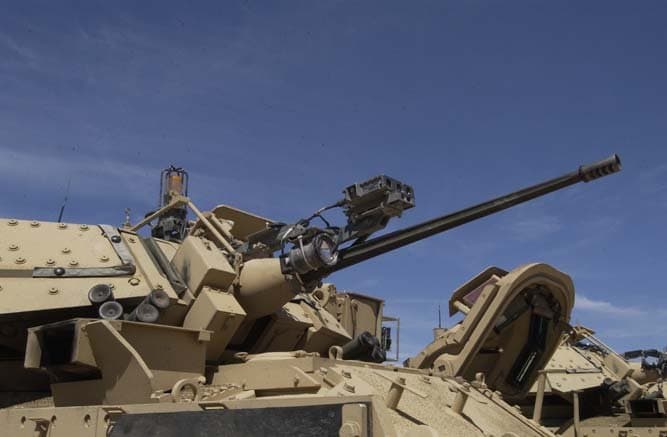

Credit
Simpson · Public domain · Resized · Public domain · Source ↗ · Modified


Preparing your view.
At a glance
Measured figures
Length
Single source2,672 mm (105.2 in)[source]
travelling
Single sourceConfiguration
| Specification | M242 Bushmaster | Oerlikon GDF |
|---|---|---|
| Type | Chain gun autocannon[source] | Autocannon[source] |
| Place of origin | United States[source] | Switzerland (1958–present)[source] |
| In service | 1981–present[source] | 1963–present[source] |
| Used by | See Operators[source] | See Operators |
7.8 m (25 ft 7 in) (travelling)[source]
Effective; Effective firing range
Single sourceMaximum; Maximum firing range
Single sourceRange
Single source3,000 metres (9,800 ft )[source]
6,800 metres (22,300 ft)[source]
230 miles[source]
Effective; Ceiling
Single sourceMaximum; Oerlikon GDF; Ammunition section maximum range
Single sourceBars compare reported quantities only. A larger figure does not make a system better; configurations and test conditions differ.
| Designer | Hughes Helicopters[source] | Oerlikon[source] |
|---|
| Designed | 1976[source] | — |
|---|
| Manufacturer | Hughes Helicopters (1981–1985) McDonnell Douglas Helicopters (1985–2002) Alliant Techsystems (2002–2015) Orbital ATK (2015–2018) Northrop Grumman Innovation Systems (2018–present)[source] | Oerlikon (1958–2009) Rheinmetall (2009–present)[source] |
|---|
| Produced | 1981–present[source] | 1958–present[source] |
|---|
| No. built | >11,000[source] | — |
|---|
| Variants | See variants[source] | — |
|---|
| Shell | 25 × 137 mm[source] | Complete round: 35×228mm, 1.565 kg (3 lb 7 oz)[source] |
|---|
| Barrels | Single barrel (progressive RH parabolic twist)[source] | — |
|---|
| Action | Externally powered, chain driven, open bolt[source] | Gas-operated , propped-lock locking system[source] |
|---|
| Role | 25 mm (25×137mm) single-barrel chain-driven autocannon[source] | — |
|---|
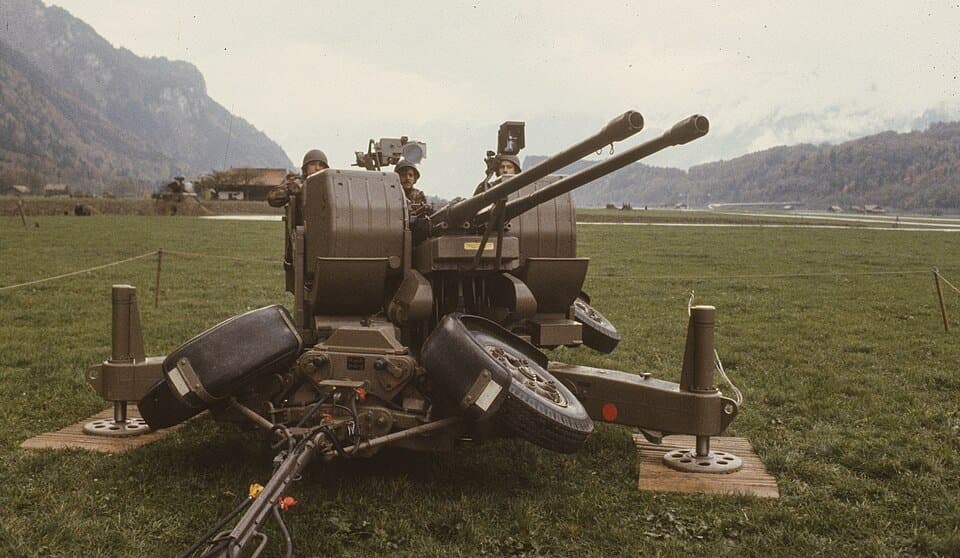
| Source measurement | The M242 Bushmaster chain gun is a 25 mm (25×137mm) single-barrel chain-driven autocannon . It is used extensively by the U.S. military , such as in the Bradley fighting vehicle , as well as by other NATO members and some other nations in ground combat vehicles and various watercraft. Hughes Helicopters in Culver City, California, was the original designer and manufacturer. As of 2019 , Northrop Grumman Innovation Systems produces the gun.[source]M242 Bushmaster · Lead; only the objects and conditions stated in this passage It is an externally-powered, chain-driven, single-barrel weapon that may be fired in semi-automatic, burst, or automatic modes. It is fed by a metallic link belt and has dual-feed capability. The term chain gun derives from the use of a roller chain that drives the bolt back and forth. The gun can destroy lightly armored vehicles and aerial targets such as helicopters and other slow-flying aircraft. It can also apply suppression fire against exposed troops, dug-in positions, and occupied built-up areas. The standard rate of fire is 200 rounds per minute. The weapon has an effective range of 2,000 metres (6,600 ft ), depending on the type of ammunition used. With over 11,000 units sold worldwide, it is one of the most successful modern autocannons.[source]M242 Bushmaster · Lead; only the objects and conditions stated in this passage Unlike most automatic firearms , the M242 does not depend on gas or recoil to actuate its firing system. Instead, it uses a 1 hp (0.75 kW) DC motor , positioned in the receiver to drive the chain and dual-feed system. This system uses sprockets and extractor grooves to feed, load, fire, extract, and eject rounds. A system of clutches provides for an alternate sprocket to engage and thus allows the gunner to switch between armor-piercing and high-explosive rounds .[source]M242 Bushmaster · Description; only the objects and conditions stated in this passage The weapon assembly consists of three parts: the barrel assembly, the feeder assembly, and the receiver assembly. The three-part structure makes it possible for a two-person team to install or remove the system (under ideal conditions) despite its considerable total weight.[source]M242 Bushmaster · Description; only the objects and conditions stated in this passage Low rate fully automatic , in which the weapon fires 100 rounds per minute, ± 25 rounds.[source]M242 Bushmaster · Description; only the objects and conditions stated in this passage High rate fully automatic , in which the weapon fires 200 rounds per minute, ± 25 rounds.[source]M242 Bushmaster · Description; only the objects and conditions stated in this passage The Bushmaster project started as an offshoot of the US Army 's MICV-65 program that was attempting to introduce a new infantry fighting vehicle to replace their existing M113 armored personnel carriers . Part of this program called for a new scout vehicle to replace the M114 , a parallel development taking place under the XM800 Armored Reconnaissance Scout Vehicle . Both the XM800 and the cavalry version of the XM701 MICV vehicles were armed with the M139 , a US-built version of the Hispano-Suiza HS.820 20 mm autocannon. During the testing phase, the Army eventually rejected the XM701 and started work on a newer design known as the XM723. Soon after the XM800 was also rejected. This led to the combination of the two programs, moving the scout role to the cavalry version of the XM723.[source]M242 Bushmaster · History; only the objects and conditions stated in this passage At the same time, the M139 proved to be disappointing and a contract for a new weapon to replace it started as a competitive development in 1972 simultaneously at Ford 's Aeronutronic Division with the PFB-25 (self-powered weapon) and the Hughes Helicopters ' Ordnance Division (externally-powered,) under the Summa Corporation as the Vehicle Rapid-Fire Weapons System-Successor , or VRFWS-S . This was essentially a power-driven gun firing similar 20 mm ammunition to the HS.820, the power-driven mechanism was to ensure operation even in the case of a misfire.[source]M242 Bushmaster · History; only the objects and conditions stated in this passage Progress on the VRFWS-S was slow, and eventually resulted in a switch to a much more powerful, 25 mm, round. Similar delays in the MICV program meant the ultimate vehicles descending from their efforts, the M2/M3 Bradley fighting vehicle, did not enter production until 1981, by which point the Bushmaster had matured. Since 1990, there have been several enhancements made upon the weapon, resulting in the enhanced 25 mm gun .[source]M242 Bushmaster · History; only the objects and conditions stated in this passage The HEI-T can destroy unarmored vehicles and helicopters and suppress anti-tank missile positions and enemy squads out to a maximum effective range of 2,200 meters. Uses the M758 fuse, reported velocity of 1,100 m/sec.[source]M242 Bushmaster · Ammunition; only the objects and conditions stated in this passage The TP-T cartridge is a fixed-type, percussion-primed training round that matches the high explosive incendiary with tracer (HEI-T M792) round ballistically. The TP-T's tracer is visible out to 2,000 meters, however, the round has a maximum effective range (accuracy-limited) of 1,600 meters. Reported velocity of 1,100 m/sec.[source]M242 Bushmaster · Ammunition; only the objects and conditions stated in this passage A Mk 38 MOD 2 25 mm autocannon gun system aboard the amphibious dock landing ship USS Pearl Harbor forward ejecting the spent casings.[source]M242 Bushmaster · Variants; only the objects and conditions stated in this passage The M242 is standard equipment on the U. S. Army M2 and M3 Bradley fighting vehicles; it is also in use on the LAV-25 . Before the project was cancelled, the Mk44 Bushmaster II 30 mm chain gun (a successor to the M242) was used on the Marine Corps' Expeditionary Fighting Vehicle (EFV).[source]M242 Bushmaster · Variants / Ground vehicles; only the objects and conditions stated in this passage In 1977, the U. S. Navy realized that it needed a replacement for the Oerlikon 20 mm Mk 16 series of guns . In 1986, this requirement was satisfied with the introduction of the Mk 38 Mod 0 weapons system. A derivative of the M242 system, the Mk 38 consists of the M242 chain gun and the Mk 88 Mod 0 machine gun mount. It provides ships with defensive and offensive gunfire capability for the engagement of a variety of surface targets. Designed primarily as a close-range defensive measure, it provides protection against patrol boats , floating mines , and various shore-based targets.[source]M242 Bushmaster · Variants / Naval; only the objects and conditions stated in this passage The Mod 3 updates electronics and adds a coaxial 7.62 mm machine gun with a 570-round-per-minute rate of fire.[source]M242 Bushmaster · Variants / Naval / Mk 38 Mod 2 and Mod 3; only the objects and conditions stated in this passage BAE and Boeing teamed together after a March 2011 contract to add a directed energy weapon to the Mk 38 Mod 2 gun mount, known as the Mk 38 Mod 2 tactical laser system . The TLS combines a Boeing-designed solid-state laser with the existing BAE-manufactured Mk 38 mount to deliver high-precision accuracy against fast surface and air threats including speed boats and unmanned aerial vehicles (UAVs). Laser power levels can be adjusted depending on the target and mission objectives. Originally, the system was armed with a 10 kW laser, but in April 2017 BAE announced they had increased power to 60 kW.[source]M242 Bushmaster · Variants / Naval / Aselsan STOP; only the objects and conditions stated in this passage In April 2012, BAE unveiled a potential version of the system mount, developed in collaboration with Rafael Advanced Defense Systems . It is visually distinctive from previous versions with its stealthy housing, which also protects the gun from weather and allows for easier access to internal components through large access panels. The upgrade mounts a larger Alliant Techsystems Mk44 Bushmaster II 30 mm cannon for a 500-meter range increase, as well as a coaxial .50 caliber M2 heavy machine gun . Elevation is increased to +75 degrees for engaging UAVs and helicopters, and ammunition storage is greater at 420 30 mm rounds. Other features include a larger manual fire control panel, an offset mode specifically for firing warning shots, and a surveillance mode where the gun can be pointed away from a target but the EO sensor remains pointed in the target direction. Although it has a high degree of commonality and has the same footprint as previous models, the upgrade is 20 percent heavier due to the greater ammo load.[source]M242 Bushmaster · Variants / Naval / Proposed upgrades; only the objects and conditions stated in this passage | — |
|---|
| Compatible mounting operation | The SABER is a medium calibre one-man, power operated turret that can be fitted on wheeled and tracked armoured vehicles.The SABER turret is equipped with the latest technologies in turret drives, fire control, protection and lethality. Its compact dimensions and light weight make the SABER a suitable choice for different types of armoured vehicles.[source]M242 Bushmaster · FNSS SABER one-man mounting, 25mm M242 configuration | — |
|---|
| Compatible mounting armament | M242 25 mm dual-feed automatic cannon, 40 mm automatic grenade launcher (AGL) or a 12.7 mm machine gun. A 7.62 mm coaxial machine gun is also available with all these configurations.[source]M242 Bushmaster · FNSS SABER one-man mounting, 25mm M242 configuration | — |
|---|
| Wars | — | Iran–Iraq War Falklands War South African Border War 2025 India–Pakistan conflict Twelve-Day War[source] |
|---|
| Carriage | — | 4 wheels with outriggers[source] |
|---|
| Elevation | — | −5°/+92°[source] |
|---|
| Traverse | — | Full 360°[source] |
|---|
| Reported operators |
|---|