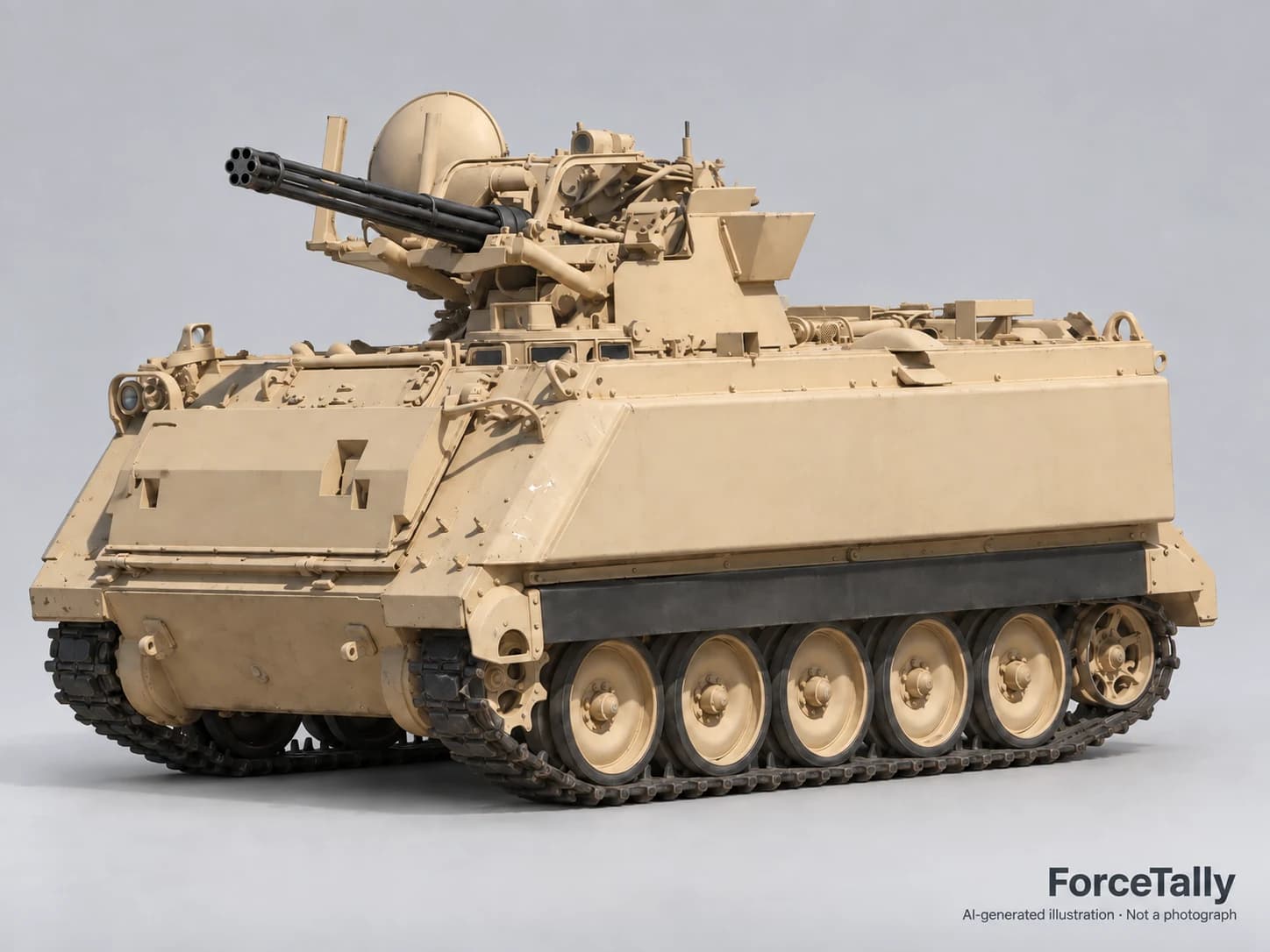
| Source measurement | The M163 Vulcan Air Defense System ( VADS ), officially Gun, Air Defense Artillery, Self-Propelled 20-mm, M163 , is a self-propelled anti-aircraft gun (SPAAG) primarily used by the United States Army . The M163 provides mobile, short-range air defense protection for ground units against low-flying fixed-wing aircraft and helicopters . It replaced the M42 Duster as the standard American armored light air-defense gun.[source]M163 VADS · Lead; only the objects and conditions stated in this passage The M163 VADS uses the M168 gun, a variant of the General Dynamics 20 mm (0.79 in) M61A1 rotary cannon , the standard cannon in most U.S. combat aircraft since the 1960s. The gun is mounted on a modified M113A1 vehicle (the M741 carrier). Designed to complement the M48 Chaparral missile system, it is limited to fair-weather operations. The M163 uses a small range-only AN/VPS-2 radar and an M61 optical lead-calculating sight, and is incapable of using the radar to scan an area for targets. The system is suitable for night operations with the use of AN/PVS series night vision sights that can be mounted to the right side of the primary sight.[source]M163 VADS · Specifications; only the objects and conditions stated in this passage The gun fires at 3,000 rounds per minute in short bursts of 10, 30, 60, or 100 rounds, or it can fire in continuous fire mode at a rate of 1,000 rounds per minute. A linkless feed system is used. Its 20x102mm round gave it a low effective range of only 1,200 meters (3,900 ft), and its standard air-defense load of HEI-T rounds would self-destruct at approximately 1,800 meters (5,900 ft), a hard limit on range. The feed drum holds 1,200 rounds ready to fire, with 800 rounds stowed in reserve for the M163, later increased to 1,030 rounds stowed in reserve for the M163A1 and A2.[source]M163 VADS · Specifications; only the objects and conditions stated in this passage In 1984, the improved PIVADS (Product-Improved VADS) system was introduced, providing improvements in the ease of use and accuracy of fire, but the limitations of the 20×102 mm caliber remained. In 1988, the fourth crewmember (observer/loader) was issued a Stinger launcher and two rounds.[source]M163 VADS · Upgrades and replacement; only the objects and conditions stated in this passage Eventually, the M163 was replaced in US service by the M1097 Avenger and the M6 Linebacker , an M2 Bradley with FIM-92 Stinger missiles instead of the standard TOW anti-tank guided missiles : the Stinger missile providing the necessary range to deal with helicopters with anti-tank missiles far out-ranging the 20 mm gun, as well as considerably extending the reach against fixed-wing targets. The final US Army VADS-equipped unit at Fort Riley Kansas completed turn-in of its Vulcans in 1994.[source]M163 VADS · Upgrades and replacement; only the objects and conditions stated in this passage A close-up of the 20 mm Vulcan cannon on the M163 VADS.[source]M163 VADS · Variants; only the objects and conditions stated in this passage | The Type 09 (PLA military designation: PGZ09 – Chinese : 09式自行高射炮 ; pinyin : 09 shì zì xíng gāoshèpào , "Type 09 self-propelled anti-aircraft artillery") is a Chinese self-propelled anti-aircraft vehicle manufactured by Norinco . It is armed with two 35 millimeter cannons and optionally two to four fire-and-forget infrared homing missiles. It started to gradually replace the predecessor Type 95 in 2009. Some military analysts designated the vehicle as Type 07, but the official designation was confirmed as Type 09 on the Theme Exhibition of the 90th Anniversary of Chinese People's Liberation Army in 2017.[source]PGZ-09 · Lead; only the objects and conditions stated in this passage In 1987, China imported the Oerlikon GDF-002 with manufacture licenses, which was designated as Type 90 twin 35 mm anti-aircraft gun systems in China. Type 90 is mainly designed to engage low-flying target such as Close air support aircraft, helicopters, unmanned aerial vehicles (UAV) and cruise missiles. Type 09 is the self-propelled version of Type 90.[source]PGZ-09 · History; only the objects and conditions stated in this passage Type 09 utilizes a tracked chassis similar to PLZ-05 , which is powered by an 8V150 diesel engine with 800 hp. The chassis features six roadwheels with combined torsion bar and hydropneumatic suspension system and CH700 manual transmission. The tracked design and 800hp engine allows for a road speed of up to 55 km/h. The turret is made of welded steel armor that protects the crew from small arms fire and shell splinters. Over the frontal arc the armor is rated to withstand 14.5mm heavy machine gun round.[source]PGZ-09 · Design; only the objects and conditions stated in this passage The main armaments are PG-99 (Type 90) twin-barrel anti-aircraft guns. The twin-barrel artillery has a combined cyclic rate of 1100 rounds per minute. The vehicle can choose from five types of ammunition before engagement, including HEI (High Explosive Incendiary) with tracer variant, SAPHEI (Semi-armor-piercing high-explosive incendiary) with tracer variant, armor-piercing discarding sabot, programmable Air burst and Target Practice Tracer. The turret has two separate loading mechanism for each barrel. |
|---|