Loading the evidence…
Preparing your view.


At a glance
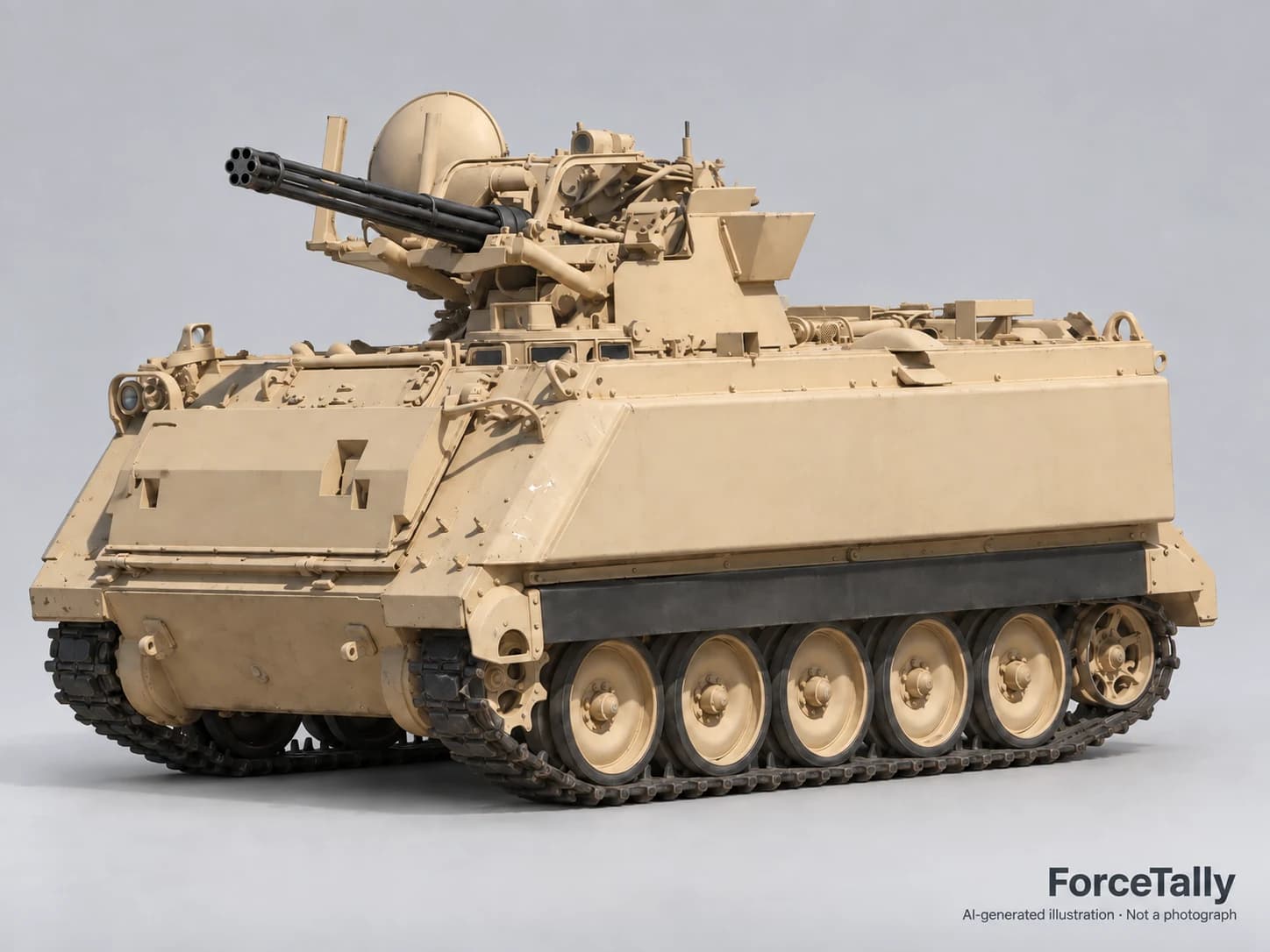
M163 VADSlarger figure on 2 of 4
M53/59 Pragalarger figure on 2 of 4
Counts only measures both sources give with the same scope. A larger figure is not a better system.
True scale
Side by side. From every angle. A human reference for perspective.
3.26 MB · Loads when you open it| Model | Length | Width / span | Height |
|---|---|---|---|
| M163 VADS | ≈ 4.86 m | ≈ 2.49 m (Width) | ≈ 3.69 m |
| M53/59 Praga | ≈ 6.92 m | ≈ 2.35 m (Width) | ≈ 3.65 m |
Scaled uniformly to the sourced length of 4.86 m. Not an official model or a measured survey.
ForceTally · All rights reserved
Scaled uniformly to the sourced length of 6.92 m. The width was fitted to the sourced 2.35 m. Not an official model or a measured survey.
ForceTally · All rights reserved
The human reference is a generic 1.75 m figure. Models describe external size, not combat performance.
Measured figures
Length
Single source191.5 in (4.86 m)[source]
Length
Single sourceConfiguration
| Specification | M163 VADS | M53/59 Praga |
|---|---|---|
| Type | Self-propelled anti-aircraft gun[source] | Self-propelled anti-aircraft gun[source] |
| Place of origin | United States[source] | Czechoslovakia[source] |
| In service | 1968–present[source] | 1959−1992 (Czechoslovakia)[source] |
| Used by | See list of operators[source] | See operators[source] |
6.92 m (22.7 ft)[source]
Operational; M163A1
Single sourceOperational; M163/A2
Single source275 mi (443 km) (M163/A2) 300 mi (480 km) (M163A1)[source]
Effective; Effective firing range
Single sourceMaximum; horizontal
Single sourceper barrel (cyclic)
Single sourceper barrel (practical)
Single source450−500 rpm per barrel (cyclic) 150 rpm per barrel (practical)[source]
Bars compare reported quantities only. A larger figure does not make a system better; configurations and test conditions differ.
| Wars | Vietnam War Western Sahara War 1982 Lebanon War Invasion of Panama Persian Gulf War Israeli–Palestinian conflict Iraq War (limited) Yemeni Civil War Saudi Arabian–led intervention in Yemen 2025 Cambodia-Thailand conflict[source] | Gulf War Yugoslav Wars Second Congo War[source] |
|---|
| Designer | General Electric[source] | — |
|---|
| Designed | 1964[source] | — |
|---|
| Produced | 1965–1970, 1975–1979, 1982[source] | 1959–1978[source] |
|---|
| No. built | 654[source] | 900+[source] |
|---|
| Elevation | +80° / -5°[source] | -10° – +85°[source] |
|---|
| Armor | Rolled 5083/5086 H32 aluminium , 29 mm (1.14 in) - 45 mm (1.77 in)[source] | Steel, 10 mm (0.39 in) max (estimated)[source] |
|---|
| Main armament | M168 General Dynamics 20 mm Rotary cannon 2,000 rounds (M163) 2,230 rounds (M163A1/A2)[source] | 30 mm twin AA autocannon (600−900 rounds)[source] |
|---|
| Suspension | torsion bar , 5 road wheels[source] | — |
|---|
| Former operator · Portugal | Portugal[source] | — |
|---|
| Former operator · Israel | Israel[source] | — |
|---|
| Former operator · Sudan | Sudan[source] | — |
|---|
| Former operator · Yemen | Yemen[source] | — |
|---|
| Role | self-propelled anti-aircraft gun (SPAAG) primarily[source] | Czechoslovak self-propelled anti-aircraft gun[source] |
|---|
| Source measurement | The M163 Vulcan Air Defense System ( VADS ), officially Gun, Air Defense Artillery, Self-Propelled 20-mm, M163 , is a self-propelled anti-aircraft gun (SPAAG) primarily used by the United States Army . The M163 provides mobile, short-range air defense protection for ground units against low-flying fixed-wing aircraft and helicopters . It replaced the M42 Duster as the standard American armored light air-defense gun.[source]M163 VADS · Lead; only the objects and conditions stated in this passage The M163 VADS uses the M168 gun, a variant of the General Dynamics 20 mm (0.79 in) M61A1 rotary cannon , the standard cannon in most U.S. combat aircraft since the 1960s. The gun is mounted on a modified M113A1 vehicle (the M741 carrier). Designed to complement the M48 Chaparral missile system, it is limited to fair-weather operations. The M163 uses a small range-only AN/VPS-2 radar and an M61 optical lead-calculating sight, and is incapable of using the radar to scan an area for targets. The system is suitable for night operations with the use of AN/PVS series night vision sights that can be mounted to the right side of the primary sight.[source]M163 VADS · Specifications; only the objects and conditions stated in this passage The gun fires at 3,000 rounds per minute in short bursts of 10, 30, 60, or 100 rounds, or it can fire in continuous fire mode at a rate of 1,000 rounds per minute. A linkless feed system is used. Its 20x102mm round gave it a low effective range of only 1,200 meters (3,900 ft), and its standard air-defense load of HEI-T rounds would self-destruct at approximately 1,800 meters (5,900 ft), a hard limit on range. The feed drum holds 1,200 rounds ready to fire, with 800 rounds stowed in reserve for the M163, later increased to 1,030 rounds stowed in reserve for the M163A1 and A2.[source]M163 VADS · Specifications; only the objects and conditions stated in this passage In 1984, the improved PIVADS (Product-Improved VADS) system was introduced, providing improvements in the ease of use and accuracy of fire, but the limitations of the 20×102 mm caliber remained. In 1988, the fourth crewmember (observer/loader) was issued a Stinger launcher and two rounds.[source]M163 VADS · Upgrades and replacement; only the objects and conditions stated in this passage Eventually, the M163 was replaced in US service by the M1097 Avenger and the M6 Linebacker , an M2 Bradley with FIM-92 Stinger missiles instead of the standard TOW anti-tank guided missiles : the Stinger missile providing the necessary range to deal with helicopters with anti-tank missiles far out-ranging the 20 mm gun, as well as considerably extending the reach against fixed-wing targets. The final US Army VADS-equipped unit at Fort Riley Kansas completed turn-in of its Vulcans in 1994.[source]M163 VADS · Upgrades and replacement; only the objects and conditions stated in this passage A close-up of the 20 mm Vulcan cannon on the M163 VADS.[source]M163 VADS · Variants; only the objects and conditions stated in this passage | The M53/59 Praga is a Czechoslovak self-propelled anti-aircraft gun developed in the late 1950s. It consists of an armoured version of the Praga V3S six-wheel drive truck chassis, armed with a modified version of the M53 twin 30 mm (1.2 in) anti-aircraft gun mounted on the rear, which can be removed and used to provide ground support.[source]M53/59 Praga · Lead; only the objects and conditions stated in this passage The twin guns have an elevation of +85°, and a depression of −10°, except over the crew compartment where the depression is limited to +2° and the commander's cupola where there is none. A steel plate on the back of the crew compartment prevents the gun barrels from hitting the roof. The turret can fully traverse 360° degrees and the traverse, elevation, and depression hydraulic systems can be manually controlled in case of emergency. The gunner is seated on the left side of the turret under the armoured cabin protection.[source]M53/59 Praga · Description; only the objects and conditions stated in this passage The 30 mm twin autocannons are gas-operated , with a maximum rate of fire of 450 to 500 rounds per barrel/minute and a practical rate of fire of 150 rounds per barrel/minute. Each gun has a 50-round magazine which are fed with 10-round clips. Each vehicle typically carries around 600 to 800 rounds. Fully loaded magazines are carried in the back of the crew compartment fastened to the floor by quick-release catches, while three spare magazines are carried on either side of the platform. Originally the guns were fitted with muzzle brakes , but they were later observed with conical flash hiders instead. The barrels can be quickly changed when overheated, and spare barrels were provided to the crews as part of the basic equipment.[source]M53/59 Praga · Description; only the objects and conditions stated in this passage Maximum horizontal range is 9.7 km (6 mi), maximum vertical range is 6.3 km (4 mi), and effective anti-aircraft range is 3 km (2 mi). The M53 guns can fire armor-piercing incendiary rounds capable of penetrating 55 mm (2.2 in) of RHA at a 0° angle at a range of 500 m (550 yd) and high-explosive incendiary rounds. |
|---|

| Manufacturer | General Electric[source] | Praga[source] Praga[source] Strojárske a metalurgické závody, závod Trenčín-Kubrá (1959–1961) Škoda, n. p., Plzeň[source]M53/59 own native Manufacturer row · original Trenčín-Kubrá 1959–1961 and Škoda Plzeň production, retaining source dates |
|---|
| Shell | — | Armour-piercing incendiary (API) High-explosive incendiary (HEI)[source] |
|---|
| Barrels | — |
|---|
| Action | — | Gas-operated[source] |
|---|
| Traverse | — | 360°[source] |
|---|
| Feed system | — | 50-round box magazines[source] |
|---|
| Power/weight | — | 11.57 hp/t (8.63 kW/t)[source] |
|---|
| Transmission | — | Manual with 4 forward and 2 reverse gears[source] |
|---|
| Fuel capacity | — | 120 L (26 imp gal; 32 US gal)[source] |
|---|
| Former operator · Bosnia and Herzegovina | — | Bosnia and Herzegovina[source] |
|---|
| Former operator · Croatia | — | Croatia[source] |
|---|
| Former operator · Czech Republic | — | Czech Republic[source] |
|---|
| Former operator · Czechoslovakia | — | Czechoslovakia[source] |
|---|
| Former operator · Herzeg-Bosnia | — | Herzeg-Bosnia[source] |
|---|
| Former operator · Iraq | — | Iraq[source] |
|---|
| Former operator · Libya | — | Libya[source] |
|---|
| Former operator · Republika Srpska | — | Republika Srpska[source] |
|---|
| Former operator · Serbia and Montenegro | — | Serbia and Montenegro[source] |
|---|
| Former operator · Serbian Krajina | — | Serbian Krajina[source] |
|---|
| Former operator · Slovakia | — | Slovakia[source] |
|---|
| Former operator · Slovenia | — | Slovenia[source] |
|---|
| Former operator · Yugoslavia | — | Yugoslavia[source] |
|---|
| Reported operators |
|
|---|
Maximum; vertical
Single sourceOperational; Operational range
Single source3,000 m (9,800 ft)[source]
9,700 m (31,800 ft) (horizontal) 6,300 m (20,700 ft) (vertical)[source]
500 km (310 mi)[source]
The system lacks radar guidance, and night vision equipment, which makes it only effective during the day under good weather conditions. Other drawbacks of the M53/59 are the lack of a NBC protection system, no amphibious capabilities, and no central tire pressure regulation system. It also suffers from poor cross-country mobility, preventing effective coordination with tracked vehicles. Despite these drawbacks, the Czechoslovak Army used the M53/59 in place of the Soviet ZSU-57-2 .[source]M53/59 Praga · Description; only the objects and conditions stated in this passage
Praga VS35 M19 − A proposed upgrade by Srboauto in 2019 to meet the requirements of the Serbian Armed Forces . Improvements included a new four-door cab fully armoured to the NATO STANAG 4569 Level 2 standard, fitted with bullet/splinter proof windows on the front and sides and an Eberspächer 8 kW (11 hp) heater installed in the crew compartment.[source]M53/59 Praga · Variants / Serbia; only the objects and conditions stated in this passage
At least one M53/59 was seen in 2012 in the city of Goma . While its exact origin is unknown (possibly from Serbia, Slovakia, or Libya), it is known that the newly reformed DRC Army was armed with weapons left by the former Zairean Army and whatever could be purchased abroad.[source]M53/59 Praga · Combat history / Democratic Republic of Congo; only the objects and conditions stated in this passage