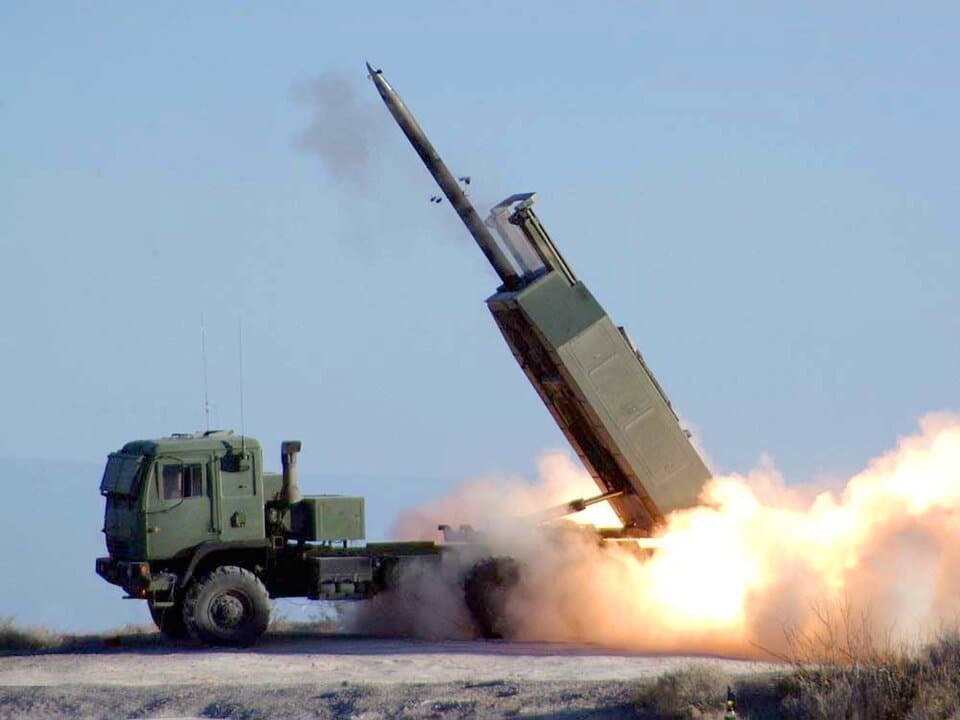

Credit
U.S. Army photo · Public domain · Resized · Public domain · Source ↗ · Modified


Preparing your view.

At a glance
M142 HIMARSlarger figure on 2 of 5
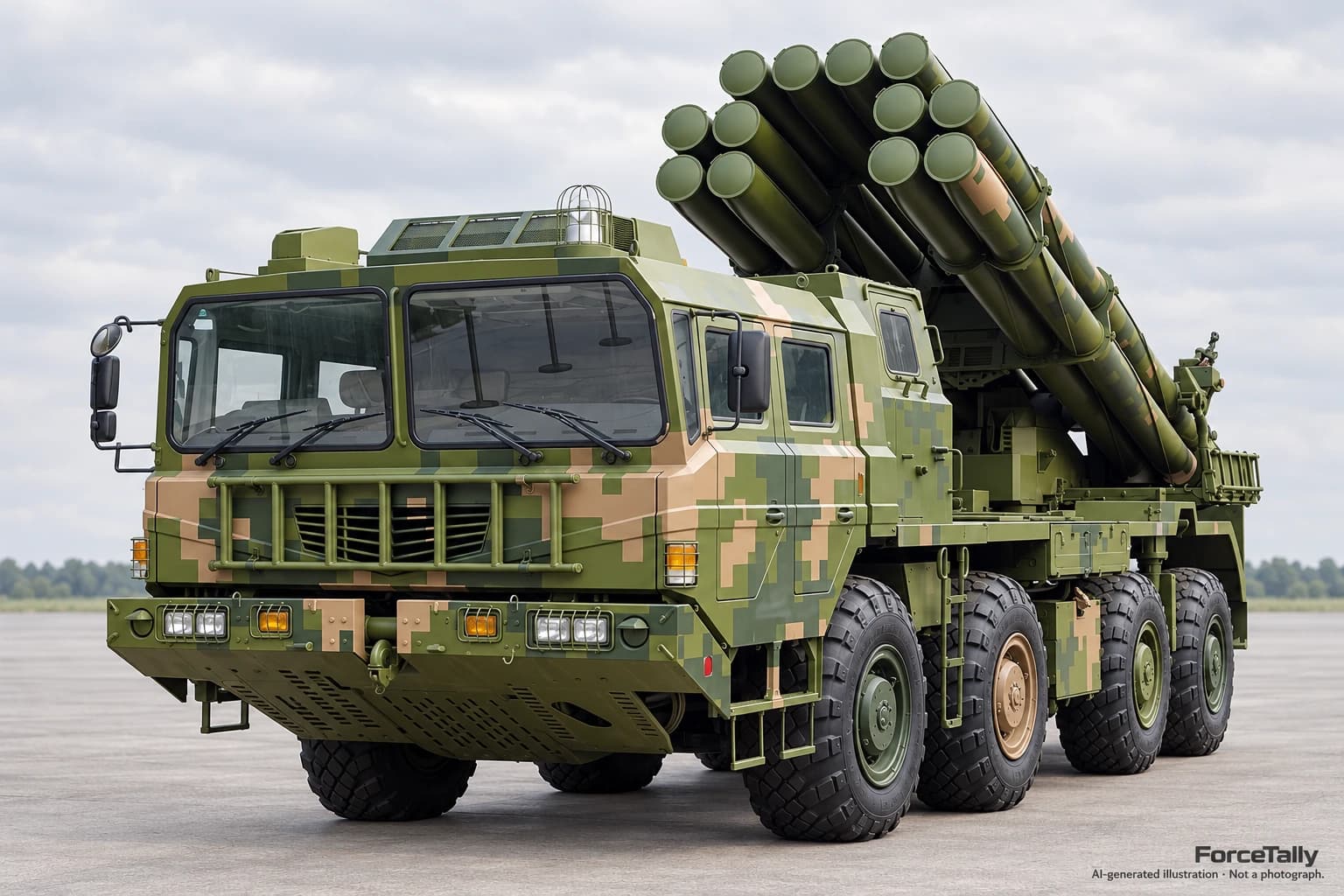
PHL-03
True scale
Side by side. From every angle. A human reference for perspective.
3.32 MB · Loads when you open it| Model | Length | Width / span | Height |
|---|---|---|---|
| M142 HIMARS | ≈ 6.94 m | ≈ 2.66 m (Width) | ≈ 2.75 m |
| PHL-03 | ≈ 12 m | ≈ 3 m (Width) | ≈ 3.42 m |
Scaled uniformly to the sourced length of 6.94 m. The shape was turned square to the axes. Not an official model or a measured survey.
ForceTally · All rights reserved
Scaled uniformly to the sourced length of 12 m. The width was fitted to the sourced 3 m. Not an official model or a measured survey.
ForceTally · All rights reserved
The human reference is a generic 1.75 m figure. Models describe external size, not combat performance.
Measured figures
Length
Single source6.94 m (22 ft 9 in)[source]
Length
Single sourceConfiguration
| Specification | M142 HIMARS | PHL-03 |
|---|---|---|
| Type | Multiple rocket launcher Tactical ballistic missile[source] | Multiple rocket launcher[source] |
| Place of origin | United States[source] | China[source] |
| In service | 2005–present[source] | 2004–present[source] |
| Used by | See Operators[source] | People's Liberation Army Ground Force Ethiopian Ground Forces Royal Moroccan Armed Forces Tanzania People's Defence Force |
Counts only measures both sources give with the same scope. A larger figure is not a better system.
12 m (39 ft 4 in)[source]
Operational; Operational range
Single sourceEffective; AT2
Single sourceEffective; ER GMLRS
Single sourceEffective; GLSDB
Single sourceEffective; M26
Single sourceEffective; M26A1 ER / A2 ER
Single sourceEffective; M30
Single sourceEffective; M31
Single sourceEffective; M32
Single sourceEffective; M39
Single sourceEffective; M39A1
Single sourceEffective; M48
Single sourceEffective; M57
Single sourceEffective; PrSM
Single sourceM26 : 15 to 32 km (9.3 to 20 mi) M26A1 ER / A2 ER : 15 to 45 km (9.3 to 28 mi) AT2 : 15 to 38 km (9.3 to 24 mi) M30 : 15 to 92 km (9.3 to 57 mi) M31 : 15 to 92 km (9.3 to 57 mi) M32 : 15 to 92 km (9.3 to 57 mi) ER GMLRS : 150 km (93 mi) GLSDB : 150 km (93 mi) M39 : 25 to 165 km (16 to 100 mi) M39A1 : 20 to 300 km (12 to 190 mi) M48 : 70 to 300 km (43 to 190 mi) M57 : 70 to 300 km (43 to 190 mi) PrSM : 60 to 499 km (37 to 310 mi)[source]
480 km (300 mi)[source]
up to and in excess of 400 kilometers[source]Current and future Multiple Launch Rocket System Family of Munitions; different munitions, not one uniform launcher rangeSource text · numeric interpretation needs review
Operational; Operational range
Single sourceMaximum; Maximum firing range
Single sourceHIMARS-compatible GMLRS rockets only; not ATACMS or PrSM
Single sourceHIMARS-compatible MLRS rockets only; not ATACMS or PrSM
Single source227 mm[source]HIMARS-compatible MLRS rockets only; not ATACMS or PrSM
227 mm[source]HIMARS-compatible GMLRS rockets only; not ATACMS or PrSM
Caliber
Single source300 mm (12 in)[source]
Bars compare reported quantities only. A larger figure does not make a system better; configurations and test conditions differ.
| Wars | War in Afghanistan (2001–2021) Syrian Civil War War in Iraq (2013–2017) Russo-Ukrainian War Russian invasion of Ukraine 2026 Iran war[source] | Tigray War[source] |
|---|
| Manufacturer | Lockheed Martin Missiles and Fire Control[source] | China Ordnance Industries Group Corporation Limited[source] |
|---|
| Unit cost | Domestic cost: $3.5 million per one launcher+carrier (FY 2014); $4,901,857 per one launcher (FY 2024), $168,000 per one M31 GMLRS (FY 2023) Export cost: $19–20 million per one launcher+carrier (FY 2022); $434,000 per one M31ER GMLRS (FY 2022)[source] | — |
|---|
| Produced | 2003–2013 (first production run) 2017–present (second production run)[source] | — |
|---|
| No. built | 750 (as of November 2025)[source] | — |
|---|
| Traverse | 360°[source] | — |
|---|
| Main armament | 6 × MLRS or 2 x PrSM or 1 × MGM-140 ATACMS[source] | — |
|---|
| Power/weight | 20.31 hp/t (15.1 kW/t) (combat weight)[source] | — |
|---|
| Accuracy | 186 miles range (300 km) within 3 feet (1 meter)[source] | — |
|---|
| Role | light multiple rocket launcher[source] | — |
|---|
| Source measurement | The HIMARS carries one pod with either six Guided Multiple Launch Rocket System (GMLRS) rockets or one Army Tactical Missile System (ATACMS) missile. It is based on the U.S. Army's FMTV five-ton truck, and is capable of launching all rockets in the Multiple Launch Rocket System Family of Munitions . HIMARS ammunition pods are interchangeable with the M270 MLRS . It has a single pod, as opposed to the standard two for the M270 and its variants.[source]M142 HIMARS · Lead; only the objects and conditions stated in this passage In February 2010, the International Security Assistance Force (ISAF) for Afghanistan indicated in a press release that two rockets fired from a HIMARS were believed to have fallen 300 metres short of their intended target, killing 12 civilians during Operation Moshtarak . ISAF suspended the use of the HIMARS until a full review of the incident was completed. A British officer later said that the rockets were on target, that the target was in use by the Taliban , and that use of the system had been reinstated. Reports indicated that the civilian deaths were due to the Taliban's use of human shields . The presence of civilians at that location had not been known to the ISAF forces. A report in the New York Times in October 2010 credited the HIMARS with aiding the NATO offensive in Kandahar by targeting Taliban commanders' hideouts, forcing many to flee to Pakistan, at least temporarily.[source]M142 HIMARS · Operational history / Afghanistan and the Middle East; only the objects and conditions stated in this passage In October 2016, HIMARS were stationed at Qayyarah Airfield West , some 65 kilometres (40 mi) south of Mosul, taking part in the Battle of Mosul .[source]M142 HIMARS · Operational history / Afghanistan and the Middle East; only the objects and conditions stated in this passage On 24 May 2018, a HIMARS strike killed 50 Taliban fighters and leaders in Musa Qala , Afghanistan. Three rockets struck the building within a 14-second timespan.[source]M142 HIMARS · Operational history / Afghanistan and the Middle East; only the objects and conditions stated in this passage In September 2018, US support forces coordinated with Syrian Democratic Forces fighting to defeat ISIS in east Syria in the Deir ez-Zor campaign , sometimes striking ISIS positions with GMLRS rockets 30 times per day. The HIMARS used in this support operation were located in the Omar oilfields, some 25 km (16 mi) north of the ISIS-controlled targets.[source]M142 HIMARS · Operational history / Afghanistan and the Middle East; only the objects and conditions stated in this passage On 1 June 2022, the US announced that it would be supplying four HIMARS to Ukraine with M31 GMLRS unitary rockets. On 23 June, the first HIMARS arrived in Ukraine, according to Ukrainian Defense Minister Oleksii Reznikov . On 25 June 2022, Ukraine started deploying the system against Russian forces during the 2022 Russian invasion of Ukraine . According to the Commander-in-Chief of the Armed Forces of Ukraine , Valeriy Zaluzhnyi , "Artillerymen of the Armed Forces of Ukraine hit ... military targets of the enemy on our, Ukrainian, territory". The Ukrainian military stated that this first strike, on a Russian base in Izyum, killed over 40 soldiers. The day before, a second batch of four was announced to be delivered in mid-July.[source]M142 HIMARS · Operational history / Ukraine; only the objects and conditions stated in this passage On 30 August 2022, The Washington Post reported on Ukrainian claims to have successfully used decoy HIMARS units made out of wood to draw at least 10 Russian 3M-54 Kalibr cruise missiles. One US diplomat stated that Russian sources had claimed more HIMARS destroyed than the US had sent. A Pentagon official had earlier in the month asserted that no HIMARS had been destroyed at that time. On 8 September, US General Mark Milley , chairman of the Joint Chiefs of Staff, told reporters: "We are seeing real and measurable gains from Ukraine in the use of these systems. For example, the Ukrainians have struck over 400 targets with the HIMARS and they've had devastating effect".[source]M142 HIMARS · Operational history / Ukraine; only the objects and conditions stated in this passage On 10 February 2024, two Ukrainian HIMARS systems were seen arriving onboard an Antonov Airlines An-124-100M at Harrisburg International Airport in Pennsylvania. Both systems appeared damaged, with one having cracked windows in the crew compartment, and the other missing its front right wheel.[source]M142 HIMARS · Operational history / Ukraine; only the objects and conditions stated in this passage On 21 May 2025, it was reported that a Ukrainian HIMARS rocket launcher had recently been destroyed just 10 kilometers from the frontline near Chasiv Yar in Donetsk Oblast by a Russian drone operated by Rubicon —an elite unmanned aerial unit.[source]M142 HIMARS · Operational history / Ukraine; only the objects and conditions stated in this passage MLRS is a series of 227 mm rockets.[source]M142 HIMARS · Armament / MLRS; only the objects and conditions stated in this passage M26 rockets carrying 644 DPICM M77 submunitions. Range: 15–32 km (9.3–19.9 mi).[source]M142 HIMARS · Armament / MLRS; only the objects and conditions stated in this passage M26A1 ER rockets carrying 518 M85 submunitions. Range: 15–45 km (9.3–28.0 mi).[source]M142 HIMARS · Armament / MLRS; only the objects and conditions stated in this passage M26A2 ER rockets carrying 518 M77 submunitions. Range: 15–45 km (9.3–28.0 mi).[source]M142 HIMARS · Armament / MLRS; only the objects and conditions stated in this passage AT2 German M26 variant carrying 28 AT2 anti-tank mines. Range: 15–38 km (9.3–23.6 mi)[source]M142 HIMARS · Armament / MLRS; only the objects and conditions stated in this passage M28A1 Reduced-Range Practice Rocket (RRPR) with blunt nose. Range reduced to 9 km (5.6 mi).[source]M142 HIMARS · Armament / MLRS; only the objects and conditions stated in this passage M28A2 Low-Cost Reduced-Range Practice Rocket (LCRRPR) with blunt nose. Range reduced to 9 km (5.6 mi).[source]M142 HIMARS · Armament / MLRS; only the objects and conditions stated in this passage Guided Multiple Launch Rocket System (GMLRS) 227 mm rockets have an extended range and add GPS -aided guidance to their Inertial Navigation System . GMLRS rockets were introduced in 2005 and the M30 and M31 rockets are, except for their warheads, identical. As of 1 December 2021 50,000 GMLRS rockets have been produced, with yearly production now exceeding 9,000 rockets. Each rocket pod contains 6 identical rockets. Both Lockheed Martin and the U.S. Army report that the GMLRS has a maximum range of 70+ km (43+ mi). According to a U.S. Department of Defense document the maximum demonstrated performance of a GMLRS is 84 km (52 mi), a figure also reported elsewhere. Another source reports a maximum range of about 90 km (56 mi). In 2009 Lockheed Martin announced that a GMLRS had been successfully test fired 92 km (57 mi).[source]M142 HIMARS · Armament / MLRS / GMLRS; only the objects and conditions stated in this passage M30 rockets carrying 404 DPICM M101 submunitions. Range: 15–92 km (9.3–57.2 mi). 3,936 produced between 2004 and 2009, production ceased in favor of the M30A1. The remaining M30 rockets are being updated with either the M30A1 or M31A1 warhead.[source]M142 HIMARS · Armament / MLRS / GMLRS; only the objects and conditions stated in this passage M30A1 rockets with Alternative Warhead (AW). Range: 15–92 km (9.3–57.2 mi). GMLRS rocket that replaces the M30's submunitions with approximately 182,000 pre-formed tungsten fragments for area effects without unexploded ordnance. Entered production in 2015. This warhead is superior not just because it does not use cluster munitions but is also superior to a normal high explosive round: "A high explosive round is very impressive because it produces a big bomb and large pieces of shrapnel, but this round is small pellets and covers a much larger area." The M30A1 uses a proximity sensor fuze mode with a 10 meter burst height.[source]M142 HIMARS · Armament / MLRS / GMLRS; only the objects and conditions stated in this passage M30A2 rockets with Alternative Warhead (AW). Range: 15–92 km (9.3–57.2 mi). Improved M30A1 with Insensitive Munition Propulsion System (IMPS). Only M30 variant in production since 2019.[source]M142 HIMARS · Armament / MLRS / GMLRS; only the objects and conditions stated in this passage M31 rockets with 200 lb (91 kg) high-explosive unitary warhead. Range: 15–92 km (9.3–57.2 mi). Entered production in 2005. The warhead is produced by General Dynamics and contains 51 pounds (23 kg) of PBX-109 high explosive in a steel blast-fragmentation case.[source]M142 HIMARS · Armament / MLRS / GMLRS; only the objects and conditions stated in this passage M31A1 rockets with 200 lb (91 kg) high-explosive unitary warhead. Range: 15–92 km (9.3–57.2 mi). Improved M31 with new multi-mode fuze that added airburst to the M31's fuze point detonation and delay.[source]M142 HIMARS · Armament / MLRS / GMLRS; only the objects and conditions stated in this passage M31A2 rockets with 200 lb (91 kg) high-explosive unitary warhead. Range: 15–92 km (9.3–57.2 mi). Improved M31A1 with Insensitive Munition Propulsion System (IMPS). Only M31 variant in production since 2019.[source]M142 HIMARS · Armament / MLRS / GMLRS; only the objects and conditions stated in this passage ER GMLRS rockets with extended range beyond 150 km (93 mi). Rockets use a slightly increased rocket motor size, a newly designed hull, and tail-driven guidance while still containing six per pod. It will come in unitary and AW variants. The first successful test flight of an ER GMLRS occurred in March 2021. Lockheed Martin anticipates adding the ER to its production line in the fiscal year 2023 contract award, and is planning to produce the new rockets at its Camden facility. Full operational capability is planned for 2025. In 2022 Finland became the first foreign customer to order ER GMLRS. In November 2022 Lithuania announced that it will obtain GMLRS-ER. In February 2023, Poland ordered GMLRS-ER AW missiles.[source]M142 HIMARS · Armament / MLRS / GMLRS; only the objects and conditions stated in this passage The Ground Launched Small Diameter Bomb (GLSDB) is an M26-rocket based weapon made by Boeing and the Saab Group , who modified Boeing's GBU-39 Small Diameter Bomb (SDB) with the addition of an obsolete M26 rocket motor. It has a range of up to 150 km (93 mi).[source]M142 HIMARS · Armament / GLSDB; only the objects and conditions stated in this passage The Army Tactical Missile System (ATACMS) is a series of 610 mm surface-to-surface missile (SSM) with a range of up to 300 km (190 mi). Each rocket pod contains one ATACMS missile. As of 2022 , only the M48, M57, and M57E1 remain in the US military's arsenal.[source]M142 HIMARS · Armament / ATACMS; only the objects and conditions stated in this passage M39 (ATACMS BLOCK I) missile with inertial guidance. The missile carries 950 M74 Anti-personnel and Anti‑materiel (APAM) bomblets. Range: 25–165 km (16–103 mi). 1,650 M39 were produced between 1990 and 1997, when production ceased in favor of the M39A1. During Desert Storm 32 M39 were fired at Iraqi targets, and during Operation Iraqi Freedom a further 379 M39 were fired. The remaining M39 missiles are being updated to M57E1 missiles. The M39 is the only ATACMS variant, which can be fired by all MLRS and HIMARS variants.[source]M142 HIMARS · Armament / ATACMS; only the objects and conditions stated in this passage M39A1 (ATACMS BLOCK IA) missile with GPS-aided guidance. The missile carries 300 M74 APAM bomblets. Range: 20–300 km (12–186 mi). 610 M39A1 were produced between 1997 and 2003. During Operation Iraqi Freedom 74 M39A1 were fired at Iraqi targets. The remaining M39A1 missiles are being updated to M57E1 missiles. The M39A1 and all subsequently introduced ATACMS missiles can be used only with the M270A1 (or variants thereof) and the HIMARS.[source]M142 HIMARS · Armament / ATACMS; only the objects and conditions stated in this passage M48 (ATACMS Quick Reaction Unitary; QRU) missile with GPS-aided guidance. The missile carries the 500-pound (230 kg) WDU-18/B penetrating high explosive blast fragmentation warhead of the US Navy 's Harpoon anti-ship missile, which was packaged into the newly designed WAU-23/B warhead section. Range: 70–300 km (43–186 mi). 176 M48 were produced between 2001 and 2004, when production ceased in favor of the M57. During Operation Iraqi Freedom 16 M48 were fired at Iraqi targets; a further 42 M48 were fired during Operation Enduring Freedom . The remaining M48 missiles remain in the U.S. Army and US Marine Corps ' arsenal.[source]M142 HIMARS · Armament / ATACMS; only the objects and conditions stated in this passage M57 (ATACMS TACMS 2000) missile with GPS-aided guidance. The missile carries the same WAU-23/B warhead section as the M48. Range: 70–300 km (43–186 mi). 513 M57 were produced between 2004 and 2013.[source]M142 HIMARS · Armament / ATACMS; only the objects and conditions stated in this passage The Precision Strike Missile (PrSM) is a new series of GPS-guided missiles, which will begin to replace ATACMS missiles in 2024. PrSM carries a newly designed area-effects warhead and has a range of 60–499 km (37–310 mi). PrSM missiles can be launched from the M270A2 and the HIMARS, with rockets pods containing 2 missiles. As of 2022 , the PrSM is in low-rate initial production , with 110 missiles being delivered to the US military over the year. PrSM will enter operational service in 2023.[source]M142 HIMARS · Armament / PrSM; only the objects and conditions stated in this passage In 2023, Rheinmetall and Lockheed Martin signed a collaboration agreement for the development of the Global Mobility Artillery System (GMARS) to address the need for future long-range artillery. The GMARS launcher consists of two pods as opposed to HIMARS' single pod. Current munition options include the MFOM family of munitions such as GMLRS, ER-GMLRS, MGM-140 ATACMS and Precision Strike Missile . Surfaced launched version of AGM-158 JASSM and 122 mm unguided rockets are expected to be integrated later. It was unveiled during the Eurosatrory 2024 and mounted on Rheinmetall's HX 8x8 chassis. Both Rheinmetall and Lockheed Martin are actively engaging with European customers for potential sales.[source]M142 HIMARS · Related developments / GMARS; only the objects and conditions stated in this passage Republic of China Army 11 in service, 100 more planned 10th Army Corps 58th Artillery Command[source]M142 HIMARS · Operators; only the objects and conditions stated in this passage Canadian Army : The Long Range Precision Fires Project identified the M142 HIMARS as the most suitable choice. A US Foreign Military Sale was approved in Oct. 2025 in response to a Canadian request to buy 26 HIMARS launchers, 328 GMLRS pods, 64 ATACMS pods, and related equipment for approximately US$1.75 billion. The formal contract was reportedly signed in Jan. 2026, and in Apr. 2026 production of HIMARS for Canada was confirmed in DoD contract announcements. The Canadian Army is planning to take delivery of the first systems in 2029.[source]M142 HIMARS · Operators / Future operators; only the objects and conditions stated in this passage | — |
|---|
| Capacity | six rockets or one missile[source]HIMARS · launcher ammunition | — |
|---|
| Launcher capacity | one pod of precision rockets/missiles[source]HIMARS launcher · one pod; rocket count not stated | — |
|---|
| Barrels | — | 12[source] |
|---|
| Suspension | — | 8×8 wheeled[source] |
|---|