
FORCETALLY
Loading the evidence…
Preparing your view.


Preparing your view.

Measured figures
Configuration
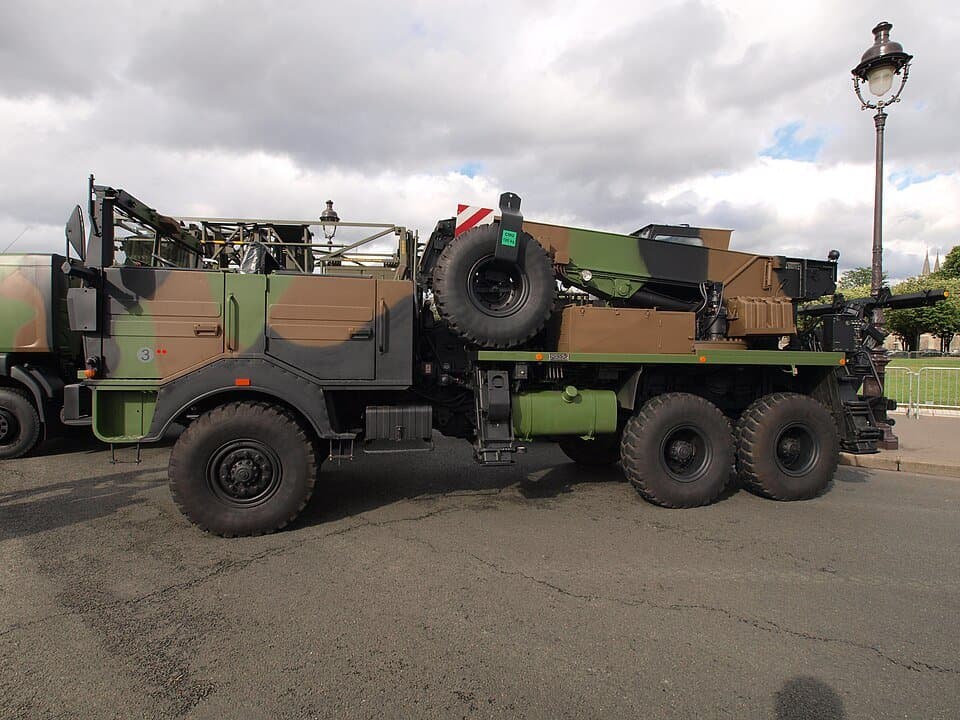
| Specification | M1301 infantry squad vehicle | Renault TRM 10000 |
|---|---|---|
| Type | Light utility vehicle[source] | Heavy cargo truck[source] |
| Place of origin | United States[source] | France[source] |
| In service | 2020–present[source] | 1987–Present[source] |
| Manufacturer | GM Defense Ricardo plc Rod Hall Products Hendrick Motorsports[source] |
Width
Single source2.50 m[source]
Maximum; Maximum speed
Single source89 km/h[source]
Operational; Operational range
Single source1,200 km[source]
Bars compare reported quantities only. A larger figure does not make a system better; configurations and test conditions differ.
Renault Trucks[source] |
| Produced | 2020–present[source] | 1985 to Present[source] |
|---|
| Payload capacity | 3,200 pounds (1,500 kg)[source] | 10,000 kg[source] |
|---|
| Transmission | 6L50 Six-speed automatic[source] | — |
|---|
| Role | air-transportable high-speed, light utility vehicle selected[source] | — |
|---|
| Source measurement | The operational requirements of the ISV were nine passengers, a payload of 3,200 pounds (1,500 kg), transportable by external sling load by a Sikorsky UH-60 Black Hawk helicopter, internal load/external lift by Boeing CH-47 Chinook helicopter, low-velocity air drop by Lockheed C-130 Hercules or Boeing C-17 Globemaster III transport aircraft and exceptional mobility over all terrains allowing Infantry Brigade Combat Teams to move with their equipment over difficult terrain.[source]M1301 infantry squad vehicle · Development; only the objects and conditions stated in this passage The ISV is a doorless body-on-frame design, with steel and aluminum body panels. It is capable of seating 9 personnel (the size of a standard US Army rifle or weapons squad ) in a 2/3/2/2 configuration within a simple roll-over protection structure . In addition to its occupants the ISV can store their rucksacks and sustainment items like water and ammunition. The ISV can be transported by the UH-60 Blackhawk via sling load , and internally carried in the CH-47 Chinook .[source]M1301 infantry squad vehicle · Design; only the objects and conditions stated in this passage M1301 with nine paratroopers conducting 50-kilometer road test after parachute drop[source]M1301 infantry squad vehicle · Design; only the objects and conditions stated in this passage In August 2022, the Army revealed it was developing a directed energy weapon to protect IBCTs from small drones . The program is called the Army Multipurpose High Energy Laser (AMP-HEL) and plans to integrate a 20 kW laser onto an ISV in 2023, which is enough power to defend against group one and two UAVs .[source]M1301 infantry squad vehicle · Variants / AMP-HEL; only the objects and conditions stated in this passage TEWS-I is an all-weather, 24-hour mounted capability that enables commanders to detect, locate, and identify enemy radio frequency emitters and apply non-lethal electronic effects to disrupt, deny, or degrade adversary communications and coordination.[source]M1301 infantry squad vehicle · Variants / TEWS-I; only the objects and conditions stated in this passage In October 2025, the U.S. Army’s 2nd Battalion, 35th Infantry Regiment tested the Scorpion Mortar system mounted on an ISV-U. Each ISV-U carrying the Scorpion Mortar system is equipped with an M252 81mm mortar and 72 mortar rounds. The system features an advanced digital fire control system , enabling rapid and accurate targeting and re-aiming with minimal crew intervention. Additionally, the ISV-U can be internally transported by a CH-47 Chinook helicopter, allowing for rapid deployment in remote and austere environments. The Scorpion mortar system is manufactured by the Spanish NTGS, and is known locally as the Alakran.[source]M1301 infantry squad vehicle · Variants / ISV-U; only the objects and conditions stated in this passage The M1301 ISV was first used by 2nd Brigade, 101st Airborne Division in a Defense Support of Civil Authorities mission to provide aid to Hurricane Helene victims in eastern Tennessee and western North Carolina in October 2024. ISVs were transported via internal load in CH-47 Chinook helicopters and via a 350 mile (563 km) convoy from Fort Campbell , KY to Asheville, NC.[source]M1301 infantry squad vehicle · Operational use; only the objects and conditions stated in this passage GM Defense has since converted one of its bid vehicles for the ISV to an all-electric version. A variant of the ISV, carrying a 12.7 mm (.50) caliber gun and five infantrymen was on display at AUSA in October 2021.[source]M1301 infantry squad vehicle · Production; only the objects and conditions stated in this passage In July 2024 the Canadian government announced the acquisition of 90 vehicles in phase 1, with an option for a further 18, to equip the Canadian Army with Light Forces as part of EFP Latvia. 36 will be cargo variants and 54 personnel variants and will be received by October 2024. Phase 2 is to see the acquisition of up to 222 in cargo and personnel variants and up to 23 light trailers.[source]M1301 infantry squad vehicle · Production; only the objects and conditions stated in this passage | — |
|---|
| Used by | — | French Army[source] |
|---|
| No. built | — | ~1000[source] |
|---|
| Variants | — | Renault TRM 700-100 Renault TRM 10000 CLD[source] |
|---|
| Ground clearance | — | 0.63 m[source] |
|---|
| Fuel capacity | — | 500 l[source] |
|---|