


Preparing your view.
At a glance
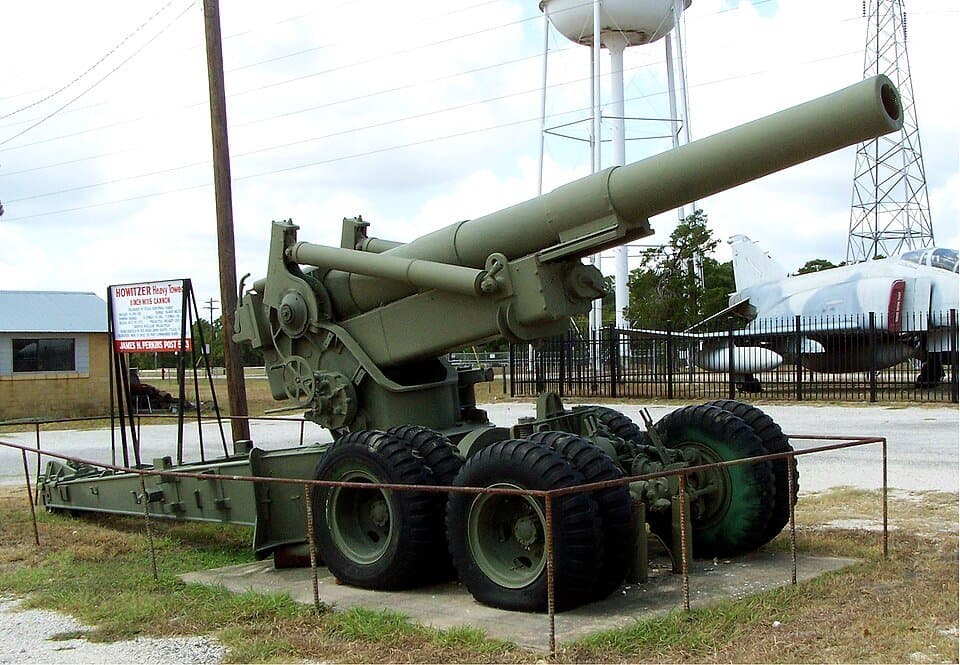
M115 howitzerlarger figure on 2 of 6
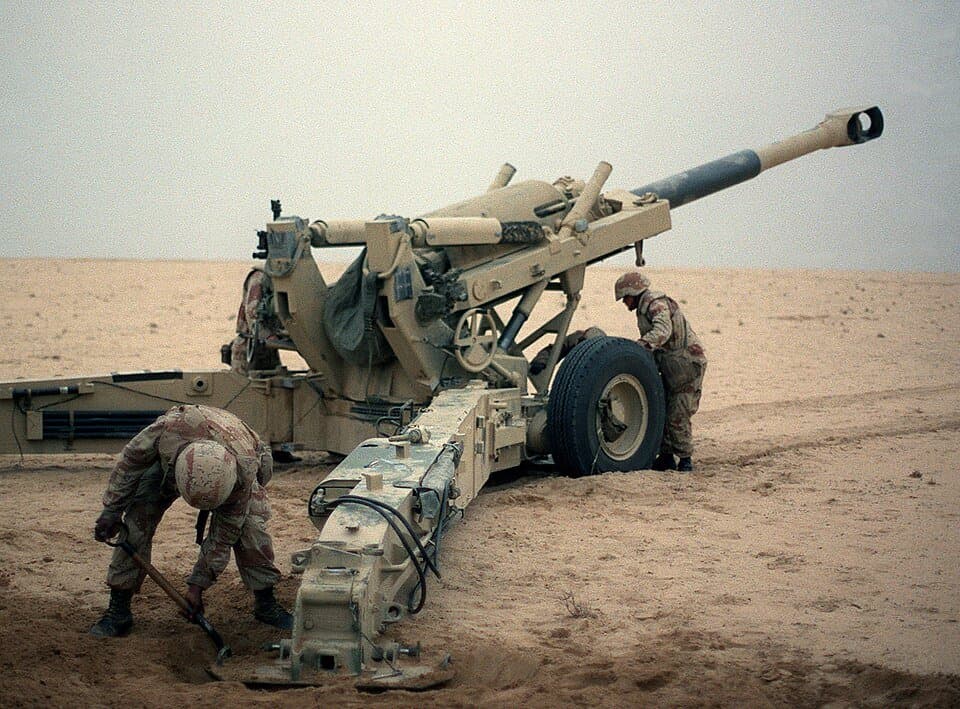
M198 howitzerlarger figure on 4 of 6
Counts only measures both sources give with the same scope. A larger figure is not a better system.
True scale
Side by side. From every angle. A human reference for perspective.
3.34 MB · Loads when you open it| Model | Length | Width / span | Height |
|---|---|---|---|
| M115 howitzer | ≈ 10.97 m | ≈ 2.5 m (Width) | ≈ 2.22 m |
| M198 howitzer | ≈ 12.3 m | ≈ 2.8 m (Width) | ≈ 2.96 m |
Scaled uniformly to the sourced length of 10.972 m. Thin antennas or poles standing above the body were pressed down to it, so they do not set the height; the width was fitted to the sourced 2.5 m. Not an official model or a measured survey.
ForceTally · All rights reserved
Scaled uniformly to the sourced length of 12.3 m. The width was fitted to the sourced 2.8 m. Not an official model or a measured survey.
ForceTally · All rights reserved
The human reference is a generic 1.75 m figure. Models describe external size, not combat performance.
Measured figures
Travel
Single sourceTravel: 10.972 m (36 ft 0 in)[source]
Travel
Single sourceConfiguration
| Specification | M115 howitzer | M198 howitzer |
|---|---|---|
| Type | Towed heavy howitzer[source] | Towed howitzer[source] |
| Place of origin | United States[source] | United States[source] |
| In service | 1944–Present[source] | 1979–present[source] |
| Wars | World War II Korean War Vietnam War Iran–Iraq War Croatian war of independence[source] | Lebanese Civil War Gulf War Somali Civil War War in Afghanistan (2001–2021) Iraq War War in Iraq (2013-2017) Syrian Civil War 2025 Cambodia‒Thailand conflict 2026 Afghanistan-Pakistan war |
Combat
Single sourceCombat: 11 m (36 ft 2 in) Travel: 12.3 m (40 ft 6 in)[source]
Bars compare reported quantities only. A larger figure does not make a system better; configurations and test conditions differ.
| Designed | 1939–1940[source] | 1968–1977[source] |
|---|
| Produced | 1942–1945[source] | 1978–1992[source] |
|---|
| No. built | 1,006[source] | 1,600+[source] |
|---|
| Shell | Separate loading charge and projectile[source] | Separate loading charge and projectile[source] |
|---|
| Shell weight | 90.7 kg (200 lb)[source] | — |
|---|
| Breech | Interrupted screw[source] | Interrupted screw[source] |
|---|
| Recoil | Hydro-pneumatic[source] | Hydro-pneumatic[source] |
|---|
| Carriage | Split trail[source] | Split trail[source] |
|---|
| Elevation | −2° / +65°[source] | −5° to +72°[source] |
|---|
| Traverse | 30°[source] | 45°[source] |
|---|
| Former operator · Belgium | Belgium[source] | — |
|---|
| Former operator · Croatia | Croatia[source] | — |
|---|
| Former operator · Denmark | Denmark[source] | — |
|---|
| Former operator · Greece | Greece[source] | — |
|---|
| Former operator · Italy | Italy[source] | — |
|---|
| Former operator · Japan | Japan[source] | — |
|---|
| Former operator · Spain | Spain[source] | — |
|---|
| Former operator · West Germany | West Germany[source] | — |
|---|
| Former operator · United States | United States[source] | — |
|---|
| Role | towed heavy howitzer[source] | — |
|---|
| Source measurement | During World War I , licensed production of the British 8-inch howitzer Mark VI was undertaken by the Midvale Steel and Ordnance Company, located in the Nicetown neighborhood of Philadelphia , Pennsylvania . Both American and British-manufactured weapons were used by the American Expeditionary Force in France. In 1940, the United States still had 475 Mark VII and Mark VIII 1/2 howitzers in storage, but there are no reports of the Mark VI or other marks being used during World War II.[source]M115 howitzer · Development; only the objects and conditions stated in this passage The original design of the M1 8-inch howitzer started in 1919, and resulted in the M1920 howitzer, but the program lapsed until resurrected in 1927. The T2 and T3 howitzers were prototypes of a partner piece for a new 155 mm gun. The first publicity photographs of the M1-type 8-inch howitzer on its redesigned carriage appeared in 1931, but development was slowed by the Great Depression. The T3 was standardized as the 8-inch howitzer M1 in 1940.[source]M115 howitzer · Development; only the objects and conditions stated in this passage Like the British 8-inch howitzer of the First World War (and most other large artillery), the M1 uses a Welin screw for its breech. The carriage was the same as used for the US 155 mm gun and was also adopted by the British for their BL 7.2-inch howitzer . It consists of a split trail with equilibrator assemblies, elevating and traversing mechanisms, a two-axle bogie with eight tires, and a single-axle, single-wheel limber for towing. Four spades, carried on the trails, were used to emplace the weapon.[source]M115 howitzer · Design; only the objects and conditions stated in this passage The M1 saw U.S. service in World War II, the Korean War , and the Vietnam War . During World War II, the M1 was towed by the Mack NO 7½ 6×6 Truck or the M4 High Speed Tractor . 59 battalions were raised during the war, of which 39 saw combat service in Northwest Europe or Italy and three in the Pacific.[source]M115 howitzer · Service history; only the objects and conditions stated in this passage The howitzer was mounted on a modified M4 medium tank chassis, in mount M17. The resulting vehicle was initially designated 8-inch howitzer motor carriage T89 and eventually standardized as the 8-inch howitzer motor carriage M43 . A total of 48 units were built.[source]M115 howitzer · Self-propelling mounts; only the objects and conditions stated in this passage 8-inch howitzer motor carriage T80 – based on T23 Medium Tank chassis, never advanced past proposal stage.[source]M115 howitzer · Self-propelling mounts; only the objects and conditions stated in this passage 8-inch howitzer motor carriage T84 – based on T26 Medium Tank chassis, a single pilot was built in 1945.[source]M115 howitzer · Self-propelling mounts; only the objects and conditions stated in this passage The howitzer was mounted on a purpose-built tracked chassis to become the 8-inch self-propelled howitzer M110 . Notably, accuracy and rate of fire suffered from having to depress the cannon tube to loading elevation for each round in order to use the track-mounted auto loader, but the later M110A1 & M110A2 version had improved accuracy and ranges.[source]M115 howitzer · Self-propelling mounts; only the objects and conditions stated in this passage | — |
|---|
| Manufacturer | Stati Uniti d'America[source]Own subject first infobox · explicit producer country, not an inferred corporate manufacturer. | Rock Island Arsenal (US)[source] |
|---|
| Used by | — | See Operators[source] |
|---|
| Unit cost | — | US$ 527,337[source] |
|---|
| Reported operators |
|---|
Maximum; RAP and L/52 barrel
Single sourceConventional: 22.4km (14 mi), RAP : 30km (18.6 mi), RAP and L/52 barrel: 40km (25 mi)[source]