
Credit
Mike1979 Russia · CC BY-SA 4.0 · Resized · CC BY-SA 4.0 · Source ↗ · Modified


Preparing your view.

At a glance
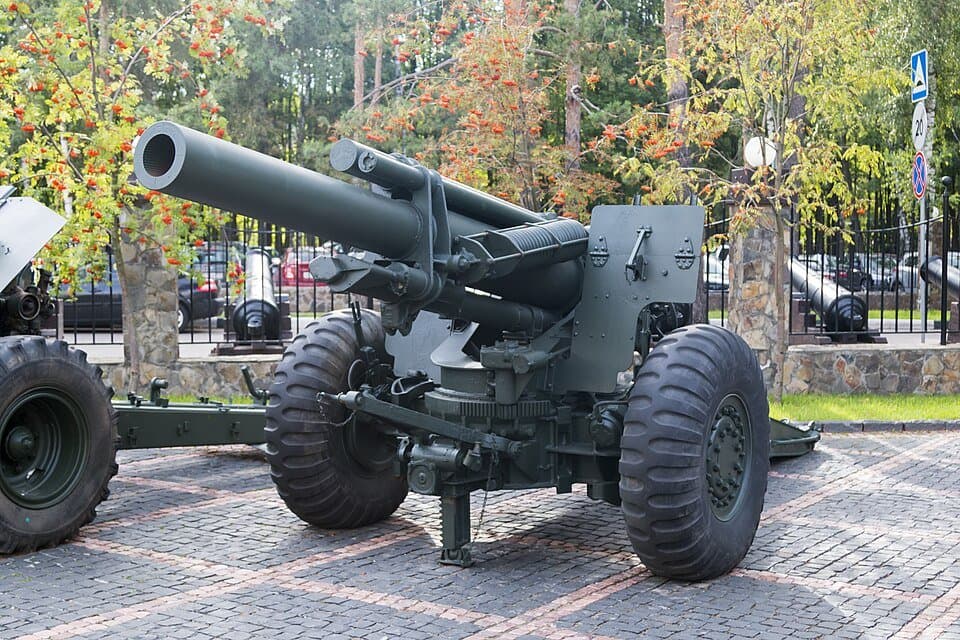
M114 155 mm howitzerlarger figure on 2 of 3
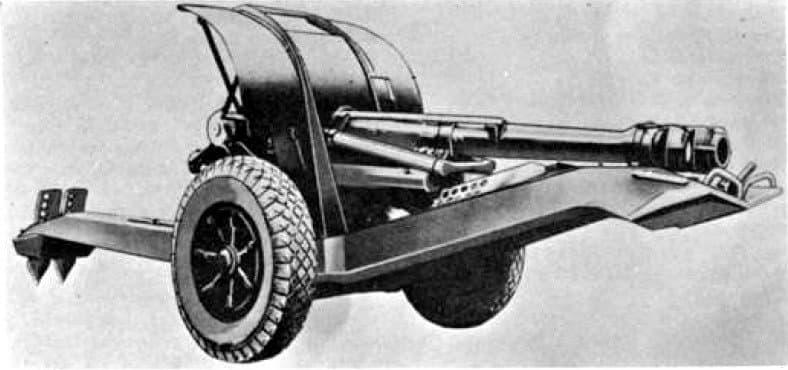
Obusier de 105 modèle 1950larger figure on 1 of 3
Counts only measures both sources give with the same scope. A larger figure is not a better system.
Measured figures
Travel
Single sourceTravel: 24 ft 0 in (7.315 m)[source]
Configuration
| Specification | M114 155 mm howitzer | Obusier de 105 modèle 1950 |
|---|---|---|
| Type | Field Howitzer[source] | Howitzer[source] Towed Howitzer[source]105mm Mle 50 TF 105mm 23-caliber ordnance[source]105mm Mle 50 TF Two wheel carriage[source]105mm Mle 50 TF |
| Place of origin | United States[source] |
105mm Mle 50 TF · in travel configuration
Length
Single sourceCombat
Single sourceTravel
Single sourceTravel: 12,800 lb (5,800 kg) Combat: 12,300 lb (5,600 kg)[source]
105mm Mle 50 TF · in travel configuration
Single sourceMass
Single sourceL/24.5 Bore L/23
Single sourceOverall
Single sourceOverall: 12 ft 5 in (3.79 m) L/24.5 Bore: 11 ft 8 in (3.564 m) L/23[source]
105mm Mle 50 TF · including muzzle brake
Single sourceL/23 (with muzzle brake )
Single sourceBurst Sustained: 40 rounds per hour
Single sourceBurst: 4 rpm Sustained: 40 rounds per hour[source]
Bars compare reported quantities only. A larger figure does not make a system better; configurations and test conditions differ.
France[source]
| In service | 1942–present[source] | — |
|---|
| Used by | See § Operators[source] | See users[source] |
|---|
| Wars | World War II Korean War Vietnam War Cambodian Civil War Laotian Civil War Lebanese Civil War Salvadoran Civil War Iran–Iraq War Kurdish–Turkish conflict (1978–present) Yugoslav Wars Syrian Civil War Russian invasion of Ukraine Operation Zarb e Azb 2025 India-Pakistan conflict 2025 Afghanistan-Pakistan conflict[source] | — |
|---|
| Designer | U.S. Army Ordnance Department[source] | DEFA[source] |
|---|
| Designed | 1939–1941[source] | 1946[source] |
|---|
| Manufacturer | Rock Island Arsenal (US)[source] | DEFA[source] |
|---|
| Produced | 1941–1953 (US)[source] | 1950[source] |
|---|
| No. built | 10,300 (US)[source] | — |
|---|
| Variants | See § Variants[source] | — |
|---|
| Shell | Separate-loading bagged charge[source] | Semi-fixed 105x372 mm R[source] |
|---|
| Breech | Slow-cone interrupted screw[source] | — |
|---|
| Recoil | Hydro-pneumatic[source] | Hydro-pneumatic[source] |
|---|
| Carriage | Split trail[source] | Tripod[source] |
|---|
| Elevation | −2° / +63°[source] | -7° to +70°[source] -7° to -70°, manual[source]105mm Mle 50 TF |
|---|
| Traverse | 25° left / 25° right[source] | 360°[source] 360°, manual[source]105mm Mle 50 TF |
|---|
| Former operator · Austria | Austria[source] | — |
|---|
| Former operator · Bosnia and Herzegovina | Bosnia and Herzegovina[source] | — |
|---|
| Former operator · Brazil | Brazil[source] | — |
|---|
| Former operator · Cambodia | Cambodia[source] | — |
|---|
| Former operator · Canada | Canada[source] | — |
|---|
| Former operator · Croatia | Croatia[source] | — |
|---|
| Former operator · Croatian Republic of Herzeg-Bosnia | Croatian Republic of Herzeg-Bosnia[source] | — |
|---|
| Former operator · Denmark | Denmark[source] | — |
|---|
| Former operator · Ethiopian Empire | Ethiopian Empire[source] | — |
|---|
| Former operator · West Germany | West Germany[source] | — |
|---|
| Former operator · Imperial State of Iran | Imperial State of Iran[source] | — |
|---|
| Former operator · Israel | Israel[source] | — |
|---|
| Former operator · Italy | Italy[source] | — |
|---|
| Former operator · Japan | Japan[source] | — |
|---|
| Former operator · South Korea | South Korea[source] | — |
|---|
| Former operator · Lebanon | Lebanon[source] | — |
|---|
| Former operator · Libya | Libya[source] | — |
|---|
| Former operator · Montenegro | Montenegro[source] | — |
|---|
| Former operator · Norway | Norway[source] | — |
|---|
| Former operator · Netherlands | Netherlands[source] | — |
|---|
| Former operator · Republika Srpska | Republika Srpska[source] | — |
|---|
| Former operator · Serbia | Serbia[source] | — |
|---|
| Former operator · Serbian Krajina | Serbian Krajina[source] | — |
|---|
| Former operator · Singapore | Singapore[source] | — |
|---|
| Former operator · Somalia | Somalia[source] | — |
|---|
| Former operator · Spain | Spain[source] | — |
|---|
| Former operator · Thailand | Thailand[source] | — |
|---|
| Former operator · United States | United States[source] | — |
|---|
| Former operator · South Vietnam | South Vietnam[source] | — |
|---|
| Former operator · North Yemen | North Yemen[source] | — |
|---|
| Former operator · Yemen | Yemen[source] | — |
|---|
| Former operator · FR Yugoslavia | FR Yugoslavia[source] | — |
|---|
| Former operator · Yugoslavia | Yugoslavia[source] | — |
|---|
| Role | towed howitzer[source] | French Howitzer[source] |
|---|
| Status | The M114A1 remains in service in some countries.[source]M114A1 · source-literal variant status | — |
|---|
| Source measurement | The 155 mm Howitzer M114 is a towed howitzer developed and used by the United States Army . It was first produced in 1941 as a medium artillery piece under the designation of 155 mm Howitzer M1 . It saw service with the US Army during World War II , the Korean War , and the Vietnam War , before being replaced by the M198 howitzer .[source]M114 155 mm howitzer · Lead; only the objects and conditions stated in this passage After the end of the First World War a board - later named the Westervelt Board after its president, Brigadier General William I. Westervelt - was convened to assess the artillery experience of the combatant powers and map out future directions for the US Army artillery. The conclusion of the board vis-a-vis corps (heavy field) artillery was that an ideal heavy howitzer should have range of at least 16,000 yards (15 km) and allow elevation of 65° The board also recommended that the new 155-mm howitzer and the new 4.7-inch (120 mm) gun use the same carriage, even if it compromised both designs.[source]M114 155 mm howitzer · Development / Early development; only the objects and conditions stated in this passage The M1920 carriage resulting from this requirements was of the split-trail type with pneumatic equilibrators , permitting a total traverse of 60°. Unfortunately, it "gave considerable trouble due to the persistent failure of the top carriage" on the firing tests. In 1923–1925 the design was modified with the top carriage reinforced and standardized as M1925. However, it was never built in steel, because after the evaluation of a wooden model the project was abandoned. Instead, two new carriages were developed and built in the following years, which were designated T1 and T1E1. All of them had the same ballistics (perhaps even the same gun body), with maximal range of 16,390 yards (14.99 km), and were undergoing tests in the early 1930s. By 1934, the US Army was concerned about the arising high-speed towing requirements not satisfied by the plain bearings and solid rubber ties.[source]M114 155 mm howitzer · Development / Early development; only the objects and conditions stated in this passage The carriage was also used by the 4.5-inch gun M1 . It went through a number of minor changes over time. The original Warner electric brakes were replaced by Westinghouse air brakes on the M1A1. Both the M1 and M1A1 carriages used a mid-axle firing pedestal that was extended by a ratchet mechanism. The M1A2 replaced the ratchet with a screw-jack system and also modified the traveling lock. The M1A1E1 carriage was intended for use in jungle and muddy terrain and replaced the wheels of the M1A1 with a free-wheeling tracked suspension, but the project was terminated after V-J Day without having reached production. The T-9 and T-10 carriages were projects using low-grade steel alloys that were canceled when no longer needed. The T-16 was a light-weight carriage using high-grade steel that was estimated to save some 1,200 lb (540 kg); work began in July 1945 and continued after the war, although nothing seems to have come from it.[source]M114 155 mm howitzer · Development / Before and during World War II; only the objects and conditions stated in this passage After World War II , the production of M1 howitzers continued to 1953. Additionally it was redesignated as the Howitzer, Medium, Towed: 155 mm, M114 , with the complete system composed of the cannon (M1), carriage (M1A1), and recoil system (M6, M6A1, M6B1 or M6B2).[source]M114 155 mm howitzer · Development / Post World War II; only the objects and conditions stated in this passage A mid-1960s carriage variant was the 155mm XM123 & M123A1 auxiliary-propelled howitzers. The XM123 was produced by American Machine and Foundry and outfitted with two 20 horsepower air-cooled engines produced by Consolidated Diesel Corporation, driver's seat, steering wheel, and guide wheel on the left trail, allowing it to be more rapidly emplaced when detached from the prime mover, while the XM123A1 provided a single 20 horsepower motor with electric steering. The extra weight on the left trail displaced the howitzer after each round was fired, requiring it to be realigned, and the project was abandoned. The concept was copied from the Soviet 85mm SD-44 auxiliary-propelled anti-tank gun developed in 1954 and used by airborne forces (VDV).[source]M114 155 mm howitzer · Development / Post World War II; only the objects and conditions stated in this passage M114A2 − Similar to the M114A1, but with a slightly longer barrel. Its main distinguishing feature is a groove cut around the barrel about 2.0–2.8 inches (50–70 mm) from the end. The bore of the M114A2 have a 1 in 20 twist instead of the 1 in 12 used in earlier models, extending the range of the projectiles. In 1997, the United States supplied Bosnia-Herzegovina with 116 ex-US Army M114A2s while an additional 145 were earmarked for spare parts.[source]M114 155 mm howitzer · Variants; only the objects and conditions stated in this passage M114/39 (Netherlands) − Dutch modernization by RDM Technology, it features a 155 mm 39 caliber barrel supplied by Bofors (now BAE Systems ) amongst other upgrades. 96 M114s were modernized for Denmark , 82 for the Netherlands, and 48 for Norway .[source]M114 155 mm howitzer · Variants; only the objects and conditions stated in this passage M114S − Israeli modernization package by Soltam Systems , the M114S features a 33 calibers long barrel, allowing a standard 155 mm M107 HE projectile to be fired to a maximum distance of 20,000 yards (18,300 m); a muzzle brake in the barrel, a pneumatic ramming system for the loader, improved mounts and fixtures, and an optional telescopic sight for direct fire. One prototype was built, but wasn't adopted by the Israel Defense Forces or exported.[source]M114 155 mm howitzer · Variants; only the objects and conditions stated in this passage KM114A1 - Reverse engineered version of the M114A1 by South Korea. It is modified to fire RAP ammunition at a maximum range of 12.1 mi (19.5 km). Produced since the late 1970s until the introduction of the KH179 .[source]M114 155 mm howitzer · Variants; only the objects and conditions stated in this passage 155 mm Howitzer M65 − Yugoslav copy of the M114A1, which was also used by the Yugoslav People's Army . It is virtually identical to the original, with a few minor differences. The M65 fires the standard American M107 HE shell. For training the M65 can be fitted with a 20 mm (0.79 in) sub-caliber barrel insert. It was built only in small numbers.[source]M114 155 mm howitzer · Variants; only the objects and conditions stated in this passage The howitzer was experimentally mounted on a lengthened chassis of the M5 light tank . The resulting vehicle received the designation 155 mm Howitzer Motor Carriage T64. A single prototype was built before the T64 project was abandoned in favor of T64E1, based on the M24 Chaffee light tank chassis. This was eventually adopted as the M41 Howitzer Motor Carriage and saw action in the Korean War . Towards the end of the Korean War the US Army replaced the M41 self-propelled howitzer with the M44 self-propelled howitzer .[source]M114 155 mm howitzer · Self-propelled mounts; only the objects and conditions stated in this passage | In the aftermath of World War II, the French Army was equipped with a variety of weaponry. There were French, British, German and US weapons in use. In 1946 DEFA (Direction des Études et Fabrications d'Armament) began a design study to build a new 105 mm howitzer for the French Army to replace its assortment of weapons. It would be the first 105 mm gun designed and built in Western Europe after World War II.[source]Obusier de 105 modèle 1950 · History; only the objects and conditions stated in this passage The mle 1950 would be a departure from previous designs because it would feature a three outrigger tripod carriage which was more common for anti-aircraft guns than howitzers. For travel, the gun was towed by one rearward facing outrigger which had a towing eye and two outriggers folded forward for the barrel to rest on. The carriage also had a two-wheeled torsion bar suspension and a curved three-piece gun shield for the crew. Once in firing position, the wheels were raised and the outriggers were spread to form a Y. This allowed a wide range of elevation -7° to +70° as well as 360° traverse similar to the Soviet D30 howitzer. However, unlike the D-30 the mle 1950 had a hydro-pneumatic recoil system mounted below the barrel, it had a double-baffle muzzle brake, and there wasn't a towing eye on the barrel.[source]Obusier de 105 modèle 1950 · Design; only the objects and conditions stated in this passage In addition to its towed version the mle 1950 was the primary armament of the Mk 61 105 mm self-propelled howitzer . This consisted of a mle 1950 mounted in a large non-traversing armored casemate on an AMX-13 light tank chassis.[source]Obusier de 105 modèle 1950 · Self-propelled artillery; only the objects and conditions stated in this passage |
|---|
| Shell weight | — | 15 kg (33 lb)[source] |
|---|
| Origin | — | France[source]105mm Mle 50 TF |
|---|
| Ammunition | — | 105x372mmR, semi-fixed case[source]105mm Mle 50 TF |
|---|
| Muzzle brake | — | Yes, double baffle[source]105mm Mle 50 TF |
|---|
| Sights | — | Indirect fire sight[source]105mm Mle 50 TF Direct fire sight[source]105mm Mle 50 TF |
|---|
| Limber | — | No, towing eye on outrigger[source]105mm Mle 50 TF |
|---|
| Gun shield | — | Yes[source]105mm Mle 50 TF |
|---|
| Towing vehicle | — | 4x4 or 6x6 truck, such as TRM 4000[source]105mm Mle 50 TF |
|---|
| Towed speed | — | 50 km/h[source]105mm Mle 50 TF |
|---|
| Autonomous mobility | — | Can be manhandled over very short distances[source]105mm Mle 50 TF |
|---|
| APU | — | No[source]105mm Mle 50 TF |
|---|
| Reported operators |
|---|