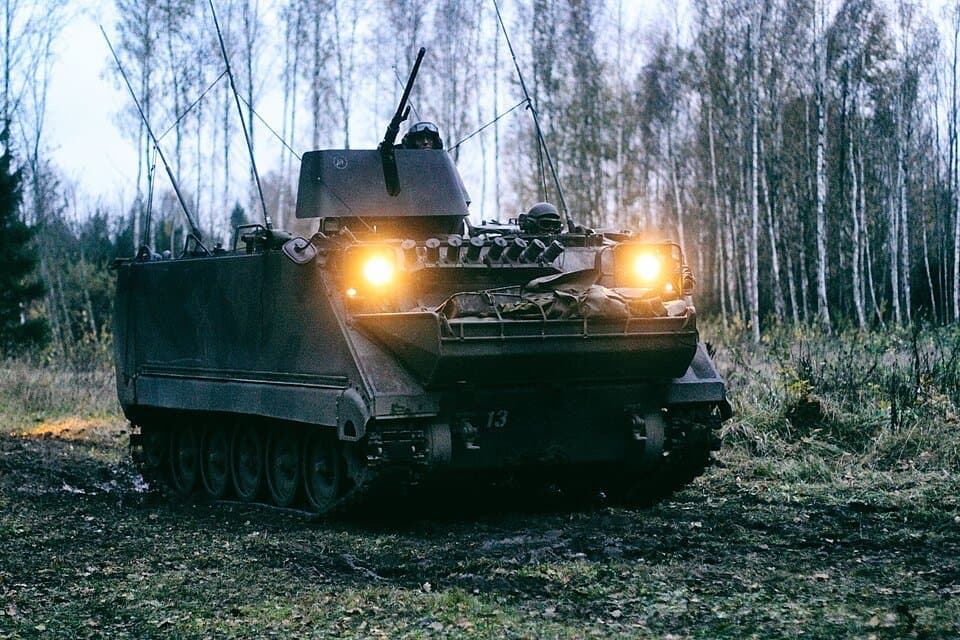

Credit
Mike.Bravo88 · CC BY-SA 4.0 · Resized · CC BY-SA 4.0 · Source ↗ · Modified


Preparing your view.

At a glance
Measured figures
M113A2 · Length · M113A2 · Dimensions · Length
Single source4.86 m[source]M113A2 · Dimensions · Length
Length
Single sourceConfiguration
| Specification | M113A2 | Type 73 armored personnel carrier |
|---|---|---|
| Variant description | M113A2[source]Only the source-declared variant M113A2 In 1979, further upgrades were introduced. Engine cooling was improved by switching the locations of the fan and radiator. Higher-strength torsion bars increased ground clearance, and shock absorbers reduced the effects of ground strikes. The weight of the M113A2 was increased to 11,740 kilograms (25,880 lb). Because the added weight affected its freeboard when afloat, it was no longer required to be amphibious. Four-tube smoke grenade launchers were also added. The suffix A2 is used on all variants to denote upgrade to A2 standard.[source]Only the source-declared variant M113A2 | — |
| Source measurement | M113A2 APC. This APC has many different Variants[source]M113A2 · System Tracked APC with rear ramp (door also) for 11 soldiers to dismount. Soldiers must expose themselves through the roof of the vehicle to fire their weapons. No firing ports.[source]M113A2 · System |
5.80 m (19.0 ft)[source]
Maximum; M113A2 · afloat · M113A2 · Mobility · Speed
Single sourceMaximum; M113A2 · On road · M113A2 · Mobility · Speed
Single source61 km/h on road[source]M113A2 · Mobility · Speed
6 km/h afloat[source]M113A2 · Mobility · Speed
Maximum; road
Single sourceMaximum; water
Single sourceBars compare reported quantities only. A larger figure does not make a system better; configurations and test conditions differ.
INA[source]M113A2 · System
11[source]M113A2 · System · units: ea
The M113 and its variants are the most widely produced and utilized APC of the Western World.[source]M113A2 · System
Additionally, there is a M113A2 Armored Recovery Vehicle and a Stretched M113A2.[source]M113A2 · System
5.3[source]M113A2 · Dimesions · units: m
3.0[source]M113A2 · Dimesions · units: m
1.85[source]M113A2 · Dimesions · units: m
14.2[source]M113A2 · Dimesions · units: tons
General Motors 6V53T[source]M113A2 · Automotive · Engine Name
V6 diesel engine[source]M113A2 · Automotive · Engine Type
275[source]M113A2 · Automotive · units: hp · Engine Power
360 Liters[source]M113A2 · Automotive · Fuel Capacity
483[source]M113A2 · Automotive · units: km · Cruising Range
66[source]M113A2 · Automotive · units: km/h · Speed (Max Road)
35[source]M113A2 · Automotive · units: km/h · Speed (Max Off-Road)
INA[source]M113A2 · Automotive · Speed (Average cross-country)
5.8[source]M113A2 · Automotive · units: km/h · Speed (Max Swim)
60[source]M113A2 · Automotive · units: % · Gradient
30[source]M113A2 · Automotive · units: % · Side Slope
0.6[source]M113A2 · Automotive · units: m · Vertical Step
1.7[source]M113A2 · Automotive · units: m · Trench
Amphibious[source]M113A2 · Automotive · Fording Depths
Automatic gearbox.[source]M113A2 · Automotive · Gearbox
Reinforced suspension[source]M113A2 · Automotive · Suspension
Higher-strength torsion bars increased ground clearance[source]M113A2 · Automotive · Torsion Bars
Yes, reducing the effects of ground strikes[source]M113A2 · Automotive · Shock Absorbers
On water it is propelled by spinning its tracks[source]M113A2 · Automotive · Note
Varies depending on the model and country.[source]M113A2 · Communications
12.7 mm machine gun mounted over commander's hatch.[source]M113A2 · Main Weapon System
INA[source]M113A2 · Fire Control
No[source]M113A2 · Fire Control
Protection of the M113A1 was rather limited. All-round protection is against 7.62 mm ball rounds and artillery shell splinters. At close range the M113 would be penetrated by 12.7 mm heavy machine gun rounds[source]M113A2 · Protection
Yes, on the bottom of the APC[source]M113A2 · Protection
Available[source]M113A2 · Protection
No[source]M113A2 · Protection
Available[source]M113A2 · Protection
Yes[source]M113A2 · Protection
No[source]M113A2 · Protection
Anti-mine armor on bottom[source]M113A2 · Protection
Yes[source]M113A2 · Protection
Up to 40% of vehicle components are manufactured from light alloys[source]M113A2 · Protection
M2 HB Anti-Aircraft Machine Gun[source]M113A2 · Main Weapon System · System · Name
12.7mm[source]M113A2 · Main Weapon System · System · Type
1933-Present[source]M113A2 · Main Weapon System · System · In Service
Over 3 Million[source]M113A2 · Main Weapon System · System · Proliferation
1,654 mm[source]M113A2 · Main Weapon System · System · Length
1,143 mm[source]M113A2 · Main Weapon System · System · Barrel Length
38 kg[source]M113A2 · Main Weapon System · System · Weight, Gun Only
58 kg[source]M113A2 · Main Weapon System · System · Weight, Gun with Tripod
450-600 rds/min[source]M113A2 · Main Weapon System · System · Max Rate of Fire (M2HB Version)
750-850 rds/min[source]M113A2 · Main Weapon System · System · Max Rate of Fire (AN/M2 Version)
1,200-1,300 rds/min[source]M113A2 · Main Weapon System · System · Max Rate of Fire (AN/M3 Version)
Short recoil-operated[source]M113A2 · Main Weapon System · System · Action
1,800-2,000 m[source]M113A2 · Main Weapon System · System · Effective Range
INA[source]M113A2 · Main Weapon System · Ammunition · Name
Rifle[source]M113A2 · Main Weapon System · Ammunition · Type
12.7 mm[source]M113A2 · Main Weapon System · Ammunition · Caliber
0.50 BMG (12.7×99mm NATO)[source]M113A2 · Main Weapon System · Ammunition · Cartridge
450-1,300 m/s[source]M113A2 · Main Weapon System · Ammunition · Muzzle Velocity
2,000 ea[source]M113A2 · Main Weapon System · Ammunition · Basic Load
United States[source]M113A2 · General · Origin
Armored personnel carrier[source]M113A2 · General · Type
2 + 11 (driver, gunner, 11 troops)[source]M113A2 · General · Crew
12.7mm M2HB heavy machine gun[source]M113A2 · Main armament · Type
Pintle mount[source]M113A2 · Main armament · Mount
2.000 rounds, 100 ready to fire[source]M113A2 · Main armament · Ammunition
Manual traverse and elevation[source]M113A2 · Main armament · Traverse
No[source]M113A2 · Main armament · Stabilizer
Tracked chassis, 5 roadwheels[source]M113A2 · Chassis · Chassis type
Drive sprocket front, idler rear[source]M113A2 · Chassis · Layout
2.16 m[source]M113A2 · Chassis · Tread
0.38 m[source]M113A2 · Chassis · Track width
2.67 m[source]M113A2 · Chassis · Length on ground
0.55 kg/cm²[source]M113A2 · Chassis · Ground pressure
Torsion bar[source]M113A2 · Chassis · Suspension
Detroit Diesel 6V-53[source]M113A2 · Automotive · Engine model
6-cylinder diesel[source]M113A2 · Automotive · Engine type
TX-100-1, 3 forward, 1 reverse[source]M113A2 · Automotive · Transmission
360 L[source]M113A2 · Automotive · Fuel
7.9 m[source]M113A2 · Mobility · Turn radius
18.7 hp/t[source]M113A2 · Mobility · Power to weight ratio
0.43 m[source]M113A2 · Obstacle crossing · Ground clearance
0.6 m[source]M113A2 · Obstacle crossing · Wall
1.7 m[source]M113A2 · Obstacle crossing · Trench
60 %[source]M113A2 · Obstacle crossing · Gradient
30 %[source]M113A2 · Obstacle crossing · Slope
Amphibious[source]M113A2 · Obstacle crossing · Fording
Aluminum[source]M113A2 · Protection · Armor type
38 - 45 mm[source]M113A2 · Protection · Armor thickness
Yes[source]M113A2 · Protection · NBC system
2x4 smoke grenade dischargers[source]M113A2 · Protection · Smoke system
Yes, for driver[source]M113A2 · Equipment · Night vision
M113A2 Similar to M113A1, but with cooling and suspension improvements and smoke grenade launchers on the glacis plate. Introduced in 1979.[source]M113A2 · own variant description
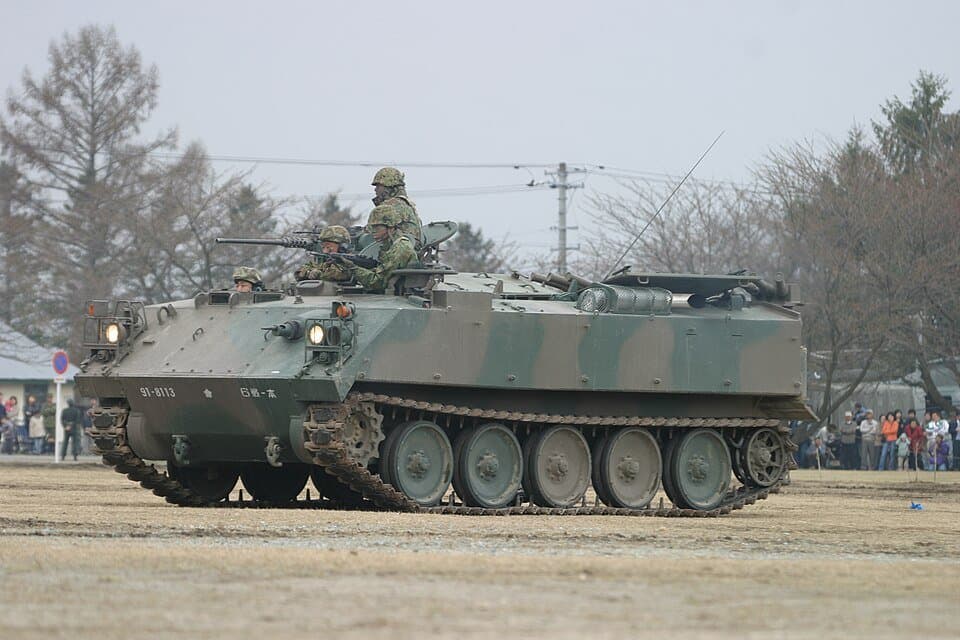
In 1967, the Defense Agency 's Technical Research and Development Institute issued a requirement for a new armored personnel carrier to replace the Type 60 . Concerns were raised that the Type 60 cannot be equipped with nuclear, biological, and chemical protection equipment. The requirements included a maximum speed of over 60 km/h (37 mph), ability to carry 12 men including the crew, being fully amphibious, having all-welded aluminium armor, provision for the infantry to use their small arms from inside the vehicle, and being armed with a 20 mm autocannon , a 12.7 mm heavy machine gun , and a 7.62 mm machine gun .[source]Type 73 armored personnel carrier · Development; only the objects and conditions stated in this passage Developing the engine began before the vehicle prototyping efforts. Mitsubishi developed the ZF series air-cooled diesel engines with the aim of increasing parts commonality between Japan Ground Self-Defense vehicles. Depending on the platform power requirements, an engine with the appropriate number of cylinders was selected. For example, the Type 74 tank used the 10-cylinder 10ZF, the Type 75 155 mm self-propelled howitzer utilised the 6-cylinder 6ZF, and the 4-cylinder 4ZF was mounted on the Type 73 and the Type 74 105 mm self-propelled howitzer .[source]Type 73 armored personnel carrier · Development; only the objects and conditions stated in this passage Mitsubishi's aluminium model was chosen for operational use and standardised as the Type 73 in December 1973. Mitsubishi was the prime contractor and the tracks were made by Komatsu, while Hitachi was in charge of manufacturing the vehicle's transmission system.[source]Type 73 armored personnel carrier · Development; only the objects and conditions stated in this passage During development, mounting a 20 mm autocannon was also tested. The autocannon would have been produced under licence from Rheinmetall . However, plans to install an autocannon on production vehicles were postponed and eventually cancelled due to associated costs.[source]Type 73 armored personnel carrier · Development; only the objects and conditions stated in this passage Serial production of the Type 73 started in 1973. By 1994, a total of 338 vehicles had been produced. The Type 96 armored personnel carrier is slowly replacing the Type 73 in Japan Ground Self-Defence Force service , although 220 vehicles remain in use by 2024.[source]Type 73 armored personnel carrier · Development; only the objects and conditions stated in this passage The Type 73 has a 12.7 mm M2HB heavy machine gun with 600 rounds of ammunition and a 7.62 mm Type 74 bow machine gun with 4,500 rounds available. The M2HB heavy machine gun can be operated remotely from within the vehicle, but it has little elevation as a consequence and is of limited use against aerial threats. The gunner's cupola can traverse a full 360°, but the bow gunner's weapon can only traverse, elevate, and depress 30°. The mounted infantry can fire their personal weapons from inside the vehicle through six T-shaped firing ports . The eight troops are seated on four folding seats on both sides of the rear of the vehicle facing each other.[source]Type 73 armored personnel carrier · Design; only the objects and conditions stated in this passage While the Type 73 is amphibious , it requires additional equipment for travelling on water. Preparation for amphibious operations takes about 30 minutes, after which the Type 73 is able to traverse water bodies propelled by its tracks at 6 km/h (3.7 mph). The Type 73 is fitted with infra-red driving lights, can be equipped with a passive periscope for night driving , and has a nuclear, biological, and chemical protection system as standard equipment.[source]Type 73 armored personnel carrier · Design; only the objects and conditions stated in this passage The Type 74 105 mm self-propelled howitzer , produced by Komatsu, which used a version of the Type 73 chassis that shared components with Komatsu's SUB 2 prototype.[source]Type 73 armored personnel carrier · Variants; only the objects and conditions stated in this passage The Type 75 130 mm multiple rocket launcher , manufactured by Komatsu, with a chassis that utilised components from Komatsu's SUB 2 prototype.[source]Type 73 armored personnel carrier · Variants; only the objects and conditions stated in this passage The Type 75 155 mm self-propelled howitzer , which was produced by Mitsubishi.[source]Type 73 armored personnel carrier · Variants; only the objects and conditions stated in this passage The Type 75 wind measurement vehicle , manufactured by Komatsu, which supported the Type 75 130 mm multiple rocket launcher in service.[source]Type 73 armored personnel carrier · Variants; only the objects and conditions stated in this passage In addition, the Type 76 counter-battery radar system includes a vehicle built by Komatsu that uses a modified Type 74 105 mm self-propelled howitzer chassis, itself a derivative of the Type 73. The Acquisition, Technology & Logistics Agency has also adapted a Type 73 chassis for testing hybrid electric propulsion.[source]Type 73 armored personnel carrier · Variants; only the objects and conditions stated in this passage Mitsubishi 's SUB 1 prototype with a turret for a 20 mm autocannon at Camp Kasumigaura[source]Type 73 armored personnel carrier · Gallery; only the objects and conditions stated in this passage Komatsu 's SUB 2 prototype with a turret for a 20 mm autocannon at Camp Tsuchiura[source]Type 73 armored personnel carrier · Gallery; only the objects and conditions stated in this passage A close-up view of the 7.62 mm bow machine gun mount on Komatsu's SUB 2 prototype at Camp Tsuchiura[source]Type 73 armored personnel carrier · Gallery; only the objects and conditions stated in this passage A close-up view of the turret for a 20 mm autocannon on Komatsu's SUB 2 prototype at Camp Tsuchiura[source]Type 73 armored personnel carrier · Gallery; only the objects and conditions stated in this passage |
| Country of origin | United States[source]M113A2 | — |
|---|
| Designation: | M113A2[source]M113A2 · M113A2 | — |
|---|
| Manufacturer | BAE Systems Land and Armament[source]M113A2 · M113A2 | Mitsubishi Heavy Industries , Komatsu Limited[source] |
|---|
| Product type: | Armoured Vehicles[source]M113A2 · M113A2 | — |
|---|
| Name: | Tracked armoured personnel carrier[source]M113A2 · M113A2 | — |
|---|
| Type | — | Armored personnel carrier[source] |
|---|
| Place of origin | — | Japan[source] |
|---|
| In service | — | 1973 –…[source] |
|---|
| Used by | — | Japan Ground Self-Defense Force[source] |
|---|
| Designer | — | Technical Research and Development Institute[source] |
|---|
| Designed | — | 1967 –1973[source] |
|---|
| Unit cost | — | ¥ 100 million[source] |
|---|
| Produced | — | 1973 –1994[source] |
|---|
| No. built | — | 338[source] |
|---|
| Variants | — | See Variants[source] |
|---|
| Passengers | — |
|---|
| Armor | — | Aluminium[source] |
|---|
| Main armament | — | 12.7 mm M2HB heavy machine gun[source] |
|---|
| Secondary armament | — | 7.62 mm Type 74 bow machine gun[source] |
|---|
| Power/weight | — | 22.56 hp/t (16.82 kW/t)[source] |
|---|
| Transmission | — | Automatic (4 forward, 1 reverse gear)[source] |
|---|
| Suspension | — | Torsion bar[source] |
|---|
| Ground clearance | — | 0.4 m (16 in)[source] |
|---|
| Fuel capacity | — | 450 L (120 US gal)[source] |
|---|
| Role | — | Japanese tracked armored personnel carrier[source] |
|---|
| Reported operators | — |
|---|
60 km/h (37 mph) (road) 6 km/h (3.7 mph) (water)[source]