
AI-generated illustration · Not a photograph
Credit
ForceTally · AI-generated illustration · ForceTally · AI-generated illustration · Source ↗ · Modified


Preparing your view.


At a glance
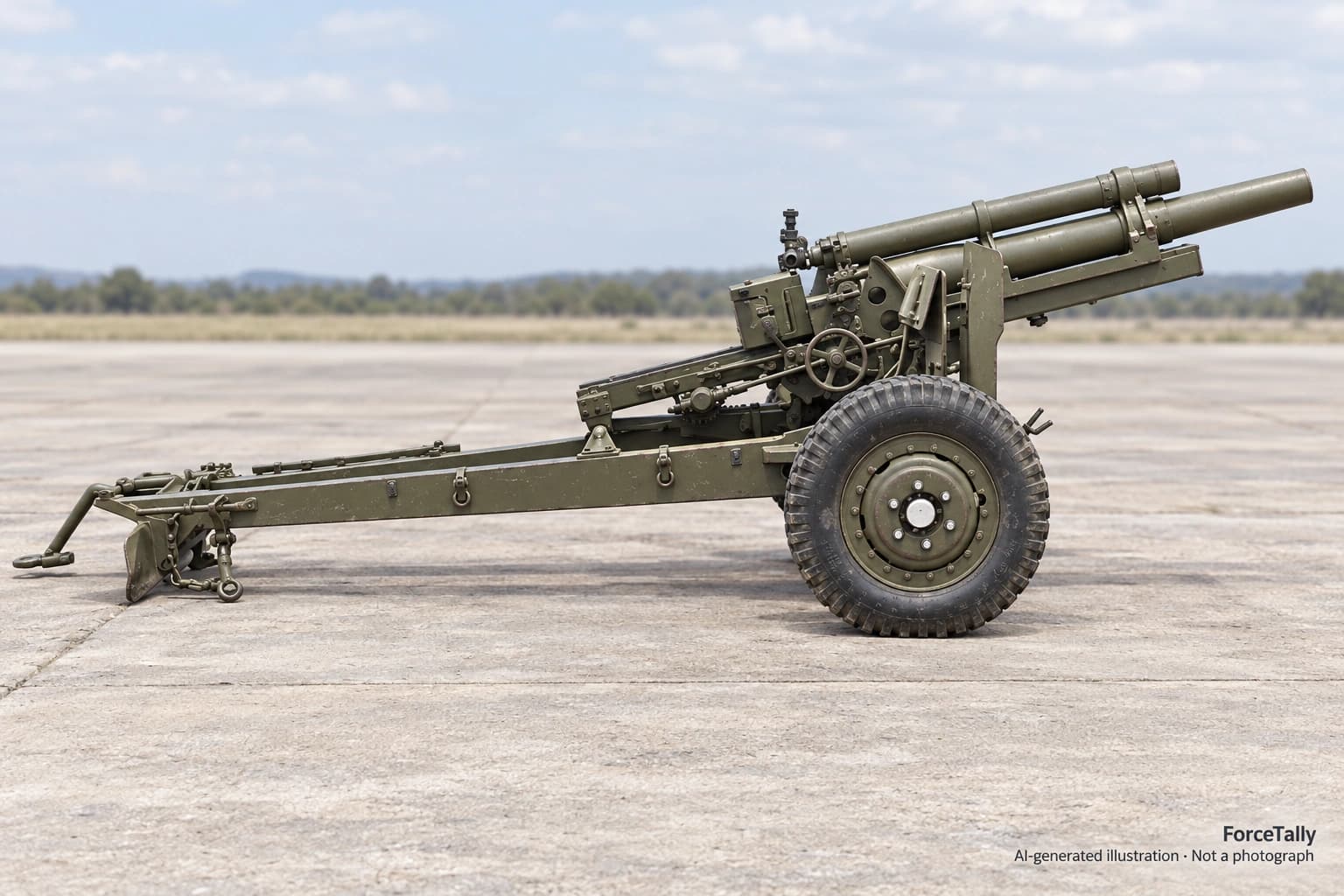
M101 howitzerlarger figure on 0 of 4
Measured figures
Length
Single source105-mm M101 Howitzer · travelling
Single sourceConfiguration
| Specification | M101 howitzer | Santa Bárbara Sistemas 155/52 |
|---|---|---|
| Type | Howitzer[source] | Howitzer[source] |
| Place of origin | United States[source] | Spain[source] |
| In service | 1941–present[source] | 2002–present[source] |
| Wars | List of Conflicts World War II Chinese Civil War Korean War First Indochina War Vietnam War Cambodian Civil War Laotian Civil War Football War Insurgency in the Philippines Rhodesian Bush War Iran–Iraq War Lebanese Civil War Nicaraguan Revolution Salvadoran Civil War Yugoslav Wars Battle of Marawi Russo-Ukrainian War Yemeni Civil War Russo-Ukrainian war (2022–present) 2025 Cambodia-Thailand conflict |
Counts only measures both sources give with the same scope. A larger figure is not a better system.
Length
Single source10.3 m (33 ft 10 in)[source]
Maximum; Maximum speed
Single source18 km/h (11 mph)[source]
Diesel APU
Single sourceDiesel APU 106 hp (79 kW )[source]
Muzzle velocity
Single source1,550 ft/s (472 m/s)[source]
Bars compare reported quantities only. A larger figure does not make a system better; configurations and test conditions differ.
| — |
| Manufacturer | Rock Island Arsenal Kia Machine Tool Sorel industries (Canadian C3)[source] | Santa Bárbara Sistemas[source]Santa Bárbara Sistemas 155/52 — explicit named producer; no component/sibling identity |
|---|
| Produced | 1941–1953[source] | — |
|---|
| No. built | 10,200[source] | 111[source] |
|---|
| Shell | 105×372 mm R[source] | Separate loading charge and projectiles[source] |
|---|
| Breech | Horizontal-block[source] | Interrupted screw[source] |
|---|
| Recoil | Hydro-pneumatic , constant, 42 in (110 cm)[source] | Hydro-pneumatic[source] |
|---|
| Carriage | split trail[source] | Split trail[source] |
|---|
| Elevation | −5° (−89 mils) to 65° (1,156 mils)[source] | −3° to +72°[source] |
|---|
| Traverse | ±23° (±409 mils)[source] | 40°[source] |
|---|
| Status (M101A1) | Today, the M101A1 has been retired by the U.S. military, although it is still retained for ceremonial purposes.[source]M101A1 · source-literal primary status | — |
|---|
| Source measurement | The M101A1 (previously designated Howitzer M2A2 on Carriage M2A2 ) howitzer is an artillery piece developed and used by the United States. It was the standard U.S. light field howitzer in World War II and saw action in both the European and Pacific theaters and during the Korean War . Entering production in 1941, it quickly gained a reputation for accuracy and a powerful punch. The M101A1 fires 105 mm high explosive (HE) semi-fixed ammunition and has a range of 12,330 yards (11,270 m) or 7 miles, making it suitable for supporting infantry .[source]M101 howitzer · Lead; only the objects and conditions stated in this passage After World War I, the U.S. Army Ordnance Department studied various captured German 105 mm-caliber howitzers and developed the 105 mm Howitzer M1920 by using the Carriage M1920. A box trail carriage design (the M1925E carriage) and two other split trail designs (the T1 and T2) were also developed, but the original split trail design was found superior after testing. After being selected, the piece was standardized in December 1927 as the 105 mm howitzer M1 on carriage M1. The Army intended to replace all 75 mm guns in its divisional and non-divisional field artillery regiments with 105 mm pieces, but a lack of appropriations stalled the idea and eventually forced it to be completely abandoned by 1929; a limited plan developed in 1925 envisioned re-equipping three regiments, but by 1933, only 14 M1 howitzers had been manufactured.[source]M101 howitzer · History / Development; only the objects and conditions stated in this passage A modified version of the M1, which was trialed in 1932, used semi-fixed ammunition instead of separate-loading ammunition. Since this development required a different breech block, the new piece was designated the 105 mm howitzer M2 on carriage M1. 48 pieces were manufactured in 1939. The original M1 carriage had been designed for towing using horses rather than trucks, and a new carriage, the T5 (M2), was developed in 1939 and standardized in February 1940. The breech ring of the howitzer M2 was modified in March 1940 before large-scale production began, creating the 105 mm howitzer M2A1 on carriage M2.[source]M101 howitzer · History / Development; only the objects and conditions stated in this passage In 1939, the new howitzer cost $25,000, which was three times as much as the modernisation cost of a 75 mm field gun M1897 on M2 carriage , and its adoption required procurement of a colossal amount of new ammunition (War Department estimate of $26 million).[source]M101 howitzer · History / Development; only the objects and conditions stated in this passage 3,325 pieces were built in 1942, 2,684 in 1943, 1,200 in 1944, and 730 up to and including August 1945. The gun was designed to be very durable and was therefore heavy for its caliber, but studies after 1943 found that, after prolonged firing, the muzzle end of the barrel was prone to cracking. To relieve stress in the barrel, new production M2A1 tubes were counterbored two inches from the muzzle starting in the late 1940s. By the end of World War II, 8,543 105 mm towed howitzers had been built.[source]M101 howitzer · History / World War II; only the objects and conditions stated in this passage The M2A2 howitzer was retired from regular service with the Australian Army in 1988, when it was replaced by the 105 mm L118 and L119 , which in turn were replaced by the M777A2 in 2014. The M2A2 remained in service with the Australian Army Reserve until its replacement by 81-millimetre (3.2 in) mortars in the late 2000s. Australia's Federation Guard retains six pieces for ceremonial use.[source]M101 howitzer · Users / Australia; only the objects and conditions stated in this passage The Canadian Forces procured at least 60 US made M2A1 howitzers, beginning in 1952, and also had Sorel Industries of Canada produce 232 of a slightly modified M2A2 version, starting in 1955. The Canadian produced guns were later designated C1, while the US produced guns were designated C2. These continued in service until the early 2000s. In the late 1990s, ninety-six C1 guns were selected and sent to RDM in the Netherlands to extend their service life. These guns were re-designated as the C3. The changes include a longer 33-calibre barrel, a muzzle brake , reinforced trails and the removal of shield flaps. It remains the standard light howitzer of Canadian Forces Reserve units. The C3 is used by 1RCHA in Glacier National Park in British Columbia as a means of avalanche control . The modified 105mm C3 howitzer has a range of 18km.[source]M101 howitzer · Users / Canada; only the objects and conditions stated in this passage The German Army adopted the M101 howitzer in a modified form in March 1956, designated Feldhaubitze 105 mm M1A2 (Bw). Using components made by Rheinmetall , the new howitzers had a longer, un-counterbored 27-caliber barrel, a large single-baffle muzzle brake, and a larger gun shield.[source]M101 howitzer · Users / Germany; only the objects and conditions stated in this passage Starting on 6 July 1950, South Korea received a total of 1,127 M2A1s until the end of the Korean War to supplement and replace the M1 75 mm howitzer and the M3 105 mm howitzer .[source]M101 howitzer · Users / South Korea; only the objects and conditions stated in this passage In February 1974, hostilities grew after North Korea sunk a South Korean fishing boat and kidnapped fishermen near Baengnyeong Island . As a response, 10 howitzers crafted prior to the research cooperation were sent to the island, but pulled out after having severe malfunctions during operations. In November 1975, the reinforced variant experienced barrel breakdown; the failure led to the invitation of American engineers in January 1976 for an overview. After 1.5 months of inspection, the engineers suggested the Eighth United States Army replace South Korean copy with the original M101A1 design. The U.S. then provided its technical data package to South Korea, which quickly readied mass production of the howitzer before the year ended. Production began in 1977 as KM101A1 by Kia Machine Tool (now Hyundai Wia ) in Changwon .[source]M101 howitzer · Users / South Korea; only the objects and conditions stated in this passage In 1978, South Korea restarted a domestic howitzer program based on the M101A1. The howitzer barrel was extended to a length of 38 calibers, which extended the maximum range to 18 km using RAP ammunition. Only 18 howitzers saw service with the South Korean military, which preferred mass producing KH179 155 mm towed howitzer .[source]M101 howitzer · Users / South Korea; only the objects and conditions stated in this passage M3 – lightweight howitzer, with barrel shortened by 27 inches (69 cm) with carriage of the M1 pack howitzer .[source]M101 howitzer · Variants; only the objects and conditions stated in this passage T8 – prototype vehicle-mounted variant with modified breech and with cylindrical recoil surface, standardized as 105 mm M4 howitzer in September, 1943.[source]M101 howitzer · Variants; only the objects and conditions stated in this passage M2A1 – modernized L33 variant by Yugoimport SDPR with max range of 15 km (9.3 mi)/18.1 km (11.2 mi) (boat tail shell/base bleed shell)[source]M101 howitzer · Variants; only the objects and conditions stated in this passage M2A2E2 – prototype with increased elevation to 70 degrees.[source]M101 howitzer · Variants; only the objects and conditions stated in this passage XM124 & XM124E1 light auxiliary propelled howitzer – prototype (1962–1965) – produced by Sundstrand Aviation Corporation, who added an auxiliary drive system for local maneuverability (See also similar XM123 Medium Auxiliary Propelled 155 mm Howitzer with similar configuration). The base XM124 provided two 20 horsepower (15 kW), air-cooled engines, while the XM124E1 provided a single 20 horsepower (15 kW) engine and electric steering.[source]M101 howitzer · Variants; only the objects and conditions stated in this passage M2A2 Terra Star auxiliary propelled howitzer – prototype (1969–1977) – Lockheed Aircraft Service Company added an auxiliary drive system and a tri-star wheel system to the carriage of an M2A2 105 mm light howitzer to provide local maneuverability. The last surviving example is at the Rock Island Arsenal Museum.[source]M101 howitzer · Variants; only the objects and conditions stated in this passage XM124E2 light auxiliary-propelled 105 mm howitzer at the Rock Island Arsenal museum.[source]M101 howitzer · Variants; only the objects and conditions stated in this passage 105 mm howitzer motor carriage T9 (based on Cletrac MG-2 tractor) .[source]M101 howitzer · Self-propelled mounts; only the objects and conditions stated in this passage 105 mm howitzer motor carriage T19 (based on M3 halftrack ) – M2A1.[source]M101 howitzer · Self-propelled mounts; only the objects and conditions stated in this passage 105 mm howitzer motor carriage T32 / M7 – M2A1.[source]M101 howitzer · Self-propelled mounts; only the objects and conditions stated in this passage 105 mm howitzer motor carriage T76 / M37 ( Light Tank M24 chassis) – M4 in mount M5.[source]M101 howitzer · Self-propelled mounts; only the objects and conditions stated in this passage 105 mm amphibian gun motor carriage T87 (based on GMC M18 automotive components) – T8[source]M101 howitzer · Self-propelled mounts; only the objects and conditions stated in this passage 105 mm howitzer motor carriage T88 (GMC M18 chassis) – M4 in mount M20.[source]M101 howitzer · Self-propelled mounts; only the objects and conditions stated in this passage K105HT – 105 mm howitzer mounted on an armored 5-ton truck system built by Samsung Techwin for the Republic of Korea Army (initially called EVO-105)[source]M101 howitzer · Self-propelled mounts; only the objects and conditions stated in this passage The gun fired semi-fixed ammunition, with 105 mm Cartridge Case M14. The propelling charge consisted of a base charge and six incremental charges, forming seven charges from 1 (the smallest) to 7 (the largest). Use of M1 HE rounds prepared for the 105 mm howitzer M3 (same projectile and cartridge, but different propelling charge) was authorized.[source]M101 howitzer · Ammunition; only the objects and conditions stated in this passage | For transport, the split trail carriage can be closed and the barrel and rotated 180° while being towed by an IVECO Pegaso 6x6 artillery tractor . There is also a 106 hp (79 kW ) diesel auxiliary power unit (APU) at the front of the carriage with a driver's station that can move the gun at 18 km/h (11 mph) over short distances. The APU also powers the hydraulic automatic gun-laying system (AGLS) that controls elevation, traverse, spreading, and retraction. Two retractable wheels on the tail of the gun carriage can be lowered when the gun is being moved by the APU.[source]Santa Bárbara Sistemas 155/52 · Design; only the objects and conditions stated in this passage The howitzer fires a variety of separate loading NATO standard projectiles, including extended-range base bleed and rocket-assisted projectiles up to 40 km (25 mi). The howitzer has a hydraulic ammunition loader that can be loaded at any angle and provides a high rate of fire.[source]Santa Bárbara Sistemas 155/52 · Design; only the objects and conditions stated in this passage Santa Bárbara Sistemas 155/52 APU (V07) – is an upgraded coastal artillery model. There are 16 in service with the Coastal Artillery Regiment No. 4 ( Regimiento de Artillería de Costa nº 4 ) of the Spanish Army. The system software is specialized for tracking and firing at mobile naval targets instead of static land targets.[source]Santa Bárbara Sistemas 155/52 · Models; only the objects and conditions stated in this passage |
|---|
| Used by | — | Colombia Spain El Salvador[source] |
|---|
| Action | — | Hydraulic loader[source] |
|---|
| Role | — | modern field howitzer[source] |
|---|
| Source manufacturer statement | — | The Santa Bárbara Sistemas 155/52 is a modern field howitzer designed and manufactured by the Spanish armament manufacturer Santa Bárbara Sistemas (SBS) a division of General Dynamics and was produced from 2002 to 2009 at the La Vega and Trubia factories in Asturias .[source]Only the subject, component or variant named in this passage; unresolved names do not create a manufacturer identity The barrel is produced by the German company Rheinmetall , while the gun carriage is produced by SBS.[source]Only the subject, component or variant named in this passage; unresolved names do not create a manufacturer identity |
|---|