
FORCETALLY
Loading the evidence…
Preparing your view.


Preparing your view.
At a glance
LT PGBlarger figure on 3 of 3
RGD-5larger figure on 0 of 3
Counts only measures both sources give with the same scope. A larger figure is not a better system.
Measured figures
Length
Single source3580mm[source]
Length
Single sourceConfiguration
| Specification | LT PGB | RGD-5 |
|---|---|---|
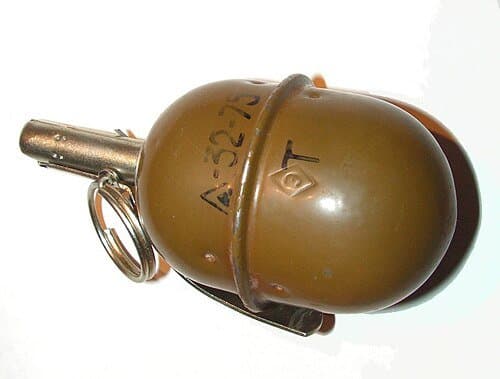
| Type | LGB / Precision-guided bomb[source] | Hand grenade[source] |
| Place of origin | China[source] | Soviet Union[source] |
| In service | 2004—present[source] | 1954–present[source] |
| Used by | People's Liberation Army Air Force[source] | — |
| Produced |
116.8 mm (4.60 in)[source]
tail fin
Single source950mm (tail fin)[source]
Maximum; ≥ at launch
Single source≥230m/s (at launch)[source]
Filling weight
Single source110 g (3.9 oz)[source]
Bars compare reported quantities only. A larger figure does not make a system better; configurations and test conditions differ.
2004—present[source]
| — |
| Warhead | various gravity bombs[source] | — |
|---|
| Detonation mechanism | Impact / Proximity[source] | 3.2 to 4.2 seconds. pyrotechnic delay fuse[source] |
|---|
| Guidance system | laser guidance[source] | — |
|---|
| Launch platform | aerial platforms[source] | — |
|---|
| Source measurement | LT-2 was the first bomb in the LT series, which was renamed from the LS-500J guided bomb. The LT-2 is a strap-on bomb kit that can be mounted on any 500 kg (1,100 lb) class general-purpose bomb . The seeker is an annular airfoil seeker with a quadrant detection assembly similar to that of Paveway I and II. The tail kit is in a similar configuration to the Paveway I. The guidance system is unstabilized in roll, relying on bang–bang control like the Paveway II, and the cruciform tail assembly provides maneuverability.[source]LT PGB · Development / LT series; only the objects and conditions stated in this passage LT-3 is a sophisticated upgrade of LT-2. The LT-3 has a dual-mode seeker, combining a satellite / inertial guidance tail kit with a gimbaled laser guidance module. Weighing 564 kg (1,243 lb) and ranging 24 km (13 nmi), the warhead can penetrate 1.5 meters thick reinforced concrete . The mounting bracket and tail structure of the LT-3 is derived from the LS-6 250kg version, though the two bombs have different guidance methods and masses. The concept of the LT-3 is very close to the Paveway III or GBU-55 Laser JDAM . According to the Industry Corporation of China (AVIC) representative at Zhuhai Airshow 2008, the upgrade was substantial. The LT-3 uses a wide field-of-view (FOV) laser beam-riding gimbal, similar to Paveway III. In contrast, the older LT-2 relies on the bang–bang control system that was common in the 1960s on bombs such as Paveway I.[source]LT PGB · Development / LT series; only the objects and conditions stated in this passage In the 1990s, multiple targeting pods were developed for the laser-guided bombs. One of the earliest types was called Blue Sky ( Chinese : 蓝天 ; pinyin : Lán tiān ), and was publicly revealed in the late 1990s. The Blue Sky targeting pod is externally similar to the American LANTIRN . The targeting range for LT-2 is 15 km (8.1 nmi). Alternatively, LT PGB can be guided by forward-looking targeting pods, such as FILAT .[source]LT PGB · Targeting pod; only the objects and conditions stated in this passage LT-2 : Laser-guided 500 kg (1,100 lb) bombs, originally called LS-500J. In PLAAF service, LS-500J (LT-2) is designated K/YGB500.[source]LT PGB · Variants; only the objects and conditions stated in this passage LT-3 : Laser + satellite / inertial navigation dual moddule guided 500 kg (1,100 lb) bombs with a wide FOV seeker, incorporating technologies from LS-6 series.[source]LT PGB · Variants; only the objects and conditions stated in this passage | — |
|---|
| Wars | — | Vietnam War Six-Day War The Troubles Yom Kippur War Soviet–Afghan War Iran–Iraq War Invasion of Kuwait Gulf War First Chechen War Kosovo War Second Chechen War Iraq War Russo-Georgian War First Libyan Civil War Syrian Civil War Russo-Ukrainian War[source] |
|---|
| Filling | — | Trinitrotoluene[source] |
|---|
| Blast yield | — | ~350 fragments[source] |
|---|
| Manufacturer | — | Vytis[source]Lithuanian licensed copy · production 1992–1996 |
|---|
| Reported operators | — |
|
|---|