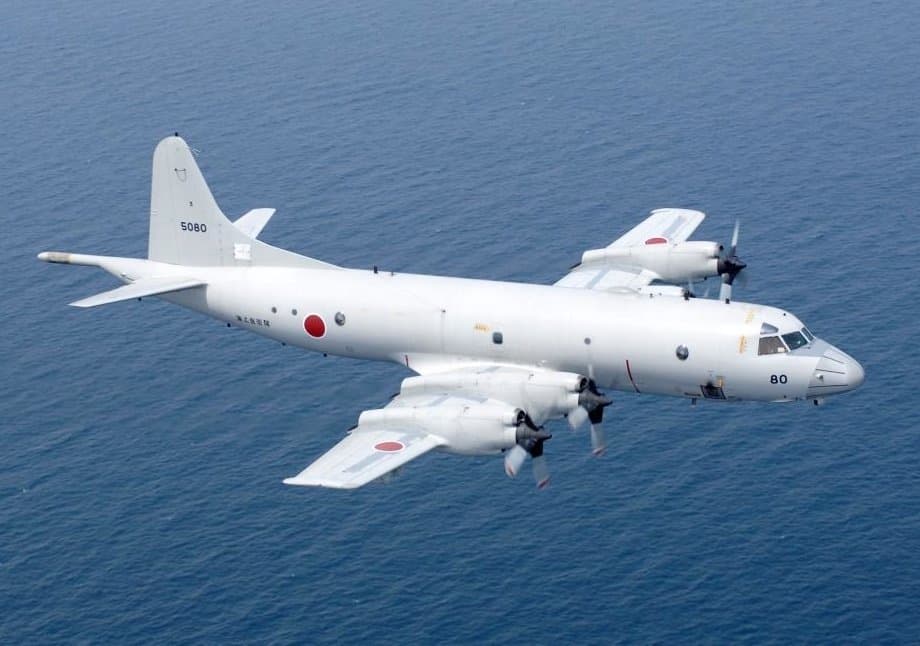

Credit
海上自衛隊 · CC BY-SA 4.0 · Resized · CC BY-SA 4.0 · Source ↗ · Modified


Preparing your view.

At a glance
True scale
Side by side. From every angle. A human reference for perspective.
3.14 MB · Loads when you open it| Model | Length | Width / span | Height |
|---|---|---|---|
| Lockheed P-3 Orion | ≈ 35.61 m | ≈ 30.38 m (Width) | ≈ 10.28 m |
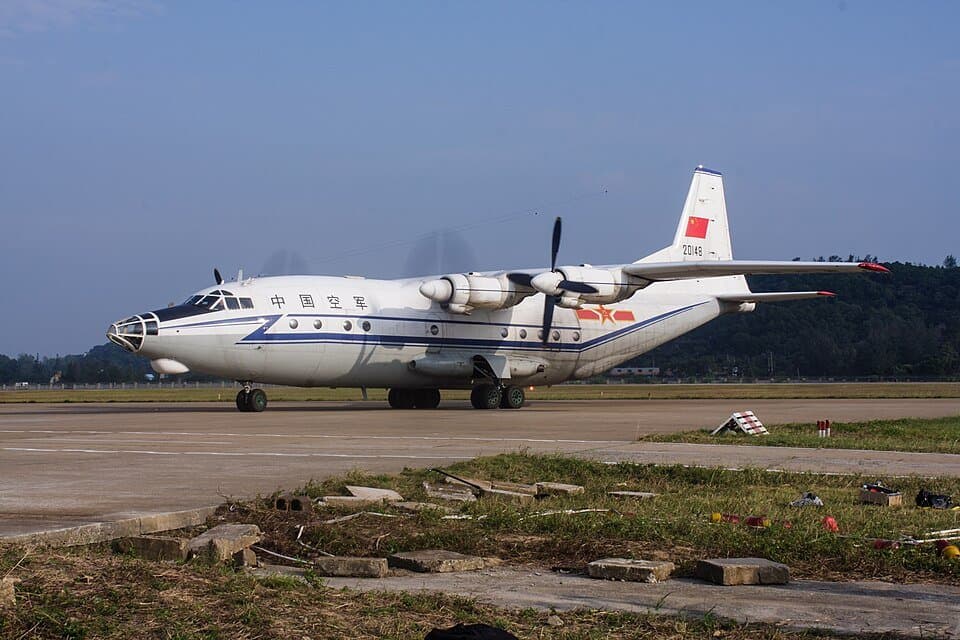
| Shaanxi Y-8 | ≈ 34.02 m | ≈ 38 m (Width) | ≈ 11.16 m |
Scaled uniformly to the sourced length of 35.61 m. The shape was turned square to the axes; the height was fitted to the sourced 10.274 m; the width was fitted to the sourced 30.38 m. Not an official model or a measured survey.
ForceTally · All rights reserved
Scaled uniformly to the sourced length of 34.02 m. The shape was turned square to the axes; the height was fitted to the sourced 11.16 m; the width was fitted to the sourced 38 m. Not an official model or a measured survey.
ForceTally · All rights reserved
The human reference is a generic 1.75 m figure. Models describe external size, not combat performance.
Measured figures
P-3C Orion · Length
Single source116 ft 10 in (35.61 m)[source]
Configuration
| Specification | Lockheed P-3 Orion | Shaanxi Y-8 |
|---|---|---|
| Type | Maritime patrol aircraft[source] | Military transport aircraft / Maritime patrol aircraft[source] |
| National origin | United States[source] | China[source] |
| Manufacturer | Lockheed Lockheed Martin Kawasaki Aerospace Company[source] | Shaanxi Aircraft Corporation[source] |
| Status | Active[source] | In service, in production |
Y-8 · Length
34.02 m (111 ft 7 in)[source]
Empty; P-3C Orion · Empty weight
Single sourceMaximum take-off; P-3C Orion · MTOW normal
Single source61,491 lb (27,892 kg)[source]
135,000 lb (61,235 kg) MTOW normal[source]
Empty; Y-8 · Empty weight
Single sourceMaximum take-off; Y-8 · Max takeoff weight
Single sourceCruise; P-3C Orion · at 25,000 ft (7,600 m) and 110,000 lb (50,000 kg)
Single sourceMaximum; P-3C Orion · at 15,000 ft (4,600 m) and 105,000 lb (48,000 kg)
Single source411 kn (473 mph, 761 km/h) at 15,000 ft (4,600 m) and 105,000 lb (48,000 kg)[source]
328 kn (377 mph, 607 km/h) at 25,000 ft (7,600 m) and 110,000 lb (50,000 kg)[source]
Cruise; Y-8 · Cruise speed
Single sourceMaximum; Y-8 · Maximum speed
Single sourceP-3C Orion · (3 hours on station at 1,500 ft (460 m))
Single source1,345 nmi (1,548 mi, 2,491 km) (3 hours on station at 1,500 ft (460 m))[source]
P-3C Orion · 4 × Allison T56-A-14 turboprop engines, 4,910 shp ( ) each (equivalent
Single source4 × Allison T56-A-14 turboprop engines, 4,910 shp (3,660 kW) each (equivalent)[source]
Y-8 · 4 × Zhuzhou WoJiang-6 (WJ-6) turboprop engines each
Single source4 × Zhuzhou WoJiang-6 (WJ-6) turboprop engines, 3,170 kW (4,250 hp) each[source]
P-3C Orion · at 15,000 ft (4,600 m) on two engines
Single source17 hours 12 minutes at 15,000 ft (4,600 m) on two engines[source]
Bars compare reported quantities only. A larger figure does not make a system better; configurations and test conditions differ.
| Primary users | United States Navy Republic of China Navy Japan Maritime Self-Defense Force Republic of Korea Navy[source] | People's Liberation Army Air Force People's Liberation Army Navy Air Force Myanmar Air Force Pakistan Air Force[source] |
|---|
| Number built | Lockheed – 650, Kawasaki – 107, Total – 757[source] | 169 (2010)[source] |
|---|
| Manufactured | 1961–1990[source] | 1981–present[source] |
|---|
| Introduction date | August 1962[source] | — |
|---|
| First flight | November 1959[source] | 25 December 1974[source] |
|---|
| Developed from | Lockheed L-188 Electra[source] | Antonov An-12[source] |
|---|
| Variants | Lockheed AP-3C Orion Lockheed CP-140 Aurora Lockheed EP-3 Lockheed WP-3D Orion[source] | — |
|---|
| Developed into | Lockheed P-7[source] | Shaanxi Y-9[source] |
|---|
| Fuel capacity | 9,200 US gal (7,700 imp gal; 35,000 L) usable fuel in 5 wing and fuselage tanks; (62,500 lb (28,350 kg) maximum fuel weight); 111 US gal (92 imp gal; 420 L) usable oil in 4 tanks[source] | — |
|---|
| Hardpoints | 10 wing stations in total (3x on each wing and 2x on each wing root) and eight internal bomb bay stations with a capacity of 20,000 lb (9,100 kg) , with provisions to carry combinations of: Rockets: None Missiles: Air-to-surface missile :4× AGM-65 Maverick , 6× AGM-84 Harpoon , 4× AGM-84 Standoff Land Attack Missile (SLAM-ER) Bombs: Depth charges , Mk 101 Lulu nuclear depth bomb ,10× Mk 20 Rockeye , MK80 Series (18×MK82, MK83, MK84) general-purpose bombs, B57 nuclear bomb (US service only, retired 1993) Other: Mk 44 (mostly retired from service), 8× Mk 46 , 6× Mk 50 , 7× Mk 54 or MU90 Impact torpedoes Mk 25, Mk 39, Mk 55, 7× Mk 56, Mk 60 CAPTOR or 6× Mk 65 or 18× Mk 62 or 11×Mk 63 Quickstrike naval mines Active and passive Sonobuoys[source] | — |
|---|
| Aspect ratio | 7.5[source] | — |
|---|
| Airfoil | root: NACA 0014 modified ; tip: NACA 0012 modified[source] | root: C-5-18; tip: C-3-14[source] |
|---|
| Zero-fuel weight | 77,200 lb (35,017 kg)[source] | — |
|---|
| Maximum landing weight | (MLW) 103,880 lb (47,119 kg)[source] | — |
|---|
| Propellers | 4-bladed Hamilton Standard 54H60-77, 13 ft 6 in (4.11 m) diameter constant-speed fully-feathering reversible propellers[source] | 4-bladed constant-speed propellers[source] |
|---|
| Patrol speed | 206 kn (237 mph; 382 km/h) at 1,500 ft (460 m) and 110,000 lb (50,000 kg)[source] | — |
|---|
| Stall speed | 133 kn (153 mph, 246 km/h) flaps up[source] | — |
|---|
| Time to altitude | 25,000 ft (7,600 m) in 30 minutes[source] | — |
|---|
| Wing loading | 103.8 lb/sq ft (507 kg/m 2 )[source] | — |
|---|
| Power/mass | 0.1455 hp/lb (0.2392 kW/kg) (equivalent)[source] | — |
|---|
| Take-off run | 4,240 ft (1,290 m)[source] | — |
|---|
| Take-off distance to 50 ft (15 m) | 5,490 ft (1,670 m)[source] | — |
|---|
| Landing distance from 50 ft (15 m) | 2,770 ft (840 m)[source] | — |
|---|
| Rockets | None[source] | — |
|---|
| Missiles | Air-to-surface missile :4× AGM-65 Maverick , 6× AGM-84 Harpoon , 4× AGM-84 Standoff Land Attack Missile (SLAM-ER)[source] | — |
|---|
| Bombs | Depth charges , Mk 101 Lulu nuclear depth bomb ,10× Mk 20 Rockeye , MK80 Series (18×MK82, MK83, MK84) general-purpose bombs, B57 nuclear bomb (US service only, retired 1993)[source] | — |
|---|
| Other | Mk 44 (mostly retired from service), 8× Mk 46 , 6× Mk 50 , 7× Mk 54 or MU90 Impact torpedoes Mk 25, Mk 39, Mk 55, 7× Mk 56, Mk 60 CAPTOR or 6× Mk 65 or 18× Mk 62 or 11×Mk 63 Quickstrike naval mines Active and passive Sonobuoys[source] | — |
|---|
| Variant | — | Shaanxi KJ-200[source] |
|---|
| Capacity | — | ≈90 equipped troops / 20,000 kg (44,092 lb) payload[source] |
|---|
| Guns | — | 2× 23 mm (0.906 in) cannon in tail turret (early models only)[source] |
|---|
| Role | — | medium-size, four-engine turboprop military transport aircraft[source] |
|---|
| Source measurement | — | The Shaanxi Y-8 or Yunshuji Y-8 ( Chinese : 运-8 ; pinyin : Yùn Bā ) aircraft is a medium-size, four-engine turboprop military transport aircraft produced by Shaanxi Aircraft Corporation in China , based on the Soviet Antonov An-12 . It has become one of China's most popular military and civilian transport/cargo aircraft, with many variants produced and exported. Although the Soviet Union ended production of the An-12 in 1973, the Chinese Y-8 continues to be upgraded and produced. An estimated 169 Y-8 aircraft had been built by 2010.[source]Shaanxi Y-8 · Lead; only the objects and conditions stated in this passage Design of the aircraft was completed by February 1972. Major features of the Y-8 included a glazed nose and tail turret derived from that of the H-6 bomber, a roller-type palletized-cargo-handling device instead of the overhead conveyor, and a gaseous oxygen system as opposed to a liquid oxygen system. The original Y-8 inherited the An-12's twin 23 mm cannon tail turret, but this was removed on subsequent variants.[source]Shaanxi Y-8 · Design and development / Domestic; only the objects and conditions stated in this passage The Y-8 is capable of carrying troops, dropping supplies, parachute drops, and functioning as an air ambulance. It also can be used for commercial purposes as a freighter. It is capable of hauling 20 tons of cargo, approximately 96 soldiers, or about 82 paratroopers in the cargo compartment which is 13.5 metres long, 3 metres wide and 2.4 metres high. It can also carry 60 severely wounded soldiers with their stretchers, 20 slightly injured soldiers and 3 medical attendants. Many variants for specialized roles have been built, but information on them can be vague or difficult to obtain due to the secretive nature of the Chinese military.[source]Shaanxi Y-8 · Design and development / Domestic; only the objects and conditions stated in this passage In 1986, two engineers from Beijing's Ministry of Aviation visited Lockheed. They could not speak very much English, and the Lockheed-Georgia sales person who met them could not speak Chinese. So for half a day, they did a point-and-grunt tour until they found a Lockheed employee who could speak Chinese. The Chinese wanted to purchase Lockheed wind tunnel testing on the Y-8 in order to address the stall problem.[source]Shaanxi Y-8 · Design and development / Modification; only the objects and conditions stated in this passage As a result of these wind tunnel tests, conducted in 1986, Lockheed was given a contract to do a flight test series on the Y-8. Lockheed was told that flight test data was not provided by the Soviets when they helped China build the Y-8 factory. The flight test series was flown by Lockheed test pilot Hank Dees. Hank had flown the test flight series for the Lockheed L-1011 and later for China's Y-12 in Harbin.[source]Shaanxi Y-8 · Design and development / Modification; only the objects and conditions stated in this passage Y-8F-200 : This model has a 2.2m (7 ft 10in) stretched fuselage. Capacity: 23 tons.[source]Shaanxi Y-8 · Variants; only the objects and conditions stated in this passage Y-8F-300 : Civil transport with western avionics. Capacity: 23 tons.[source]Shaanxi Y-8 · Variants; only the objects and conditions stated in this passage Y-8F-400 : As for Y-8F-300 but with pressurised cargo hold. Capacity: 23 tons.[source]Shaanxi Y-8 · Variants; only the objects and conditions stated in this passage Y-8F-600 : Newest civilian transport variant with a redesigned fuselage, Pratt and Whitney turboprop engines, an Electronic Flight Instrument System "glass cockpit", and a two-person crew. Capacity: 25 tons. Cancelled in 2008 and developed into the Y-9 .[source]Shaanxi Y-8 · Variants; only the objects and conditions stated in this passage Y-8G : IFR tanker. (project). Also identified as the Y-8GX3.[source]Shaanxi Y-8 · Variants; only the objects and conditions stated in this passage Y-8H : Aerial survey aircraft.[source]Shaanxi Y-8 · Variants; only the objects and conditions stated in this passage Capacity: ≈90 equipped troops / 20,000 kg (44,092 lb) payload[source]Shaanxi Y-8 · Specifications (Y-8); only the objects and conditions stated in this passage Length: 34.02 m (111 ft 7 in)[source]Shaanxi Y-8 · Specifications (Y-8); only the objects and conditions stated in this passage Wingspan: 38 m (124 ft 8 in)[source]Shaanxi Y-8 · Specifications (Y-8); only the objects and conditions stated in this passage Height: 11.16 m (36 ft 7 in)[source]Shaanxi Y-8 · Specifications (Y-8); only the objects and conditions stated in this passage Wing area: 121.9 m 2 (1,312 sq ft)[source]Shaanxi Y-8 · Specifications (Y-8); only the objects and conditions stated in this passage Empty weight: 35,490 kg (78,242 lb)[source]Shaanxi Y-8 · Specifications (Y-8); only the objects and conditions stated in this passage Max takeoff weight: 61,000 kg (134,482 lb)[source]Shaanxi Y-8 · Specifications (Y-8); only the objects and conditions stated in this passage Powerplant: 4 × Zhuzhou WoJiang-6 (WJ-6) turboprop engines, 3,170 kW (4,250 hp) each[source]Shaanxi Y-8 · Specifications (Y-8); only the objects and conditions stated in this passage Maximum speed: 660 km/h (410 mph, 360 kn)[source]Shaanxi Y-8 · Specifications (Y-8); only the objects and conditions stated in this passage Cruise speed: 550 km/h (340 mph, 300 kn)[source]Shaanxi Y-8 · Specifications (Y-8); only the objects and conditions stated in this passage Range: 5,615 km (3,489 mi, 3,032 nmi)[source]Shaanxi Y-8 · Specifications (Y-8); only the objects and conditions stated in this passage Service ceiling: 10,400 m (34,100 ft)[source]Shaanxi Y-8 · Specifications (Y-8); only the objects and conditions stated in this passage Rate of climb: 10 m/s (2,000 ft/min)[source]Shaanxi Y-8 · Specifications (Y-8); only the objects and conditions stated in this passage Guns: 2× 23 mm (0.906 in) cannon in tail turret (early models only)[source]Shaanxi Y-8 · Specifications (Y-8); only the objects and conditions stated in this passage |
|---|
| Origin reported by inventory | — | China / Pakistan[source]Inventory Origin column; table 1, row 52, cell 4; revision 1377423821; retrieved 2026-10-02 |
|---|