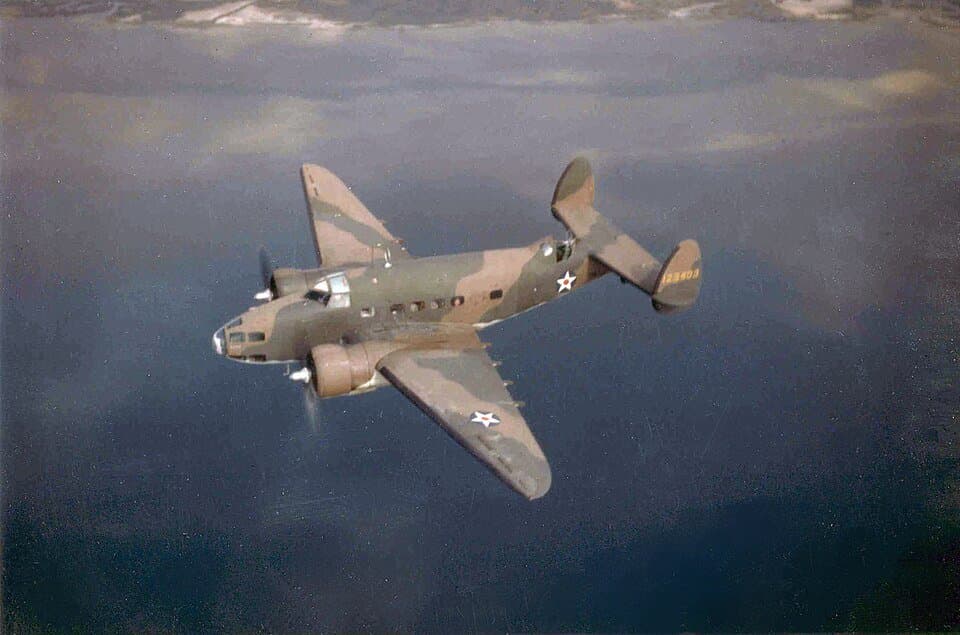

Credit
USAAF · Public domain · Resized · Public domain · Source ↗ · Modified


Preparing your view.

At a glance
Measured figures
Hudson Mk I · Length
Single source44 ft 4 in (13.51 m)[source]
Configuration
| Specification | Lockheed Hudson | Shaanxi Y-8 |
|---|---|---|
| Crew | Five[source] | 5, 3, or 2 ( Y-8F600 )[source] |
| Type | Bomber , reconnaissance , transport , maritime patrol aircraft[source] | Military transport aircraft / Maritime patrol aircraft[source] |
| Manufacturer | Lockheed[source] | Shaanxi Aircraft Corporation[source] |
| Designer | Clarence "Kelly" Johnson[source] |
Y-8 · Length
34.02 m (111 ft 7 in)[source]
Empty; Hudson Mk I · Empty weight
Single sourceGross; Hudson Mk I · Gross weight
Single sourceMaximum take-off; Max takeoff weight
Single source11,630 lb (5,275 kg)[source]
17,500 lb (7,938 kg)[source]
8390 кг[source]
Empty; Y-8 · Empty weight
Single sourceMaximum take-off; Y-8 · Max takeoff weight
Single sourceCruise; Hudson Mk I · Cruise speed
Single sourceMaximum; Hudson Mk I · at 6,500 ft (2,000 m)
Single source246 mph (396 km/h, 214 kn) at 6,500 ft (2,000 m)[source]
220 mph (350 km/h, 190 kn)[source]
Cruise; Y-8 · Cruise speed
Single sourceMaximum; Y-8 · Maximum speed
Single sourceHudson Mk I · 2 × Wright GR-1820-G102A Cyclone 9-cylinder radial engines each
Single source2 × Wright GR-1820-G102A Cyclone 9-cylinder radial engines , 1,100 hp (820 kW) each[source]
Y-8 · 4 × Zhuzhou WoJiang-6 (WJ-6) turboprop engines each
Single source4 × Zhuzhou WoJiang-6 (WJ-6) turboprop engines, 3,170 kW (4,250 hp) each[source]
Bars compare reported quantities only. A larger figure does not make a system better; configurations and test conditions differ.
| — |
| Primary users | Royal Air Force Royal Canadian Air Force Royal Australian Air Force United States Army Air Forces[source] | People's Liberation Army Air Force People's Liberation Army Navy Air Force Myanmar Air Force Pakistan Air Force[source] |
|---|
| Number built | 2,941[source] | 169 (2010)[source] |
|---|
| Manufactured | 1938–1943[source] | 1981–present[source] |
|---|
| Introduction date | 1939[source] | — |
|---|
| First flight | 10 December 1938[source] | 25 December 1974[source] |
|---|
| Developed from | Lockheed Model 14 Super Electra[source] | Antonov An-12[source] |
|---|
| Guns | 2 × .303 in (7.7 mm) Browning machine guns in dorsal turret 2× .303 Browning machine guns in nose[source] | 2× 23 mm (0.906 in) cannon in tail turret (early models only)[source] |
|---|
| Bombs | 1,400 lb (640 kg) of bombs or depth charges[source] | — |
|---|
| Role | light bomber and coastal reconnaissance aircraft[source] | medium-size, four-engine turboprop military transport aircraft[source] |
|---|
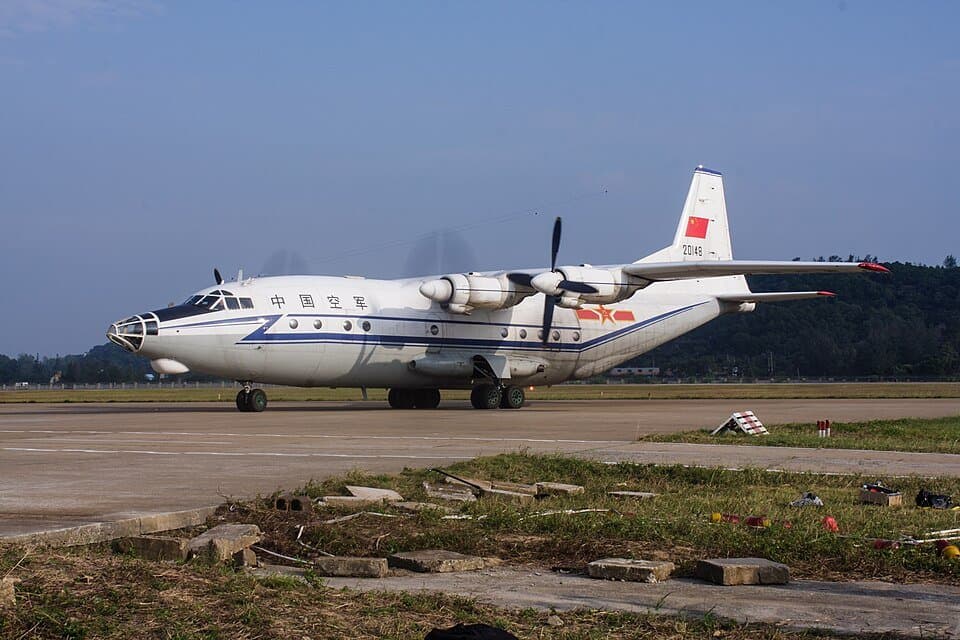
| Source measurement | A total of 350 Mk I and 20 Hudson Mk IIs were supplied (the Mk II had different propellers ). These had two fixed Browning machine guns in the nose and two more in the Boulton Paul dorsal turret . The Hudson Mk III added one ventral and two beam machine guns and replaced the 1,100 hp Wright R-1820 Cyclone 9-cylinder radials with 1,200 hp versions (428 produced).[source]Lockheed Hudson · Design and development; only the objects and conditions stated in this passage The Hudson Mk V (309 produced) and Mk VI (450 produced) were powered by the 1,200 hp Pratt & Whitney R-1830 Twin Wasp 14-cylinder two-row radial. The RAF also obtained 380 Mk IIIA and 30 Mk IV Hudsons under the Lend-Lease program.[source]Lockheed Hudson · Design and development; only the objects and conditions stated in this passage Following Japanese landings at Kota Bharu during the Malayan campaign , Hudsons from No. 1 Squadron RAAF became the first Allied aircraft to make an attack in the Pacific War , sinking a Japanese transport ship, the Awazisan Maru , off Kota Bharu at 0118h local time, an hour before the attack on Pearl Harbor .[source]Lockheed Hudson · Operational history / World War II; only the objects and conditions stated in this passage High-scoring Japanese ace Saburō Sakai , praised the skill and fighting abilities of an RAAF Hudson crew killed in action over New Guinea after being engaged by nine highly manoeuvrable Mitsubishi A6M Zeroes on 22 July 1942. The crew, captained by P/O Warren Cowan, in Hudson Mk IIIA A16-201 (bu. no. 41-36979 ) of No. 32 Squadron RAAF , was intercepted over Buna by nine Zeroes of the Tainan Kaigun Kōkūtai led by Sakai. The Hudson crew accomplished many aggressive and unexpected turns, engaging the Japanese pilots in a dogfight for more than 10 minutes. It was only after Sakai scored hits on the rear/upper turret that the Hudson could be destroyed. Its crew made such an impression on Sakai that, after the war's end, he sought to identify them. In 1997, Sakai wrote formally to the Australian government, recommending that Cowan be "posthumously awarded your country's highest military decoration ". In 2023, the crew of A16-201 were posthumously awarded the Medal for Gallantry .[source]Lockheed Hudson · Operational history / World War II; only the objects and conditions stated in this passage On 23 November 1942, the crew of a No. 3 Squadron, Royal New Zealand Air Force (RNZAF) Hudson Mk IIIA, NZ2049 , ( 41-46465 ) after spotting an enemy convoy near Vella Lavella , was engaged by three Japanese floatplane fighters. After skilled evasive manoeuvring at an altitude of less than 50 feet (15 metres), by the Hudson's captain, Flying Officer George Gudsell, the crew returned with no casualties to Henderson Field , Guadalcanal.[source]Lockheed Hudson · Operational history / World War II; only the objects and conditions stated in this passage Mk III with two 1,200 hp (890 kW) Pratt & Whitney R-1830-S3C4-G Twin Wasp engines; 409 built.[source]Lockheed Hudson · Variants; only the objects and conditions stated in this passage US Military designation powered by two 1,050 hp (780 kW) Pratt & Whitney R-1830-45 engines; 52 lend-lease to Australia as Hudson IVA.[source]Lockheed Hudson · Variants; only the objects and conditions stated in this passage US Military designation powered by two 1,200 hp (890 kW) Pratt & Whitney R-1830-67 engines, interiors convertible to troop transports; 450 lend-lease to RAF/RCAF/RNZAF as Hudson VI; 27 units passed to the Brazilian Air Force .[source]Lockheed Hudson · Variants; only the objects and conditions stated in this passage US Military designation powered by two 1,200 hp (890 kW) Wright R-1820-87 engines; lend lease version intended for the RAF, 153 diverted to United States Army Air Forces (USAAF) as the RA-29 and 20 to the United States Navy (USN) as the PBO-1.[source]Lockheed Hudson · Variants; only the objects and conditions stated in this passage Length: 44 ft 4 in (13.51 m)[source]Lockheed Hudson · Specifications (Hudson Mk I); only the objects and conditions stated in this passage Wingspan: 65 ft 6 in (19.96 m)[source]Lockheed Hudson · Specifications (Hudson Mk I); only the objects and conditions stated in this passage Height: 11 ft 10 in (3.61 m)[source]Lockheed Hudson · Specifications (Hudson Mk I); only the objects and conditions stated in this passage Wing area: 551 sq ft (51.2 m 2 )[source]Lockheed Hudson · Specifications (Hudson Mk I); only the objects and conditions stated in this passage Empty weight: 11,630 lb (5,275 kg)[source]Lockheed Hudson · Specifications (Hudson Mk I); only the objects and conditions stated in this passage Gross weight: 17,500 lb (7,938 kg)[source]Lockheed Hudson · Specifications (Hudson Mk I); only the objects and conditions stated in this passage Powerplant: 2 × Wright GR-1820-G102A Cyclone 9-cylinder radial engines , 1,100 hp (820 kW) each[source]Lockheed Hudson · Specifications (Hudson Mk I); only the objects and conditions stated in this passage Maximum speed: 246 mph (396 km/h, 214 kn) at 6,500 ft (2,000 m)[source]Lockheed Hudson · Specifications (Hudson Mk I); only the objects and conditions stated in this passage Cruise speed: 220 mph (350 km/h, 190 kn)[source]Lockheed Hudson · Specifications (Hudson Mk I); only the objects and conditions stated in this passage Range: 1,960 mi (3,150 km, 1,700 nmi)[source]Lockheed Hudson · Specifications (Hudson Mk I); only the objects and conditions stated in this passage Service ceiling: 25,000 ft (7,600 m)[source]Lockheed Hudson · Specifications (Hudson Mk I); only the objects and conditions stated in this passage Rate of climb: 2,180 ft/min (11.1 m/s)[source]Lockheed Hudson · Specifications (Hudson Mk I); only the objects and conditions stated in this passage Guns: 2 × .303 in (7.7 mm) Browning machine guns in dorsal turret 2× .303 Browning machine guns in nose[source]Lockheed Hudson · Specifications (Hudson Mk I); only the objects and conditions stated in this passage Bombs: 1,400 lb (640 kg) of bombs or depth charges[source]Lockheed Hudson · Specifications (Hudson Mk I); only the objects and conditions stated in this passage | The Shaanxi Y-8 or Yunshuji Y-8 ( Chinese : 运-8 ; pinyin : Yùn Bā ) aircraft is a medium-size, four-engine turboprop military transport aircraft produced by Shaanxi Aircraft Corporation in China , based on the Soviet Antonov An-12 . It has become one of China's most popular military and civilian transport/cargo aircraft, with many variants produced and exported. Although the Soviet Union ended production of the An-12 in 1973, the Chinese Y-8 continues to be upgraded and produced. An estimated 169 Y-8 aircraft had been built by 2010.[source]Shaanxi Y-8 · Lead; only the objects and conditions stated in this passage Design of the aircraft was completed by February 1972. Major features of the Y-8 included a glazed nose and tail turret derived from that of the H-6 bomber, a roller-type palletized-cargo-handling device instead of the overhead conveyor, and a gaseous oxygen system as opposed to a liquid oxygen system. The original Y-8 inherited the An-12's twin 23 mm cannon tail turret, but this was removed on subsequent variants.[source]Shaanxi Y-8 · Design and development / Domestic; only the objects and conditions stated in this passage The Y-8 is capable of carrying troops, dropping supplies, parachute drops, and functioning as an air ambulance. It also can be used for commercial purposes as a freighter. It is capable of hauling 20 tons of cargo, approximately 96 soldiers, or about 82 paratroopers in the cargo compartment which is 13.5 metres long, 3 metres wide and 2.4 metres high. It can also carry 60 severely wounded soldiers with their stretchers, 20 slightly injured soldiers and 3 medical attendants. Many variants for specialized roles have been built, but information on them can be vague or difficult to obtain due to the secretive nature of the Chinese military.[source]Shaanxi Y-8 · Design and development / Domestic; only the objects and conditions stated in this passage In 1986, two engineers from Beijing's Ministry of Aviation visited Lockheed. They could not speak very much English, and the Lockheed-Georgia sales person who met them could not speak Chinese. So for half a day, they did a point-and-grunt tour until they found a Lockheed employee who could speak Chinese. The Chinese wanted to purchase Lockheed wind tunnel testing on the Y-8 in order to address the stall problem. |
|---|
| Country of origin | United States[source] United States[source] United States[source] United States[source] | — |
|---|
| National origin | — | China[source] |
|---|
| Status | — | In service, in production[source] |
|---|
| Variant | — | Shaanxi KJ-200[source] |
|---|
| Developed into | — | Shaanxi Y-9[source] |
|---|
| Capacity | — | ≈90 equipped troops / 20,000 kg (44,092 lb) payload[source] |
|---|
| Airfoil | — | root: C-5-18; tip: C-3-14[source] |
|---|
| Propellers | — | 4-bladed constant-speed propellers[source] |
|---|
| Origin reported by inventory | — | China / Pakistan[source]Inventory Origin column; table 1, row 52, cell 4; revision 1377423821; retrieved 2026-10-02 |
|---|
As a result of these wind tunnel tests, conducted in 1986, Lockheed was given a contract to do a flight test series on the Y-8. Lockheed was told that flight test data was not provided by the Soviets when they helped China build the Y-8 factory. The flight test series was flown by Lockheed test pilot Hank Dees. Hank had flown the test flight series for the Lockheed L-1011 and later for China's Y-12 in Harbin.[source]Shaanxi Y-8 · Design and development / Modification; only the objects and conditions stated in this passage
Y-8F-200 : This model has a 2.2m (7 ft 10in) stretched fuselage. Capacity: 23 tons.[source]Shaanxi Y-8 · Variants; only the objects and conditions stated in this passage
Y-8F-300 : Civil transport with western avionics. Capacity: 23 tons.[source]Shaanxi Y-8 · Variants; only the objects and conditions stated in this passage
Y-8F-400 : As for Y-8F-300 but with pressurised cargo hold. Capacity: 23 tons.[source]Shaanxi Y-8 · Variants; only the objects and conditions stated in this passage
Y-8F-600 : Newest civilian transport variant with a redesigned fuselage, Pratt and Whitney turboprop engines, an Electronic Flight Instrument System "glass cockpit", and a two-person crew. Capacity: 25 tons. Cancelled in 2008 and developed into the Y-9 .[source]Shaanxi Y-8 · Variants; only the objects and conditions stated in this passage
Y-8G : IFR tanker. (project). Also identified as the Y-8GX3.[source]Shaanxi Y-8 · Variants; only the objects and conditions stated in this passage
Y-8H : Aerial survey aircraft.[source]Shaanxi Y-8 · Variants; only the objects and conditions stated in this passage
Capacity: ≈90 equipped troops / 20,000 kg (44,092 lb) payload[source]Shaanxi Y-8 · Specifications (Y-8); only the objects and conditions stated in this passage
Length: 34.02 m (111 ft 7 in)[source]Shaanxi Y-8 · Specifications (Y-8); only the objects and conditions stated in this passage
Wingspan: 38 m (124 ft 8 in)[source]Shaanxi Y-8 · Specifications (Y-8); only the objects and conditions stated in this passage
Height: 11.16 m (36 ft 7 in)[source]Shaanxi Y-8 · Specifications (Y-8); only the objects and conditions stated in this passage
Wing area: 121.9 m 2 (1,312 sq ft)[source]Shaanxi Y-8 · Specifications (Y-8); only the objects and conditions stated in this passage
Empty weight: 35,490 kg (78,242 lb)[source]Shaanxi Y-8 · Specifications (Y-8); only the objects and conditions stated in this passage
Max takeoff weight: 61,000 kg (134,482 lb)[source]Shaanxi Y-8 · Specifications (Y-8); only the objects and conditions stated in this passage
Powerplant: 4 × Zhuzhou WoJiang-6 (WJ-6) turboprop engines, 3,170 kW (4,250 hp) each[source]Shaanxi Y-8 · Specifications (Y-8); only the objects and conditions stated in this passage
Maximum speed: 660 km/h (410 mph, 360 kn)[source]Shaanxi Y-8 · Specifications (Y-8); only the objects and conditions stated in this passage
Cruise speed: 550 km/h (340 mph, 300 kn)[source]Shaanxi Y-8 · Specifications (Y-8); only the objects and conditions stated in this passage
Range: 5,615 km (3,489 mi, 3,032 nmi)[source]Shaanxi Y-8 · Specifications (Y-8); only the objects and conditions stated in this passage
Service ceiling: 10,400 m (34,100 ft)[source]Shaanxi Y-8 · Specifications (Y-8); only the objects and conditions stated in this passage
Rate of climb: 10 m/s (2,000 ft/min)[source]Shaanxi Y-8 · Specifications (Y-8); only the objects and conditions stated in this passage
Guns: 2× 23 mm (0.906 in) cannon in tail turret (early models only)[source]Shaanxi Y-8 · Specifications (Y-8); only the objects and conditions stated in this passage