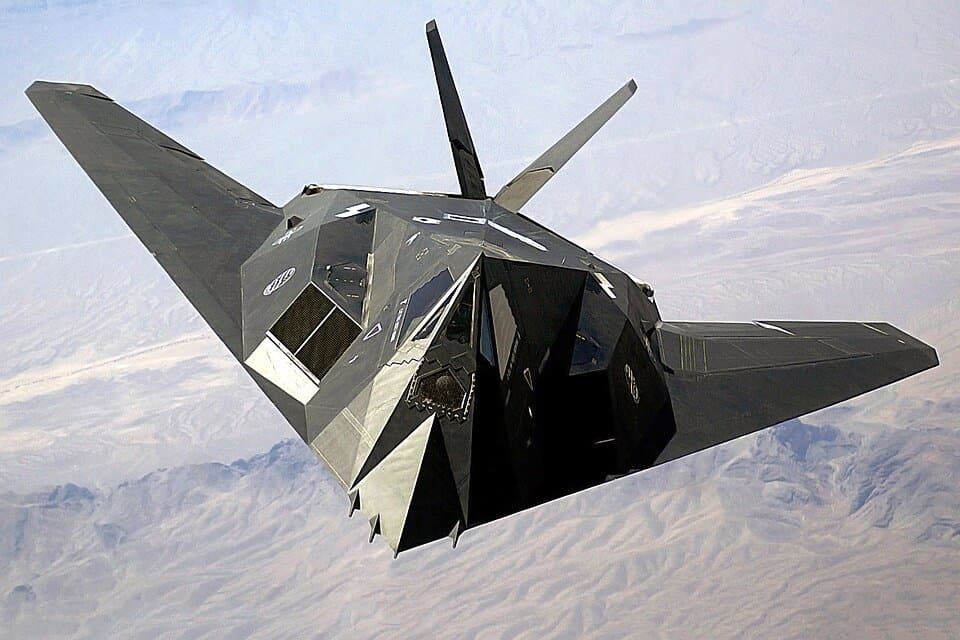

Credit
Staff Sgt. Aaron Allmon II · Public domain · Resized · Public domain · Source ↗ · Modified


Preparing your view.
At a glance
Measured figures
F-117A · Length
Single source65 ft 11 in (20.09 m)[source]
Configuration
| Specification | Lockheed F-117 Nighthawk | Soko J-21 Jastreb |
|---|---|---|
| Type | Stealth attack aircraft[source] | Light attack aircraft[source] |
| National origin | United States[source] | — |
| Manufacturer | Lockheed Corporation[source] | SOKO[source] |
| Status | Retired from combat in 2008, used as training aircraft as of 2025[source] | Retired from Republika Srpska Air Force (2006) |
J-21 Jastreb · Length
10.88 m (35 ft 8 in)[source]
Maximum; F-117A · Maximum speed
Single source594 kn (684 mph, 1,100 km/h)[source]
F-117A · 2 × General Electric F404-F1D2 turbofan engines thrust each
Single source2 × General Electric F404-F1D2 turbofan engines, 9,040 lbf (40.2 kN) thrust each[source]
J-21 Jastreb · 1 × BMB (Rolls-Royce/Bristol Siddeley) Viper Mk 531 turbojet engine thrust
Single source1 × BMB (Rolls-Royce/Bristol Siddeley) Viper Mk 531 turbojet engine, 13.32 kN (2,990 lbf) thrust[source]
J-21 Jastreb · 4,100 ft/min
Single source21 m/s (4,100 ft/min)[source]
Bars compare reported quantities only. A larger figure does not make a system better; configurations and test conditions differ.
| Primary user | United States Air Force[source] | Yugoslav Air Force[source] |
|---|
| Number built | 64 (5 YF-117As, 59 F-117As)[source] | 224[source] |
|---|
| Manufactured | 1981–1990[source] | 1968–1977[source] |
|---|
| Introduction date | October 1983 ( 1983-10 )[source] | — |
|---|
| First flight | 18 June 1981 ( 1981-06-18 )[source] | 19 July 1965[source] |
|---|
| Airfoil | Lozenge section, three flats Upper, two flats Lower[source] | — |
|---|
| Wing loading | 67.3 lb/sq ft (329 kg/m 2 ) calculated from[source] | — |
|---|
| Thrust/weight | 0.40[source] | — |
|---|
| Bombs | GBU-10 Paveway II laser-guided bomb with 2,000 lb (910 kg) Mk84 blast/fragmentation or BLU-109 or BLU-116 Penetrator warhead GBU-12 Paveway II laser-guided bomb with 500 lb (230 kg) Mk82 blast/fragmentation warhead GBU-27 Paveway III laser-guided bomb with 2,000 lb (910 kg) Mk84 blast-fragmentation or BLU-109 or BLU-116 Penetrator warhead GBU-31 JDAM INS / GPS guided munition with 2,000 lb (910 kg) Mk84 blast-frag or BLU-109 Penetrator warhead B61 nuclear bomb[source] | — |
|---|
| Hardpoints | 2 × internal weapons bays with one hardpoint each (total of two weapons) equipped to carry:[source] | 8 with a capacity of inboard pylons (2 of) 250 kg (550 lb), outboard pylons (6 of) 50 kg (110 lb), with provisions to carry combinations of:[source] |
|---|
| Role | retired American single-seat, subsonic, twin-engined stealth attack aircraft[source] | Yugoslav single-seat, single-engined, light attack aircraft ,[source] |
|---|
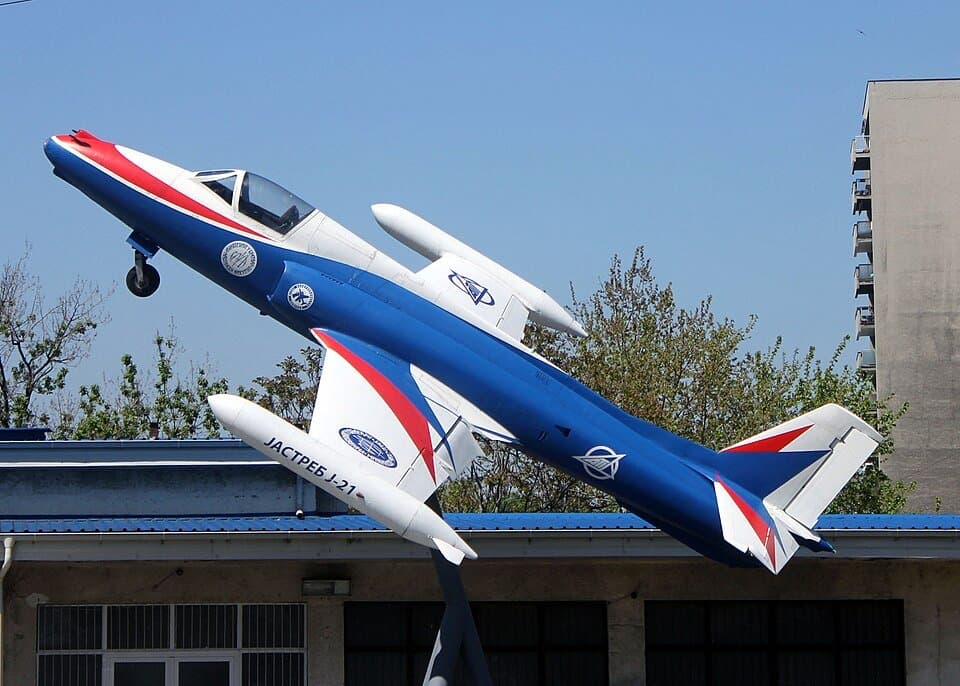
| Source measurement | The aircraft's faceted shape (made from flat surfaces) heavily contributes to its relatively low radar cross-section of about 0.001 m 2 (0.0108 sq ft). To minimize its infrared signature , its non-circular tail pipe mixes hot exhaust with cool ambient air and lacks afterburners ; it is also restricted to subsonic speeds, as breaking the sound barrier would produce an obvious sonic boom that would increase its acoustic and infrared footprints. While commonly referred to as the "Stealth Fighter", the aircraft was designed and employed as a dedicated attack aircraft ; its performance in air combat maneuvering was less than that of most contemporary fighters. The F-117 has integrated digital navigation and attack systems, with targeting via a thermal imaging infrared system and a laser rangefinder / laser designator . It is aerodynamically unstable in all three aircraft principal axes , thus requiring constant flight corrections via a fly-by-wire flight system to maintain controlled flight.[source]Lockheed F-117 Nighthawk · Lead; only the objects and conditions stated in this passage Even in the years after it entered service, the F-117 was a black project . Its existence was denied by USAF officials until 10 November 1988, when the aircraft was first publicly acknowledged. Its first combat mission was flown during the U.S. invasion of Panama in 1989. The last of the 59 production F-117s was delivered on 3 July 1990. The F-117 gained note in the Gulf War of 1991, during which it flew about 1,300 sorties and struck what the US military described as 1,600 high-value targets in Iraq. F-117s also participated in the conflict in Yugoslavia , during which one was shot down by a surface-to-air missile in 1999. It was also active during Operation Enduring Freedom in 2001 and Operation Iraqi Freedom in 2003. The USAF retired the F-117 in 2008, primarily because the F-22 Raptor had entered service, but has kept some aircraft in flying condition for research and development, testing, and training.[source]Lockheed F-117 Nighthawk · Lead; only the objects and conditions stated in this passage The aircraft is air refuelable and features a V-tail . The maximum speed is 623 mph (1,003 km/h; 541 kn) at high altitude, the maximum rate of climb is 2,820 feet (860 m) per minute, and the service ceiling is 43,000 to 45,000 feet (13,000 to 14,000 m). The cockpit was quite spacious, with ergonomic displays and controls, but the field of view was somewhat obstructed with a large blind spot to the rear.[source]Lockheed F-117 Nighthawk · Design; only the objects and conditions stated in this passage The aircraft is equipped with sophisticated navigation and attack systems integrated into a digital avionics suite. It navigates primarily by GPS and high-accuracy inertial navigation . Missions are coordinated by an automated planning system that can automatically perform all aspects of an attack mission, including weapons release. Targets are acquired by a thermal imaging , infrared system, paired with a laser rangefinder / laser designator that finds the range and designates targets for laser-guided bombs . The F-117's split internal bay can carry 5,000 pounds (2,300 kg) of ordnance. Typical weapons are a pair of GBU-10 , GBU-12 , or GBU-27 laser-guided bombs, two BLU-109 penetration bombs, or, after 2006, two Joint Direct Attack Munitions (JDAM) GPS/INS-guided stand-off bombs.[source]Lockheed F-117 Nighthawk · Design / Avionics; only the objects and conditions stated in this passage The F-117 has an RCS around 0.001 m 2 (0.0108 sq ft). Among the penalties for stealth are subsonic speeds to prevent frame heating, heat on the engine inlet and outlet prevent certain thrusting maneuvers, a very low wing aspect ratio , and a high sweep angle (50°), needed to deflect incoming radar waves to the sides. With these design considerations and no afterburner , the F-117 is limited to subsonic speeds. Additionally, to maintain its low observability, the F-117 was not equipped with radar; not only would an active radar be detectable through its emissions, but also an inactive radar antenna would also act as a reflector of radar energy. Whether it carries any radar detection equipment remained classified as of 2008.[source]Lockheed F-117 Nighthawk · Design / Stealth; only the objects and conditions stated in this passage Its faceted shape (made from two-dimensional flat surfaces) resulted from the limitations of the 1970s-era computer technology used to calculate its RCS. Later supercomputers made subsequent aircraft like the B-2 bomber made using curved surfaces while maintaining stealth possible, through the use of far more computational resources to perform the additional calculations. The F-117 was covered by almost one ton of radio-wave absorbing materials, manufactured as flat sheets. The sheets were held in place by glue, with the gaps between filled by a kind of putty material called "butter".[source]Lockheed F-117 Nighthawk · Design / Stealth; only the objects and conditions stated in this passage The F-117 reached initial operating capability status in 1983. The Nighthawk's pilots called themselves "Bandits". Each of the 558 Air Force pilots who have flown the F-117 has a Bandit number, such as "Bandit 52", that indicates the sequential order of their first flight in the F-117. Pilots told friends and families that they flew the Northrop F-5 in aggressor squadrons against Tactical Air Command.[source]Lockheed F-117 Nighthawk · Operational history / Early activities; only the objects and conditions stated in this passage The aircraft was operated in secret from Tonopah for almost a decade; after the Gulf War, all aircraft moved to Holloman in 1992, but its integration with the USAF's nonstealth "iron jets" occurred slowly. As one senior F-117 pilot later said: "Because of ongoing secrecy, others continued to see the aircraft as 'none of their business, a stand-alone system'." The F-117 and members of the 49th Fighter Wing were deployed to Southwest Asia on multiple occasions. On their first deployment, with the aid of aerial refueling, pilots flew nonstop from Holloman to Kuwait, around an 18.5-hour flight.[source]Lockheed F-117 Nighthawk · Operational history / Early activities; only the objects and conditions stated in this passage One F-117 (AF ser. no. 82-0806) was lost to enemy action. It was downed during an Operation Allied Force mission against the Army of Yugoslavia on 27 March 1999. The aircraft was shot down at a distance of 8.1 mi (13 km) and an altitude of 26,000 ft (8 km). SA-3s were then launched by a Yugoslav version of the Soviet Isayev S-125 "Neva" (NATO name SA-3 "Goa") antiaircraft missile system. The launcher was run by the 3rd Battalion of the 250th Air Defence Missile Brigade under the command of Colonel Zoltán Dani . After the explosion, the aircraft became uncontrollable, forcing the pilot to eject. The pilot was recovered six hours later by a USAF pararescue team. The stealth technology from the downed F-117 has reportedly been studied by Russia, and possibly China. The U.S. did not attempt to destroy the wreckage; senior Pentagon officials claimed that its technology was already dated and no longer important to protect.[source]Lockheed F-117 Nighthawk · Operational history / Yugoslavia; only the objects and conditions stated in this passage The loss of an F-117 in Serbia caused the USAF to create a subsection of its existing weapons school to improve tactics. More training was done with other units, and the F-117 began to participate in Red Flag exercises . Though advanced for its time, the F-117's stealthy faceted airframe required a large amount of maintenance and was eventually superseded by streamlined shapes produced with computer-aided design . Other weapons systems began to take on the F-117's roles, such as the F-22 Raptor gaining the ability to drop guided bombs. By 2005, the aircraft was used only for certain missions, such as if a pilot needed to verify that the correct target had been hit, or when minimal collateral damage was vital.[source]Lockheed F-117 Nighthawk · Operational history / Program closeout; only the objects and conditions stated in this passage The USAF had once planned to retire the F-117 in 2011, but Program Budget Decision 720 (PBD 720), dated 28 December 2005, proposed retiring it by October 2008 to free up an estimated $1.07 billion to buy more F-22s. PBD 720 called for 10 F-117s to be retired in FY2007 and the remaining 42 in FY2008, stating that other USAF planes and missiles could stealthily deliver precision ordnance, including the B-2 Spirit , F-22, and JASSM . The planned introduction of the multirole F-35 Lightning II also contributed to the retirement decision.[source]Lockheed F-117 Nighthawk · Operational history / Program closeout; only the objects and conditions stated in this passage In May 2023, two F-117s participated in exercise Northern Edge 23-1, marking the first time they were officially spotted operating outside of the continental US after their retirement. On 1 February 2024, two F-117s were seen at testing range R-2508 in the Mojave Desert.[source]Lockheed F-117 Nighthawk · Operational history / Postretirement service; only the objects and conditions stated in this passage The United States Navy tested the F-117 in 1984, but determined it was unsuitable for carrier use. In the early 1990s, Lockheed proposed an upgraded carrier-capable F-117 variant dubbed the "Seahawk" to the Navy as an alternative to the canceled A/F-X program. The unsolicited proposal was received poorly by the Department of Defense, which lacked interest in the single-mission capabilities on offer, particularly as it would take money away from the Joint Advanced Strike Technology program, which evolved into the Joint Strike Fighter . The F-117N would have differed from the land-based F-117 in several ways, such as the use of "elevators, a bubble canopy, a less sharply swept wing and reconfigured tail". It would also be re-engined with General Electric F414 turbofans in place of the General Electric F404s . The aircraft would be optionally fitted with hardpoints, allowing for an additional 8,000 lb (3,600 kg) of payload, and a new ground-attack radar with air-to-air capability. In that role, the F-117N could carry AIM-120 AMRAAM air-to-air missiles.[source]Lockheed F-117 Nighthawk · Variants / F-117N "Sea Hawk"; only the objects and conditions stated in this passage After being rebuffed by the Navy, Lockheed submitted an updated proposal that included afterburning capability and a larger emphasis on the F-117N as a multimission aircraft, rather than just an attack aircraft. To boost interest, Lockheed also proposed an F-117B land-based variant that shared most of the F-117N capabilities. This variant was proposed to the USAF and RAF. Two RAF pilots formally evaluated the aircraft in 1986 as a reward for British help with the American bombing of Libya that year. RAF exchange officers began flying the F-117 in 1987, but the British declined an offer during the Reagan administration to purchase the aircraft. This renewed F-117N proposal was also known as the A/F-117X . Neither the F-117N nor the F-117B was ordered.[source]Lockheed F-117 Nighthawk · Variants / F-117B; only the objects and conditions stated in this passage 80-0785 – Pole-mounted outside the Skunk Works facility at United States Air Force Plant 42 in Palmdale, California, it is a hybrid airframe comprising the wreckage of 80–0785, the first production F-117A, and static test articles 778 and 779. It is fixed to a pedestal and serves as a monument.[source]Lockheed F-117 Nighthawk · Aircraft on display / United States; only the objects and conditions stated in this passage 85-0831 – is located at the Strategic Air Command & Aerospace Museum in Ashland, Nebraska , where it has undergone restoration and is now on display. It served as a test aircraft at Air Force Plant 42 in Palmdale, California from 1987 to 2008.[source]Lockheed F-117 Nighthawk · Aircraft on display / United States; only the objects and conditions stated in this passage Length: 65 ft 11 in (20.09 m)[source]Lockheed F-117 Nighthawk · Specifications (F-117A); only the objects and conditions stated in this passage Wingspan: 43 ft 4 in (13.21 m)[source]Lockheed F-117 Nighthawk · Specifications (F-117A); only the objects and conditions stated in this passage Height: 12 ft 5 in (3.78 m)[source]Lockheed F-117 Nighthawk · Specifications (F-117A); only the objects and conditions stated in this passage Wing area: 780 sq ft (72 m 2 )[source]Lockheed F-117 Nighthawk · Specifications (F-117A); only the objects and conditions stated in this passage Empty weight: 29,500 lb (13,381 kg)[source]Lockheed F-117 Nighthawk · Specifications (F-117A); only the objects and conditions stated in this passage Max takeoff weight: 52,500 lb (23,814 kg)[source]Lockheed F-117 Nighthawk · Specifications (F-117A); only the objects and conditions stated in this passage Powerplant: 2 × General Electric F404-F1D2 turbofan engines, 9,040 lbf (40.2 kN) thrust each[source]Lockheed F-117 Nighthawk · Specifications (F-117A); only the objects and conditions stated in this passage Maximum speed: 594 kn (684 mph, 1,100 km/h)[source]Lockheed F-117 Nighthawk · Specifications (F-117A); only the objects and conditions stated in this passage Range: 930 nmi (1,070 mi, 1,720 km)[source]Lockheed F-117 Nighthawk · Specifications (F-117A); only the objects and conditions stated in this passage Service ceiling: 45,000 ft (14,000 m)[source]Lockheed F-117 Nighthawk · Specifications (F-117A); only the objects and conditions stated in this passage 2 × internal weapons bays with one hardpoint each (total of two weapons) equipped to carry: Bombs: GBU-10 Paveway II laser-guided bomb with 2,000 lb (910 kg) Mk84 blast/fragmentation or BLU-109 or BLU-116 Penetrator warhead GBU-12 Paveway II laser-guided bomb with 500 lb (230 kg) Mk82 blast/fragmentation warhead GBU-27 Paveway III laser-guided bomb with 2,000 lb (910 kg) Mk84 blast-fragmentation or BLU-109 or BLU-116 Penetrator warhead GBU-31 JDAM INS / GPS guided munition with 2,000 lb (910 kg) Mk84 blast-frag or BLU-109 Penetrator warhead B61 nuclear bomb[source]Lockheed F-117 Nighthawk · Specifications (F-117A); only the objects and conditions stated in this passage | Compared to the Galeb, the Jastreb has a strengthened structure, allowing more weapons to be carried, including three 12.7 mm (0.5 in) Browning AN/M3 machine guns, mounted in the nose of the aircraft. Also, the Jastreb is able to carry up to 800 kg (1,800 lb) on under-wing pylons, two inner pylons having a capacity of 250 kg (550 lb) for bombs, rocket launchers, and additional tanks, while the six outer pylons can carry VRZ-157 127 mm (5.00 in) rockets.[source]Soko J-21 Jastreb · Design and development; only the objects and conditions stated in this passage The first Yugoslav Air Force attack on Croatian troops took place on July 9, 1991 near Ilok, when two J-21 Jastreb attacked the base of the 1st Brigade of the Croatian National Guard . On August 24, 1991, during the Battle of Vukovar a member of the Croatian National Guard shot down one Yugoslav Air Force J-21 and damaged another aircraft with M55 anti-aircraft gun. On 15 November 1991, during the Battle of the Dalmatian Channels , three Yugoslav Air Force J-21 Jastrebs flew low over Brač and Šolta; minutes later, two were reportedly shot down by Croatian M55 anti-aircraft gun and Strela 2M. On 7 August 1995, during Operation Storm near Dvor na Una, members of the Air Defence Battalion of the 2nd Guards Brigade shot down a J-21 Jastreb over Bosanski Novi.[source]Soko J-21 Jastreb · Operational history / Croatia; only the objects and conditions stated in this passage Length: 10.88 m (35 ft 8 in)[source]Soko J-21 Jastreb · Specifications (J-21 Jastreb); only the objects and conditions stated in this passage Wingspan: 10.56 m (34 ft 8 in)[source]Soko J-21 Jastreb · Specifications (J-21 Jastreb); only the objects and conditions stated in this passage Height: 3.64 m (11 ft 11 in) |
|---|
| Designer | — | Aeronautical Technical Institute (ATI)[source] |
|---|
| Developed from | — | Soko G-2 Galeb[source] |
|---|
| Fuel capacity | — | 440 kg (970 lb) internal fuel + 435 kg (959 lb) in 2x 275 L (60 imp gal; 73 US gal) jettisonable wing-tip fuel tanks.[source] |
|---|
| g limits | — | +8 -4[source] |
|---|
| Guns | — | 3 × 12.7 mm (0.5 in) Browning AN/M3 machine guns[source] |
|---|
| Rockets | — | 6 × VRZ-157 127 mm (5.00 in) rockets[source] |
|---|
| Country of origin | — | Yugoslavia[source]Inventory Origin column; table 1, row 6, cell 2; revision 1376096397 |
|---|
Wing area: 19.43 m 2 (209.1 sq ft)[source]Soko J-21 Jastreb · Specifications (J-21 Jastreb); only the objects and conditions stated in this passage
Max takeoff weight: 5,100 kg (11,244 lb)[source]Soko J-21 Jastreb · Specifications (J-21 Jastreb); only the objects and conditions stated in this passage
Fuel capacity: 440 kg (970 lb) internal fuel + 435 kg (959 lb) in 2x 275 L (60 imp gal; 73 US gal) jettisonable wing-tip fuel tanks.[source]Soko J-21 Jastreb · Specifications (J-21 Jastreb); only the objects and conditions stated in this passage
Powerplant: 1 × BMB (Rolls-Royce/Bristol Siddeley) Viper Mk 531 turbojet engine, 13.32 kN (2,990 lbf) thrust[source]Soko J-21 Jastreb · Specifications (J-21 Jastreb); only the objects and conditions stated in this passage
Powerplant: 2 × JATO units solid-fuelled rockets, 4.45 kN (1,000 lbf) thrust each[source]Soko J-21 Jastreb · Specifications (J-21 Jastreb); only the objects and conditions stated in this passage
Maximum speed: 820 km/h (510 mph, 440 kn)[source]Soko J-21 Jastreb · Specifications (J-21 Jastreb); only the objects and conditions stated in this passage
Cruise speed: 740 km/h (460 mph, 400 kn) at 5,000 m (16,000 ft)[source]Soko J-21 Jastreb · Specifications (J-21 Jastreb); only the objects and conditions stated in this passage
Range: 1.520 km (0.944 mi, 0.821 nmi) with tip tanks[source]Soko J-21 Jastreb · Specifications (J-21 Jastreb); only the objects and conditions stated in this passage
Service ceiling: 12,000 m (39,000 ft)[source]Soko J-21 Jastreb · Specifications (J-21 Jastreb); only the objects and conditions stated in this passage
Rate of climb: 21 m/s (4,100 ft/min)[source]Soko J-21 Jastreb · Specifications (J-21 Jastreb); only the objects and conditions stated in this passage
Guns: 3 × 12.7 mm (0.5 in) Browning AN/M3 machine guns[source]Soko J-21 Jastreb · Specifications (J-21 Jastreb); only the objects and conditions stated in this passage
Hardpoints: 8 with a capacity of inboard pylons (2 of) 250 kg (550 lb), outboard pylons (6 of) 50 kg (110 lb), with provisions to carry combinations of: Other:[source]Soko J-21 Jastreb · Specifications (J-21 Jastreb); only the objects and conditions stated in this passage
2 × rocket pods each with 12x 55 mm (2.17 in) rockets[source]Soko J-21 Jastreb · Specifications (J-21 Jastreb); only the objects and conditions stated in this passage
Rockets: 6 × VRZ-157 127 mm (5.00 in) rockets[source]Soko J-21 Jastreb · Specifications (J-21 Jastreb); only the objects and conditions stated in this passage
2 × 250 kg (550 lb) general-purpose bombs or[source]Soko J-21 Jastreb · Specifications (J-21 Jastreb); only the objects and conditions stated in this passage
2 × 150 kg (330 lb) cluster bombs or[source]Soko J-21 Jastreb · Specifications (J-21 Jastreb); only the objects and conditions stated in this passage
2 × 120 kg (260 lb) cluster fragmentation bombs[source]Soko J-21 Jastreb · Specifications (J-21 Jastreb); only the objects and conditions stated in this passage