ASupport aircraft
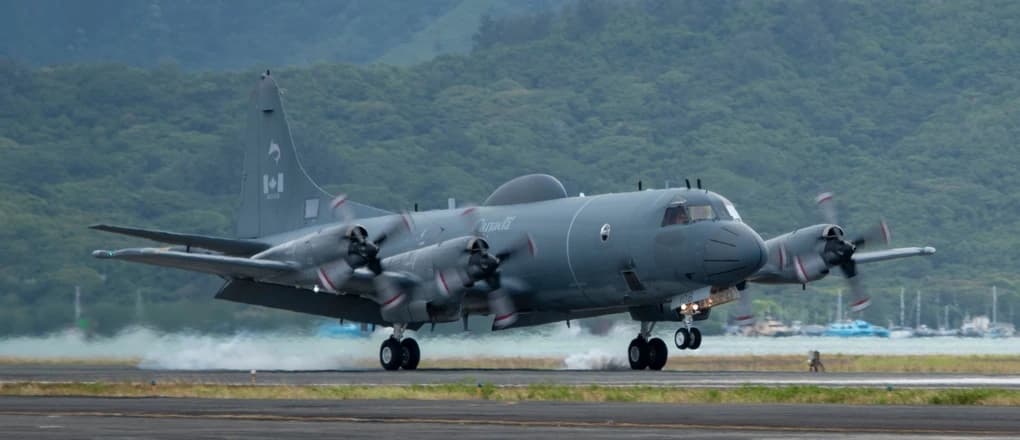
Lockheed CP-140 Aurora
Maritime patrol aircraft (CP-140) MPA trainer aircraft (CP-140A)
Preparing your view.


ASupport aircraft
Maritime patrol aircraft (CP-140) MPA trainer aircraft (CP-140A)

At a glance
True scale
Side by side. From every angle. A human reference for perspective.
3.20 MB · Loads when you open it| Model | Length | Width / span | Height |
|---|---|---|---|
| Lockheed CP-140 Aurora | ≈ 35.61 m | ≈ 30.37 m (Width) | ≈ 10.3 m |
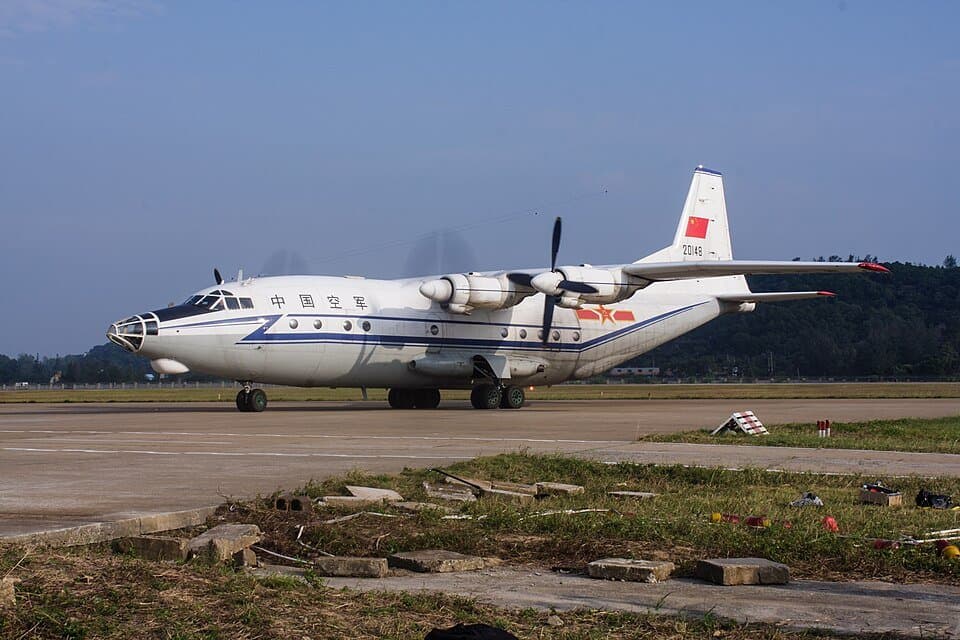
| Shaanxi Y-8 | ≈ 34.02 m | ≈ 38 m (Width) | ≈ 11.16 m |
Scaled uniformly to the sourced length of 35.61 m. The shape was turned square to the axes; the height was fitted to the sourced 10.3 m; the width was fitted to the sourced 30.37 m. Not an official model or a measured survey.
ForceTally · All rights reserved
Scaled uniformly to the sourced length of 34.02 m. The shape was turned square to the axes; the height was fitted to the sourced 11.16 m; the width was fitted to the sourced 38 m. Not an official model or a measured survey.
ForceTally · All rights reserved
The human reference is a generic 1.75 m figure. Models describe external size, not combat performance.
Measured figures
CP-140 Aurora · Length
Single sourceCP-140 · Length
Single sourceConfiguration
| Specification | Lockheed CP-140 Aurora | Shaanxi Y-8 |
|---|---|---|
| Crew | Mission minimum 8, typically 12 to 15[source] | 5, 3, or 2 ( Y-8F600 )[source] |
| Type | Maritime patrol aircraft (CP-140) MPA trainer aircraft (CP-140A)[source] | Military transport aircraft / Maritime patrol aircraft[source] |
| Manufacturer | Lockheed Corporation[source] | Shaanxi Aircraft Corporation[source] |
| Status | Active (CP-140M only)[source] |
116 ft 10 in (35.61 m)[source]
35.61 m[source]CP-140 Aurora
35.61 m[source]
Y-8 · Length
Single source34.02 m (111 ft 7 in)[source]
Gross; CP-140 Aurora · Gross weight · Maximum gross weight
Single sourceGross; CP-140 · Gross weight
Single sourceMaximum take-off; CP-140 Aurora · maximum gross aircraft weight in Royal Canadian Air Force technical specifications; not empty weight, payload or CP-140A training configuration · CP-140 Aurora · maximum gross aircraft weight in Royal Canadian Air Force technical specifications; not empty weight, payload or CP-140A training configuration · CP-140 Aurora
Single source61,362 lb (27,833 kg)[source]
64,410 kg[source]CP-140 Aurora · maximum gross aircraft weight in Royal Canadian Air Force technical specifications; not empty weight, payload or CP-140A training configuration
64,410 kg[source]CP-140 Aurora · Maximum gross weight
Empty; Y-8 · Empty weight
Single sourceMaximum take-off; Y-8 · Max takeoff weight
Single sourceMaximum; CP-140 Aurora · Maximum speed
Single sourceMaximum; CP-140 Aurora · Maximum speed · Maximum speed
Single sourceMaximum; CP-140 · below cruise ceiling
Single source375 kn (432 mph, 694 km/h) below cruise ceiling[source]
750 km/h[source]CP-140 Aurora
750 km/h[source]CP-140 Aurora · Maximum speed
750 km/h[source]CP-140 Aurora
750 km/h[source]
Cruise; Y-8 · Cruise speed
Single sourceMaximum; Y-8 · Maximum speed
Single sourceCP-140 · 4 × Allison T56-A-14-LFE turboprop engines each
Single source4 × Allison T56-A-14-LFE turboprop engines, 4,909 hp (3,661 kW) each[source]
Y-8 · 4 × Zhuzhou WoJiang-6 (WJ-6) turboprop engines each
Single source4 × Zhuzhou WoJiang-6 (WJ-6) turboprop engines, 3,170 kW (4,250 hp) each[source]
CP-140 · on station at 1,000 nmi (1,151 mi; 1,852 km) radius
Single source8 hours 12 minutes on station at 1,000 nmi (1,151 mi; 1,852 km) radius[source]
CP-140 · Hardpoints: 8 in weapons bay; 10 under-wing from capacity with a capacity of
Single sourceCP-140 · total in weapons bay, with provisions to carry combinations of
Single sourceHardpoints: 8 in weapons bay; 10 under-wing from 611 to 2,450 lb (277 to 1,111 kg) capacity with a capacity of 4,800 lb (2,177 kg) total in weapons bay, with provisions to carry combinations of:[source]
Y-8 · 2,000 ft/min
Single source10 m/s (2,000 ft/min)[source]
Bars compare reported quantities only. A larger figure does not make a system better; configurations and test conditions differ.
In service, in production[source]
| Primary user | Royal Canadian Air Force[source] | — |
|---|
| Number built | 21 (18 CP-140M + 3 CP-140A)[source] | 169 (2010)[source] |
|---|
| Introduction date | 1980[source] | — |
|---|
| First flight | 22 March 1979 (CP-140)[source] | 25 December 1974[source] |
|---|
| Retired | 2011 (CP-140A only)[source] | — |
|---|
| Developed from | Lockheed P-3 Orion[source] | Antonov An-12[source] |
|---|
| Fuel capacity | 7,661 imp gal (9,200 US gal; 34,828 L) usable fuel in one fuselage tank and four wing integral tanks[source] | — |
|---|
| Hardpoints | 8 in weapons bay; 10 under-wing from 611 to 2,450 lb (277 to 1,111 kg) capacity with a capacity of 4,800 lb (2,177 kg) total in weapons bay, with provisions to carry combinations of: Other: signal chargers, smoke markers , illumination flares[source] 8 in weapons bay; 10 under-wing from 611 to 2,450 lb (277 to 1,111 kg) capacity with a capacity of 4,800 lb (2,177 kg) total in weapons bay, with provisions to carry combinations of:[source] | — |
|---|
| Aspect ratio | 7.5[source] | — |
|---|
| Airfoil | root: NACA 0014 (modified) ; tip: NACA 0012 (modified)[source] | root: C-5-18; tip: C-3-14[source] |
|---|
| Propellers | 4-bladed Hamilton Standard 54H60, 13 ft 6 in (4.11 m) diameter constant-speed fully-feathering reversible-pitch propellers[source] | 4-bladed constant-speed propellers[source] |
|---|
| Maximum transit speed | 395 kn (455 mph; 732 km/h) at optimum altitude[source] | — |
|---|
| FAR balanced field length | 7,900 ft (2,408 m)[source] | — |
|---|
| Take-off distance to 50 ft (15 m) | 6,000 ft (1,829 m)[source] | — |
|---|
| Landing distance from 50 ft (15 m) | 3,200 ft (975 m) at 114,000 lb (51,710 kg) landing weight[source] | — |
|---|
| Other | signal chargers, smoke markers , illumination flares[source] | — |
|---|
| Rockets | air-to-surface rockets can be fitted after a minor retrofit.[source] | — |
|---|
| Bombs | Mk 46 Mod V torpedoes, conventional bombs[source] | — |
|---|
| Role | maritime patrol aircraft[source] | medium-size, four-engine turboprop military transport aircraft[source] |
|---|
| Source measurement | Once AIMP was completed the CP-140 was designated as CP-140M.[source]Lockheed CP-140 Aurora · Design and development / Aurora Incremental Modernization Project; only the objects and conditions stated in this passage Several options had been suggested for a CP-140M replacement. These included the Boeing P-8 Poseidon and the Raytheon Sentinel , based on the Bombardier Global Express -6500, as well as late entrant PAL Aerospace Global Express 6500-based P-6.[source]Lockheed CP-140 Aurora · Operational history / Replacement; only the objects and conditions stated in this passage The RCAF had planned to downsize the fleet from eighteen to fourteen aircraft, with three already being withdrawn and a fourth test aircraft to be retired in the near future. The retirement of the CP-140 was originally expected around 2030, and could have resulted in a capability gap as the RCAF did not anticipate replacements to be delivered until 2032 to 2038. The RCAF's Weapon System Manager (WSM) had prepared plans to have the CP-140M operational until 2035 to 2040.[source]Lockheed CP-140 Aurora · Operational history / Replacement; only the objects and conditions stated in this passage Royal Canadian Air Force 404 Long Range Patrol and Training Squadron , CFB Greenwood , Nova Scotia 4 × CP-140M Aurora 405 Long Range Patrol Squadron , CFB Greenwood , Nova Scotia 11 × CP-140M Aurora and 1 × CP-140 Aurora to be retained as a test aircraft until retirement in the near future. 415 Long Range Patrol Force Development Squadron , CFB Greenwood , Nova Scotia 407 Long Range Patrol Squadron , CFB Comox , British Columbia 3 × CP-140M Aurora[source]Lockheed CP-140 Aurora · Operators; only the objects and conditions stated in this passage Length: 116 ft 10 in (35.61 m)[source]Lockheed CP-140 Aurora · Specifications (CP-140); only the objects and conditions stated in this passage Wingspan: 99 ft 8 in (30.38 m)[source]Lockheed CP-140 Aurora · Specifications (CP-140); only the objects and conditions stated in this passage Height: 33 ft 8.5 in (10.274 m)[source]Lockheed CP-140 Aurora · Specifications (CP-140); only the objects and conditions stated in this passage Wing area: 1,300 sq ft (120 m 2 )[source]Lockheed CP-140 Aurora · Specifications (CP-140); only the objects and conditions stated in this passage Gross weight: 61,362 lb (27,833 kg)[source]Lockheed CP-140 Aurora · Specifications (CP-140); only the objects and conditions stated in this passage Powerplant: 4 × Allison T56-A-14-LFE turboprop engines, 4,909 hp (3,661 kW) each[source]Lockheed CP-140 Aurora · Specifications (CP-140); only the objects and conditions stated in this passage Propellers: 4-bladed Hamilton Standard 54H60, 13 ft 6 in (4.11 m) diameter constant-speed fully-feathering reversible-pitch propellers[source]Lockheed CP-140 Aurora · Specifications (CP-140); only the objects and conditions stated in this passage Maximum speed: 375 kn (432 mph, 694 km/h) below cruise ceiling[source]Lockheed CP-140 Aurora · Specifications (CP-140); only the objects and conditions stated in this passage Maximum transit speed: 395 kn (455 mph; 732 km/h) at optimum altitude[source]Lockheed CP-140 Aurora · Specifications (CP-140); only the objects and conditions stated in this passage Range: 5,000 nmi (5,800 mi, 9,300 km)[source]Lockheed CP-140 Aurora · Specifications (CP-140); only the objects and conditions stated in this passage Endurance: 8 hours 12 minutes on station at 1,000 nmi (1,151 mi; 1,852 km) radius[source]Lockheed CP-140 Aurora · Specifications (CP-140); only the objects and conditions stated in this passage Service ceiling: 35,100 ft (10,700 m)[source]Lockheed CP-140 Aurora · Specifications (CP-140); only the objects and conditions stated in this passage FAR balanced field length: 7,900 ft (2,408 m)[source]Lockheed CP-140 Aurora · Specifications (CP-140); only the objects and conditions stated in this passage Take-off distance to 50 ft (15 m): 6,000 ft (1,829 m)[source]Lockheed CP-140 Aurora · Specifications (CP-140); only the objects and conditions stated in this passage Landing distance from 50 ft (15 m): 3,200 ft (975 m) at 114,000 lb (51,710 kg) landing weight[source]Lockheed CP-140 Aurora · Specifications (CP-140); only the objects and conditions stated in this passage Hardpoints: 8 in weapons bay; 10 under-wing from 611 to 2,450 lb (277 to 1,111 kg) capacity with a capacity of 4,800 lb (2,177 kg) total in weapons bay, with provisions to carry combinations of: Other: signal chargers, smoke markers , illumination flares[source]Lockheed CP-140 Aurora · Specifications (CP-140); only the objects and conditions stated in this passage | The Shaanxi Y-8 or Yunshuji Y-8 ( Chinese : 运-8 ; pinyin : Yùn Bā ) aircraft is a medium-size, four-engine turboprop military transport aircraft produced by Shaanxi Aircraft Corporation in China , based on the Soviet Antonov An-12 . It has become one of China's most popular military and civilian transport/cargo aircraft, with many variants produced and exported. Although the Soviet Union ended production of the An-12 in 1973, the Chinese Y-8 continues to be upgraded and produced. An estimated 169 Y-8 aircraft had been built by 2010.[source]Shaanxi Y-8 · Lead; only the objects and conditions stated in this passage Design of the aircraft was completed by February 1972. Major features of the Y-8 included a glazed nose and tail turret derived from that of the H-6 bomber, a roller-type palletized-cargo-handling device instead of the overhead conveyor, and a gaseous oxygen system as opposed to a liquid oxygen system. The original Y-8 inherited the An-12's twin 23 mm cannon tail turret, but this was removed on subsequent variants.[source]Shaanxi Y-8 · Design and development / Domestic; only the objects and conditions stated in this passage The Y-8 is capable of carrying troops, dropping supplies, parachute drops, and functioning as an air ambulance. It also can be used for commercial purposes as a freighter. It is capable of hauling 20 tons of cargo, approximately 96 soldiers, or about 82 paratroopers in the cargo compartment which is 13.5 metres long, 3 metres wide and 2.4 metres high. It can also carry 60 severely wounded soldiers with their stretchers, 20 slightly injured soldiers and 3 medical attendants. Many variants for specialized roles have been built, but information on them can be vague or difficult to obtain due to the secretive nature of the Chinese military.[source]Shaanxi Y-8 · Design and development / Domestic; only the objects and conditions stated in this passage In 1986, two engineers from Beijing's Ministry of Aviation visited Lockheed. They could not speak very much English, and the Lockheed-Georgia sales person who met them could not speak Chinese. So for half a day, they did a point-and-grunt tour until they found a Lockheed employee who could speak Chinese. The Chinese wanted to purchase Lockheed wind tunnel testing on the Y-8 in order to address the stall problem. |
|---|

| Country of origin | United States[source] United States[source] | — |
|---|
| National origin | — | China[source] |
|---|
| Primary users | — | People's Liberation Army Air Force People's Liberation Army Navy Air Force Myanmar Air Force Pakistan Air Force[source] |
|---|
| Manufactured | — | 1981–present[source] |
|---|
| Variant | — | Shaanxi KJ-200[source] |
|---|
| Developed into | — | Shaanxi Y-9[source] |
|---|
| Capacity | — | ≈90 equipped troops / 20,000 kg (44,092 lb) payload[source] |
|---|
| Guns | — | 2× 23 mm (0.906 in) cannon in tail turret (early models only)[source] |
|---|
| Origin reported by inventory | — | China / Pakistan[source]Inventory Origin column; table 1, row 52, cell 4; revision 1377423821; retrieved 2026-10-02 |
|---|
As a result of these wind tunnel tests, conducted in 1986, Lockheed was given a contract to do a flight test series on the Y-8. Lockheed was told that flight test data was not provided by the Soviets when they helped China build the Y-8 factory. The flight test series was flown by Lockheed test pilot Hank Dees. Hank had flown the test flight series for the Lockheed L-1011 and later for China's Y-12 in Harbin.[source]Shaanxi Y-8 · Design and development / Modification; only the objects and conditions stated in this passage
Y-8F-200 : This model has a 2.2m (7 ft 10in) stretched fuselage. Capacity: 23 tons.[source]Shaanxi Y-8 · Variants; only the objects and conditions stated in this passage
Y-8F-300 : Civil transport with western avionics. Capacity: 23 tons.[source]Shaanxi Y-8 · Variants; only the objects and conditions stated in this passage
Y-8F-400 : As for Y-8F-300 but with pressurised cargo hold. Capacity: 23 tons.[source]Shaanxi Y-8 · Variants; only the objects and conditions stated in this passage
Y-8F-600 : Newest civilian transport variant with a redesigned fuselage, Pratt and Whitney turboprop engines, an Electronic Flight Instrument System "glass cockpit", and a two-person crew. Capacity: 25 tons. Cancelled in 2008 and developed into the Y-9 .[source]Shaanxi Y-8 · Variants; only the objects and conditions stated in this passage
Y-8G : IFR tanker. (project). Also identified as the Y-8GX3.[source]Shaanxi Y-8 · Variants; only the objects and conditions stated in this passage
Y-8H : Aerial survey aircraft.[source]Shaanxi Y-8 · Variants; only the objects and conditions stated in this passage
Capacity: ≈90 equipped troops / 20,000 kg (44,092 lb) payload[source]Shaanxi Y-8 · Specifications (Y-8); only the objects and conditions stated in this passage
Length: 34.02 m (111 ft 7 in)[source]Shaanxi Y-8 · Specifications (Y-8); only the objects and conditions stated in this passage
Wingspan: 38 m (124 ft 8 in)[source]Shaanxi Y-8 · Specifications (Y-8); only the objects and conditions stated in this passage
Height: 11.16 m (36 ft 7 in)[source]Shaanxi Y-8 · Specifications (Y-8); only the objects and conditions stated in this passage
Wing area: 121.9 m 2 (1,312 sq ft)[source]Shaanxi Y-8 · Specifications (Y-8); only the objects and conditions stated in this passage
Empty weight: 35,490 kg (78,242 lb)[source]Shaanxi Y-8 · Specifications (Y-8); only the objects and conditions stated in this passage
Max takeoff weight: 61,000 kg (134,482 lb)[source]Shaanxi Y-8 · Specifications (Y-8); only the objects and conditions stated in this passage
Powerplant: 4 × Zhuzhou WoJiang-6 (WJ-6) turboprop engines, 3,170 kW (4,250 hp) each[source]Shaanxi Y-8 · Specifications (Y-8); only the objects and conditions stated in this passage
Maximum speed: 660 km/h (410 mph, 360 kn)[source]Shaanxi Y-8 · Specifications (Y-8); only the objects and conditions stated in this passage
Cruise speed: 550 km/h (340 mph, 300 kn)[source]Shaanxi Y-8 · Specifications (Y-8); only the objects and conditions stated in this passage
Range: 5,615 km (3,489 mi, 3,032 nmi)[source]Shaanxi Y-8 · Specifications (Y-8); only the objects and conditions stated in this passage
Service ceiling: 10,400 m (34,100 ft)[source]Shaanxi Y-8 · Specifications (Y-8); only the objects and conditions stated in this passage
Rate of climb: 10 m/s (2,000 ft/min)[source]Shaanxi Y-8 · Specifications (Y-8); only the objects and conditions stated in this passage
Guns: 2× 23 mm (0.906 in) cannon in tail turret (early models only)[source]Shaanxi Y-8 · Specifications (Y-8); only the objects and conditions stated in this passage