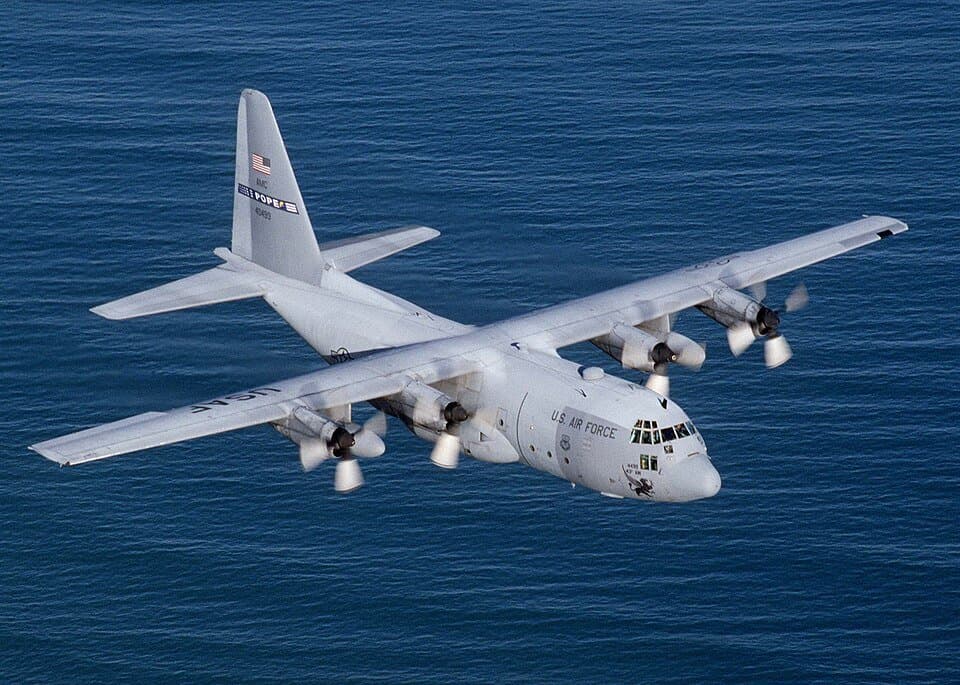

Credit
U.S. Air Force photo by Tech. Sgt. Howard Blair · Public domain · Resized · Public domain · Source ↗ · Modified


Preparing your view.
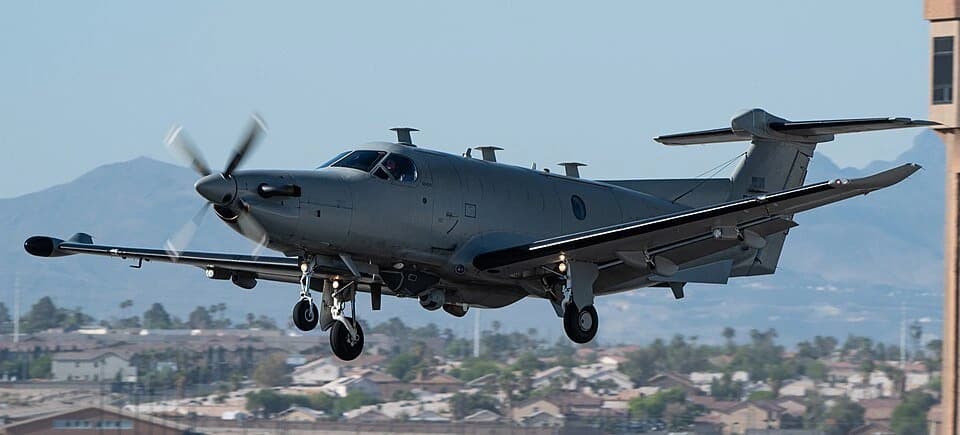
BSupport aircraft
Special operations, tactical ISR, Forward Air Control, counter-insurgency.
At a glance
Measured figures
C-130H · Length
Single source97 ft 9 in (29.79 m)[source]
Configuration
| Specification | Lockheed C-130 Hercules | Pilatus U-28 Draco |
|---|---|---|
| Type | Tactical airlifter[source] | — |
| National origin | United States[source] | United States[source] |
| Manufacturer | Lockheed Corporation Lockheed Martin[source] Lockheed Corporation[source] Lockheed Martin[source] | Pilatus Aircraft (base aircraft), Sierra Nevada Corporation (militarization)[source] |
U-28A · Length
14.4 meters[source]
C-130H · Wingspan
Single source132 ft 7 in (40.41 m)[source]
Empty; C-130H · Empty weight
Single sourceMaximum take-off; C-130H · Max takeoff weight
Single source75,800 lb (34,382 kg)[source]
155,000 lb (70,307 kg)[source]
Maximum take-off; Pilatus U-28A Draco · own Specifications (U-28A) maximum takeoff weight
Single source10,935 pounds[source]Pilatus U-28A Draco · own Specifications (U-28A) maximum takeoff weight
C-130H · 2 pilots, CSO/navigator , flight engineer and loadmaster
Single source5 (2 pilots, CSO/navigator , flight engineer and loadmaster )[source]
C-130H · 4 × Allison T56 -A-15 turboprop engines, 4,590 shp ( ) each
Single source4 × Allison T56 -A-15 turboprop engines, 4,590 shp (3,420 kW) each[source]
U-28A · 1 Pratt-Whitney PT6A-67B turboprop producing
Single source1 Pratt-Whitney PT6A-67B turboprop producing 1200 hp[source]
C-130H · Wing area
Single source1,745 sq ft (162.1 m 2 )[source]
C-130H · Empty
Single source33,000 ft (10,000 m) empty[source]
C-130H · 1,830 ft/min (
Single source1,830 ft/min (9.3 m/s)[source]
Bars compare reported quantities only. A larger figure does not make a system better; configurations and test conditions differ.
| Status | In service[source] | — |
|---|
| Primary users | United States Air Force United States Navy United States Coast Guard United States Marine Corps[source] | — |
|---|
| Number built | 2,700+ (as of June 2024)[source] | 30+, 28 in service as of January 2025[source] |
|---|
| Manufactured | 1954–present[source] | — |
|---|
| Introduction date | December 1956[source] | 2006[source] |
|---|
| First flight | August 23, 1954 ( 1954-08-23 )[source] | — |
|---|
| Variants | Lockheed AC-130 Lockheed DC-130 Lockheed EC-130 Lockheed EC-130H Compass Call Lockheed HC-130 Lockheed Martin KC-130 Lockheed LC-130 Lockheed MC-130 Lockheed RC-130 Lockheed WC-130 Lockheed L-100 Hercules Lockheed Martin C-130J Super Hercules[source] | — |
|---|
| Capacity | 42,000 lb (19,000 kg) payload C-130E/H/J cargo hold: length, 40 ft (12.19 m); width, 9 ft 11 in (3.02 m); height, 9 ft (2.74 m). Rear ramp: length, 123 in (3.12 m); width, 119 in (3.02 m) C-130J-30 cargo hold: length, 55 ft (16.76 m); width, 9 ft 11 in (3.02 m); height, 9 ft (2.74 m). Rear ramp: length, 123 inches (3.12 m); width, 119 in (3.02 m) 92 passengers or 64 airborne troops or 74 litter patients with 5 medical crew or 6 pallets or 2–3 Humvees or 2 M113 armored personnel carriers 1 CAESAR self-propelled howitzer[source] | — |
|---|
| Former operator · Afghanistan | Afghanistan[source] | — |
|---|
| Former operator · Angola | Angola[source] | — |
|---|
| Former operator · Belgium | Belgium[source] | — |
|---|
| Former operator · Brazil | Brazil[source] | — |
|---|
| Former operator · Honduras | Honduras[source] | — |
|---|
| Former operator · Rhodesia | Rhodesia[source] | — |
|---|
| Former operator · South Vietnam | South Vietnam[source] | — |
|---|
| Former operator · Spain | Spain[source] | — |
|---|
| Airfoil | root: NACA 64A318 ; tip: NACA 64A412[source] | — |
|---|
| Propellers | 4-bladed Hamilton Standard 54H60 constant-speed fully feathering reversible propellers, 13 ft 6 in (4.11 m) diameter[source] | — |
|---|
| Takeoff distance | 3,586 ft (1,093 m) at 155,000 lb (70,307 kg) max gross weight;[source] | — |
|---|
| Alternative designation | C-130 Hercules[source] | — |
|---|
| Role | — | Special operations, tactical ISR, Forward Air Control, counter-insurgency.[source] The Pilatus-SNC U-28A Draco is an American special operations , tactical intelligence, surveillance and reconnaissance (ISR) , forward air control , and counter insurgency aircraft[source]Pilatus-SNC U-28A Draco own operated ISR aircraft; excludes parent PC-12 and other PC-12 variants |
|---|
| Issued by | — | United States Special Operations Command[source] |
|---|
| Service | — | Air Force Special Operations Command[source] |
|---|
| Developed from | — | Pilatus PC-12[source] |
|---|
| Source measurement | — | U-28A tail number 07-0736 from the 34th Special Operations Squadron crashed on 18 February 2012 at approximately 19:18 five miles southwest of Camp Lemonier , Djibouti , from which it was operating. The aircraft was destroyed and all four aircrew members died. The cause of the crash was found to be spatial disorientation .[source]Pilatus U-28 Draco · Operational history / Accidents and losses; only the objects and conditions stated in this passage A detachment of U-28s were stationed at Kabul international airport in August 2021, during the Fall of Kabul . They participated in Operation Allies Refuge , the effort to evacuate 124,000 people from the country. They provided continuous ISR support to the ground forces; as one U-28 landed, another would take off to take its place. The aircraft informed coalition forces on the ground of perimeter breaches, crowd movements and approaching Taliban forces.[source]Pilatus U-28 Draco · Operational history / Fall of Kabul; only the objects and conditions stated in this passage In 2013, the highly tasked U-28s began to require a 20,000 flight hour inspection costing $595,000 per aircraft, with a further $1.14 million inspection required at 35,000 hours expected for 2017. To avoid these costs, and other expenses required to upgrade sensors, communications and data-sharing equipment, AFSOC planned to replace them all with the MC-12W Liberty , which had been used by Air Combat Command . However that plan was cancelled after pushback from Congress. Instead, AFSOC modified additional PC-12 airframes from its inventory into the U-28 configuration.[source]Pilatus U-28 Draco · Operational history / Replacement; only the objects and conditions stated in this passage Engine : 1 Pratt-Whitney PT6A-67B turboprop producing 1200 hp[source]Pilatus U-28 Draco · Specifications (U-28A) / General characteristics; only the objects and conditions stated in this passage Wingspan : 16.23 meters[source]Pilatus U-28 Draco · Specifications (U-28A) / General characteristics; only the objects and conditions stated in this passage Length : 14.4 meters[source]Pilatus U-28 Draco · Specifications (U-28A) / General characteristics; only the objects and conditions stated in this passage Height : 4.25 meters[source]Pilatus U-28 Draco · Specifications (U-28A) / General characteristics; only the objects and conditions stated in this passage MTOW : 10,935 pounds[source]Pilatus U-28 Draco · Specifications (U-28A) / General characteristics; only the objects and conditions stated in this passage Electro-Optical and Infrared Imaging (EO/IR) sensor turrets are present : a Multi-Spectral Targeting System is located in the tail of the aircraft , originaly an AN/AAS-52 MTS-A later upgraded to AN/DAS-1 MTS-B, it folds in and out of the fuselage, the same arrangement is found on the commercially available Pilatus PC-12M surveillance aircraft. The other EO/IR turret is an Wescam MX-15 , it is not seen on all airframes but is mounted on the underbelly on the aircraft as part of a larger underbelly gondola. These are often the primary sensors, they allow the crew to find and surveil persons and things of interests (such as friendly or enemy forces).[source]Pilatus U-28 Draco · Specifications (U-28A) / Mission equipment; only the objects and conditions stated in this passage Provides a manned fixed-wing, on- call/surge capability for Im- proved Tactical Airborne Intelligence, Surveillance, and Reconnaissance in support of special operations forces.[source]U-28A · Primary function |
|---|