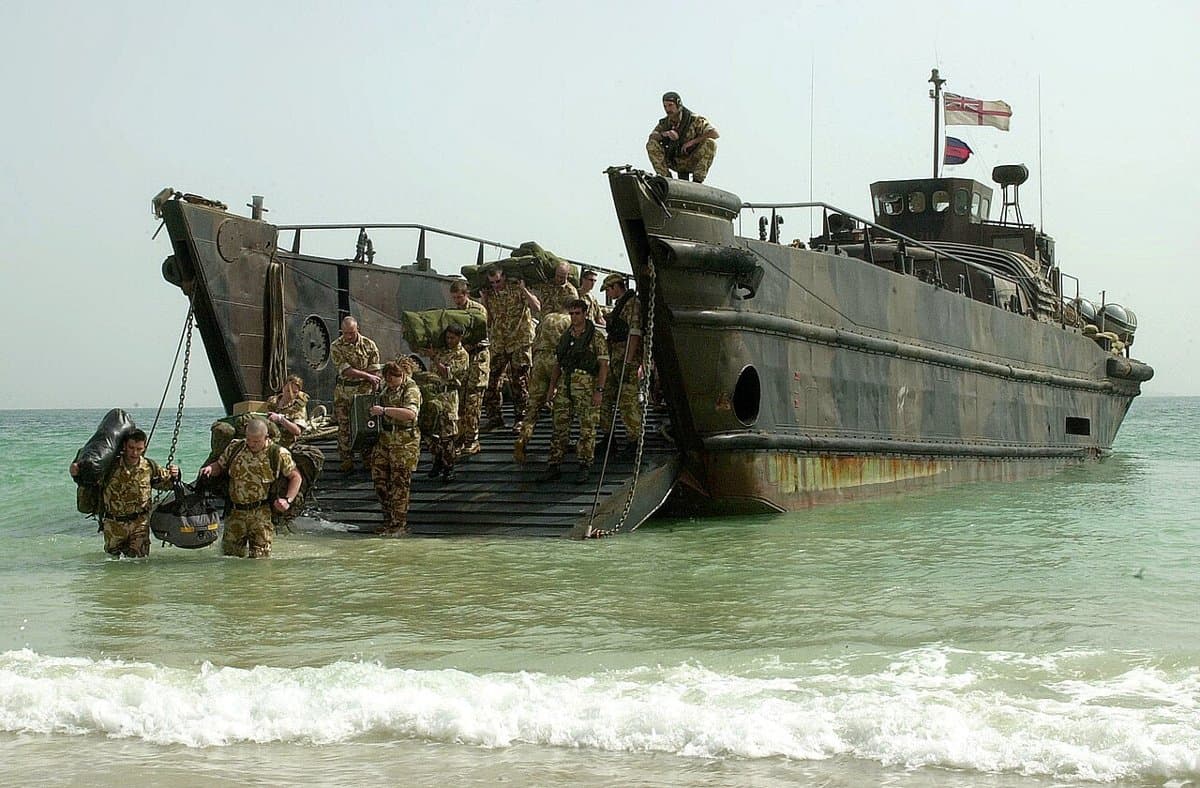

Credit
PH1(SW) Arlo Abrahamson · Public domain · Resized · Public domain · Source ↗ · Modified


Preparing your view.


At a glance
Landing craft utilitylarger figure on 2 of 4
Measured figures
Length
DisputedLanding Craft Utility (LCU) 1700-class Vessels, USA · Length
Single sourceConfiguration
| Specification | Landing craft utility | Type 271 landing craft |
|---|---|---|
| Power | 2 × Caterpillar C18 diesel motors, 412 kW (553 shp)[source] | two 6300ZC diesel @ 600 hp each[source] |
| Name | Golfo de Tribugá class[source] | Type 271I landing craft utility[source] |
| Builders | COTECMAR[source] | — |
| Operators | Colombian National Navy Guatemalan Navy Honduran Navy[source] | People's Liberation Army Navy[source] |
Type 271 landing craftlarger figure on 2 of 4
Counts only measures both sources give with the same scope. A larger figure is not a better system.
49.0 m (160.8 ft)[source]
41,1 meter[source]
139ft (42.3m)[source]Landing Craft Utility (LCU) 1700-class Vessels, USA
62.8m[source]
Length
Single source54m[source]
Draft
Single sourceakterskeppet
Single sourceDraught
Single sourceförskeppet
Single sourceLanding Craft Utility (LCU) 1700-class Vessels, USA · Draft
Single source1.5 m (4 ft 11 in)[source]
2.1 m (6 ft 11 in)[source]
1,07 meter (förskeppet) 2,08 meter (akterskeppet)[source]förskeppet; akterskeppet
5.3ft[source]Landing Craft Utility (LCU) 1700-class Vessels, USA
Draft
Single source1.7m[source]
Maximum; Speed
Single sourceMaximum; Landing Craft Utility (LCU) 1700-class Vessels, USA · Speed
Single sourceMaximum; Maximum speed
Manufacturer claim8.5 knots (15.7 km/h; 9.8 mph)[source]
9 knots[source]
9 knots[source]
9 knots[source]
11kt[source]Landing Craft Utility (LCU) 1700-class Vessels, USA
15k[source]
9 knots[source]
Maximum; Speed
Single source13 kn[source]
at 6 kn (11 km/h)
Single sourceat 8.5 kn (15.7 km/h)
Single sourceRange
Single source1,500 nmi (2,800 km) at 8.5 kn (15.7 km/h) 2,500 nmi (4,600 km) at 6 kn (11 km/h)[source]
1500mn@9 knots 2500mn@6 knots[source]
1500mn@9 knots 2500mn@6 knots[source]
1500mn@9 knots 2500mn@6 knots[source]
1 200 NM (vid 8 knop)[source]
1,200nm[source]Landing Craft Utility (LCU) 1700-class Vessels, USA
1,500nmi[source]
1500mn@9 knots 2500mn@6 knots[source]
@ 10 kn
Single source1000 nmi @ 10 kn[source]
Bars compare reported quantities only. A larger figure does not make a system better; configurations and test conditions differ.
| In service | 2014–present[source] | — |
|---|
| In commission | 2014–present[source] | — |
|---|
| Completed | — |
|---|
| Active | — |
|---|
| Type | Landing craft utility[source] | Landing Craft Utility[source] |
|---|
| Endurance | 20 days with 51 crew. 40 days with 15 crew.[source] | 20 days[source] |
|---|
| Capacity | 120 t (130 short tons)[source] | 100 t normal, 150 max[source] |
|---|
| Troops | 36[source] | — |
|---|
| Laid up | — |
|---|
| Armament | 1 or 2 × Rheinmetall MK 20 Rh 202 20 mm (0.79 in) autocannon Mine laying capability[source] | Machine guns[source] |
|---|
| Source measurement | The Engin de débarquement amphibie rapide (EDA-R) landing catamaran or L-CAT, entered service in January 2011. They can carry a main battle tank like other European LCUs but are capable of much higher speeds, up to 30 knots (56 km/h; 35 mph).[source]Landing craft utility · France; only the objects and conditions stated in this passage In 2005 and 2006 the five vessels were modernized to the type Mark II . The vessels have been stretched by 9 meters to decrease their draft, which increased their load carrying capacity by 20 tons and allows them to come closer to shore. In addition they were fitted with a strengthened bow ramp, and they can now accommodate the Royal Netherlands Army Leopard 2 A6 main battle tank. Because of the lengthening of the Mark II, the Rotterdam can take two LCUs (plus three LCVPs ) in its dock. The dock of Rotterdam ' s sister ship, HNLMS Johan de Witt , has the capacity to transport two LCUs, but carries four LCVPs in davits.[source]Landing craft utility · Netherlands; only the objects and conditions stated in this passage Sweden operates 16 small and fast (25 kn) water jet landing craft (Swedish: Lätt trossbåt ) with a displacement of 65 tonnes. They are armed with one 12.7 mm machine gun but can also lay out mines and are equipped with depth charges for anti submarine warfare. The vessel type has been exported to the United Arab Emirates.[source]Landing craft utility · Sweden; only the objects and conditions stated in this passage HSwMS Loke (A344) is a larger vessel with a displacement of 305 tonnes, capable of carrying 150 tonnes. The ship has a crew of 7 and is armed with two 7.62 mm machine guns.[source]Landing craft utility · Sweden; only the objects and conditions stated in this passage The LCU 1466, 1610 and 1627 class vessels are operated by the United States Navy at support commands. They are a self-sustaining craft complete with living accommodations and mess facilities for a crew of thirteen. Each LCU is assigned a non-commissioned-officer-in-charge (Craft Master) who is either a chief petty officer or petty officer first class in the boatswain's mate, quartermaster or operations specialist rating. These vessels have bow ramps for onload/offload and can be linked bow to stern gate to create a temporary pier-like structure. Its welded steel hull provides high durability with deck loads of 3,900 kg/m 2 (800 pounds per square foot). Arrangement of machinery and equipment has taken into account built-in redundancy in the event of battle damage.[source]Landing craft utility · United States / LCU 1466, 1610 and 1627 classes; only the objects and conditions stated in this passage The Runnymede-class large landing craft or LCU 2000 class vessels are operated by the United States Army . They transport rolling and tracked vehicles, containers, and outsized and general cargo from ships offshore to shore, as well as to areas that cannot be reached by oceangoing vessels (coastal, harbor, and intercoastal waterways). They can be self-deployed or transported aboard a float-on/float-off vessel. They are classed for full ocean service and one-man engine room operations and built to U.S. Coast Guard standards. The vessel can sustain a crew of 2 warrant officers and 11 enlisted personnel for up to 18 days and 10,000 miles. This class is also equipped with an aft anchor to assist in retracting from the beach.[source]Landing craft utility · United States / LCU 2000; only the objects and conditions stated in this passage The LCU 1700-class boats are destined to replace the existing LCU 1610-class of amphibious landing craft on a one-to-one basis. The LCU-1700 is 139 feet long, can reach speeds of 11 knots, has a range of 1,200 nautical miles at 8 knots, and has accommodations for a mixed gender crew of 14. It can carry two M1A1 tanks, or 350 combat troops, or 170 short tons of cargo.[source]Landing craft utility · United States / LCU 1700; only the objects and conditions stated in this passage Navy amphibious warfare ships, for design purposes defined by the dimensions of LHD, LPD, LSD and LHA classes without ship alterations, while transporting loads up to 11 feet high above the craft’s vehicle deck.[source]Landing craft utility · United States / LCU 1700; only the objects and conditions stated in this passage | — |
|---|
| Total length: | 49 m[source] 49 m[source] 49 m[source] 49 m[source] | — |
|---|
| Molded Breadth: | 11 m[source] 11 m[source] 11 m[source] 11 m[source] | — |
|---|
| Depth (to main deck): | 3,10 m[source] 3,10 m[source] 3,10 m[source] 3,10 m[source] | — |
|---|
| Design draft: | 1,75 m[source] 1,75 m[source] 1,75 m[source] 1,75 m[source] | — |
|---|
| Propulsion | Diesel engine[source]Landing Craft Utility (LCU) 1700-class Vessels, USA | — |
|---|
| Country of origin | Republic of China[source]Inventory Origin column; table 3, row 10, cell 5; revision 1376074437 | China[source]Type 271 landing craft · origin explicitly stated in the linked current national-inventory row; no inference from operator or shipyard |
|---|
| Builder | — | Qingdao Shipyard[source] |
|---|
| Fate | — | Converted to Type 271II[source] |
|---|
| Preceded by | — | LCU 1600 series[source] |
|---|
| Succeeded by | — | Type 271II[source] |
|---|
| Class & type | — | Yupen class[source] |
|---|
| Reported operators |
| — |
|---|
400t normal, 500t max[source]