

Credit
Hisamikabunomura ( talk )Hisamikabunomura · CC BY-SA 3.0 · Resized · CC BY-SA 3.0 · Source ↗ · Modified


Preparing your view.


At a glance
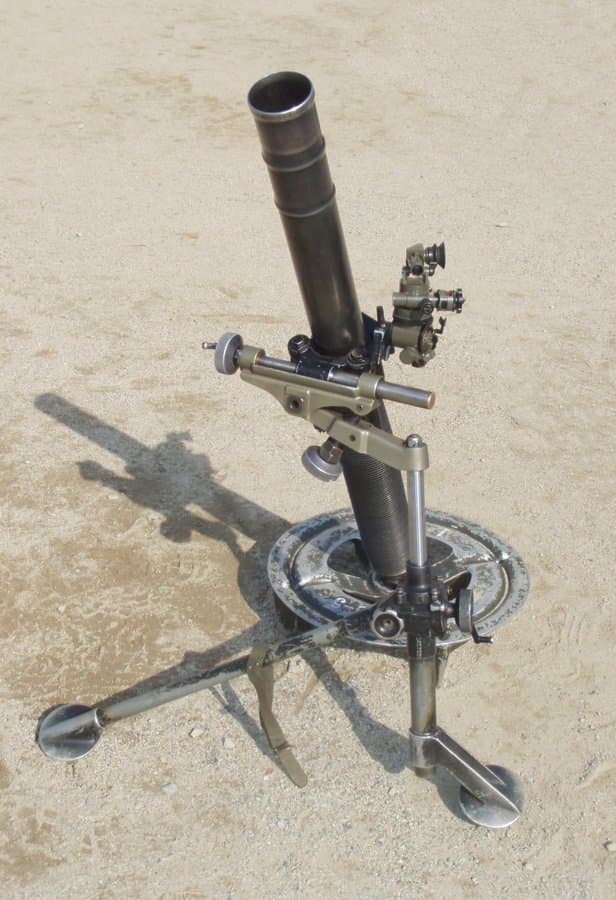
L16 81mm mortarlarger figure on 1 of 3
Mortier 120 mm Rayé Tracté Modèle F1larger figure on 2 of 3
Counts only measures both sources give with the same scope. A larger figure is not a better system.
Measured figures
Mass
Single source35.3 kg (78 lb)[source]
Mass
Single sourceConfiguration
| Specification | L16 81mm mortar | Mortier 120 mm Rayé Tracté Modèle F1 |
|---|---|---|
| Type | Mortar[source] | Heavy mortar[source] |
| Place of origin | United Kingdom Canada[source] | France[source] |
| Used by | See Users[source] | See Operators[source] |
| Wars | Rhodesian Bush War Lebanese Civil War Nepalese civil war Borneo, South Arabia, Oman Vietnam War Falklands War Indo-Pakistani War of 1971 Balkans, Kuwait, Iraq, Afghanistan, Mali. Syrian Civil War |
582 kg (1,283 lb)[source]
Effective; HE
Single sourceEffective; Illumination
Single sourceEffective; Smoke
Single sourceMaximum; Maximum firing range
Single sourceHE: 100–5,675 m (109–6,206 yd) Smoke: 100–5,675 m (109–6,206 yd) Illumination: 400–4,800 m (437–5,249 yd)[source]
5,650 m (6,180 yd)[source]
Effective; with rocket-assisted projectile
Single sourceEffective; with standard projectile
Single sourcesustained
Single sourcefor short periods
Single sourceRate of fire
Single source15 rpm, 1–12 rpm sustained, 20 rpm for short periods[source]
sustained
Single sourcemaximum
Single sourceMuzzle velocity
Single source225 m/s (740 ft/s)[source]
Bars compare reported quantities only. A larger figure does not make a system better; configurations and test conditions differ.
Gulf War Lebanese Civil War War in Afghanistan Operation Serval Russo-Ukrainian War[source] |
| Designer | Royal Armament Research and Development Establishment, Fort Halstead (barrel and bipod)[source] | Thales, Thomson-Brandt[source] |
|---|
| Designed | 1956[source] | — |
|---|
| Manufacturer | Royal Ordnance (barrel and bipod)[source] | Thales, TDA Armements (France), Thomson-CSF/Daimler Benz Aerospace (Germany), Hotchkiss Brandt (Netherlands), Howa (Japan)[source] |
|---|
| Produced | 1965[source] | 1961–present[source] |
|---|
| Shell weight | 4.2 kilograms (9.3 lb) (L3682).[source] | — |
|---|
| Action | muzzle loading[source] | — |
|---|
| Breech | none[source] | — |
|---|
| Recoil | baseplate and spring buffered mounting clamp[source] | — |
|---|
| Feed system | Manual[source] | — |
|---|
| Sights | Optical (C2) with Trilux illumination[source] | — |
|---|
| Former operator · Australia | Australia[source] | — |
|---|
| Former operator · Rhodesia | Rhodesia[source] | — |
|---|
| Source measurement | The L16 81mm mortar is a British and Canadian standard mortar used by the Canadian Army , British Army , and many other armed forces. It originated as a joint design by the UK and Canada. The U.S. armed forces version is the M252 .[source]L16 81mm mortar · Lead; only the objects and conditions stated in this passage It was introduced in 1965–66, replacing the Ordnance ML 3 inch Mortar in UK service, where it is used by the British Army , the Royal Marines and the RAF Regiment .[source]L16 81mm mortar · Description; only the objects and conditions stated in this passage In UK armoured/mechanised infantry battalions, the L16 mortar is mounted in an FV 432 AFV (six per battalion mortar platoon). British army light role infantry battalions and the Royal Marines may transport their mortars in BvS 10 vehicles (the replacement for the Bv 206 ). Otherwise, it is carried disassembled in three loads, (barrel, baseplate and bipod with sights, each approximately 11 kg), normally carried by a vehicle or helicopter and assembled for firing from the ground.[source]L16 81mm mortar · Description; only the objects and conditions stated in this passage Video of L16 81mm mortar fired by JGSDF soldiers during Orient Shield 2012[source]L16 81mm mortar · Gallery; only the objects and conditions stated in this passage | The MO-120 RT (factory designator) or MO-120-RT is a French heavy mortar . The RT in the designator stands for rayé, tracté , which means rifled, towed. The MO-120-RT is currently used by the French Army (where it is known as RT F1 or Mortier de 120 mm Rayé Tracté Modèle F1 —"120 mm rifled towed mortar, model F1"), and has also been exported to more than 24 foreign countries or in some cases, produced under licence. It is issued to artillery units, where it complements artillery guns and systems; although infantry units operate it in some countries.[source]Mortier 120 mm Rayé Tracté Modèle F1 · Lead; only the objects and conditions stated in this passage The MO-120 RT uses 120 mm rounds with a range of 8.2 km (5.1 mi) and the PRPA (RAP-Rocket Assisted Projectile) with a range of 13 km (8.1 mi). The weapon can be fired either by dropping the round down the tube (after aligning of the rifling bands) resulting in an automatic firing once the bomb hits the tube base, or by a controlled firing by dropping the bomb down the tube and pulling on a lanyard that will in turn set off the triggering mechanism in the base of the tube.[source]Mortier 120 mm Rayé Tracté Modèle F1 · Design; only the objects and conditions stated in this passage Fired mortar rounds can reach as high as 4,000 m (13,000 ft) and hit the ground with an effective kill radius of 76 m (249 ft).[source]Mortier 120 mm Rayé Tracté Modèle F1 · Design; only the objects and conditions stated in this passage In French service, this weapon is normally towed by the VTM 120 ( Véhicule Tracteur Mortier de 120 mm ), a wheeled armored vehicle that is a derivative of the VAB 4×4 series of armored personnel carrier. Towing is accomplished by a towing hitch that is screwed onto the muzzle of the weapon. The VTM 120 also carries 70 rounds for the mortar and offers basic ballistic protection from small arms fire and shrapnel for the crew. The RT-61 can also be towed by the AMX-10 TM ( Tracteur de Mortier ), which is a version of the AMX-10P tracked APC or the future French Scorpion SERVAL Vehicle.[source]Mortier 120 mm Rayé Tracté Modèle F1 · Service; only the objects and conditions stated in this passage In France, the mortars, which originally equipped infantry regiments, have now all been transferred to the artillery regiments, where they augment the 155 mm towed artillery.[source]Mortier 120 mm Rayé Tracté Modèle F1 · Service; only the objects and conditions stated in this passage The United States Marine Corps began looking for an expeditionary fire support system (EFSS) in 2001 after the start of operations in Afghanistan exposed their lack of expeditionary artillery lighter than a 155 mm howitzer but heavier than a 60 mm mortar. Early on, the 120 RT weapon became tied to the development of the MV-22 Osprey , which would contain a Growler ITV jeep that would tow it; both efforts were troubled and experienced delays. The EFSS was first used operationally in Afghanistan in February 2011, firing an M1105 illumination projectile. The full EFSS was introduced in 2009, consisting of two light vehicles, one towing the mortar and the other an ammunition trailer, that fit inside an MV-22 or CH-53E Super Stallion ; an EFSS battery is made up of roughly 50 marines.[source]Mortier 120 mm Rayé Tracté Modèle F1 · Variants / M327 expeditionary fire support system; only the objects and conditions stated in this passage The 35 lb (16 kg) round increased range from 8 km (5.0 mi) to 16 km (9.9 mi), falling within 10 m (33 ft) of the target and as close as two meters, costing $18,000 each, and having 2.5–3 times the lethality.[source]Mortier 120 mm Rayé Tracté Modèle F1 · Variants / M327 expeditionary fire support system; only the objects and conditions stated in this passage M327 120 mm rifled towed mortar[source]Mortier 120 mm Rayé Tracté Modèle F1 · Variants / M327 expeditionary fire support system; only the objects and conditions stated in this passage |
|---|
| In service | — | 1961–present[source] |
|---|
| Shell | — | 18.7 kg (41 lb)[source] |
|---|
| Carriage | — | wheeled[source] |
|---|
| Elevation | — | 30–85°[source] |
|---|
| Traverse | — | ±14° from centreline[source] |
|---|
| Former operator · Canada | — | Canada[source] |
|---|
| Former operator · Iraq | — | Iraq[source] |
|---|
| Former operator · Panama | — | Panama[source] |
|---|
| Former operator · Rwanda | — | Rwanda[source] |
|---|
| Former operator · United States | — | United States[source] |
|---|
| Role | — | French heavy mortar[source] |
|---|
| Status | — | The MO-120-RT is currently used by the French Army (where it is known as RT F1 or Mortier de 120 mm Rayé Tracté Modèle F1 —"120 mm rifled towed mortar, model F1"), and has also been exported to more than 24 foreign countries or in some cases, produced under licence.[source]MO-120-RT · source-literal primary status |
|---|
| Reported operators |
|
|
|---|
range of
Disputed8,140 m (8,900 yd) with standard projectile 12,850 m (14,050 yd) with rocket-assisted projectile[source]
range of 8.2 km (5.1 mi)[source]Mortier 120 mm Rayé Tracté Modèle F1 · Design · The MO-120 RT uses 120 mm rounds with a range of 8.2 km (5.1 mi) and the PRPA (RAP-Rocket Assisted Projectile) with a range of 13 km (8.1 mi).
range of 13 km (8.1 mi)[source]Mortier 120 mm Rayé Tracté Modèle F1 · Design · The MO-120 RT uses 120 mm rounds with a range of 8.2 km (5.1 mi) and the PRPA (RAP-Rocket Assisted Projectile) with a range of 13 km (8.1 mi).
18 rounds per minute (maximum) 6 rounds per minute (sustained)[source]