


Preparing your view.

At a glance
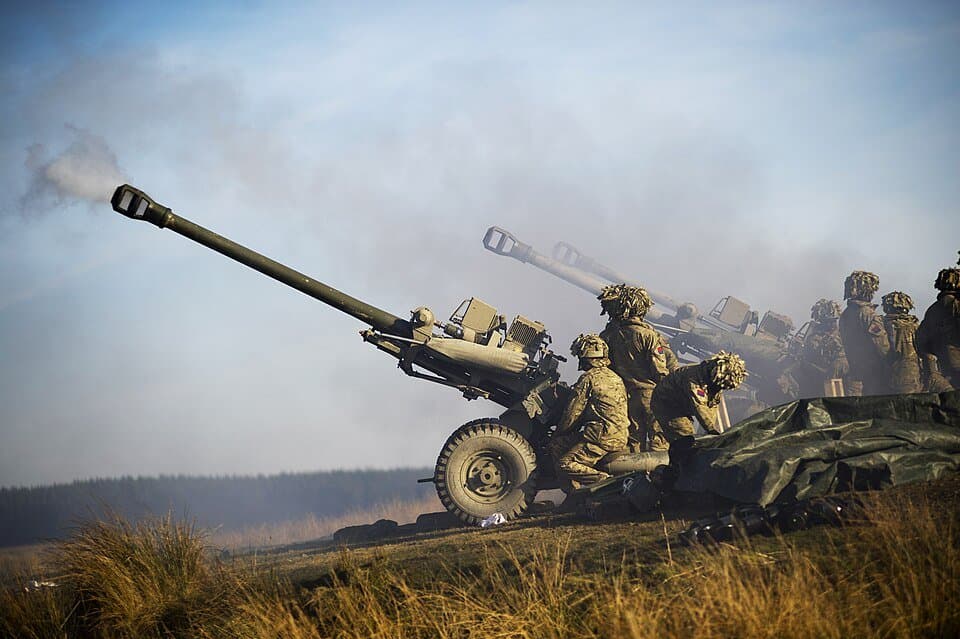
L118 light gunlarger figure on 0 of 1
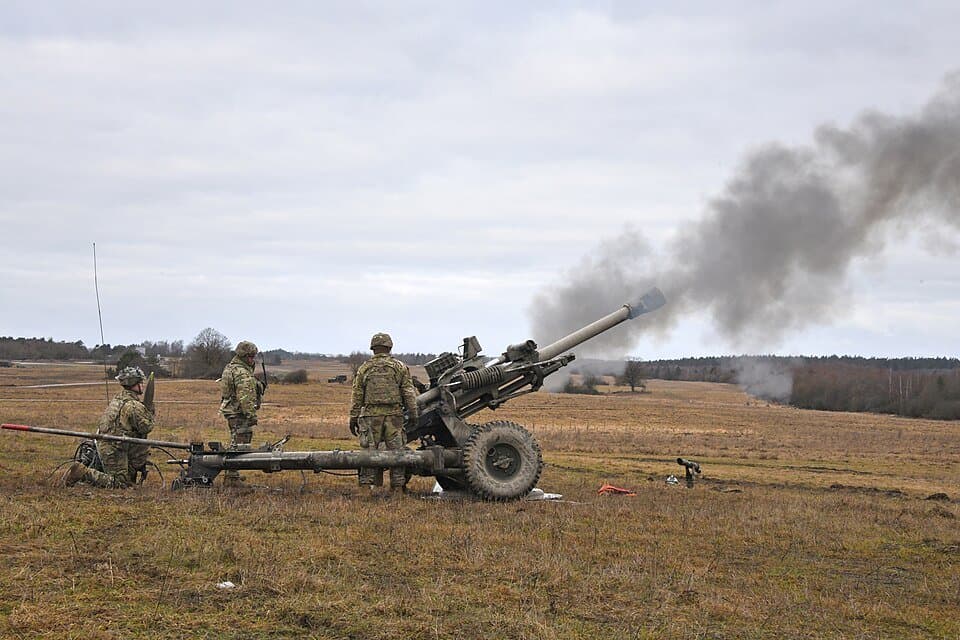
M119 howitzerlarger figure on 1 of 1
Counts only measures both sources give with the same scope. A larger figure is not a better system.
Measured figures
firing
Single sourcetravelling
Single sourceConfiguration
| Specification | L118 light gun | M119 howitzer |
|---|---|---|
| Type | Towed field gun[source] | Towed field gun[source] |
| Place of origin | United Kingdom[source] | United States[source] |
| In service | 1974–present[source] | — |
| Used by | See Operators[source] | See operators[source] |
7.01 m (23 ft) firing 4.876 m (16 ft) travelling[source]
Mass
Single source1,982 kg (1.951 long tons; 2.185 short tons)[source]
Cannon alone
Single sourceCombat
Single sourceWith BII
Single sourceWithout BII
Single sourceWith BII: 5,110 lb (2,320 kg) Without BII: 4,690 lb (2,130 kg) Cannon alone: 1,389 lb (630 kg) Combat: 4,268 lb (1,936 kg)[source]
Maximum; base bleed
Single sourceMaximum; Maximum firing range
Single source17.2 km (10.7 mi) 20.6 km (12.8 mi) base bleed[source]
Maximum; Charge 7
Single sourceMaximum; Charge 7 Charge 8 (with RAP)
Single sourcerapid
Single sourcesustained
Single source12 rds/min rapid 3 rds/min sustained[source]
for 3 minutes Sustained for 30 minutes
Single sourceMaximum
Single sourceBars compare reported quantities only. A larger figure does not make a system better; configurations and test conditions differ.
| Wars | Western Sahara War Falklands War Yugoslav Wars Sierra Leone Civil War Iraq War War in Afghanistan (2001–2021) Russo-Ukrainian War Russian invasion of Ukraine 2025 Cambodia-Thailand conflict[source] | War in Afghanistan (2001-2021) Iraq War Saudi Arabian–led intervention in Yemen Russian invasion of Ukraine[source] |
|---|
| Designer | Royal Armament Research and Development Establishment[source] | — |
|---|
| Designed | 1966–1973[source] | — |
|---|
| Manufacturer | Royal Ordnance Factory (later BAE Systems Land and Armaments )[source] | Joint Manufacturing Technology Center of Rock Island Arsenal[source] |
|---|
| Produced | 1974–2016[source] | 1989–2013[source] |
|---|
| No. built | Over 1,100[source] | — |
|---|
| Variants | L119 M119[source] | M119, M119A1, M119A2, M119A3[source] |
|---|
| Shell | Separate loading cased charge 105 x 326 mm R[source] | Semi-fixed 105 x 372 mm R[source] |
|---|
| Shell weight | L31 HE (16.1 kg (35 lb)) L50 HE‐ IM ER ( base bleed ) L42 HESH (10.49 kg (23 lb)) L43 Illuminating L45 Smoke (15.89 kg (35 lb)) L37 Smoke, red L38 Smoke, orange[source] | — |
|---|
| Barrels | L19 ordnance[source] | — |
|---|
| Breech | Vertical sliding block[source] | — |
|---|
| Recoil | Hydro-pneumatic[source] | — |
|---|
| Carriage | L17 box trail carriage with circular firing platform[source] | — |
|---|
| Elevation | +1244 mils (+70 °) –98 mils (–5.5 °)[source] | -5.625° (−100 mils) to +69.975° (+1,244 mils)[source] |
|---|
| Traverse | 200 mils (11.25 °) fine 6400 mils (360 °) on turntable[source] | 5.625° (100 mils) left or right[source] |
|---|
| Sights | Hall & Watts artillery sighting system Selex ES LINAPS Direct fire telescope[source] | 3 × M90A2 telescope, M137A1 panoramic telescope[source] |
|---|
| References | Janes & BAE Systems[source] | — |
|---|
| Former operator · Australia | Australia[source] | — |
|---|
| Former operator · Netherlands | Netherlands[source] | — |
|---|
| Former operator · South Korea | South Korea[source] | — |
|---|
| Former operator · Switzerland | Switzerland[source] | — |
|---|
| Role | 105 mm towed howitzer[source] | lightweight 105 mm howitzer ,[source] |
|---|
| Source measurement | The L118 light gun is a 105 mm towed howitzer . It was originally designed and produced in the United Kingdom for the British Army in the 1970s. It has since been widely exported. The L119 and the United States Army's M119 are variants that use a different type of ammunition.[source]L118 light gun · Lead; only the objects and conditions stated in this passage From 1961 to 1975, the British Army used the 105 mm pack howitzer L5 with L10 ordnance ( OTO Melara Mod 56 ) as its light artillery weapon, replacing the 75 mm howitzer , 4.2 inch mortar , and 25-pounder gun in eight regular artillery regiments. It fires the US M1 type ammunition (called "105 mm How" in the UK). The Mod 56 was originally designed in Italy for its mountain artillery units. It was light enough to be lifted by Westland Wessex helicopters or towed by Land Rovers . It could also be dismantled, with no piece heavier than 128 kg (282 lb) to be transported by mules or horses. It lacked range (making it potentially vulnerable to counter-battery fire), was not notably robust, and had poor sights. Nor were its rate of fire and time to prepare for opening fire satisfactory.[source]L118 light gun · History / Development; only the objects and conditions stated in this passage In 1965, a general staff requirement was approved for a new 105 mm weapon system because the L5 pack howitzer "lacked range and lethality". Key characteristics included 6400 mil (360°) traverse by one soldier, maximum weight of 3,500 pounds (1,600 kg), small enough size to be carried inside new Chinook helicopters and Andover transport aircraft , and ability to fire immediately after being under water for 30 minutes. The ammunition to be used was the 105 mm Fd Mk 2 ammunition used in the L13 ordnance of the gun equipment 105 mm L109 (better known as the " Abbot self-propelled gun "). This ammunition uses electrical instead of percussion primers and is an entirely different design from the US M1 type ammunition as used in the L5 pack howitzer. The two types are not interchangeable. An early requirement was for the new weapon to use 105 mm Fd Mk 1 ammunition, which uses the M1 shell, in training. However, in 1968, this was changed to allow a different version of the weapon, which subsequently became the L119, to fire US 1935 pattern (i.e. M1) ammunition.[source]L118 light gun · History / Development; only the objects and conditions stated in this passage The light gun entered service with the British Army in 1976. It was heavier than its predecessor, but helicopters that could carry it, such as the Puma and Westland Sea King , were entering service at the same time. A new vehicle, the Land Rover 101 Forward Control ("Land Rover, one-ton"), was designed as its prime mover in the field (and also for the Rapier air-defence missile launcher). Since the end of the 1990s, the British Army has used Pinzgauer ATVs as their gun tractors. In Arctic service, and elsewhere, the gun is towed by the Hägglunds Bv 206 and is fitted with skis when over snow.[source]L118 light gun · History / In British service; only the objects and conditions stated in this passage The narrow wheelbase prevents the ordnance rotating the 3200 mil (180°) required to 'unfold' the gun. Because of this, the gun features a knock-off hub on one side, allowing the ordnance to be rotated by removing one wheel. With a well-trained gun crew, this contributes approximately 30 seconds to the time required to deploy the gun. In British service, rotating the barrel for towing is optional.[source]L118 light gun · Design; only the objects and conditions stated in this passage When being towed in the unfolded position, the A-frame is fitted to the front transom in order to support the elevating mass. A recent modification makes it possible to keep the gun in this position indefinitely at speeds up to 40 mph (64 km/h). For long-distance transport or traversing rough terrain, the barrel is reversed and clamped to the end of the trail. For storage, the gun is in the unfolded position with the barrel elevated to an angle that balances the elevated mass on the yoke and therefore relieves pressure on the elevating gears.[source]L118 light gun · Design; only the objects and conditions stated in this passage The 105 mm Fd Mk 2 ammunition has two propelling cartridges and a blank cartridge (for saluting purposes). The normal cartridge has six propellant increments (charges 1, 2, 3, 4, 4½, and 5). Charge 4½, which is charge 5 with the blue charge three bag removed, is peculiar to the light gun and is used only for high-angle fire . A separate "charge super" cartridge is used for firing to maximum range.[source]L118 light gun · Design / Ammunition; only the objects and conditions stated in this passage Both charge five and charge super project beyond the end of the metal cartridge case. The 105 mm Fd is "separate, cased"; the shell is loaded and rammed by hand, then the cartridge with propellant is loaded. By the time the L118 entered service, propellant sub-zones A and B originally used with the Abbot had been replaced by an aerodynamic spoiler (a ring slipped over the nose of shell to lodge on the ogive) to reduce the minimum range at high-angle fire when this was required.[source]L118 light gun · Design / Ammunition; only the objects and conditions stated in this passage The 105 mm Fd Mk 2 rounds were the same as used with Abbot when the L118 was first introduced. The ammunition types originally or subsequently in UK service include:[source]L118 light gun · Design / Ammunition; only the objects and conditions stated in this passage L31 HE ( high explosive ) series is a series of 105 mm rounds which are claimed to have a 25% greater lethal area than the US 105 mm M1 HE shells.[source]L118 light gun · Design / Ammunition; only the objects and conditions stated in this passage L31A1 HE round is made from forged or cold‐extruded high‐tensile steel with a single copper band and a nominal fuzed weight of 16.103 kg (35.50 lb).[source]L118 light gun · Design / Ammunition; only the objects and conditions stated in this passage The L31A1 has two main fillings both weighing 2.431 kg (5.36 lb), Type A is 60:40 RDX / TNT , Type B is 55:45 RDX/TNT.[source]L118 light gun · Design / Ammunition; only the objects and conditions stated in this passage L31A2 HE has a nominal fuzed weight of 15.984 kg (35.24 lb) and its main filling is 2.3123 kg (5.098 lb) of creamed TNT.[source]L118 light gun · Design / Ammunition; only the objects and conditions stated in this passage L31A3 HE has a nominal fuzed weight of 16.089 kg (35.47 lb) and its main filling is 2.3123 kg (5.098 lb) of Bridgewater produced Type A 60:40 RDX/TNT and topped with TNT.[source]L118 light gun · Design / Ammunition; only the objects and conditions stated in this passage The IM-compliant shell was originally designated the L50A2, its explosive filling is 2.9 kg (6.4 lb) of ROWANEX 1100.[source]L118 light gun · Design / Ammunition; only the objects and conditions stated in this passage L45 smoke base ejection. This contains three canisters filled with hexachloroethane , which are ejected from the base of the shell in flight by a mechanical (L92) or electronic time fuze (L132 being replaced by L163). On falling to the ground, they generate dense white smoke for 60 seconds.[source]L118 light gun · Design / Ammunition; only the objects and conditions stated in this passage L43 illuminating. Provides a parachute flare base ejected by time fuze (L81) at about 400 m (1,300 ft) above the ground and burns for 30 seconds.[source]L118 light gun · Design / Ammunition; only the objects and conditions stated in this passage L50A2 HE‐IM ER (high explosive, insensitive munition , extended range) features a base bleed unit, extending the range of the projectile to 20.6 km (12.8 mi). The round's explosive fill is 2.5 kg (5.5 lb) of ROWANEX 1100. Fusing is as with the L31A4.[source]L118 light gun · Design / Ammunition; only the objects and conditions stated in this passage A white phosphorus smoke shell has never been adopted by the UK for L118. A base bleed insensitive HE shell, with a maximum range of 20.6 kilometres (12.8 mi) has been developed.[source]L118 light gun · Design / Ammunition; only the objects and conditions stated in this passage The L119 variant has a different barrel (a slightly shorter L30 ordnance with a percussion firing mechanism) for firing the ubiquitous US M1 type ammunition (UK 105 mm How), giving the gun a max range of 11,400 metres (12,500 yd). When the " semi-fixed " M1 ammunition is prepared for firing, any propellant charge bags that are not going to be used are removed from the cartridge case, then the projectile is fitted into the top of the case. The shell is then loaded into the gun as a complete round, unlike the L118 ammunition, where the projectile and cartridge case are loaded separately.[source]L118 light gun · Variants / L119; only the objects and conditions stated in this passage In British service, the L119 was used only for training at the Royal School of Artillery while stocks of 105 mm How lasted, and the last British L119s were retired in 2005. However, the L119 is popular with many export customers who still rely on M1 ammunition. In 2022, the New Zealand Army sent 30 soldiers to the United Kingdom to train Ukrainian soldiers on the L119 light gun, as military assistance to Ukraine. They were to be stationed in the United Kingdom from May to July, with each course to take a week. New Zealand also donated approximately 40 dial sights to Ukraine.[source]L118 light gun · Variants / L119; only the objects and conditions stated in this passage During the 1970s, a third variant with the L21 ordnance, was developed and prototypes produced. This was for Switzerland and used Swiss pattern 105 mm ammunition. It did not enter service.[source]L118 light gun · Variants / Other variants; only the objects and conditions stated in this passage The Indian Field Gun appears to share many features with the UK equipment. In the late 1960s India introduced the Value Engineered Abbot variant with the 105 mm Fd ammunition; this led to the 105 mm field gun (India), which appears to have some light gun features in its elevating mass, although its platform is similar to a Ordnance QF 25-pounder field gun. The 105 mm light field gun is much more like L118, although somewhat heavier.[source]L118 light gun · Variants / Other variants; only the objects and conditions stated in this passage In 1984, the L119 entered service with the Australian Army named the "Hamel gun" to replace the M2A2 . The gun was manufactured under licence in Australia for the Australian and New Zealand armies using mostly Australian produced components. Plans to produce 105 mm field ammunition were postponed.[source]L118 light gun · Variants / Other variants; only the objects and conditions stated in this passage The 105 mm saluting gun: The British Army has a number of dedicated saluting guns for ceremonial purposes. Based on the standard L118, these saluting guns are modified to exclusively fire blank cartridges, are not fitted with the APS system and are easily distinguished from the field gun variant by their distinctive bronze green paintwork, chromed muzzle brake, and chromed breech.[source]L118 light gun · Variants / Other variants; only the objects and conditions stated in this passage | The M119 howitzer is a lightweight 105 mm howitzer , used by the United States Army . It is the American licensed version of the British L119 light gun . The M119 is typically towed by the M1097 or M1152 High Mobility Multi-Purpose Wheeled Vehicle (HMMWV) , and can be easily airlifted by helicopter , or airdropped by parachute .[source]M119 howitzer · Lead; only the objects and conditions stated in this passage The howitzer was designed and produced by the British Royal Ordnance Factories as the L118 light gun . In the L118 configuration, the 105 mm ammunition is cased separate loading ammunition. The L118 entered service with the British Army in 1976 and is used by parachute and commando field artillery regiments. It saw combat during the Falklands War , where the 30 guns in action fired up to 400 rounds per gun per day, mostly at "charge super"—i.e., the most powerful propellant charge available.[source]M119 howitzer · Development; only the objects and conditions stated in this passage The L119 is the L118 reconfigured to fire NATO -standard 105 mm semi-fixed ammunition .[source]M119 howitzer · Development; only the objects and conditions stated in this passage The redesigned system operates the same, but modifies and simplifies some components, including a new buffer and recuperator with a majority of the components removed, and adds the Suspension Lockout System (SLOS) that fixes recoil length at 25 in (64 cm), which removes variable-recoil hardware, reduces stress on the carriage, and lowers buffer rod forces; the new system reduces cost, the system consists of 124 parts and the redesign will reduce that number by 40 percent to 75 parts and reusing 47 parts will consist of 65 percent for the current system, therefore only needing to manufacturing 28 new parts with overall weight savings of 45 lb (20 kg).[source]M119 howitzer · Development; only the objects and conditions stated in this passage |
|---|
| Reported operators |
|
|---|
Charge 7: 17,500 m (10.9 mi) Charge 8 (with RAP): 19,500 m (12.1 mi)[source]
Maximum: 8 rpm for 3 minutes Sustained: 3 rpm for 30 minutes[source]
with M67 propelling charges: M1 (HE) – High Explosive projectile, range: 11.5 km (7.1 mi), 2.1 kg of explosive filling M60 (WP) – White Phosphorus smoke generating projectile, range: 15.1 km (9.4 mi) (current variant: M60A2) M84 (HC) – Hexachloroethane smoke generating projectile, range: 11.5 km (7.1 mi) (current variant: 105 mm M84A1) M314 (VL) – Visible Light illuminating projectile, range: 19.5 km (12.1 mi) (current variant: M314A3) M444 (APICM) – Dual-Purpose Improved Conventional Munition (withdrawn from service), range: 11.5 km (7.1 mi) M916 (DPICM) – Dual-Purpose Improved Conventional Munition (withdrawn from service), range: 11.5 km (7.1 mi) M927 (HERA) – High Explosive Rocket Assisted projectile, range: 16.5 km (10.3 mi) M1064 (IR) – Infrared illuminating projectile, range: 19.5 km (12.1 mi) M1130 (HE PFF BB) – High Explosive Pre-Formed Fragments Base Bleed projectile – range: 13.0 km (8.1 mi)[source]M119 howitzer · Ammunition; only the objects and conditions stated in this passage
with M176 propelling charges: M548 (HERA) – High Explosive Rocket Assisted projectile, range: 15.1 km (9.4 mi)[source]M119 howitzer · Ammunition; only the objects and conditions stated in this passage
with M200 propelling charge: M760 (HE) – High Explosive projectile, range: 14.0 km (8.7 mi) M915 (DPICM) – Dual-Purpose Improved Conventional Munition (withdrawn from service), range: 14.1 km (8.8 mi)[source]M119 howitzer · Ammunition; only the objects and conditions stated in this passage
with M219 propelling charge: M913 (HERA) – High Explosive Rocket Assisted projectile, range: 19.5 km (12.1 mi)[source]M119 howitzer · Ammunition; only the objects and conditions stated in this passage
with M350 propelling charges: M1130A1 (HE PFF BB) – High Explosive Pre-Formed Fragments Base Bleed projectile, range 17.0 km (10.6 mi)[source]M119 howitzer · Ammunition; only the objects and conditions stated in this passage