

Credit
Unknown author Unknown author · CC BY 3.0 pl · Resized · CC BY 3.0 pl · Source ↗ · Modified


Preparing your view.

At a glance
KTO Rosomaklarger figure on 1 of 1
Puma (German infantry fighting vehicle)larger figure on 0 of 1
Counts only measures both sources give with the same scope. A larger figure is not a better system.
Measured figures
Length
Single source7.7 m (25 ft)[source]
Length
Single sourceConfiguration
| Specification | KTO Rosomak | Puma (German infantry fighting vehicle) |
|---|---|---|
| Type | armored personnel carrier[source] | Infantry fighting vehicle[source] |
| Place of origin | Finland / Poland[source] | Germany[source] |
| Used by | See Operators[source] | Bundeswehr[source] |
| Wars | War in Afghanistan (2001–2021) Russo-Ukrainian War[source] |
Official specification · puma; 7.4 m
Manufacturer claimSchützenpanzer Puma · Length · Länge
Single sourceWidth
Single source2.8 m (9 ft 2 in)[source]
Maximum; in water
Single sourceMaximum; over on land up to
Single sourceover 100 km/h (60 mph) on land up to 10 km/h (6.2 mph) in water[source]
Maximum; Official specification · puma; 70 km/h
Manufacturer claimMaximum; On road
Single sourceDC 13
Single sourceScania DI 12 diesel or Scania DC 13 diesel (DI 12) or
Single sourceScania DI 12 diesel or Scania DC 13 diesel 405 kW (543 hp) (DI 12) or 450 kW (600 hp) (DC 13)[source]
MTU Fried. MT 892 Ka-501 v10 11.1-litre (at 3,800 rpm), 2,200 N⋅m (1,623 ft⋅lb)
Single sourceOfficial specification · puma; 800 kW
Manufacturer claimBars compare reported quantities only. A larger figure does not make a system better; configurations and test conditions differ.
| — |
| Main armament | 1 × 30×173 mm ATK Mk44 Bushmaster II gun 2 x ATGM Spike -LR or Javelin (only on ZSSW-30 variant)[source] | Autocanon MK 30-2/ABM ( 30 mm , 200 rounds ready to fire, 200 in storage)[source] |
|---|
| Secondary armament | 1 × 7.62×51mm NATO UKM-2000 C coaxial general purpose machine gun[source] | Base variant: HK MG4 ( 5.56×45mm NATO ) S1 variant: Spike LR (MELLS) ATGM Multishot grenade launcher for close-in defense[source] |
|---|
| Power/weight | 15.6 kW/t (21.2 PS/t) (max weight)[source] | 18.6 kW/t[source] |
|---|
| Suspension | 8×8 wheeled[source] | Horstman hydrostruts[source] |
|---|
| Source manufacturer statement | It is produced by Rosomak S.A., a Polish Armaments Group company, in Siemianowice Śląskie .[source]Only the subject, component or variant named in this passage; unresolved names do not create a manufacturer identity | — |
|---|
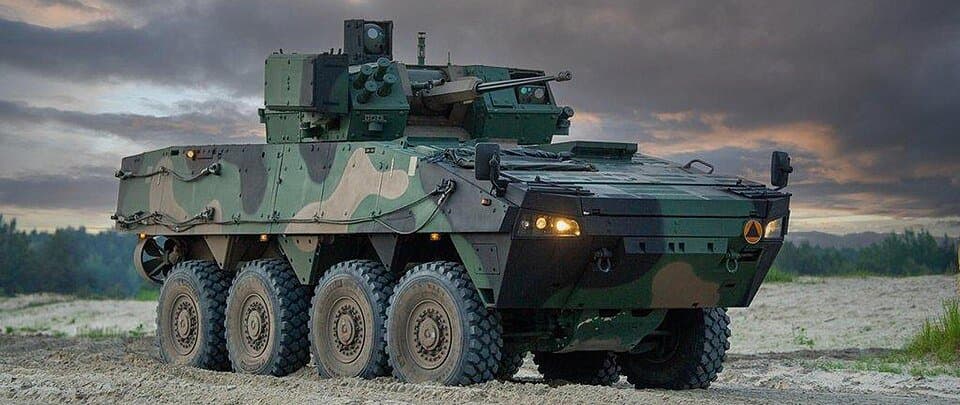
| Source measurement | The XC-360 transporter was developed as a successor to the Sisu XA-180 transporter, which had been in production since the early 1980s, and its subsequent versions. The first tactical and technical requirements for the new transporter were formulated in the mid-1990s, with the final version approved in 1999. A distinguishing feature of the vehicle was its modular construction and the reduction of physical signatures by limiting heat and noise emissions and specially shaping the hull to reduce radar reflection . Computer-aided design (CAD) techniques were extensively used in its development. The first mock-up of the vehicle (equipped with a twin-barrel AMOS 120mm mortar turret) was created in 2000 and showcased at the Eurosatory exhibition in Paris that same year. The first Prototype was completed in November 2001, initially intended only for traction tests, but these plans were changed. At the same time, the Ministry of National Defence (Poland) announced a tender for wheeled armored personnel carriers for the Polish Army .[source]KTO Rosomak · History; only the objects and conditions stated in this passage On 20 May 2002, the transporter arrived in Poland to be equipped with an American Delco turret (its main armament being the 25mm M242 Bushmaster automatic cannon).[source]KTO Rosomak · History; only the objects and conditions stated in this passage During tests in Poland, the vehicle covered nearly 2700 km without any issues.[source]KTO Rosomak · History; only the objects and conditions stated in this passage In September, the vehicle was back in Poland and was showcased at MSPO 2002 (equipped with the PML 127 OWS unmanned station with a 12.7mm NSW machine gun ).[source]KTO Rosomak · History; only the objects and conditions stated in this passage The buoyancy reserve at the maximum tested weight of 22,800 kg was 14.2%.[source]KTO Rosomak · History; only the objects and conditions stated in this passage The vehicle in the Polish configuration, designated XC-360P, did not yet exist at the time of the contract signing. The most significant changes to the Polish version of the transporter included reducing the vehicle's weight from 26 tons (in the Finnish configuration) to approximately 21 tons to enable transport by C-130 Hercules aircraft and ensure amphibious capability. Other changes included reducing the vehicle's width (the external armor of the Polish configuration features a characteristic bend not present on Finnish vehicles) and equipping the vehicle with double doors instead of a hydraulically lowered ramp .[source]KTO Rosomak · History; only the objects and conditions stated in this passage The AMV transporter features a frame construction with a longitudinal steel beam. The suspension and drive system are mounted on this structure, providing greater rigidity and easier maintenance of certain components. The vehicle is powered by a 6-cylinder, inline, turbocharged diesel engine, the Scania DI 12 56A03PE, with a maximum power output of 360 kW (490 HP) at 2100 rpm and a continuous power output of 294 kW (400 HP). The 11.7-liter engine is liquid-cooled and works with a ZF 7HP 902S Ecomat automatic transmission with 7 forward gears and 1 reverse gear, allowing a maximum speed of over 100 km/h. Water propulsion is provided by two propellers, enabling a speed of 10 km/h. The exhaust system is equipped with an exhaust gas cooling system. The fuel capacity is 325 liters.[source]KTO Rosomak · Construction; only the objects and conditions stated in this passage The vehicle has eight wheels with 14.00R20 tires, equipped with a central tire pressure regulation system. All wheels have independent suspension based on arms mounted to the support beam, and are cushioned by a hydropneumatic actuator system that allows ground clearance adjustment from +200mm to -250mm. The suspension travel is 450mm. The vehicle's turning radius is 12 meters. Terrain obstacle capabilities include: climbing slopes up to 60%; maximum side tilt up to 35 degrees; overcoming vertical walls of 0.5m; fording depths of 1.5m; and crossing trenches of 2.1m.[source]KTO Rosomak · Construction; only the objects and conditions stated in this passage Designed by the Italian company Oto Melara , the Hitfist -30P turret is a two-man turret armed with a 30mm ATK Mk 44 Bushmaster II automatic cannon (equipped with a dual-feed ammunition system) and a 7.62mm UKM-2000C machine gun. The design is an evolution of the Hitfist-25 turret used on the Italian Dardo IFV. However, the turret was significantly modified to meet Polish requirements. The most significant change is the substantial reduction in height to lower the vehicle's profile, making it possible to transport it in a C-130 Hercules aircraft. Interestingly, a turret design very similar to the Polish one was used on the Italian Centauro VBM Freccia .[source]KTO Rosomak · Hitfist-30P Turret; only the objects and conditions stated in this passage The turret is made of armored aluminum and equipped with additional ceramic armor. The armament is controlled by a fire control system featuring a Kolsman DNRS-288 day-night sight, a Galileo Avionica (now parto of Leonardo _ TILDE FC second-generation thermal camera, and a laser rangefinder. Additional equipment includes the SSP-1 Obra-3 sensor system and a smoke grenade launcher (which holds six 81mm grenades).[source]KTO Rosomak · Hitfist-30P Turret; only the objects and conditions stated in this passage The gunner sits on the right side of the vehicle and has access to the fire control system console with controllers and a ten-inch screen, a backup (optical) sight, and cranks for rotating the turret in case of electrical system failure (the right crank controls azimuth, while the left crank controls elevation). There is also a single forward-facing periscope. In front of the gunner is the shell ejection system for the main armament and the machine gun, which the gunner operates (reloading and clearing jams).[source]KTO Rosomak · Hitfist-30P Turret; only the objects and conditions stated in this passage The turret's empty weight is 2350 kg, and its combat weight is 2850 kg. Its height (with retracted periscopes) is 595 mm. The turret can rotate 360 degrees, and the elevation angles of the armament range from -10 to +60 degrees. The ready-to-use 30mm ammunition supply is 220 rounds, with an additional 250 rounds stored in two magazines under the turret.[source]KTO Rosomak · Hitfist-30P Turret; only the objects and conditions stated in this passage Rosomak Hitfist-30P – infantry fighting vehicle with an Oto Melara Hitfist -30P gun turret armed with a 30 mm ATK Mk 44 chain gun and 7.62mm NATO UKM-2000 C machine gun . The turret has advanced fire control systems with thermal sights and an Obra laser warning system connected to six 81 mm 902A ZM Dezamet smoke grenade launchers . (313 vehicles initial order, final number of 359 delivered, 60 transferred to Ukraine, 8 permanently lost in Afghanistan)[source]KTO Rosomak · Variants / Combat variants; only the objects and conditions stated in this passage Rosomak ZSSW-30 – infantry fighting vehicle with Polish designed HSW ZSSW-30 unmanned turret armed with a 30 mm gun Mk 44S, 7.62 mm UKM-2000C machine gun and two Spike-LR ATGM. 128 were ordered by 2024, and first were delivered in December 2023. Standard Rosomak with ZSSW-30 turret, non-amphibious, old platform (70+58 vehicles ordered in two batches)[source]KTO Rosomak · Variants / Combat variants; only the objects and conditions stated in this passage Rosomak-L ZSSW-30 – new platform Rosomak with ZSSW-30 turret, amphibious, new engine, larger gross weight, a variant with an extended hull (increasing overall length by 0.6 m from 7.8 m to 8.4 m), while also featuring other improvements such as new Scania DC13 engine, larger fuel tanks, new water-jet propulsion propellers, an upgraded hatch for the driver-mechanic, improved rearview mirrors, and a water deflector shield. Primary design goal of this variant was to increase buoyancy to restore amphibious capabilities compromised by the added weight of the new ZSSW-30 turret. (80 vehicles ordered so far)[source]KTO Rosomak · Variants / Combat variants; only the objects and conditions stated in this passage Rosomak-WEM – (WEM for Wóz Ewakuacji Medycznej – lit. "medical evacuation vehicle") – armored ambulance vehicle with crew of 3, capable of transporting 3 injured soldiers on stretchers and an additional four in a sitting position. May by deployed one per regular Rosomak company, amphibious (108 vehicles, tree batches 37+29+12+30 )[source]KTO Rosomak · Variants / Support variants; only the objects and conditions stated in this passage M120K Rak – 120 mm mortar artillery vehicle, first delivered in July 2017 (123 vehicles )[source]KTO Rosomak · Variants / Rak Mortar system; only the objects and conditions stated in this passage Rosomak - M2 and M3 – APC variant equipped with gun turret with 40 mm Mk-19 grenade launcher or 12.7 mm NSW / WKM-B heavy machine gun . The M2 variant was amphibious, with the base armor protection as on amphibious Hitfist-30P variant, equipped with light OSS-M turret, and intended to be used by European Union mission in Chad. The M3 variant was non-amphibious and had heavier armor equivalent to ISAF Rosomak-M1 variant. It was equipped with heavier OSS-D gun turret. Often was field modified to carry both the 12,7 NSV HMG and 7,62 UKM-2000 GPMG. Usually, the M3 variant was carrying the jamming equipment as it was easier to have electronic compatibility on simpler vehicle than on M1 variant with big 30 mm turret. (currently 39 M3 variant vehicles in the inventory )[source]KTO Rosomak · Variants / ISAF related variants; only the objects and conditions stated in this passage Rosomak - 1 - the infantry APC variant with remote weapon station and 12,7 mm machinegun, Polish Ministry of Defence decided instead to acquire vehicles armed with unmanned turrets with 30 mm gun and ATGM eventually resulting in ZSSW-30 turret.[source]KTO Rosomak · Variants / Notable prototype vehicles not adopted into service; only the objects and conditions stated in this passage Wilk (pol. "Wolf") - Fire support variant equipped with Cockerill CT-CV turret with 105 mm high-pressure gun capable of firing different variants of modern 105 mm ammunition like the M1060CV AP round and Falarick 105 barrel-launched ATGM. Some motorized infantry brigades are planned to have a single tank battalion instead.[source]KTO Rosomak · Variants / Notable prototype vehicles not adopted into service; only the objects and conditions stated in this passage Rosomak-XP - an updated version of the armoured personnel carrier was presented by Rosomak S.A. in September 2015 at the MSPO defence exhibition in Kielce . As part of the modernization, the gross vehicle weight rating ( GVWR ) was increased to 32 tonnes. In addition, a new 450 kW engine was installed, along with a new drivetrain, new wheels with 16.00R20 tyres, new rear troop ramp, and the level of ballistic and mine protection increased. Correspondingly, the licence holder Patria also presented a new version called the AMV2 Havoc intended for the US Marine Corps .[source]KTO Rosomak · Variants / Notable prototype vehicles not adopted into service; only the objects and conditions stated in this passage The Polish government announced in April 2023 it would provide the Ukrainian government with 200 KTO Rosomak. It was reported that the Ukrainian army's 21st Mechanized Brigade began receiving the first batch of these 25-ton, eight-wheel APCs in July 2023.[source]KTO Rosomak · Combat history; only the objects and conditions stated in this passage | — |
|---|
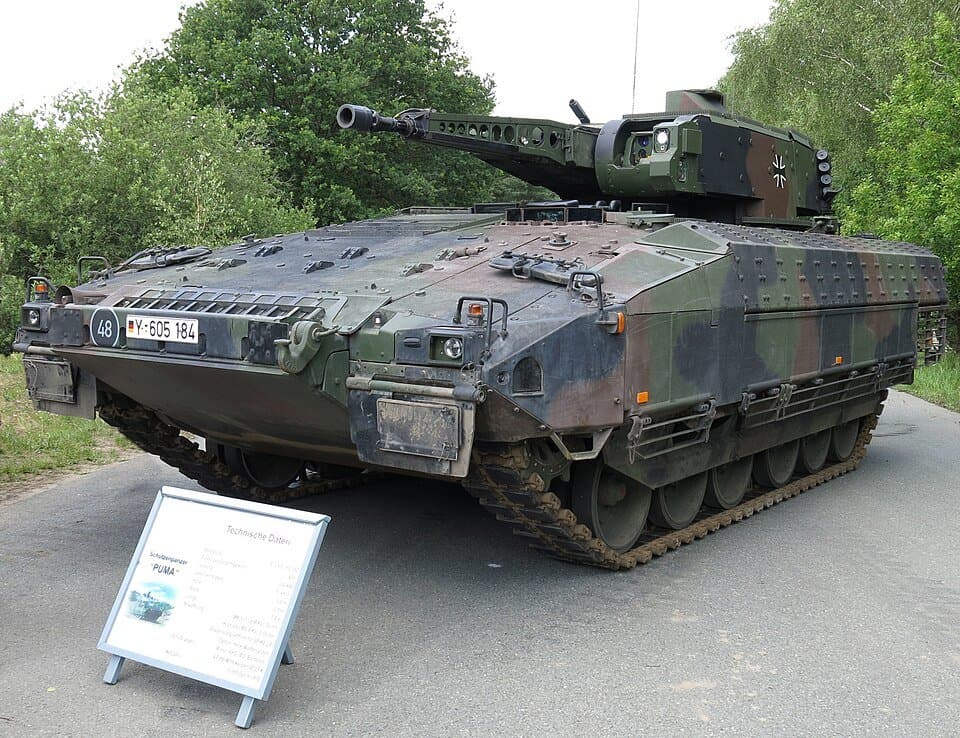
| Manufacturer | Rosomak[source] | Rheinmetall AG, KNDS Deutschland[source] |
|---|
| Origin reported by inventory | Finland Poland (under licence)[source]Inventory Origin column; table 28, row 3, cell 3; revision 1377190815; retrieved 2026-10-02 | — |
|---|
| Country of origin | Poland[source]Inventory Origin column; table 15, row 24, cell 3; revision 1377349156; retrieved 2026-10-02 | — |
|---|
| In service | — | 2015–present[source] |
|---|
| Designer | — | Krauss-Maffei Wegmann Rheinmetall Landsysteme[source] |
|---|
| Designed | — | 1995–2009[source] |
|---|
| Produced | — | 2009–present[source] |
|---|
| No. built | — | 350 as of December 2022[source] |
|---|
| Passengers | — |
|---|
| Armor | — | AMAP modular composite armor composite armour[source] |
|---|
| Transmission | — | Renk HSWL 256[source] |
|---|
| Fuel capacity | — | 900 L (240 U.S. gal; 200 imp gal)[source] |
|---|
| Reported occupants | — | 3+6[source]Schützenpanzer Puma · BesatzungSource text · numeric interpretation needs review |
|---|
| Reported operators |
| — |
|---|