Credit
Bin im Garten · CC BY-SA 3.0 · Resized · CC BY-SA 3.0 · Source ↗ · Modified


Preparing your view.

At a glance
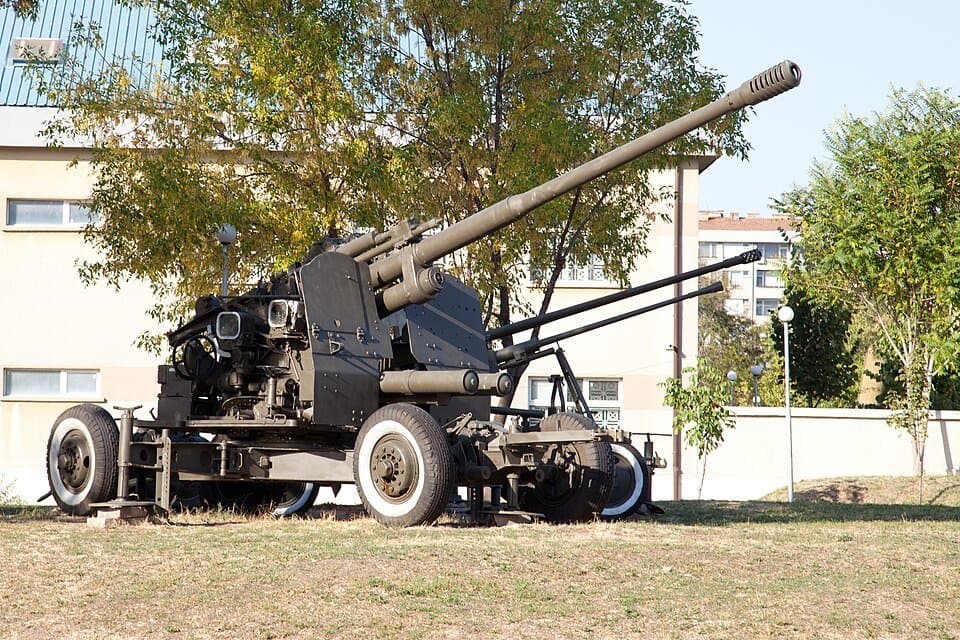
KS-19larger figure on 1 of 2
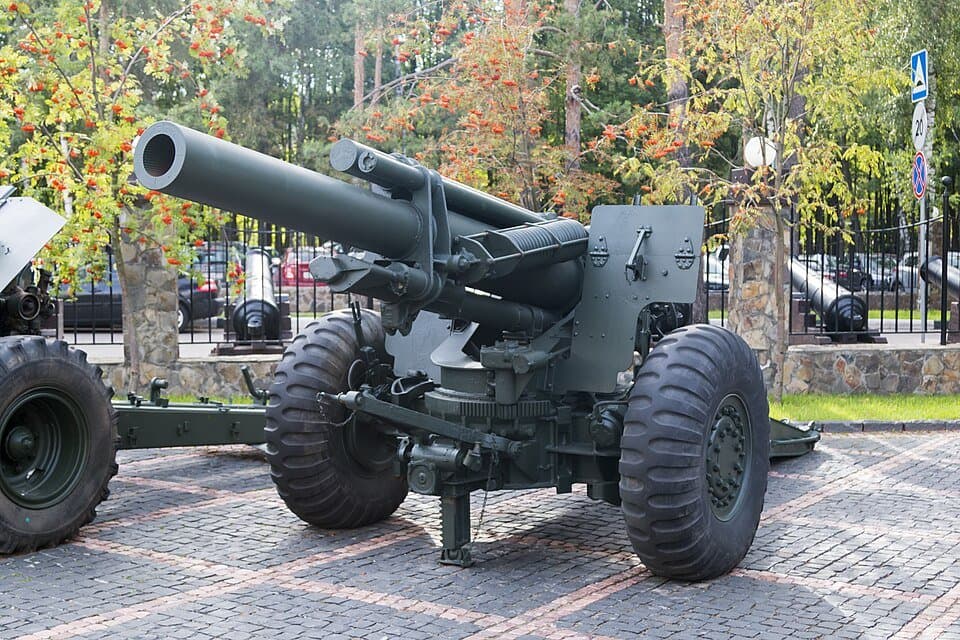
M114 155 mm howitzerlarger figure on 1 of 2
Counts only measures both sources give with the same scope. A larger figure is not a better system.
Measured figures
Length
Single source9.45 m (31.0 ft)[source]
Travel
Single sourceConfiguration
| Specification | KS-19 | M114 155 mm howitzer |
|---|---|---|
| Type | Anti-aircraft gun[source] | Field Howitzer[source] |
| Place of origin | Soviet Union[source] | United States[source] |
| In service | 1948−present[source] | 1942–present[source] |
| Used by | See § Operators[source] | See § Operators |
Travel: 24 ft 0 in (7.315 m)[source]
Maximum; horizontal
Single sourceMaximum; vertical, proximity fuze
Single sourceMaximum; vertical, time fuze
Single source21 km (13 mi) (horizontal) 15 km (9.3 mi) (vertical, proximity fuze ) 12.7 km (7.9 mi) (vertical, time fuze)[source]
Maximum; Maximum firing range
Single source16,000 yd (14,600 m)[source]
Muzzle velocity
Single source1,850 ft/s (563 m/s)[source]
Bars compare reported quantities only. A larger figure does not make a system better; configurations and test conditions differ.
| Wars | Korean War Vietnam War Iran–Iraq War Soviet–Afghan War Gulf War Somali Civil War 2003 invasion of Iraq Russo-Ukrainian War Second Nagorno-Karabakh War[source] | World War II Korean War Vietnam War Cambodian Civil War Laotian Civil War Lebanese Civil War Salvadoran Civil War Iran–Iraq War Kurdish–Turkish conflict (1978–present) Yugoslav Wars Syrian Civil War Russian invasion of Ukraine Operation Zarb e Azb 2025 India-Pakistan conflict 2025 Afghanistan-Pakistan conflict[source] |
|---|
| Designer | L. V. Lyuliev[source] | U.S. Army Ordnance Department[source] |
|---|
| Designed | 1947[source] | 1939–1941[source] |
|---|
| Manufacturer | Plant No. 4, Perm[source] | Rock Island Arsenal (US)[source] |
|---|
| Produced | 1948−1957[source] | 1941–1953 (US)[source] |
|---|
| No. built | 10,151[source] | 10,300 (US)[source] |
|---|
| Variants | See § Variants[source] | See § Variants[source] |
|---|
| Shell | AP-T, APC-T, HE, HE-FRAG, FRAG[source] | Separate-loading bagged charge[source] |
|---|
| Action | Semi-automatic horizontal sliding wedge[source] | — |
|---|
| Elevation | +85°/-3°[source] | −2° / +63°[source] |
|---|
| Traverse | 360°[source] | 25° left / 25° right[source] |
|---|
| Breech | — | Slow-cone interrupted screw[source] |
|---|
| Recoil | — | Hydro-pneumatic[source] |
|---|
| Carriage | — | Split trail[source] |
|---|
| Former operator · Austria | — | Austria[source] |
|---|
| Former operator · Bosnia and Herzegovina | — | Bosnia and Herzegovina[source] |
|---|
| Former operator · Brazil | — | Brazil[source] |
|---|
| Former operator · Cambodia | — | Cambodia[source] |
|---|
| Former operator · Canada | — | Canada[source] |
|---|
| Former operator · Croatia | — | Croatia[source] |
|---|
| Former operator · Croatian Republic of Herzeg-Bosnia | — | Croatian Republic of Herzeg-Bosnia[source] |
|---|
| Former operator · Denmark | — | Denmark[source] |
|---|
| Former operator · Ethiopian Empire | — | Ethiopian Empire[source] |
|---|
| Former operator · West Germany | — | West Germany[source] |
|---|
| Former operator · Imperial State of Iran | — | Imperial State of Iran[source] |
|---|
| Former operator · Israel | — | Israel[source] |
|---|
| Former operator · Italy | — | Italy[source] |
|---|
| Former operator · Japan | — | Japan[source] |
|---|
| Former operator · South Korea | — | South Korea[source] |
|---|
| Former operator · Lebanon | — | Lebanon[source] |
|---|
| Former operator · Libya | — | Libya[source] |
|---|
| Former operator · Montenegro | — | Montenegro[source] |
|---|
| Former operator · Norway | — | Norway[source] |
|---|
| Former operator · Netherlands | — | Netherlands[source] |
|---|
| Former operator · Republika Srpska | — | Republika Srpska[source] |
|---|
| Former operator · Serbia | — | Serbia[source] |
|---|
| Former operator · Serbian Krajina | — | Serbian Krajina[source] |
|---|
| Former operator · Singapore | — | Singapore[source] |
|---|
| Former operator · Somalia | — | Somalia[source] |
|---|
| Former operator · Spain | — | Spain[source] |
|---|
| Former operator · Thailand | — | Thailand[source] |
|---|
| Former operator · United States | — | United States[source] |
|---|
| Former operator · South Vietnam | — | South Vietnam[source] |
|---|
| Former operator · North Yemen | — | North Yemen[source] |
|---|
| Former operator · Yemen | — | Yemen[source] |
|---|
| Former operator · FR Yugoslavia | — | FR Yugoslavia[source] |
|---|
| Former operator · Yugoslavia | — | Yugoslavia[source] |
|---|
| Role | — | towed howitzer[source] |
|---|
| Status | — | The M114A1 remains in service in some countries.[source]M114A1 · source-literal variant status |
|---|
| Source measurement | — | The 155 mm Howitzer M114 is a towed howitzer developed and used by the United States Army . It was first produced in 1941 as a medium artillery piece under the designation of 155 mm Howitzer M1 . It saw service with the US Army during World War II , the Korean War , and the Vietnam War , before being replaced by the M198 howitzer .[source]M114 155 mm howitzer · Lead; only the objects and conditions stated in this passage After the end of the First World War a board - later named the Westervelt Board after its president, Brigadier General William I. Westervelt - was convened to assess the artillery experience of the combatant powers and map out future directions for the US Army artillery. The conclusion of the board vis-a-vis corps (heavy field) artillery was that an ideal heavy howitzer should have range of at least 16,000 yards (15 km) and allow elevation of 65° The board also recommended that the new 155-mm howitzer and the new 4.7-inch (120 mm) gun use the same carriage, even if it compromised both designs.[source]M114 155 mm howitzer · Development / Early development; only the objects and conditions stated in this passage The M1920 carriage resulting from this requirements was of the split-trail type with pneumatic equilibrators , permitting a total traverse of 60°. Unfortunately, it "gave considerable trouble due to the persistent failure of the top carriage" on the firing tests. In 1923–1925 the design was modified with the top carriage reinforced and standardized as M1925. However, it was never built in steel, because after the evaluation of a wooden model the project was abandoned. Instead, two new carriages were developed and built in the following years, which were designated T1 and T1E1. All of them had the same ballistics (perhaps even the same gun body), with maximal range of 16,390 yards (14.99 km), and were undergoing tests in the early 1930s. By 1934, the US Army was concerned about the arising high-speed towing requirements not satisfied by the plain bearings and solid rubber ties.[source]M114 155 mm howitzer · Development / Early development; only the objects and conditions stated in this passage The carriage was also used by the 4.5-inch gun M1 . It went through a number of minor changes over time. The original Warner electric brakes were replaced by Westinghouse air brakes on the M1A1. Both the M1 and M1A1 carriages used a mid-axle firing pedestal that was extended by a ratchet mechanism. The M1A2 replaced the ratchet with a screw-jack system and also modified the traveling lock. The M1A1E1 carriage was intended for use in jungle and muddy terrain and replaced the wheels of the M1A1 with a free-wheeling tracked suspension, but the project was terminated after V-J Day without having reached production. The T-9 and T-10 carriages were projects using low-grade steel alloys that were canceled when no longer needed. The T-16 was a light-weight carriage using high-grade steel that was estimated to save some 1,200 lb (540 kg); work began in July 1945 and continued after the war, although nothing seems to have come from it.[source]M114 155 mm howitzer · Development / Before and during World War II; only the objects and conditions stated in this passage After World War II , the production of M1 howitzers continued to 1953. Additionally it was redesignated as the Howitzer, Medium, Towed: 155 mm, M114 , with the complete system composed of the cannon (M1), carriage (M1A1), and recoil system (M6, M6A1, M6B1 or M6B2).[source]M114 155 mm howitzer · Development / Post World War II; only the objects and conditions stated in this passage A mid-1960s carriage variant was the 155mm XM123 & M123A1 auxiliary-propelled howitzers. The XM123 was produced by American Machine and Foundry and outfitted with two 20 horsepower air-cooled engines produced by Consolidated Diesel Corporation, driver's seat, steering wheel, and guide wheel on the left trail, allowing it to be more rapidly emplaced when detached from the prime mover, while the XM123A1 provided a single 20 horsepower motor with electric steering. The extra weight on the left trail displaced the howitzer after each round was fired, requiring it to be realigned, and the project was abandoned. The concept was copied from the Soviet 85mm SD-44 auxiliary-propelled anti-tank gun developed in 1954 and used by airborne forces (VDV).[source]M114 155 mm howitzer · Development / Post World War II; only the objects and conditions stated in this passage M114A2 − Similar to the M114A1, but with a slightly longer barrel. Its main distinguishing feature is a groove cut around the barrel about 2.0–2.8 inches (50–70 mm) from the end. The bore of the M114A2 have a 1 in 20 twist instead of the 1 in 12 used in earlier models, extending the range of the projectiles. In 1997, the United States supplied Bosnia-Herzegovina with 116 ex-US Army M114A2s while an additional 145 were earmarked for spare parts.[source]M114 155 mm howitzer · Variants; only the objects and conditions stated in this passage M114/39 (Netherlands) − Dutch modernization by RDM Technology, it features a 155 mm 39 caliber barrel supplied by Bofors (now BAE Systems ) amongst other upgrades. 96 M114s were modernized for Denmark , 82 for the Netherlands, and 48 for Norway .[source]M114 155 mm howitzer · Variants; only the objects and conditions stated in this passage M114S − Israeli modernization package by Soltam Systems , the M114S features a 33 calibers long barrel, allowing a standard 155 mm M107 HE projectile to be fired to a maximum distance of 20,000 yards (18,300 m); a muzzle brake in the barrel, a pneumatic ramming system for the loader, improved mounts and fixtures, and an optional telescopic sight for direct fire. One prototype was built, but wasn't adopted by the Israel Defense Forces or exported.[source]M114 155 mm howitzer · Variants; only the objects and conditions stated in this passage KM114A1 - Reverse engineered version of the M114A1 by South Korea. It is modified to fire RAP ammunition at a maximum range of 12.1 mi (19.5 km). Produced since the late 1970s until the introduction of the KH179 .[source]M114 155 mm howitzer · Variants; only the objects and conditions stated in this passage 155 mm Howitzer M65 − Yugoslav copy of the M114A1, which was also used by the Yugoslav People's Army . It is virtually identical to the original, with a few minor differences. The M65 fires the standard American M107 HE shell. For training the M65 can be fitted with a 20 mm (0.79 in) sub-caliber barrel insert. It was built only in small numbers.[source]M114 155 mm howitzer · Variants; only the objects and conditions stated in this passage The howitzer was experimentally mounted on a lengthened chassis of the M5 light tank . The resulting vehicle received the designation 155 mm Howitzer Motor Carriage T64. A single prototype was built before the T64 project was abandoned in favor of T64E1, based on the M24 Chaffee light tank chassis. This was eventually adopted as the M41 Howitzer Motor Carriage and saw action in the Korean War . Towards the end of the Korean War the US Army replaced the M41 self-propelled howitzer with the M44 self-propelled howitzer .[source]M114 155 mm howitzer · Self-propelled mounts; only the objects and conditions stated in this passage |
|---|
| Reported operators |
|
|
|---|