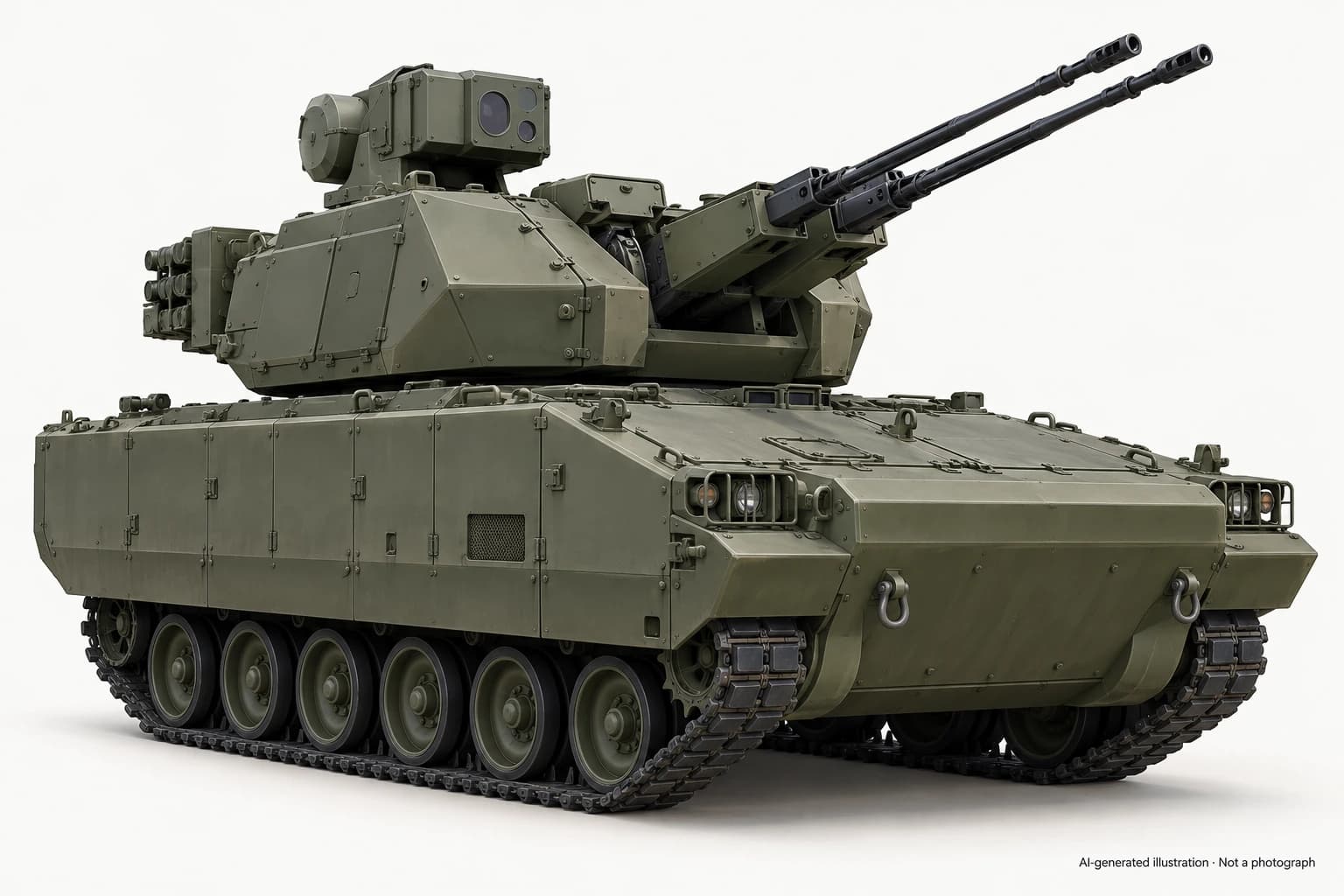

AI-generated illustration · Not a photograph
Credit
ForceTally · AI-generated illustration · Not a photograph · AI-generated · OpenAI output terms · Source ↗ · Modified


Preparing your view.

At a glance
KORKUTlarger figure on 3 of 4
M53/59 Pragalarger figure on 1 of 4
Counts only measures both sources give with the same scope. A larger figure is not a better system.
Measured figures
Length
Single sourceKorkut SSA · Length
Single sourceConfiguration
| Specification | KORKUT | M53/59 Praga |
|---|---|---|
| Type | Self-propelled anti-aircraft gun[source] Self-propelled anti-aircraft gun[source]Korkut SSA 2x 35mm Oerlikon KDC-02[source]Korkut SSA | Self-propelled anti-aircraft gun[source] |
| Place of origin | Türkiye[source] | Czechoslovakia[source] |
| In service | 2016 – present[source] | 1959−1992 (Czechoslovakia) |
Length
Single source6.92 m (22.7 ft)[source]
Bars compare reported quantities only. A larger figure does not make a system better; configurations and test conditions differ.
| Used by | Türkiye Pakistan[source] | See operators[source] |
|---|
| Wars | Second Libyan Civil War Turkish military intervention[source] | Gulf War Yugoslav Wars Second Congo War[source] |
|---|
| Designer | ASELSAN[source] | — |
|---|
| Manufacturer | Aselsan and FNSS[source] | Praga[source] Praga[source] Strojárske a metalurgické závody, závod Trenčín-Kubrá (1959–1961) Škoda, n. p., Plzeň[source]M53/59 own native Manufacturer row · original Trenčín-Kubrá 1959–1961 and Škoda Plzeň production, retaining source dates |
|---|
| No. built | 13 systems[source] | 900+[source] |
|---|
| Variants | Aselsan GOKDENIZ[source] | — |
|---|
| Traverse | 360°[source] 360°[source]Korkut SSA | 360°[source] |
|---|
| Main armament | 35 mm dual-barrelled autocannon (with 400 rounds)[source] | 30 mm twin AA autocannon (600−900 rounds)[source] |
|---|
| Secondary armament | Stinger or Igla-S MANPADS[source] | — |
|---|
| Role | Turkish all-weather-capable 35 mm self-propelled anti-aircraft gun (SPAAG)[source] | Czechoslovak self-propelled anti-aircraft gun[source] |
|---|
| Source measurement | Designed to replace the aging M42A1 Duster systems of the Turkish Armed Forces , each Korkut system comprises one command and control vehicle and three weapons platforms. Each weapon platform carries a twin 2×35 mm Oerlikon KDC-02 cannon, manufactured under licence by MKEK . Each weapons system can fire up to 1,100 rounds a minute up to a range of 4 km. The command and control vehicle has an effective radar range of 70 km. The Weapon System Vehicle and Command-and-Control Vehicle configurations designed under the Korkut Project are based on the FNSS ACV-30 and is fully amphibious and have the capability of propelling themselves in deep water and rivers.[source]KORKUT · Lead; only the objects and conditions stated in this passage The cannons can fire different types of 35×228 mm ammunitions including Aselsan made ATOM 35mm airburst ammunition.[source]KORKUT · Ammunition; only the objects and conditions stated in this passage ATOM 35mm airburst ammunition ejects tungsten pellets at a predetermined distance. It is a smart ammunition which has a base fuse. Together with the ability of precise time counting and the capability of being programmed during firing by taking muzzle velocity into consideration automatically sets the fuse to detonate the round as it approaches a pre-set distance from the target. Whilst a single pellet is too small to do major damage in itself, the accumulation of damage from multiple strikes is designed to destroy wings and control surfaces, sensors and aerodynamics, causing the target to crash. According to Aselsan, the ammunition is resistant against electromagnetic jamming.[source]KORKUT · Ammunition; only the objects and conditions stated in this passage In June 2025 Aselsan unveiled the KORKUT 100/25 SB, a dedicated counter-drone variant using 25mm AI-guided airburst ammunition; in January 2026 the KORKUT 140/35 successfully engaged an FPV drone in live-fire trials.[source]KORKUT · Ammunition; only the objects and conditions stated in this passage | The M53/59 Praga is a Czechoslovak self-propelled anti-aircraft gun developed in the late 1950s. It consists of an armoured version of the Praga V3S six-wheel drive truck chassis, armed with a modified version of the M53 twin 30 mm (1.2 in) anti-aircraft gun mounted on the rear, which can be removed and used to provide ground support.[source]M53/59 Praga · Lead; only the objects and conditions stated in this passage The twin guns have an elevation of +85°, and a depression of −10°, except over the crew compartment where the depression is limited to +2° and the commander's cupola where there is none. A steel plate on the back of the crew compartment prevents the gun barrels from hitting the roof. The turret can fully traverse 360° degrees and the traverse, elevation, and depression hydraulic systems can be manually controlled in case of emergency. The gunner is seated on the left side of the turret under the armoured cabin protection.[source]M53/59 Praga · Description; only the objects and conditions stated in this passage The 30 mm twin autocannons are gas-operated , with a maximum rate of fire of 450 to 500 rounds per barrel/minute and a practical rate of fire of 150 rounds per barrel/minute. Each gun has a 50-round magazine which are fed with 10-round clips. Each vehicle typically carries around 600 to 800 rounds. Fully loaded magazines are carried in the back of the crew compartment fastened to the floor by quick-release catches, while three spare magazines are carried on either side of the platform. Originally the guns were fitted with muzzle brakes , but they were later observed with conical flash hiders instead. The barrels can be quickly changed when overheated, and spare barrels were provided to the crews as part of the basic equipment.[source]M53/59 Praga · Description; only the objects and conditions stated in this passage Maximum horizontal range is 9.7 km (6 mi), maximum vertical range is 6.3 km (4 mi), and effective anti-aircraft range is 3 km (2 mi). The M53 guns can fire armor-piercing incendiary rounds capable of penetrating 55 mm (2.2 in) of RHA at a 0° angle at a range of 500 m (550 yd) and high-explosive incendiary rounds. |
|---|
| Origin | Türkiye[source]Korkut SSA | — |
|---|
| Mount | Main guns in turret[source]Korkut SSA | — |
|---|
| Ammunition | 400 rounds in total[source]Korkut SSA 100 rounds ready to fire per gun[source]Korkut SSA | — |
|---|
| Stabilizer | Yes[source]Korkut SSA | — |
|---|
| Chassis type | Tracked chassis, 6 roadwheels[source]Korkut SSA | — |
|---|
| Layout | Drive sprocket front, idler rear[source]Korkut SSA | — |
|---|
| Suspension | Torsion bar[source]Korkut SSA | — |
|---|
| Amphibious propulsion | 2x water jet[source]Korkut SSA | — |
|---|
| Engine type | Diesel[source]Korkut SSA | — |
|---|
| Transmission | Automatic[source]Korkut SSA | Manual with 4 forward and 2 reverse gears[source] |
|---|
| Power to weight ratio | 20.3 hp/t[source]Korkut SSA | — |
|---|
| Wall | 0.8 m[source]Korkut SSA | — |
|---|
| Trench | 2 m[source]Korkut SSA | — |
|---|
| Gradient | 60 %[source]Korkut SSA | — |
|---|
| Slope | 30 %[source]Korkut SSA | — |
|---|
| Fording | Amphibious[source]Korkut SSA | — |
|---|
| Armor type | Steel and aluminum[source]Korkut SSA | — |
|---|
| Protection level | STANAG 4569 level 4 versus small arms[source]Korkut SSA STANAG 4569 level 2 explosives[source]Korkut SSA | — |
|---|
| Smoke system | 2x4 smoke grenade dischargers[source]Korkut SSA | — |
|---|
| Night vision | Yes, for driver[source]Korkut SSA | — |
|---|
| Fire control | Fire control radar, Ku-band[source]Korkut SSA Optical tracker[source]Korkut SSA IFF system[source]Korkut SSA | — |
|---|
| Radio | Yes, including datalink to KKA[source]Korkut SSA | — |
|---|
| Produced | — | 1959–1978[source] |
|---|
| Shell | — | Armour-piercing incendiary (API) High-explosive incendiary (HEI)[source] |
|---|
| Barrels | — |
|---|
| Action | — | Gas-operated[source] |
|---|
| Elevation | — | -10° – +85°[source] |
|---|
| Feed system | — | 50-round box magazines[source] |
|---|
| Armor | — | Steel, 10 mm (0.39 in) max (estimated)[source] |
|---|
| Power/weight | — | 11.57 hp/t (8.63 kW/t)[source] |
|---|
| Fuel capacity | — | 120 L (26 imp gal; 32 US gal)[source] |
|---|
| Former operator · Bosnia and Herzegovina | — | Bosnia and Herzegovina[source] |
|---|
| Former operator · Croatia | — | Croatia[source] |
|---|
| Former operator · Czech Republic | — | Czech Republic[source] |
|---|
| Former operator · Czechoslovakia | — | Czechoslovakia[source] |
|---|
| Former operator · Herzeg-Bosnia | — | Herzeg-Bosnia[source] |
|---|
| Former operator · Iraq | — | Iraq[source] |
|---|
| Former operator · Libya | — | Libya[source] |
|---|
| Former operator · Republika Srpska | — | Republika Srpska[source] |
|---|
| Former operator · Serbia and Montenegro | — | Serbia and Montenegro[source] |
|---|
| Former operator · Serbian Krajina | — | Serbian Krajina[source] |
|---|
| Former operator · Slovakia | — | Slovakia[source] |
|---|
| Former operator · Slovenia | — | Slovenia[source] |
|---|
| Former operator · Yugoslavia | — | Yugoslavia[source] |
|---|
| Reported operators |
|
|---|
Maximum; vertical
Single sourceOperational; Operational range
Single source3,000 m (9,800 ft)[source]
9,700 m (31,800 ft) (horizontal) 6,300 m (20,700 ft) (vertical)[source]
500 km (310 mi)[source]
450−500 rpm per barrel (cyclic) 150 rpm per barrel (practical)[source]
The system lacks radar guidance, and night vision equipment, which makes it only effective during the day under good weather conditions. Other drawbacks of the M53/59 are the lack of a NBC protection system, no amphibious capabilities, and no central tire pressure regulation system. It also suffers from poor cross-country mobility, preventing effective coordination with tracked vehicles. Despite these drawbacks, the Czechoslovak Army used the M53/59 in place of the Soviet ZSU-57-2 .[source]M53/59 Praga · Description; only the objects and conditions stated in this passage
Praga VS35 M19 − A proposed upgrade by Srboauto in 2019 to meet the requirements of the Serbian Armed Forces . Improvements included a new four-door cab fully armoured to the NATO STANAG 4569 Level 2 standard, fitted with bullet/splinter proof windows on the front and sides and an Eberspächer 8 kW (11 hp) heater installed in the crew compartment.[source]M53/59 Praga · Variants / Serbia; only the objects and conditions stated in this passage
At least one M53/59 was seen in 2012 in the city of Goma . While its exact origin is unknown (possibly from Serbia, Slovakia, or Libya), it is known that the newly reformed DRC Army was armed with weapons left by the former Zairean Army and whatever could be purchased abroad.[source]M53/59 Praga · Combat history / Democratic Republic of Congo; only the objects and conditions stated in this passage