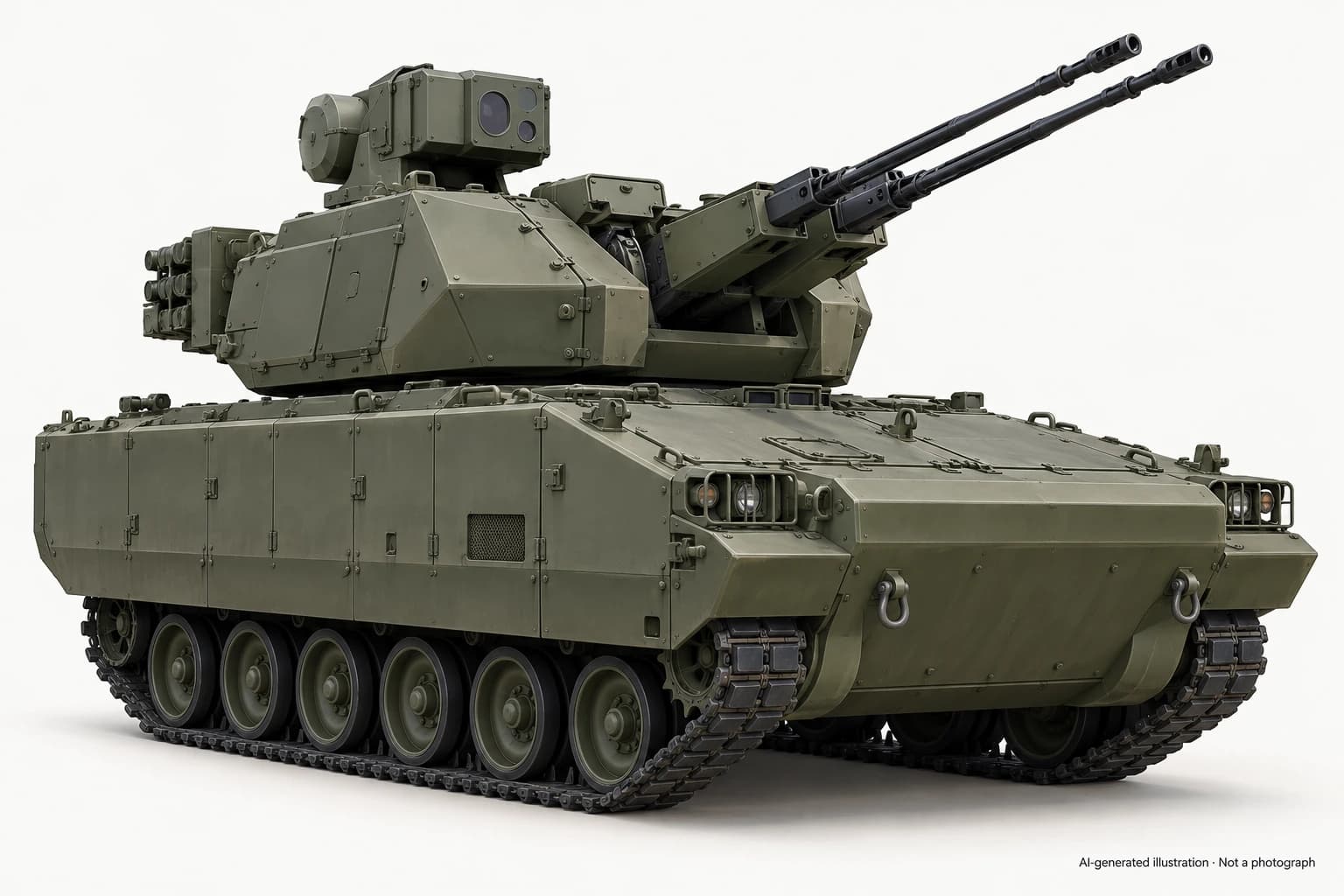

AI-generated illustration · Not a photograph
Credit
ForceTally · AI-generated illustration · Not a photograph · AI-generated · OpenAI output terms · Source ↗ · Modified


Preparing your view.

At a glance
KORKUTlarger figure on 2 of 3
M163 VADSlarger figure on 1 of 3
Counts only measures both sources give with the same scope. A larger figure is not a better system.
Measured figures
Length
Single sourceKorkut SSA · Length
Single sourceConfiguration
| Specification | KORKUT | M163 VADS |
|---|---|---|
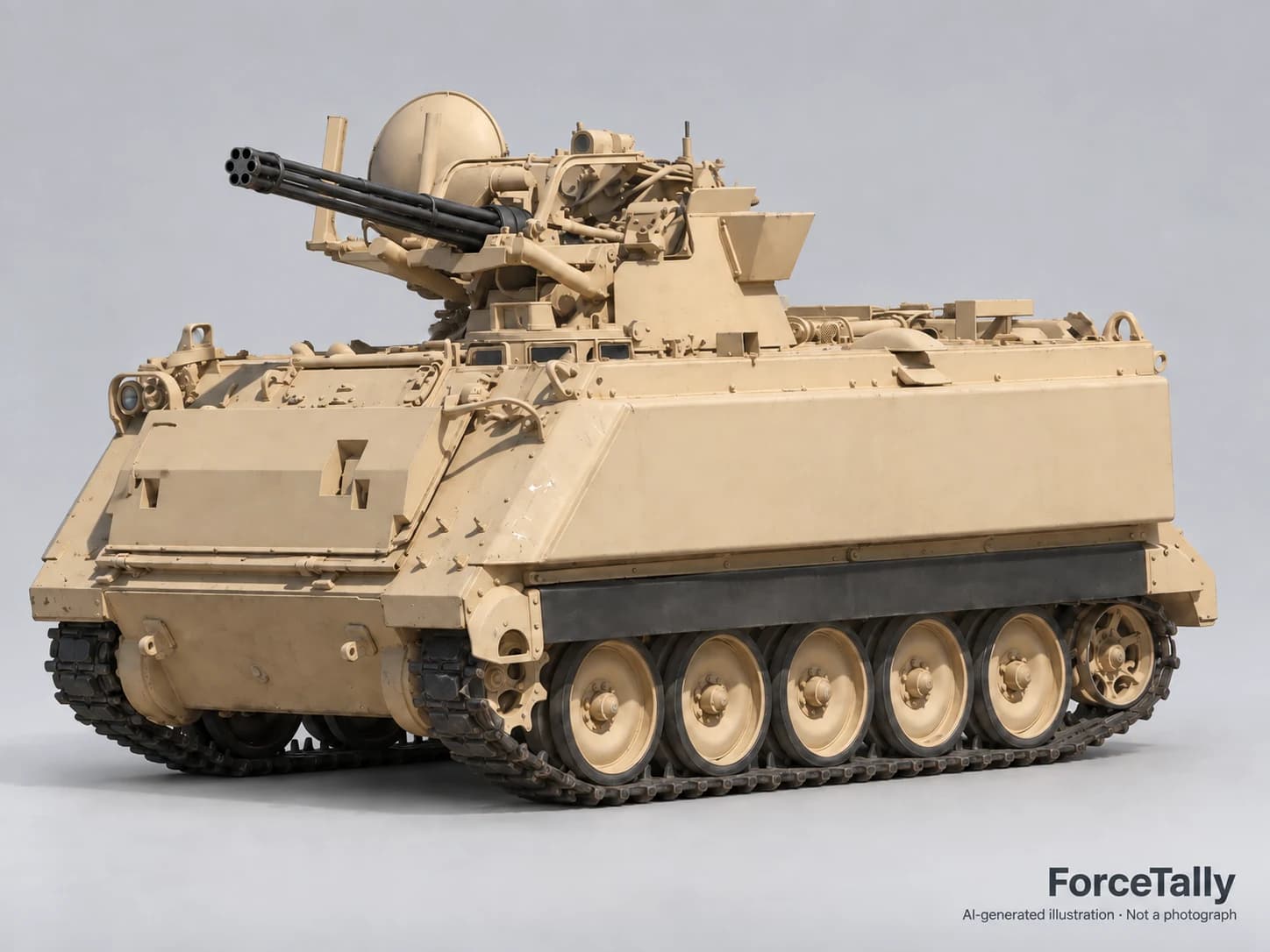
| Type | Self-propelled anti-aircraft gun[source] Self-propelled anti-aircraft gun[source]Korkut SSA 2x 35mm Oerlikon KDC-02[source]Korkut SSA | Self-propelled anti-aircraft gun[source] |
| Place of origin | Türkiye[source] | United States[source] |
| In service | 2016 – present[source] | 1968–present |
Length
Single source191.5 in (4.86 m)[source]
Bars compare reported quantities only. A larger figure does not make a system better; configurations and test conditions differ.
| Used by | Türkiye Pakistan[source] | See list of operators[source] |
|---|
| Wars | Second Libyan Civil War Turkish military intervention[source] | Vietnam War Western Sahara War 1982 Lebanon War Invasion of Panama Persian Gulf War Israeli–Palestinian conflict Iraq War (limited) Yemeni Civil War Saudi Arabian–led intervention in Yemen 2025 Cambodia-Thailand conflict[source] |
|---|
| Designer | ASELSAN[source] | General Electric[source] |
|---|
| Manufacturer | Aselsan and FNSS[source] | General Electric[source] |
|---|
| No. built | 13 systems[source] | 654[source] |
|---|
| Variants | Aselsan GOKDENIZ[source] | — |
|---|
| Traverse | 360°[source] 360°[source]Korkut SSA | — |
|---|
| Main armament | 35 mm dual-barrelled autocannon (with 400 rounds)[source] | M168 General Dynamics 20 mm Rotary cannon 2,000 rounds (M163) 2,230 rounds (M163A1/A2)[source] |
|---|
| Secondary armament | Stinger or Igla-S MANPADS[source] | — |
|---|
| Role | Turkish all-weather-capable 35 mm self-propelled anti-aircraft gun (SPAAG)[source] | self-propelled anti-aircraft gun (SPAAG) primarily[source] |
|---|
| Source measurement | Designed to replace the aging M42A1 Duster systems of the Turkish Armed Forces , each Korkut system comprises one command and control vehicle and three weapons platforms. Each weapon platform carries a twin 2×35 mm Oerlikon KDC-02 cannon, manufactured under licence by MKEK . Each weapons system can fire up to 1,100 rounds a minute up to a range of 4 km. The command and control vehicle has an effective radar range of 70 km. The Weapon System Vehicle and Command-and-Control Vehicle configurations designed under the Korkut Project are based on the FNSS ACV-30 and is fully amphibious and have the capability of propelling themselves in deep water and rivers.[source]KORKUT · Lead; only the objects and conditions stated in this passage The cannons can fire different types of 35×228 mm ammunitions including Aselsan made ATOM 35mm airburst ammunition.[source]KORKUT · Ammunition; only the objects and conditions stated in this passage ATOM 35mm airburst ammunition ejects tungsten pellets at a predetermined distance. It is a smart ammunition which has a base fuse. Together with the ability of precise time counting and the capability of being programmed during firing by taking muzzle velocity into consideration automatically sets the fuse to detonate the round as it approaches a pre-set distance from the target. Whilst a single pellet is too small to do major damage in itself, the accumulation of damage from multiple strikes is designed to destroy wings and control surfaces, sensors and aerodynamics, causing the target to crash. According to Aselsan, the ammunition is resistant against electromagnetic jamming.[source]KORKUT · Ammunition; only the objects and conditions stated in this passage In June 2025 Aselsan unveiled the KORKUT 100/25 SB, a dedicated counter-drone variant using 25mm AI-guided airburst ammunition; in January 2026 the KORKUT 140/35 successfully engaged an FPV drone in live-fire trials.[source]KORKUT · Ammunition; only the objects and conditions stated in this passage | The M163 Vulcan Air Defense System ( VADS ), officially Gun, Air Defense Artillery, Self-Propelled 20-mm, M163 , is a self-propelled anti-aircraft gun (SPAAG) primarily used by the United States Army . The M163 provides mobile, short-range air defense protection for ground units against low-flying fixed-wing aircraft and helicopters . It replaced the M42 Duster as the standard American armored light air-defense gun.[source]M163 VADS · Lead; only the objects and conditions stated in this passage The M163 VADS uses the M168 gun, a variant of the General Dynamics 20 mm (0.79 in) M61A1 rotary cannon , the standard cannon in most U.S. combat aircraft since the 1960s. The gun is mounted on a modified M113A1 vehicle (the M741 carrier). Designed to complement the M48 Chaparral missile system, it is limited to fair-weather operations. The M163 uses a small range-only AN/VPS-2 radar and an M61 optical lead-calculating sight, and is incapable of using the radar to scan an area for targets. The system is suitable for night operations with the use of AN/PVS series night vision sights that can be mounted to the right side of the primary sight.[source]M163 VADS · Specifications; only the objects and conditions stated in this passage The gun fires at 3,000 rounds per minute in short bursts of 10, 30, 60, or 100 rounds, or it can fire in continuous fire mode at a rate of 1,000 rounds per minute. A linkless feed system is used. Its 20x102mm round gave it a low effective range of only 1,200 meters (3,900 ft), and its standard air-defense load of HEI-T rounds would self-destruct at approximately 1,800 meters (5,900 ft), a hard limit on range. The feed drum holds 1,200 rounds ready to fire, with 800 rounds stowed in reserve for the M163, later increased to 1,030 rounds stowed in reserve for the M163A1 and A2.[source]M163 VADS · Specifications; only the objects and conditions stated in this passage In 1984, the improved PIVADS (Product-Improved VADS) system was introduced, providing improvements in the ease of use and accuracy of fire, but the limitations of the 20×102 mm caliber remained. In 1988, the fourth crewmember (observer/loader) was issued a Stinger launcher and two rounds. |
|---|
| Origin | Türkiye[source]Korkut SSA | — |
|---|
| Mount | Main guns in turret[source]Korkut SSA | — |
|---|
| Ammunition | 400 rounds in total[source]Korkut SSA 100 rounds ready to fire per gun[source]Korkut SSA | — |
|---|
| Stabilizer | Yes[source]Korkut SSA | — |
|---|
| Chassis type | Tracked chassis, 6 roadwheels[source]Korkut SSA | — |
|---|
| Layout | Drive sprocket front, idler rear[source]Korkut SSA | — |
|---|
| Suspension | Torsion bar[source]Korkut SSA | torsion bar , 5 road wheels[source] |
|---|
| Amphibious propulsion | 2x water jet[source]Korkut SSA | — |
|---|
| Engine type | Diesel[source]Korkut SSA | — |
|---|
| Transmission | Automatic[source]Korkut SSA | — |
|---|
| Power to weight ratio | 20.3 hp/t[source]Korkut SSA | — |
|---|
| Wall | 0.8 m[source]Korkut SSA | — |
|---|
| Trench | 2 m[source]Korkut SSA | — |
|---|
| Gradient | 60 %[source]Korkut SSA | — |
|---|
| Slope | 30 %[source]Korkut SSA | — |
|---|
| Fording | Amphibious[source]Korkut SSA | — |
|---|
| Armor type | Steel and aluminum[source]Korkut SSA | — |
|---|
| Protection level | STANAG 4569 level 4 versus small arms[source]Korkut SSA STANAG 4569 level 2 explosives[source]Korkut SSA | — |
|---|
| Smoke system | 2x4 smoke grenade dischargers[source]Korkut SSA | — |
|---|
| Night vision | Yes, for driver[source]Korkut SSA | — |
|---|
| Fire control | Fire control radar, Ku-band[source]Korkut SSA Optical tracker[source]Korkut SSA IFF system[source]Korkut SSA | — |
|---|
| Radio | Yes, including datalink to KKA[source]Korkut SSA | — |
|---|
| Designed | — | 1964[source] |
|---|
| Produced | — | 1965–1970, 1975–1979, 1982[source] |
|---|
| Elevation | — | +80° / -5°[source] |
|---|
| Armor | — | Rolled 5083/5086 H32 aluminium , 29 mm (1.14 in) - 45 mm (1.77 in)[source] |
|---|
| Former operator · Portugal | — | Portugal[source] |
|---|
| Former operator · Israel | — | Israel[source] |
|---|
| Former operator · Sudan | — | Sudan[source] |
|---|
| Former operator · Yemen | — | Yemen[source] |
|---|
| Reported operators |
|---|
275 mi (443 km) (M163/A2) 300 mi (480 km) (M163A1)[source]
Eventually, the M163 was replaced in US service by the M1097 Avenger and the M6 Linebacker , an M2 Bradley with FIM-92 Stinger missiles instead of the standard TOW anti-tank guided missiles : the Stinger missile providing the necessary range to deal with helicopters with anti-tank missiles far out-ranging the 20 mm gun, as well as considerably extending the reach against fixed-wing targets. The final US Army VADS-equipped unit at Fort Riley Kansas completed turn-in of its Vulcans in 1994.[source]M163 VADS · Upgrades and replacement; only the objects and conditions stated in this passage
A close-up of the 20 mm Vulcan cannon on the M163 VADS.[source]M163 VADS · Variants; only the objects and conditions stated in this passage