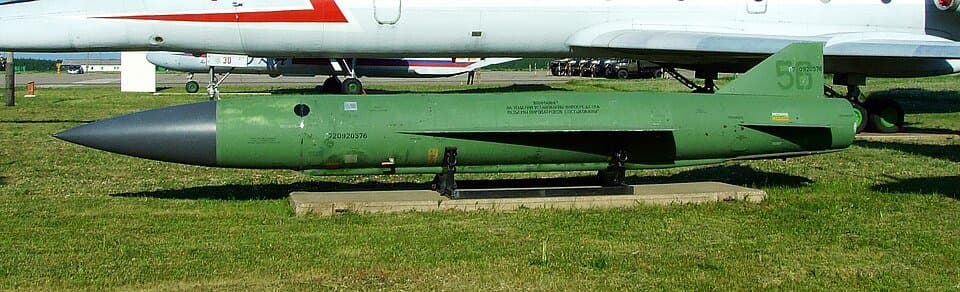
Credit
Антон Бородин · CC BY-SA 3.0 · Resized · CC BY-SA 3.0 · Source ↗ · Modified


Preparing your view.
At a glance
Kh-22larger figure on 3 of 3
Measured figures
Length
Single source11.65 m (38.2 ft)[source]
Length
Single sourceConfiguration
| Specification | Kh-22 | Type 88 surface-to-ship missile |
|---|---|---|
| Type | Anti-ship cruise missile Air-to-surface missile[source] | Anti-ship cruise missile[source] |
| Place of origin | Soviet Union[source] | Japan[source] |
| In service | 1968-present[source] | 1988[source] |
| Used by | Russia[source] |
Type 88 surface-to-ship missilelarger figure on 0 of 3
Counts only measures both sources give with the same scope. A larger figure is not a better system.
5.08 m (16.7 ft)[source]
Operational; Kh-22M/MA
Single source600 km (320 nmi) (Kh-22M/MA)[source]
Operational; or · source measurement 1
Single sourceOperational; or · source measurement 2
Single sourceOperational; sources vary
Single source100 km (54 nmi; 62 mi) or 150 km (81 nmi; 93 mi) or 180 km (97 nmi; 112 mi) (sources vary)[source]
Warhead weight
Single source225 kg (496 lb)[source]
Bars compare reported quantities only. A larger figure does not make a system better; configurations and test conditions differ.
| Wars | Russo-Ukrainian War Russo-Ukrainian war[source] | — |
|---|
| Designer | MKB Raduga[source] | — |
|---|
| Unit cost | $1 million[source] | — |
|---|
| Produced | 1962[source] | — |
|---|
| Warhead | 1,000 kg (2,205 lb) RDX or 350–1,000 kt (1.5–4.2 PJ) thermonuclear weapon[source] | HE[source] |
|---|
| Engine | R-201 liquid-fuel rocket[source] | Mitsubishi TJM2 turbojet + one solid rocket booster[source] |
|---|
| Propellant | Tonka-250 and IRFNA[source] | — |
|---|
| Flight ceiling | 10–14 km (33,000–46,000 ft) or 27 km (89,000 ft)[source] | — |
|---|
| Guidance system | Inertial guidance followed by terminal active radar homing[source] | Inertial guidance and terminal active radar homing[source] |
|---|
| Accuracy | >300 ft (91 m) (CEP)[source] | — |
|---|
| Launch platform | Tu-22M, Тu-22К, Тu-95К22[source] | Truck (Fuso Super Great, Fuso The Great)[source] |
|---|
| Manufacturer | MKB Raduga[source] | Mitsubishi Heavy Industries[source] |
|---|
| Flight altitude | — | 5-6 m[source] |
|---|
| Role | — | truck-mounted subsonic sea skimming anti-ship missile[source] |
|---|
| Source measurement | — | The Japan Ground Self-Defense Force bought 54 transporter erector launchers , each carrying six Type 88 missiles, for use as coastal batteries . With a range of 180 km (97 nmi; 112 mi), high subsonic speed and 225 kg (496 lb) warhead, it is similar to the US Harpoon missile.[source]Type 88 surface-to-ship missile · History; only the objects and conditions stated in this passage In 2015, an upgrade of the Type 88 became operational called the Type 12 . The Type 12 features INS with mid-course GPS guidance and better precision due to enhanced TERCOM and target discrimination capabilities. The weapon is networked, where initial and mid-course targeting can be provided by other platforms, and also boasts shorter reload times, reduced lifecycle costs, and a range of 200 km (110 nmi; 120 mi).[source]Type 88 surface-to-ship missile · History; only the objects and conditions stated in this passage During the Balikatan annual military exercise on May 6, 2026, the Japan Ground Self-Defense Force launched two Type-88 anti-ship missiles from the Philippines at the decommissioned 890-ton Philippine Navy ship BRP Quezon . While the first missile hit and contributed to sinking the vessel, video indicates the second missile missed by a few meters, passing the target without a hit. The target was located around 75 km off the coast of Paoay in the northern Philippines, and the missiles reached the BRP Quezon within six minutes of the launch.[source]Type 88 surface-to-ship missile · History; only the objects and conditions stated in this passage The basic launching vehicle configuration comprises a 6×6 Type 74 tactical truck with a maximum of six missile pods. The battery of type 88 includes four launch/transporters, a single target search radar, a single missile control station, four reloaders, and a digital communications station. The missile system takes about 45 minutes to transition from a camping or traveling position to combat-ready status. The missiles can be launched in two-second intervals. Usually, the SSM-1 is launched from within 100 km (62 mi) of the target.[source]Type 88 surface-to-ship missile · Configuration; only the objects and conditions stated in this passage |
|---|
| Reported operators |
| — |
|---|