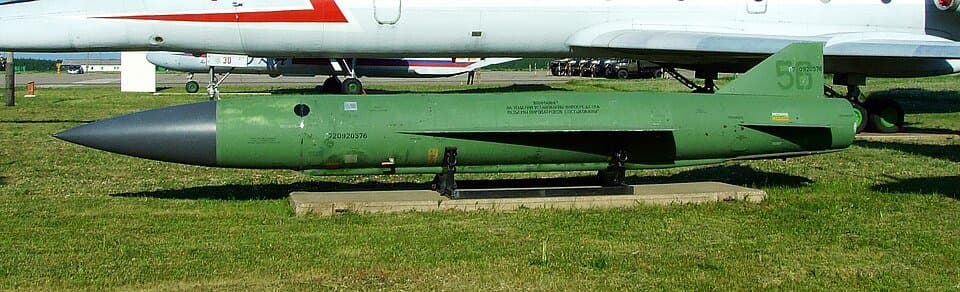
Credit
Антон Бородин · CC BY-SA 3.0 · Resized · CC BY-SA 3.0 · Source ↗ · Modified


Preparing your view.

Measured figures
Configuration
| Specification | Kh-22 | Silkworm (missile) |
|---|---|---|
| Type | Anti-ship cruise missile Air-to-surface missile[source] | Anti-ship cruise missile[source] |
| Place of origin | Soviet Union[source] | China[source] |
| In service | 1968-present[source] | — |
| Used by | Russia[source] | — |
| Wars | Russo-Ukrainian War Russo-Ukrainian war[source] |
Wingspan
Single source300 cm (120 in)[source]
Maximum; Mach 4.6 (
Single sourceMaximum; Maximum speed
Single sourceMach 4.6 (5,600 km/h; 3,500 mph)[source]
Operational; Kh-22M/MA
Single source600 km (320 nmi) (Kh-22M/MA)[source]
Bars compare reported quantities only. A larger figure does not make a system better; configurations and test conditions differ.
| — |
| Designer | MKB Raduga[source] | — |
|---|
| Unit cost | $1 million[source] | — |
|---|
| Produced | 1962[source] | — |
|---|
| Warhead | 1,000 kg (2,205 lb) RDX or 350–1,000 kt (1.5–4.2 PJ) thermonuclear weapon[source] | — |
|---|
| Engine | R-201 liquid-fuel rocket[source] | — |
|---|
| Propellant | Tonka-250 and IRFNA[source] | — |
|---|
| Flight ceiling | 10–14 km (33,000–46,000 ft) or 27 km (89,000 ft)[source] | — |
|---|
| Guidance system | Inertial guidance followed by terminal active radar homing[source] | — |
|---|
| Accuracy | >300 ft (91 m) (CEP)[source] | — |
|---|
| Launch platform | Tu-22M, Тu-22К, Тu-95К22[source] | — |
|---|
| Manufacturer | MKB Raduga[source] | Nanchang Aircraft Manufacturing Company (Now Hongdu ) China Aerospace Science and Industry Corporation Third Academy[source] |
|---|
| Source measurement | — | Prior to these attacks the missile's range was thought to be less than 80 kilometres (50 mi), but these attacks proved that the range exceeded 100 kilometres (62 mi) with Kuwaiti military observers seeing that the missiles originated from the area and tracking them on radar along with US satellite imagery of the launch sites.[source]Silkworm (missile) · Operational history / Iran–Iraq War; only the objects and conditions stated in this passage NATO reporting names CSS-N-5 Sabot . The SY-2 is a significant redesign of the SY-1 missile and is no longer a copy of the P-15. The missile has a longer, somewhat slimmer airframe and is powered by a solid propellant rocket motor instead of the liquid propellant design from the Styx, granting a range of 50km. Despite being a different, much more modern missile, however, the SY-2 still shares launchers and support equipment with the SY-1 (P-15) and not only armed the 053H1G frigates built in the 1990s but also eventually replaced the old missiles on unmodernized Jianghu class frigates.[source]Silkworm (missile) · Variants / SY series; only the objects and conditions stated in this passage An extended-range (70km) development of the SY-1 for coastal defense role; lost out to the more-ambitious HY-2 but was adopted for shipboard use due to its size growth from the SY-1 being sufficiently limited. NATO reporting names CSS-N-2 Safflower (ship-based) and CSSC-2 Silkworm (land-based.)[source]Silkworm (missile) · Variants / HY series; only the objects and conditions stated in this passage A complete re-engineering of the SY-1 design optimized for a maximum range of 100km, resulting in a still larger/longer missile more suitable for coastal defense than the more-conservative HY-1. NATO reporting names CSS-N-3 Seersucker (ship-based) and CSSC-3 Seersucker (land-based.)[source]Silkworm (missile) · Variants / HY series; only the objects and conditions stated in this passage Air-launched LACM sharing visual characteristics of the HY-2, HY-4, and YJ-6. 200 km range.[source]Silkworm (missile) · Variants / Further development; only the objects and conditions stated in this passage |
|---|
| Reported operators |
|
|
|---|