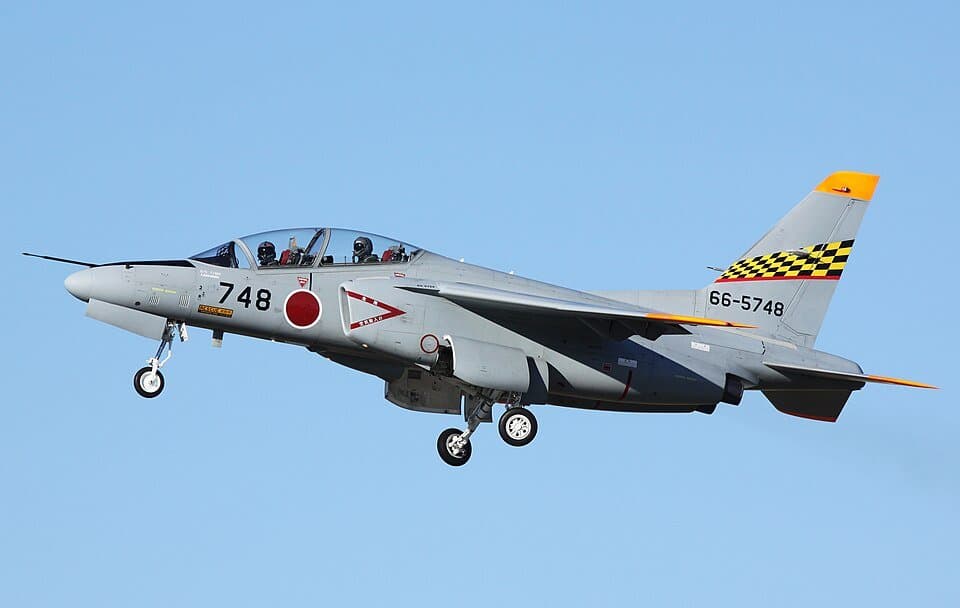

Credit
Jerry Gunner · CC BY-SA 4.0 · Resized · CC BY-SA 4.0 · Source ↗ · Modified


Preparing your view.
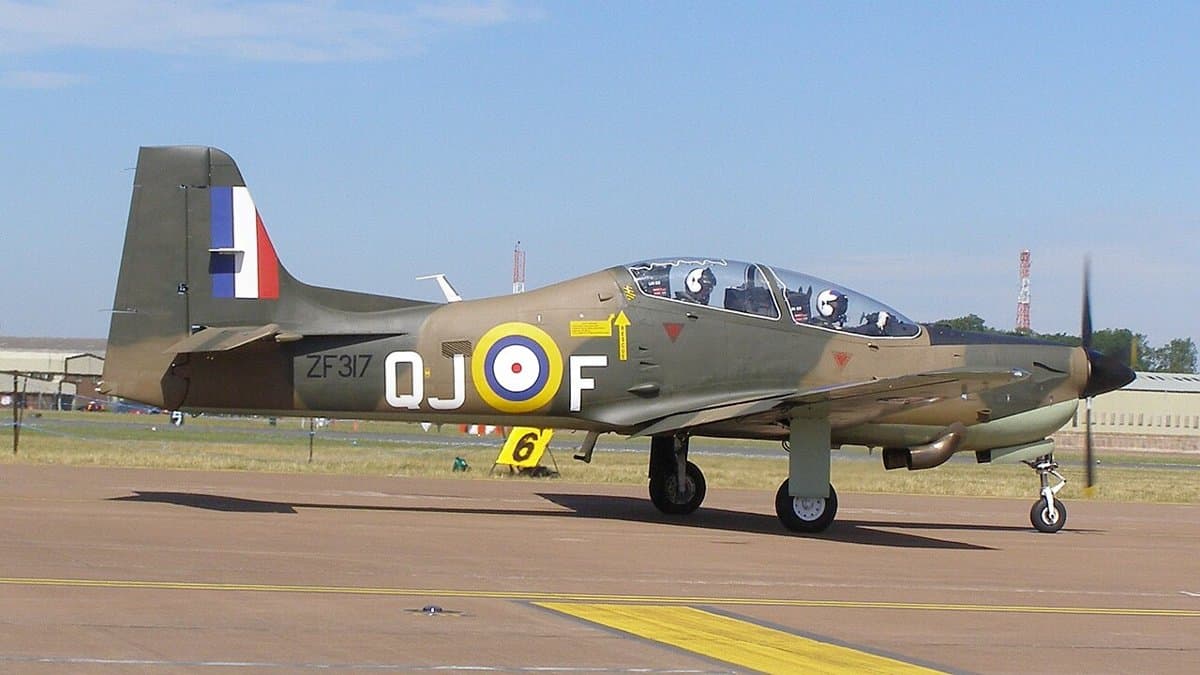

At a glance
True scale
Side by side. From every angle. A human reference for perspective.
3.16 MB · Loads when you open it| Model | Length | Width / span | Height |
|---|---|---|---|
| Kawasaki T-4 | ≈ 13 m | ≈ 9.94 m (Wingspan) | ≈ 4.6 m |
| Short Tucano | ≈ 9.86 m | ≈ 11.28 m (Wingspan) | ≈ 3.4 m |
Scaled uniformly to the sourced length of 13 m. The shape was turned square to the axes; the height was fitted to the sourced 4.6 m; the width was fitted to the sourced 9.94 m wingspan. Not an official model or a measured survey.
ForceTally · All rights reserved
Scaled uniformly to the sourced length of 9.86 m. The shape was turned square to the axes; the height was fitted to the sourced 3.4 m; the width was fitted to the sourced 11.28 m wingspan. Not an official model or a measured survey.
ForceTally · All rights reserved
The human reference is a generic 1.75 m figure. Models describe external size, not combat performance.
Measured figures
T-4 · Length
Single source13.00 m (42 ft 8 in)[source]
Tucano · Length
Configuration
| Specification | Kawasaki T-4 | Short Tucano |
|---|---|---|
| Type | Intermediate trainer aircraft[source] | Trainer aircraft[source]Tucano |
| National origin | Japan[source] | United Kingdom[source]Tucano |
| Manufacturer | Kawasaki[source] | Short Brothers[source]Tucano |
| Status | Active[source] | In limited service |
9.86 m (32 ft 4 in)[source]
Maximum; T-4 · at sea level
Single source1,038 km/h (645 mph, 560 kn) at sea level[source]
Tucano · 1 × Garrett TPE331 -12B turboprop 1,151 shp
Single source1 × Garrett TPE331 -12B turboprop , 858 kW (1,151 shp)[source]
T-4 · 2 × Ishikawajima-Harima F3 -IHI-30 turbofans thrust each
Single source2 × Ishikawajima-Harima F3 -IHI-30 turbofans , 16.32 kN (3,670 lbf) thrust each[source]
Tucano · Endurance
Single source5 h 12 min[source]
Bars compare reported quantities only. A larger figure does not make a system better; configurations and test conditions differ.
| Primary user | Japan Air Self-Defense Force[source] | — |
|---|
| Manufactured | 208+[source] | 1986–1995[source]Tucano |
|---|
| Introduction date | 1988[source] | 1989[source]Tucano |
|---|
| First flight | 29 July 1985[source] | 14 February 1986[source]Tucano |
|---|
| Fuel capacity | 2,241 L (493 imp gal; 592 US gal) internal fuel[source] | 724 L (159 imp gal; 191 US gal)[source] |
|---|
| Hardpoints | 5 (4 underwing and 1 under fuselage) for drop tanks, practice bombs and target towing equipment[source] | Provision for 1,000 lb (454 kg) of stores on four underwing hardpoints, but not on RAF Tucanos[source] |
|---|
| Aspect ratio | 4.7:1[source] | — |
|---|
| Stall speed | 167 km/h (104 mph, 90 kn)[source] | 80 km/h (50 mph, 43 kn) (flaps and gear down) (EAS)[source] |
|---|
| Primary users | — | Royal Air Force (Retired) Kenya Air Force Kuwait Air Force[source]Tucano |
|---|
| Number built | — | 160[source]Tucano |
|---|
| Retired | — | 2019 (Royal Air Force)[source]Tucano |
|---|
| Developed from | — | Embraer EMB 312 Tucano[source]Tucano |
|---|
| Airfoil | — | NACA 63 2 A-415 (root), 63A-212 (tip)[source] |
|---|
| Propellers | — | 4-bladed Hartzell constant speed , fully feathering, aluminium , reversible-pitch propeller, 2.39 m (7 ft 10 in) diameter[source] |
|---|
| Never exceed speed | — | 518 km/h (322 mph, 280 kn) ( EAS )[source] |
|---|
| g limits | — | +7/-3.6[source] |
|---|
| Takeoff run to 15 m (50 ft) | — | 524 m (1,719 ft)[source] |
|---|
| Landing run from 15 m (50 ft) | — | 573 m (1,880 ft)[source] |
|---|