ARadar & sensors
Kasta 2E
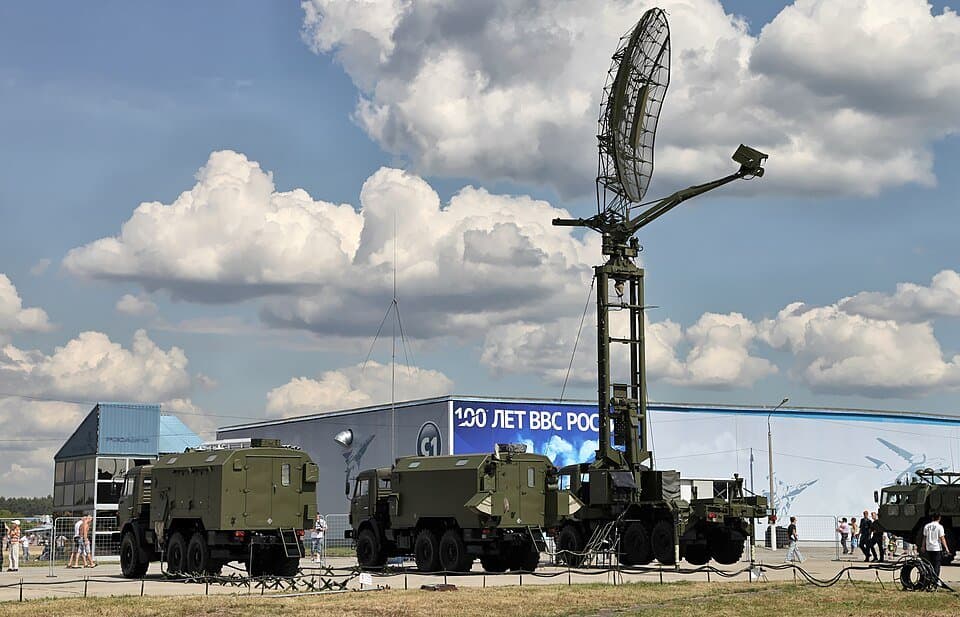
Russian radar system, consisting of the Kasta 2E1, Kasta 2E2 and their supporting equipment
Credit
Vitaly V. Kuzmin · CC BY-SA 4.0 · Resized · CC BY-SA 4.0 · Source ↗ · Modified


Preparing your view.
ARadar & sensors
Russian radar system, consisting of the Kasta 2E1, Kasta 2E2 and their supporting equipment

Measured figures
Bars compare reported quantities only. A larger figure does not make a system better; configurations and test conditions differ.
Configuration
| Specification | Kasta 2E | VERA passive sensor |
|---|---|---|
| Country of origin | Soviet Union[source] | Czech Republic[source] |
| Manufacturer | Almaz-Antey[source] | — |
| Designer | VNIIRT[source] | — |
| Introduced | 1989[source] | — |
| Type | Target acquisition[source] | Ground-based emitter tracking system[source] |
| Beamwidth | 8° (horizontal)[source] | — |
| RPM | 6-12RPM[source] | — |
| Altitude | 6 km (3.7 mi)[source] | — |
| Azimuth | 360º[source] | 120–360° depending on mode[source] |
| Precision | 450 m (1,480 ft), 100' (1.7°)[source] | — |
| Other names | Flat Face-E , 51U6 ( GRAU index), Kasta 2-1, Casta 2E1, Cyrillic : 51У6[source] | V-ELINT 18 (VEI18G/M) (resemblance)[source] |
| Role | Russian radar system, consisting of the Kasta 2E1, Kasta 2E2 and their supporting equipment[source] | — |
| Source measurement | The Kasta 2E was developed originally by the Soviet Union . Its primary objective is to overcome deficiencies or to satisfy the demand in low-level surveillance. Both radar types can be triggered with either equal or opposed phases. Both antenna types can optionally be mounted on a standard 50 meter pylon. This arrangement causes a displacement of the radar horizon which in turn increases the detection altitude up to 6 km at a distance of 150 km.[source]Kasta 2E · Development; only the objects and conditions stated in this passage | — |
| Related | — | PLESS[source] |
| Reported operators | — |
|