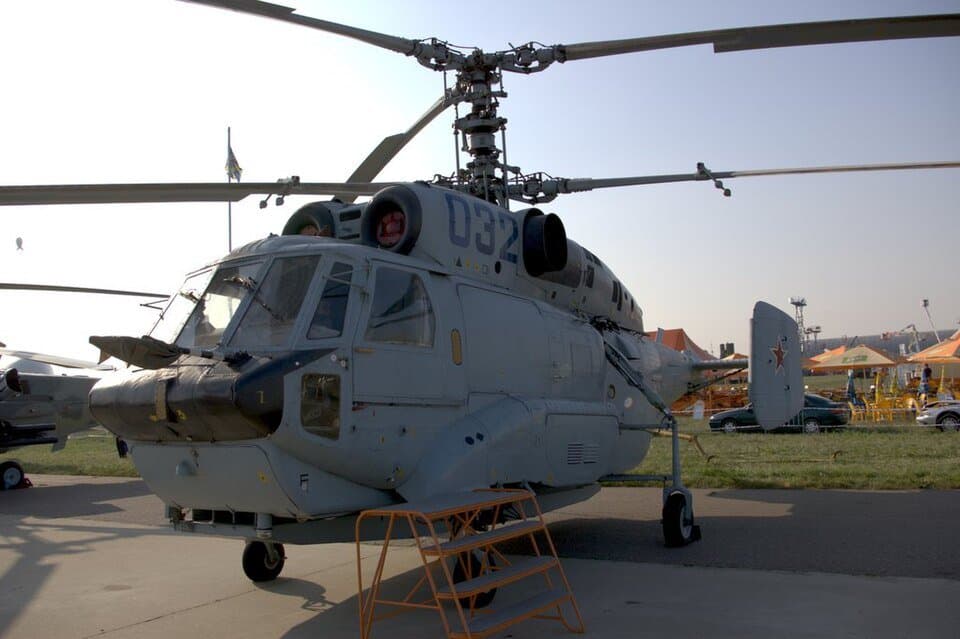

Credit
jno · CC BY-SA 1.0 · Resized · CC BY-SA 1.0 · Source ↗ · Modified


Preparing your view.

At a glance
True scale
Side by side. From every angle. A human reference for perspective.
3.11 MB · Loads when you open it| Model | Length | Width / span | Height |
|---|---|---|---|
| Kamov Ka-31 | ≈ 12.5 m | ≈ 11.65 m (Width) | ≈ 5.97 m |
| Sikorsky S-64 Skycrane | ≈ 21.41 m | ≈ 18.86 m (Width) | ≈ 7.15 m |
Scaled uniformly to the sourced length of 12.5 m. Not an official model or a measured survey.
ForceTally · All rights reserved
Scaled uniformly to the sourced length of 21.41 m. Not an official model or a measured survey.
ForceTally · All rights reserved
The human reference is a generic 1.75 m figure. Models describe external size, not combat performance.
Measured figures
Ka-31 · rotors folded
Single source12.5 m (41 ft 0 in) rotors folded[source]
Configuration
| Specification | Kamov Ka-31 | Sikorsky S-64 Skycrane |
|---|---|---|
| Type | Airborne early warning and control[source] | Aerial crane[source] |
| Manufacturer | Kamov[source] | Sikorsky Aircraft Erickson Inc.[source] |
| Status | In service, In production[source] | In service[source] |
| Primary users | Russian Navy Indian Naval Air Arm People's Liberation Army Navy[source] | — |
S-64E · Length
70 ft 3 in (21.41 m)[source]
Gross; Ka-31 · Gross weight
Single sourceMaximum take-off; Ka-31 Radar Picket Airborne Early Warning (AEW) Helicopter · Maximum take-off weight
Single source12,500 kg (27,558 lb)[source]
12,200kg[source]Ka-31 Radar Picket Airborne Early Warning (AEW) Helicopter
Empty; S-64E · Empty weight
Single sourceMaximum take-off; S-64E · Max takeoff weight
Single sourceKa-31 · Crew
Single sourceKa-31 Radar Picket Airborne Early Warning (AEW) Helicopter · pilot and navigator
Single source2 (pilot and navigator)[source]Ka-31 Radar Picket Airborne Early Warning (AEW) Helicopter
S-64E · (pilot, co-pilot), plus one rear-facing aft-stick operator during external-load operations
Single source3 (pilot, co-pilot), plus one rear-facing aft-stick operator during external-load operations[source]
Cruise; Ka-31 · Cruise speed
Single sourceMaximum; Ka-31 · Maximum speed
Single sourceMaximum; Ka-31 Radar Picket Airborne Early Warning (AEW) Helicopter · Maximum speed
Single source250 km/h (160 mph, 130 kn)[source]
205 km/h (127 mph, 111 kn)[source]
250km/h[source]Ka-31 Radar Picket Airborne Early Warning (AEW) Helicopter
Cruise; S-64E · Cruise speed
Single sourceMaximum; S-64E · Maximum speed
Single sourceKa-31 · 2 × Isotov TV3-117VMA turboshaft engines each take-off / contingency rating
Single source2 × Isotov TV3-117VMA turboshaft engines, 1,864 kW (2,500 hp) each take-off / contingency rating[source]
S-64E · 2 × Pratt & Whitney JFTD12-4A (T73-P-1) turboshaft engines, 4,500 shp ( ) each
Single source2 × Pratt & Whitney JFTD12-4A (T73-P-1) turboshaft engines, 4,500 shp (3,400 kW) each[source]
Ka-31 · on-station loiter at 3,500 m (11,500 ft)
Single source2 hours 30 minutes on-station loiter at 3,500 m (11,500 ft)[source]
S-64E · 1,330 ft/min (
Single source1,330 ft/min (6.8 m/s)[source]
Bars compare reported quantities only. A larger figure does not make a system better; configurations and test conditions differ.
| Number built |
|---|
28[source] |
100[source] |
| Manufactured | 1985–present[source] | — |
|---|
| Introduction date | 1995[source] | — |
|---|
| First flight | 1987[source] | 9 May 1962[source] |
|---|
| Developed from | Kamov Ka-27[source] | Sikorsky CH-54 Tarhe[source] |
|---|
| Main rotor area | 397.2 m 2 (4,275 sq ft)[source] | 4,070 sq ft (378 m 2 )[source] |
|---|
| Role | military helicopter originally[source] | — |
|---|
| Source measurement | 16-channel digital communication gear with range up to 250 miles (400 km).[source]Kamov Ka-31 · Design and development; only the objects and conditions stated in this passage The Ka-31 is equipped with the E-801 Oko L-band radar, capable of detecting and tracking up to 40 targets simultaneously, flying from 5 to 3,500 meters altitude. The detection range is 110 km for a fighter-aircraft-sized target, and 200 km for ship-sized targets. The antenna is six meters wide and one meter high, and rotates six times per minute. The radar can work in air-to-air, air-to-sea, and "mixed" (both at the same time) modes. The landing gear is retractable, in order to avoid interfering with the radar's functioning. When not in use, the radar's antenna is retracted under the fuselage. Due to its relatively small size, the Ka-31 doesn't have the capability to process the information collected by its radar. Instead, it transfers the information to nearby ships for them to do so.[source]Kamov Ka-31 · Design and development; only the objects and conditions stated in this passage The Indian Navy ordered four Ka-31s in 1999, and a further five in 2001. The first batch of four entered service with the Indian Navy in April 2003. The second batch was delivered in 2005. Five additional Ka-31s were ordered in 2009, and they were delivered between 2011 and 2012. As of 2019, India was considering another order for 10 Ka-31s, together with the modernisation of 10 of the 14 helicopters already in service. In May 2022, the Indian government indefinitely suspended the negotiations with Rosoboronexport due to concerns over Moscow’s ability to execute orders and issues related to payment transfers.[source]Kamov Ka-31 · Operational history; only the objects and conditions stated in this passage Length: 12.5 m (41 ft 0 in) rotors folded[source]Kamov Ka-31 · Specifications (Ka-31); only the objects and conditions stated in this passage 11.25 m (37 ft) fuselage only[source]Kamov Ka-31 · Specifications (Ka-31); only the objects and conditions stated in this passage Height: 5.6 m (18 ft 4 in)[source]Kamov Ka-31 · Specifications (Ka-31); only the objects and conditions stated in this passage Gross weight: 12,500 kg (27,558 lb)[source]Kamov Ka-31 · Specifications (Ka-31); only the objects and conditions stated in this passage Powerplant: 2 × Isotov TV3-117VMA turboshaft engines, 1,864 kW (2,500 hp) each take-off / contingency rating[source]Kamov Ka-31 · Specifications (Ka-31); only the objects and conditions stated in this passage Main rotor diameter: 2 × 15.9 m (52 ft 2 in)[source]Kamov Ka-31 · Specifications (Ka-31); only the objects and conditions stated in this passage Main rotor area: 397.2 m 2 (4,275 sq ft)[source]Kamov Ka-31 · Specifications (Ka-31); only the objects and conditions stated in this passage Maximum speed: 250 km/h (160 mph, 130 kn)[source]Kamov Ka-31 · Specifications (Ka-31); only the objects and conditions stated in this passage Cruise speed: 205 km/h (127 mph, 111 kn)[source]Kamov Ka-31 · Specifications (Ka-31); only the objects and conditions stated in this passage Range: 600 km (370 mi, 320 nmi) max. fuel with radar antenna stowed[source]Kamov Ka-31 · Specifications (Ka-31); only the objects and conditions stated in this passage Endurance: 2 hours 30 minutes on-station loiter at 3,500 m (11,500 ft)[source]Kamov Ka-31 · Specifications (Ka-31); only the objects and conditions stated in this passage | — |
|---|
| Overall length | 12.5m[source]Ka-31 Radar Picket Airborne Early Warning (AEW) Helicopter | — |
|---|
| Country of origin | Russia[source]Inventory Origin column; table 3, row 16, cell 2; revision 1376725347 | — |
|---|
| National origin | — | United States[source] |
|---|
| Primary user | — | Erickson Inc.[source] |
|---|
| Capacity | — | up to five total occupants / 20,000 lb (9,100 kg) payload[source] |
|---|
| Never exceed speed | — | 115 kn (132 mph, 213 km/h)[source] |
|---|
| Hover ceiling IGE S-64E | — | 10,600 ft (3,200 m)[source] |
|---|
| Hover ceiling IGE S-64A | — | 9,700 ft (3,000 m)[source] |
|---|