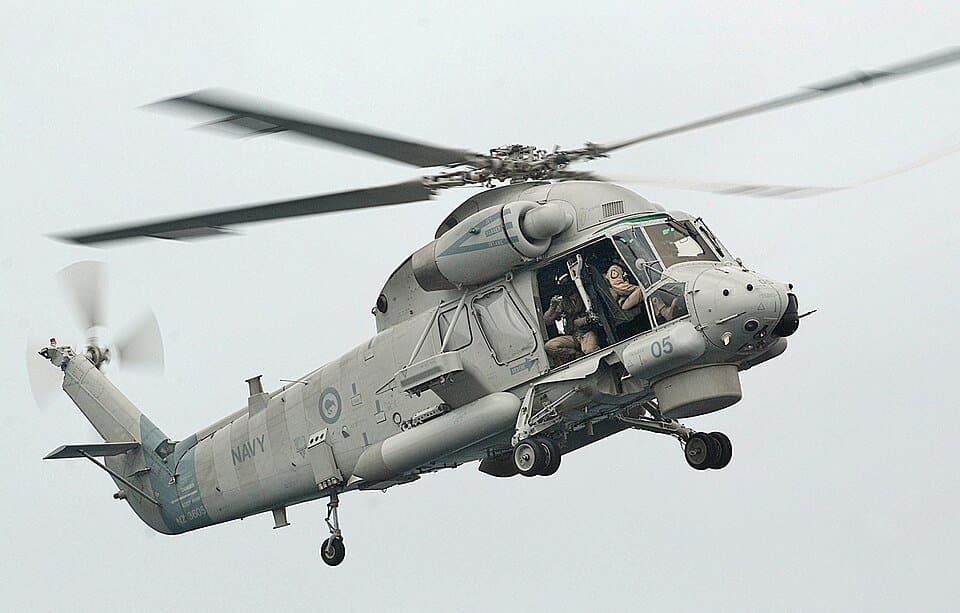

Credit
U.S. Navy photo by Mass Communication Specialist 3rd Class Justin R. Blake · Public domain · Resized · Public domain · Source ↗ · Modified


Preparing your view.

At a glance
True scale
Side by side. From every angle. A human reference for perspective.
3.08 MB · Loads when you open it| Model | Length | Width / span | Height |
|---|---|---|---|
| Kaman SH-2G Super Seasprite | ≈ 15.9 m | ≈ 13.49 m (Width) | ≈ 5.06 m |
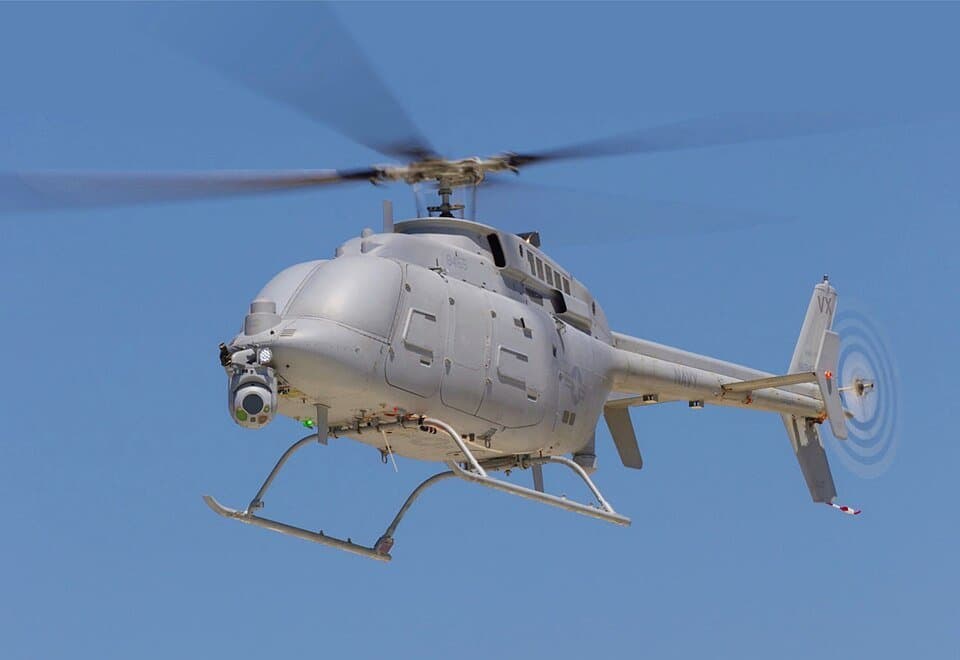
| Northrop Grumman MQ-8C Fire Scout | ≈ 10.6 m | ≈ 10.47 m (Width) | ≈ 4.13 m |
Scaled uniformly to the sourced length of 15.9 m. Not an official model or a measured survey.
ForceTally · All rights reserved
Scaled uniformly to the sourced length of 10.6 m. Not an official model or a measured survey.
ForceTally · All rights reserved
The human reference is a generic 1.75 m figure. Models describe external size, not combat performance.
Measured figures
SH-2G · Length
Single source52 ft 9 in (15.9 m)[source]
Configuration
| Specification | Kaman SH-2G Super Seasprite | Northrop Grumman MQ-8C Fire Scout |
|---|---|---|
| Type | ASW helicopter[source] | UAV helicopter[source] |
| National origin | United States[source] | — |
| Manufacturer | Kaman Aircraft[source] | Northrop Grumman Bell Helicopter[source] |
| Status | In service[source] | Development testing[source] |
Length
34 ft 8 in (10.6 m)[source]
SH-2G · (USN: pilot, co-pilot/tactical coordinator (TACCO), sensor operator (SENSO)) (RNZN: pilot, observer and helicopter loadmaster)
Single source3 (USN: pilot, co-pilot/tactical coordinator (TACCO), sensor operator (SENSO)) (RNZN: pilot, observer and helicopter loadmaster)[source]
SH-2G · 2,500 ft/min (
Single source2,500 ft/min (12.7 m/s)[source]
Bars compare reported quantities only. A larger figure does not make a system better; configurations and test conditions differ.
| Primary users | United States Navy (historical) Egyptian Navy Royal New Zealand Navy Peruvian Navy[source] | — |
|---|
| Manufactured | 1985–1995 (also conversions)[source] | — |
|---|
| Introduction date | 1993[source] | 2019[source] |
|---|
| First flight | 2 April 1985[source] | 2013[source] |
|---|
| Retired | 2001 ( United States Navy ) 2008 ( Royal Australian Navy ) 2025 ( Polish Navy )[source] | — |
|---|
| Developed from | Kaman SH-2 Seasprite[source] | Bell 407 Northrop Grumman MQ-8 Fire Scout[source] |
|---|
| Capacity | 4,390 lb (1,991 kg) load[source] | 2,950 lb (1,338 kg)[source] |
|---|
| Guns | FN MAG General-purpose machine gun x 1 (equipped on the right door only for the Royal New Zealand Navy)[source] | — |
|---|
| Hardpoints | Four total, two inboard pylons behind the main landing gear (for auxiliary fuel tanks and torpedoes) and two outboard pylons for Torpedoes and missiles.[source] | — |
|---|
| Rotor systems | 4 blades on main rotor and tail rotor. Main rotor blades are controlled by servo flaps rather than a swashplate[source] | — |
|---|
| Never exceed speed | 150 kn (173 mph, 278 km/h)[source] | — |
|---|
| Missiles | Export type only, equipped with 2 AGM-65D air-to-ground missiles or 2 AGM-119 short-range anti-ship missiles[source] | — |
|---|
| Primary user | — | United States Navy[source] |
|---|
| Number built | — | 38[source] |
|---|
| Role | — | unmanned helicopter[source] |
|---|
| Source measurement | — | In March 2013, the Navy incorporated the Rolls-Royce 250-C47E engine into the MQ-8C for a 5 percent increase in hot and high power, 2 percent reduced fuel consumption, 8 percent increase in rated takeoff power, and better reliability. The Bell 407-based MQ-8C has an endurance of 12 hours, a range of 150 nmi (170 mi; 280 km), and a payload capacity of about 318 kg (701 lb). It has twice the endurance and three times the payload as the MQ-8B.[source]Northrop Grumman MQ-8C Fire Scout · Design and development; only the objects and conditions stated in this passage In September 2013, the MQ-8C Fire-X delivered to the Navy turned on its engines for 10 minutes in preparation for first flight. First flight was scheduled for early to mid-October, although the exact date was not determined, as such tests are often delayed by minor system problems. The MQ-8C flight test regime was for six months.[source]Northrop Grumman MQ-8C Fire Scout · Design and development; only the objects and conditions stated in this passage The MQ-8C Fire Scout first flew on 31 October 2013. It flew for 7 minutes in restricted airspace using autonomous controls at Naval Base Ventura County . It flew a second time hours later that day to an altitude of 500 ft. The MQ-8C was jointly operated by Northrop Grumman and the Navy. Northrop Grumman delivered the second MQ-8C in November 2013. They were under contract to build 14 helicopters.[source]Northrop Grumman MQ-8C Fire Scout · Design and development; only the objects and conditions stated in this passage In December 2014, the MQ-8C began testing aboard the destroyer Jason Dunham , executing 22 landings and recoveries in less than four hours. Testing was completed on 19 December, executing 32 takeoffs and recoveries over three flights. The MQ-8C will be ready to perform surface warfare missions in 2018 and mine countermeasure missions in 2020. The aircraft's first deployment is expected for 2016 to give Littoral Combat Ships a 50 nmi (58 mi; 93 km)-radius ISR capability.[source]Northrop Grumman MQ-8C Fire Scout · Design and development; only the objects and conditions stated in this passage In May 2016, NAVAIR signed a contract for the Osprey 30 lightweight AESA radar for the MQ-8C, the first system of its type to offer full spherical coverage with no moving parts. The 360-degree, 50 kg (110 lb) airborne radar uses fixed panels distributed around the body of aircraft, mounting antennas weighing just over 11 kg (24 lb) each. The radar is classified as the AN/ZPY-8 and will be retrofitted onto the Navy's MQ-8C's.[source]Northrop Grumman MQ-8C Fire Scout · Design and development; only the objects and conditions stated in this passage In December 2014, the first operational MQ-8C was delivered to the US Navy. Its final developmental flight was completed in April 2015, after 450 hours completed in 327 flights. In August 2015, Northrop Grumman demonstrated the MQ-8C's endurance with an 11-hour flight. In November 2015, the MQ-8C completed a 3-week operational assessment period to assess system performance, endurance, and reliability of the unmanned helicopter over 83.4 hours in 11 flights. To date, the aircraft logged 730 flight hours over 427 flights. Ship-based testing is expected to begin in 2017. In July 2018, Air Test and Evaluation Squadron 1 concluded the initial operational test and evaluation of the MQ-8C, conducted aboard the USS Coronado .[source]Northrop Grumman MQ-8C Fire Scout · Design and development; only the objects and conditions stated in this passage Capacity: 2,950 lb (1,338 kg)[source]Northrop Grumman MQ-8C Fire Scout · Specifications; only the objects and conditions stated in this passage Length: 34 ft 8 in (10.6 m)[source]Northrop Grumman MQ-8C Fire Scout · Specifications; only the objects and conditions stated in this passage Height: 10 ft 11 in (3.3 m)[source]Northrop Grumman MQ-8C Fire Scout · Specifications; only the objects and conditions stated in this passage Max takeoff weight: 6,000 lb (2,721 kg)[source]Northrop Grumman MQ-8C Fire Scout · Specifications; only the objects and conditions stated in this passage Powerplant: 1 × Rolls-Royce 250-C47B , 813 shp (606 kW)[source]Northrop Grumman MQ-8C Fire Scout · Specifications; only the objects and conditions stated in this passage Main rotor diameter: 36 ft 7 in (11.2 m)[source]Northrop Grumman MQ-8C Fire Scout · Specifications; only the objects and conditions stated in this passage Maximum speed: 140 kn (160 mph, 260 km/h)[source]Northrop Grumman MQ-8C Fire Scout · Specifications; only the objects and conditions stated in this passage Endurance: 15 hours maximum[source]Northrop Grumman MQ-8C Fire Scout · Specifications; only the objects and conditions stated in this passage Service ceiling: 20,000 ft (6,100 m)[source]Northrop Grumman MQ-8C Fire Scout · Specifications; only the objects and conditions stated in this passage |
|---|
| Country of origin | — | Canada, United States[source] Canada[source] United States[source] |
|---|