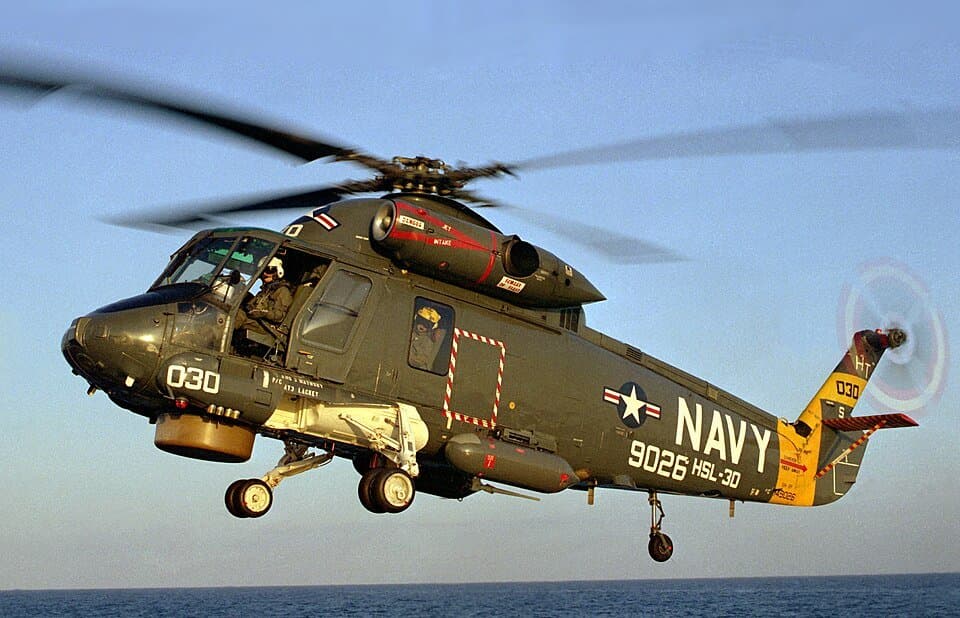

Credit
PH2 Wiggin, USN · Public domain · Resized · Public domain · Source ↗ · Modified


Preparing your view.
At a glance
Measured figures
SH-2F Seasprite · nose and blades folded
Single source38 ft 4 in (11.68 m) nose and blades folded[source]
Configuration
| Specification | Kaman SH-2 Seasprite | Mil Mi-14 |
|---|---|---|
| Type | Anti-submarine warfare helicopter[source] | Anti-submarine helicopter[source] |
| Manufacturer | Kaman Aircraft Corporation[source] | Mil Moscow Helicopter Plant[source] |
| Status | Partially retired; G model in service[source] | In service[source] |
| Primary users | United States Navy (historical) Royal New Zealand Air Force Polish Navy Egyptian Navy[source] | Soviet Navy Russian Navy Ukrainian Navy Polish Navy |
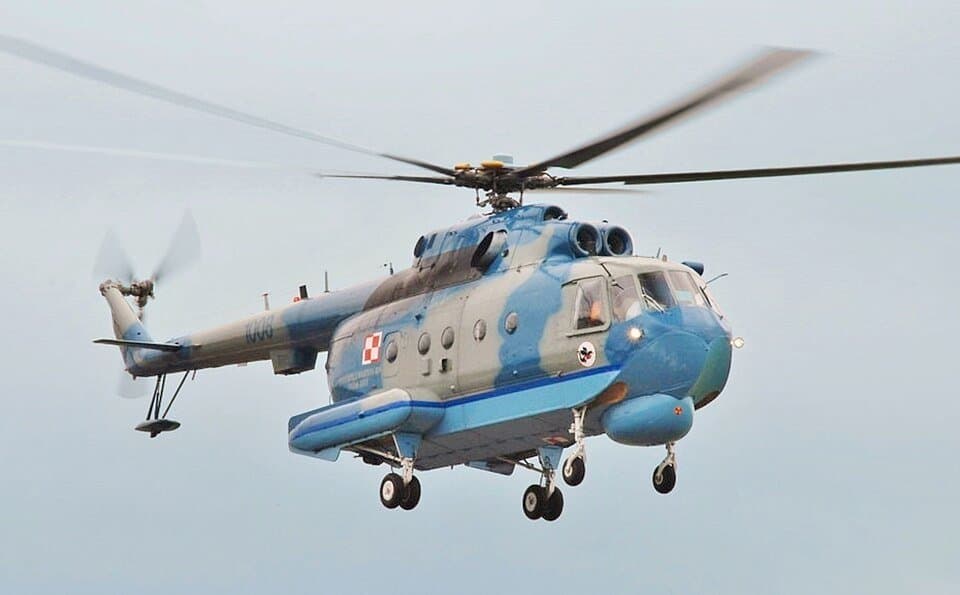
Mi-14PL · Length
Single source18.38 m (60 ft 4 in)[source]
Empty; SH-2F Seasprite · Empty weight
Single sourceMaximum take-off; SH-2F Seasprite · normal max
Single source7,040 lb (3,193 kg)[source]
12,500 lb (5,670 kg) normal max[source]
Empty; Mi-14PL · Empty weight
Single sourceMaximum take-off; Mi-14PL · Max takeoff weight
Single sourceSH-2F Seasprite · 2 × General Electric T58-GE-8F turboshaft engines, 1,350 shp ( ) each
Single source2 × General Electric T58-GE-8F turboshaft engines, 1,350 shp (1,010 kW) each[source]
Mi-14PL · 2 × Klimov TV3-117MT turboshaft engines each
Single source2 × Klimov TV3-117MT turboshaft engines, 1,454 kW (1,950 hp) each[source]
SH-2F Seasprite · 2,440 ft/min (
Single source2,440 ft/min (12.4 m/s)[source]
Bars compare reported quantities only. A larger figure does not make a system better; configurations and test conditions differ.
| Number built | 184[source] | 273[source] |
|---|
| Manufactured | 1959–1969 1971–1990s: F/G model and conversions[source] | 1969-1986[source] |
|---|
| Introduction date | December 1962[source] | 1976[source] |
|---|
| First flight | 2 July 1959 (HU2K-1)[source] | 1 August 1967[source] |
|---|
| Retired | 1993: F ( United States Navy ) 2001: G (USN) 2008: Royal Australian Navy[source] | — |
|---|
| Variant | Kaman SH-2G Super Seasprite[source] | — |
|---|
| Capacity | 1 pax with litter patient (with LAMPS installed) / 4 pax and two litter patients (with Sonobuoy launcher removed)[source] | — |
|---|
| Fuel capacity | 396 US gal (330 imp gal; 1,500 L) internal fuel tanks; 120 US gal (100 imp gal; 450 L) auxiliary external fuel tanks.[source] | — |
|---|
| Hardpoints | 2× side fuselage mounting stub/pylon stations[source] | — |
|---|
| Maximum overload take-off weight | 13,300 lb (6,000 kg)[source] | — |
|---|
| Main rotor area | 1,520.53 sq ft (141.262 m 2 ) 4-bladed main and tail rotors[source] | 356 m 2 (3,830 sq ft)[source] |
|---|
| Rotor blade section | - root: KM23014.86; tip: KM23011.47[source] | — |
|---|
| Hover ceiling IGE | 18,600 ft (5,700 m)[source] | — |
|---|
| Hover ceiling OGE | 15,400 ft (4,700 m)[source] | — |
|---|
| Missiles | Non-US aircraft carry a variety of guided missiles , including the AGM-65 Maverick (often used in the anti-ship role) and dedicated anti-ship missiles .[source] | — |
|---|
| Country of origin | United States[source] | — |
|---|
| National origin | — | Soviet Union[source] |
|---|
| Developed from | — | Mil Mi-8[source] |
|---|
| Blade section | — | NACA 23012[source] |
|---|