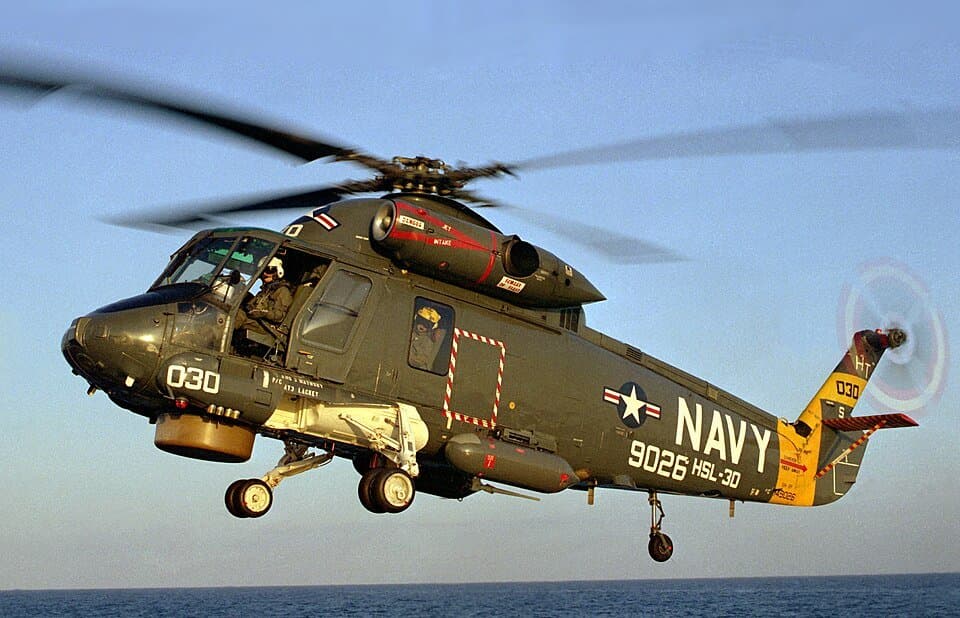

Credit
PH2 Wiggin, USN · Public domain · Resized · Public domain · Source ↗ · Modified


Preparing your view.

At a glance
True scale
Side by side. From every angle. A human reference for perspective.
3.08 MB · Loads when you open it| Model | Length | Width / span | Height |
|---|---|---|---|
| Kaman SH-2 Seasprite | ≈ 11.68 m | ≈ 9.88 m (Width) | ≈ 4.57 m |
| Kamov Ka-31 | ≈ 12.5 m | ≈ 11.65 m (Width) | ≈ 5.97 m |
Scaled uniformly to the sourced length of 11.68 m. Not an official model or a measured survey.
ForceTally · All rights reserved
Scaled uniformly to the sourced length of 12.5 m. Not an official model or a measured survey.
ForceTally · All rights reserved
The human reference is a generic 1.75 m figure. Models describe external size, not combat performance.
Measured figures
SH-2F Seasprite · nose and blades folded
Single source38 ft 4 in (11.68 m) nose and blades folded[source]
Configuration
| Specification | Kaman SH-2 Seasprite | Kamov Ka-31 |
|---|---|---|
| Type | Anti-submarine warfare helicopter[source] | Airborne early warning and control[source] |
| Manufacturer | Kaman Aircraft Corporation[source] | Kamov[source] |
| Status | Partially retired; G model in service[source] | In service, In production[source] |
| Primary users | United States Navy (historical) Royal New Zealand Air Force Polish Navy Egyptian Navy[source] | Russian Navy Indian Naval Air Arm People's Liberation Army Navy |
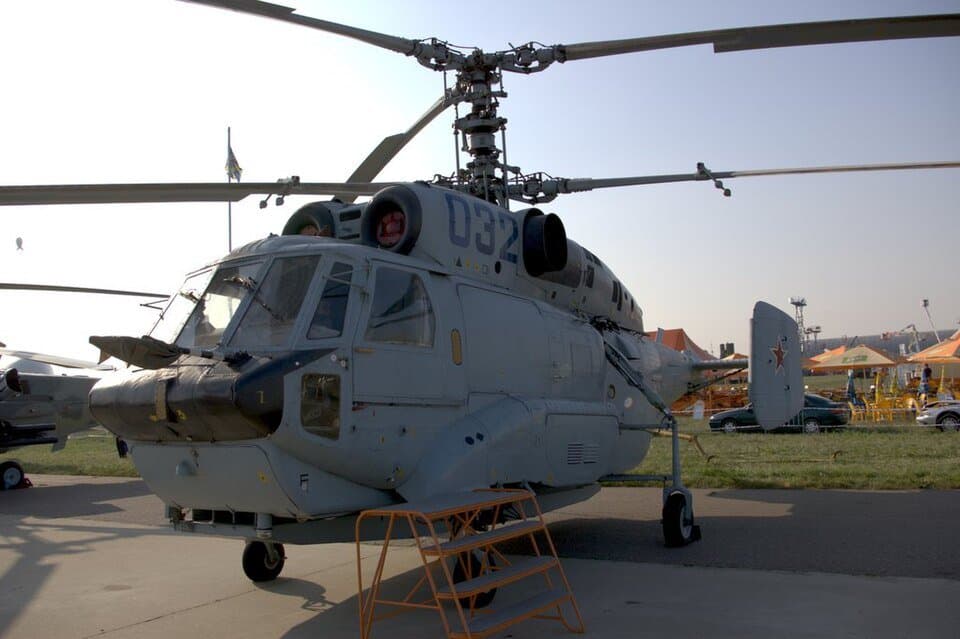
Ka-31 · rotors folded
Single source12.5 m (41 ft 0 in) rotors folded[source]
SH-2F Seasprite · to top of rotor head
Single source13 ft 7 in (4.14 m) to top of rotor head[source]
Empty; SH-2F Seasprite · Empty weight
Single sourceMaximum take-off; SH-2F Seasprite · normal max
Single source7,040 lb (3,193 kg)[source]
12,500 lb (5,670 kg) normal max[source]
Gross; Ka-31 · Gross weight
Single sourceMaximum take-off; Ka-31 Radar Picket Airborne Early Warning (AEW) Helicopter · Maximum take-off weight
Single sourceSH-2F Seasprite · (Pilot, Co-pilot/Tactical Coordinator (TACCO), Sensor Operator (SENSO))
Single source3 (Pilot, Co-pilot/Tactical Coordinator (TACCO), Sensor Operator (SENSO))[source]
Cruise; SH-2F Seasprite · Cruise speed
Single sourceMaximum; SH-2F Seasprite · at sea level
Single source143 kn (165 mph, 265 km/h) at sea level[source]
130 kn (150 mph, 240 km/h)[source]
Cruise; Ka-31 · Cruise speed
Single sourceMaximum; Ka-31 · Maximum speed
Single sourceSH-2F Seasprite · 2 × General Electric T58-GE-8F turboshaft engines, 1,350 shp ( ) each
Single source2 × General Electric T58-GE-8F turboshaft engines, 1,350 shp (1,010 kW) each[source]
Ka-31 · 2 × Isotov TV3-117VMA turboshaft engines each take-off / contingency rating
Single source2 × Isotov TV3-117VMA turboshaft engines, 1,864 kW (2,500 hp) each take-off / contingency rating[source]
SH-2F Seasprite · Service ceiling
Single source22,500 ft (6,900 m)[source]
SH-2F Seasprite · 2,440 ft/min (
Single source2,440 ft/min (12.4 m/s)[source]
Bars compare reported quantities only. A larger figure does not make a system better; configurations and test conditions differ.
| Number built | 184[source] | 28[source] |
|---|
| Manufactured | 1959–1969 1971–1990s: F/G model and conversions[source] | 1985–present[source] |
|---|
| Introduction date | December 1962[source] | 1995[source] |
|---|
| First flight | 2 July 1959 (HU2K-1)[source] | 1987[source] |
|---|
| Retired | 1993: F ( United States Navy ) 2001: G (USN) 2008: Royal Australian Navy[source] | — |
|---|
| Variant | Kaman SH-2G Super Seasprite[source] | — |
|---|
| Capacity | 1 pax with litter patient (with LAMPS installed) / 4 pax and two litter patients (with Sonobuoy launcher removed)[source] | — |
|---|
| Fuel capacity | 396 US gal (330 imp gal; 1,500 L) internal fuel tanks; 120 US gal (100 imp gal; 450 L) auxiliary external fuel tanks.[source] | — |
|---|
| Hardpoints | 2× side fuselage mounting stub/pylon stations[source] | — |
|---|
| Maximum overload take-off weight | 13,300 lb (6,000 kg)[source] | — |
|---|
| Main rotor area | 1,520.53 sq ft (141.262 m 2 ) 4-bladed main and tail rotors[source] | 397.2 m 2 (4,275 sq ft)[source] |
|---|
| Rotor blade section | - root: KM23014.86; tip: KM23011.47[source] | — |
|---|
| Hover ceiling IGE | 18,600 ft (5,700 m)[source] | — |
|---|
| Hover ceiling OGE | 15,400 ft (4,700 m)[source] | — |
|---|
| Missiles | Non-US aircraft carry a variety of guided missiles , including the AGM-65 Maverick (often used in the anti-ship role) and dedicated anti-ship missiles .[source] | — |
|---|
| Country of origin | United States[source] | Russia[source]Inventory Origin column; table 3, row 16, cell 2; revision 1376725347 |
|---|
| Developed from | — | Kamov Ka-27[source] |
|---|
| Role | — | military helicopter originally[source] |
|---|
| Source measurement | — | 16-channel digital communication gear with range up to 250 miles (400 km).[source]Kamov Ka-31 · Design and development; only the objects and conditions stated in this passage The Ka-31 is equipped with the E-801 Oko L-band radar, capable of detecting and tracking up to 40 targets simultaneously, flying from 5 to 3,500 meters altitude. The detection range is 110 km for a fighter-aircraft-sized target, and 200 km for ship-sized targets. The antenna is six meters wide and one meter high, and rotates six times per minute. The radar can work in air-to-air, air-to-sea, and "mixed" (both at the same time) modes. The landing gear is retractable, in order to avoid interfering with the radar's functioning. When not in use, the radar's antenna is retracted under the fuselage. Due to its relatively small size, the Ka-31 doesn't have the capability to process the information collected by its radar. Instead, it transfers the information to nearby ships for them to do so.[source]Kamov Ka-31 · Design and development; only the objects and conditions stated in this passage The Indian Navy ordered four Ka-31s in 1999, and a further five in 2001. The first batch of four entered service with the Indian Navy in April 2003. The second batch was delivered in 2005. Five additional Ka-31s were ordered in 2009, and they were delivered between 2011 and 2012. As of 2019, India was considering another order for 10 Ka-31s, together with the modernisation of 10 of the 14 helicopters already in service. In May 2022, the Indian government indefinitely suspended the negotiations with Rosoboronexport due to concerns over Moscow’s ability to execute orders and issues related to payment transfers.[source]Kamov Ka-31 · Operational history; only the objects and conditions stated in this passage Length: 12.5 m (41 ft 0 in) rotors folded[source]Kamov Ka-31 · Specifications (Ka-31); only the objects and conditions stated in this passage 11.25 m (37 ft) fuselage only[source]Kamov Ka-31 · Specifications (Ka-31); only the objects and conditions stated in this passage Height: 5.6 m (18 ft 4 in)[source]Kamov Ka-31 · Specifications (Ka-31); only the objects and conditions stated in this passage Gross weight: 12,500 kg (27,558 lb)[source]Kamov Ka-31 · Specifications (Ka-31); only the objects and conditions stated in this passage Powerplant: 2 × Isotov TV3-117VMA turboshaft engines, 1,864 kW (2,500 hp) each take-off / contingency rating[source]Kamov Ka-31 · Specifications (Ka-31); only the objects and conditions stated in this passage Main rotor diameter: 2 × 15.9 m (52 ft 2 in)[source]Kamov Ka-31 · Specifications (Ka-31); only the objects and conditions stated in this passage Main rotor area: 397.2 m 2 (4,275 sq ft)[source]Kamov Ka-31 · Specifications (Ka-31); only the objects and conditions stated in this passage Maximum speed: 250 km/h (160 mph, 130 kn)[source]Kamov Ka-31 · Specifications (Ka-31); only the objects and conditions stated in this passage Cruise speed: 205 km/h (127 mph, 111 kn)[source]Kamov Ka-31 · Specifications (Ka-31); only the objects and conditions stated in this passage Range: 600 km (370 mi, 320 nmi) max. fuel with radar antenna stowed[source]Kamov Ka-31 · Specifications (Ka-31); only the objects and conditions stated in this passage Endurance: 2 hours 30 minutes on-station loiter at 3,500 m (11,500 ft)[source]Kamov Ka-31 · Specifications (Ka-31); only the objects and conditions stated in this passage |
|---|
| Overall length | — | 12.5m[source]Ka-31 Radar Picket Airborne Early Warning (AEW) Helicopter |
|---|
12,500 kg (27,558 lb)[source]
12,200kg[source]Ka-31 Radar Picket Airborne Early Warning (AEW) Helicopter
Maximum; Ka-31 Radar Picket Airborne Early Warning (AEW) Helicopter · Maximum speed
Single source