Credit
André Völzke · CC BY-SA 3.0 · Resized · CC BY-SA 3.0 · Source ↗ · Modified


Preparing your view.

At a glance
Measured figures
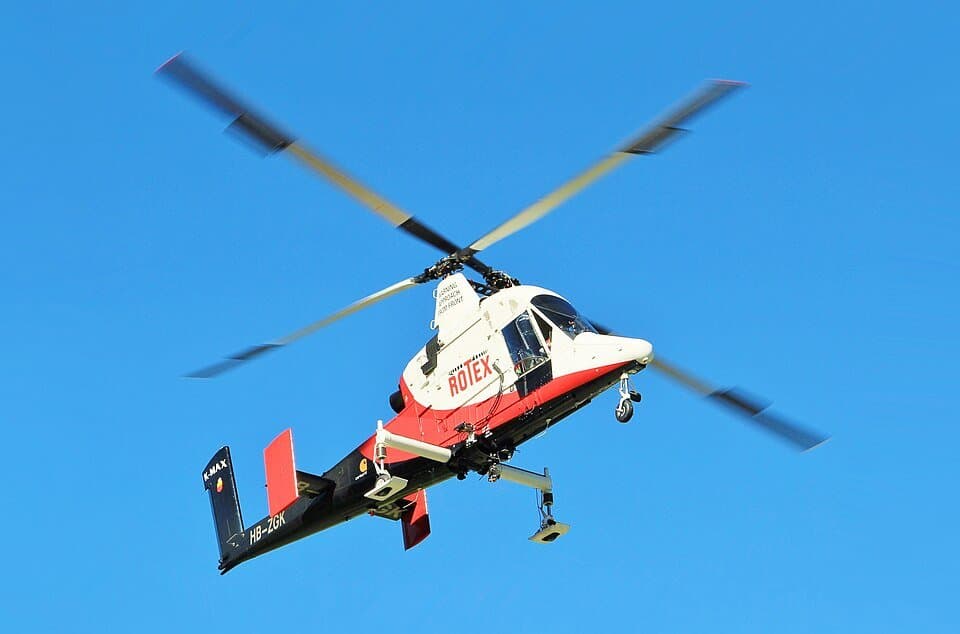
K-MAX · rotors running
Single source52 ft (16 m) rotors running[source]
Configuration
| Specification | Kaman K-MAX | Sikorsky MH-60 Jayhawk |
|---|---|---|
| Type | Medium lift helicopter[source] | Medium-range recovery helicopter[source] |
| Manufacturer | Kaman Aircraft[source] | Sikorsky Aircraft[source] |
| Status | Production ended, in service[source] | In service[source] |
| Manufactured | 1991–2003, 2015–2023[source] | 1990–1996 |
HH-60J · Length
64 ft 10 in (19.76 m)[source]
K-MAX · with rotors running
Single source51 ft 5 in (15.67 m) with rotors running[source]
HH-60J · Wingspan
Single source53 ft 8 in (16.36 m)[source]
Empty; K-MAX · Empty weight
Single sourceMaximum take-off; K-MAX · without slung load
Single source5,145 lb (2,334 kg)[source]
6,500 lb (2,948 kg) without slung load[source]
Empty; HH-60J · Empty weight
Single sourceMaximum take-off; HH-60J · Max takeoff weight
Single sourceMaximum; K-MAX commercial · With external load · 148.2 kph · MAXIMUM AIRSPEED · With external load
Manufacturer claimMaximum; K-MAX commercial · Without external load · 185.2 kph · MAXIMUM AIRSPEED · Without external load
Manufacturer claim100 kt 185.2 kph[source]K-MAX commercial · Without external load
80 kt 148.2 kph[source]K-MAX commercial · With external load
Cruise; HH-60J · Cruise speed
Single sourceMaximum; HH-60J · Maximum speed
Single sourceK-MAX · 1 × Honeywell T5317A-1 turboshaft engine, 1,350 shp ( ) flat rated for take-off up to ~29,000 ft (8,839 m) to increase transmission life
Single source1 × Honeywell T5317A-1 turboshaft engine, 1,350 shp (1,010 kW) flat rated for take-off up to ~29,000 ft (8,839 m) to increase transmission life[source]
HH-60J · 2 × General Electric T700 -GE-401C gas turbines, 1,890 shp ( ) each
Single source2 × General Electric T700 -GE-401C gas turbines, 1,890 shp (1,410 kW) each[source]
K-MAX · 2,500 ft/min ( ) at Sea Level with flat-rated torque
Single source2,500 ft/min (13 m/s) at Sea Level with flat-rated torque[source]
Bars compare reported quantities only. A larger figure does not make a system better; configurations and test conditions differ.
| First flight | December 23, 1991[source] | 8 August 1989[source] |
|---|
| Fuel capacity | 1,541 lb (699 kg) / 228.5 US gal (190 imp gal; 865 L)[source] | — |
|---|
| Length of fuselage | 41 ft 9 in (12.73 m)[source] | — |
|---|
| Main rotor area | 3,669 sq ft (340.9 m 2 )[source] | — |
|---|
| Blade section | - root: NACA 23012 ; tip: NACA 23011[source] | — |
|---|
| Never exceed speed | 100 kn (120 mph, 190 km/h) clean[source] | — |
|---|
| Hover ceiling IGE | 26,300 ft (8,016 m) at 6,000 lb (2,722 kg) AUW, ISA[source] | — |
|---|
| Disk loading | 3.52 lb/sq ft (17.2 kg/m 2 )[source] | — |
|---|
| Power/mass | 0.1045 hp/lb (0.1718 kW/kg)[source] | — |
|---|
| Fuel consumption | 85 gal/h (71 imp gal/h; 322 L/h)[source] | — |
|---|
| Capacity | 6,000 lb (2,722 kg) external load at ISA +15 °C (59.0 °F) at sea level 5,663 lb (2,569 kg) external load at ISA +15 °C (59.0 °F) at 5,000 ft (1,524 m) 5,163 lb (2,342 kg) external load at ISA +15 °C (59.0 °F) at 10,000 ft (3,048 m) 5,013 lb (2,274 kg) external load at ISA +15 °C (59.0 °F) at 12,100 ft (3,688 m) 4,313 lb (1,956 kg) external load at ISA +15 °C (59.0 °F) at 15,000 ft (4,572 m)[source] | — |
|---|
| Role | helicopter[source] | multi-mission, twin-engine, medium-range helicopter[source] |
|---|
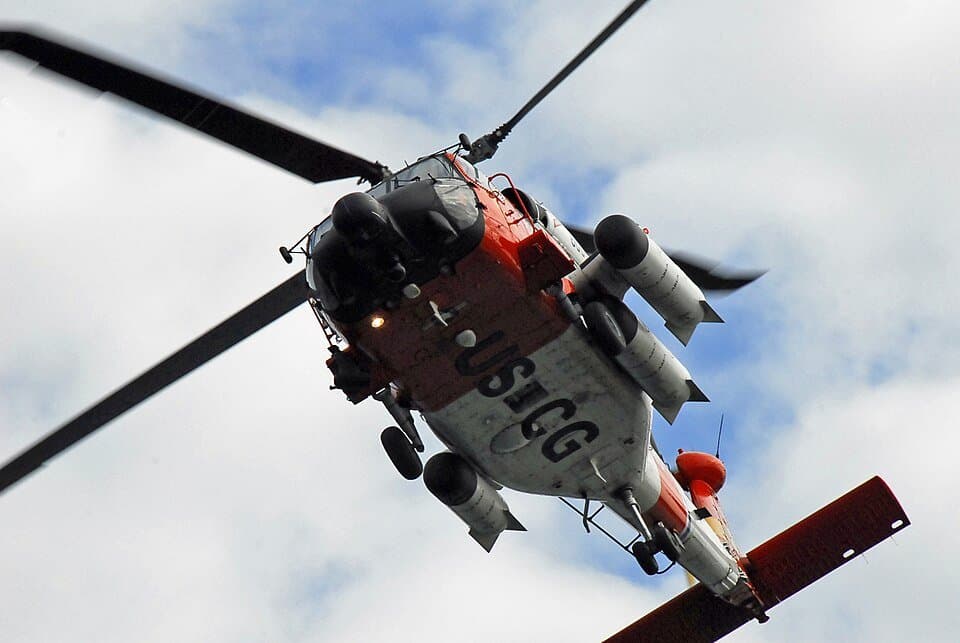
| Source measurement | Developed in the 1980s and 1990s, the K-MAX builds on the work of the German aeronautical engineer Anton Flettner . It was designed for external cargo load operations; later configurations supported aerial firefighting and casualty evacuation . It can lift more than 6,000 pounds (2,700 kg), which is greater than the helicopter's empty weight and almost twice as much as the competing Bell 205 despite sharing a similar engine.[source]Kaman K-MAX · Lead; only the objects and conditions stated in this passage The K-MAX can lift 6,000 lb (2,700 kg), almost twice as much as the Bell 205 using a different version of the same engine. The aircraft's narrow, wedge-shaped profile and bulging side windows give the pilot a good view of the load looking down&out from either side of the aircraft, with the most important flight instruments duplicated on the outside of the aircraft, near the pilot's line of sight straight down to the load. The cargo hook slides freely on a curved bearing under the helicopter's center of gravity , improving cargo handling during flight. The seat is FAA crashworthiness approved.[source]Kaman K-MAX · Development / Design; only the objects and conditions stated in this passage The transmission has a reduction ratio of 24.3:1 in three stages, and is designed for unlimited life. The two rotor masts are set at an angle of 25 degrees apart to allow the rotors to intermesh with each other. The masts transfer rotation from the transmission to the rotor blades. The rotor blades (which turn in opposite directions at 250—270 rpm) are built with a Sitka spruce wooden spar and Nomex honeycomb trailing edge sections. Wood was chosen for its damage tolerance and fatigue resistance; and to take advantage of field experience and qualification data amassed from a similar spar on the HH-43 Huskie helicopter, built for the U.S. Air Force in the 1950s and 1960s. The pilot controls the blade pitch via steel tubes running inside the mast and rotor blades to move servo flaps that pitch the blades, reducing required force and avoiding the added weight, cost and maintenance of hydraulic controls . Due to the rotor principle, the helicopter is operated slightly differently compared to regular helicopters, and pilots go through a flight training program in an HH-43 Huskie.[source]Kaman K-MAX · Development / Design; only the objects and conditions stated in this passage During February 2014, Kaman stated that it was looking into resuming K-MAX production, having recently received over 20 inquiries for firefighting, logging and industry transport requirements as well as requests for the military unmanned version. Ten firm orders convinced Kaman to put the design back into production again. By 2014, the K-MAX fleet had cumulatively flown 300,000 hours and cost $1,200 per flight hour to operate.[source]Kaman K-MAX · Development / Second production run; only the objects and conditions stated in this passage At Heli-Expo 2015 in Orlando, Kaman reported it was continuing to progress towards reopening the production line. Following the receipt of multiple customer deposits, the assembly line was restarted in January 2017. On 12 May 2017, Kaman test flew the first K-MAX to be produced since 2003; on 13 July 2017, it was delivered to Kaman's Chinese sales agent Lectern Aviation, which delivered it onwards to Guangdong Juxiang General Aviation, Guangdong Province for firefighting with the second to be delivered the following week.[source]Kaman K-MAX · Development / Second production run; only the objects and conditions stated in this passage During 2008, a single K-MAX was used for demolition work, having been outfitted with a 1,400 kg (3,000 lb) wrecking ball as a slung load .[source]Kaman K-MAX · Operational history; only the objects and conditions stated in this passage In December 2011, an unmanned K-MAX was reported to be at work in Afghanistan. On 17 December 2011, the U. S. Marine Corps conducted the first unmanned aerial system cargo delivery in a combat zone using the unmanned K-MAX, moving about 3,500 pounds (1,600 kg) of food and supplies to troops at Combat Outpost Payne. A third unmanned K-MAX in the U.S. was tested in 2012 to deliver cargo to a small homing beacon to achieve three-meter precision. By February 2013, the K-MAX had delivered two million pounds (910 metric tons) of cargo across 600 unmanned missions, during which in excess of 700 flight hours had been recorded.[source]Kaman K-MAX · Operational history; only the objects and conditions stated in this passage On July 31, 2012, Lockheed announced a second service extension for the K-MAX in Afghanistan to support the Marine Corps; on 18 March 2013, the Marine Corps announced the indefinite extension of its use of the unmanned K-MAX helicopters, stating that it would keep the two aircraft in use "until otherwise directed". At the time of the announcement, they had flown over 1,000 missions and hauled over three million pounds (1,400 metric tons) of supplies; assessments for their use after the deployment were also being studied. The unmanned K-MAX has won awards from Popular Science and Aviation Week & Space Technology , and was nominated for the 2012 Collier Trophy .[source]Kaman K-MAX · Operational history; only the objects and conditions stated in this passage Operators employed a weathervane effect to try to regain control, but its 2,000 lb (910 kg) load began to swing, which exacerbated the effect and caused it to contact the ground.[source]Kaman K-MAX · Operational history; only the objects and conditions stated in this passage In theater, the rotorcraft performed most missions at night and successfully lifted loads of up to 4,500 lb (2,000 kg).[source]Kaman K-MAX · Operational history; only the objects and conditions stated in this passage The unmanned K-MAX was successfully able to deliver 30,000 lb (14,000 kg) of cargo in one day over the course of six missions (average 5,000 lb (2,300 kg) transported cargo per mission).[source]Kaman K-MAX · Operational history; only the objects and conditions stated in this passage After deploying in December 2011, originally planned for six months, they operated in the region for almost three years and lifted 2,250 tons of cargo.[source]Kaman K-MAX · Operational history; only the objects and conditions stated in this passage During November 2014, Lockheed Martin demonstrated a fire fighting version, another demonstration was performed in October 2015, in which the K-MAX delivered over 24,000 pounds (11,000 kg) of water in one hour. In March 2015, a casualty evacuation exercise was performed in coordination with an unmanned ground vehicle (UGV) and mission planning system. A medic launched the UGV to evaluate the casualty, used a tablet to call in and automatically land the K-MAX, then strapped a mannequin to a seat aboard the helicopter.[source]Kaman K-MAX · Operational history; only the objects and conditions stated in this passage By January 2015, 11 K-MAX helicopters were reportedly no longer airworthy, some of which had been written off in accidents. Furthermore, an additional five were in storage at Kaman. By March 2015, the number of operational K-MAXs was reportedly 21, having flown a total of 315,000 hours among 250 pilots. Despite production of the type having been discontinued in 2023, Kaman pledged that it would continued to support the existing K-Max fleet in operation, which includes the provision of spare parts, servicing, training, and repairs to operators for the foreseeable future.[source]Kaman K-MAX · Operational history; only the objects and conditions stated in this passage Length: 52 ft (16 m) rotors running[source]Kaman K-MAX · Specifications (K-MAX); only the objects and conditions stated in this passage Length of fuselage: 41 ft 9 in (12.73 m)[source]Kaman K-MAX · Specifications (K-MAX); only the objects and conditions stated in this passage Width: 51 ft 5 in (15.67 m) with rotors running[source]Kaman K-MAX · Specifications (K-MAX); only the objects and conditions stated in this passage Height: 13 ft 7 in (4.14 m) to centreof hubs[source]Kaman K-MAX · Specifications (K-MAX); only the objects and conditions stated in this passage Empty weight: 5,145 lb (2,334 kg)[source]Kaman K-MAX · Specifications (K-MAX); only the objects and conditions stated in this passage Max takeoff weight: 6,500 lb (2,948 kg) without slung load[source]Kaman K-MAX · Specifications (K-MAX); only the objects and conditions stated in this passage 12,000 lb (5,443 kg) with jettisonable slung load[source]Kaman K-MAX · Specifications (K-MAX); only the objects and conditions stated in this passage Fuel capacity: 1,541 lb (699 kg) / 228.5 US gal (190 imp gal; 865 L)[source]Kaman K-MAX · Specifications (K-MAX); only the objects and conditions stated in this passage Powerplant: 1 × Honeywell T5317A-1 turboshaft engine, 1,350 shp (1,010 kW) flat rated for take-off up to ~29,000 ft (8,839 m) to increase transmission life[source]Kaman K-MAX · Specifications (K-MAX); only the objects and conditions stated in this passage Transmission rated to 1,500 shp (1,119 kW)[source]Kaman K-MAX · Specifications (K-MAX); only the objects and conditions stated in this passage Main rotor diameter: 2 × 48 ft 4 in (14.73 m)[source]Kaman K-MAX · Specifications (K-MAX); only the objects and conditions stated in this passage Main rotor area: 3,669 sq ft (340.9 m 2 )[source]Kaman K-MAX · Specifications (K-MAX); only the objects and conditions stated in this passage Never exceed speed : 100 kn (120 mph, 190 km/h) clean[source]Kaman K-MAX · Specifications (K-MAX); only the objects and conditions stated in this passage 80 kn (92 mph; 148 km/h) with external load[source]Kaman K-MAX · Specifications (K-MAX); only the objects and conditions stated in this passage Range: 300 nmi (350 mi, 560 km) with max load[source]Kaman K-MAX · Specifications (K-MAX); only the objects and conditions stated in this passage Service ceiling: 15,000 ft (4,600 m)[source]Kaman K-MAX · Specifications (K-MAX); only the objects and conditions stated in this passage Hover ceiling IGE: 26,300 ft (8,016 m) at 6,000 lb (2,722 kg) AUW, ISA[source]Kaman K-MAX · Specifications (K-MAX); only the objects and conditions stated in this passage Rate of climb: 2,500 ft/min (13 m/s) at Sea Level with flat-rated torque[source]Kaman K-MAX · Specifications (K-MAX); only the objects and conditions stated in this passage | Chosen to replace the HH-3F Pelican , the HH-60J was based on the United States Navy's SH-60 Seahawk and a member of the Sikorsky S-70 helicopter family. Compared to its predecessor the HH-3F, the HH-60J is lighter, faster, and equipped with more sophisticated electronics and more powerful engines. The HH-60J was developed in conjunction with the U.S. Navy's HH-60H Rescue Hawk .[source]Sikorsky MH-60 Jayhawk · Development; only the objects and conditions stated in this passage The normal cruising speed of the MH-60T is 135 to 140 kn (155 to 161 mph; 250 to 259 km/h) and the aircraft is capable of reaching 180 kn (207 mph; 333 km/h) for short durations. It can fly at 140 kn (161 mph; 259 km/h) for six to seven hours. With a fuel capacity of 6,460 lb (2,930 kg), the helicopter is designed to fly a crew of four up to 260 nmi (482 km) offshore, hoist up to six additional people on board while remaining on-scene for up to 45 minutes and return to base while maintaining an adequate fuel reserve.[source]Sikorsky MH-60 Jayhawk · Design; only the objects and conditions stated in this passage The Jayhawk has a radar for search/weather that gives its nose a distinctive look. A forward looking infrared (FLIR) sensor turret can be mounted below its nose. It can carry three 120 US gal (454 L) fuel tanks with two on the port side rack and one on the starboard side rack. The starboard side also carries a 600 lbf (2.67 kN) capacity rescue hoist mounted above the door. The hoist has 200 ft (61.0 m) of cable. The helicopter is normally based on land but can be based on 270 foot medium endurance Coast Guard Cutters (WMEC) or 418 foot Legend-Class National Security Cutters (WMSL) .[source]Sikorsky MH-60 Jayhawk · Design; only the objects and conditions stated in this passage The MH-60T is equipped with a 7.62 mm M240H medium machine gun and a .50 in Barrett M82 semi-automatic rifle for firing warning and disabling shots. These weapons also serve as defensive armament.[source] |
|---|
| Country of origin | American[source]Kaman K-MAX — original design/development; separate from operator or construction location | United States[source] United States[source] United States[source] United States[source] United States[source] |
|---|
| Primary user | — | United States Coast Guard[source] |
|---|
| Number built | — | 42 (+ 6 conversions)[source] |
|---|
| Developed from | — | Sikorsky SH-60 Seahawk[source] |
|---|
In 1990, HH-60J Jayhawks began replacing HH-3F Pelican and CH-3E Sea King helicopters in service with the US Coast Guard. HH-60Js perform search and rescue missions, along with other missions such as maritime patrol and drug interdiction. Coast Guard cutters with their HH-60Js and other helicopters performed security and interdiction in the Persian Gulf in 1991 in support of Operation Desert Storm and also in 2003 for Operation Enduring Freedom .[source]Sikorsky MH-60 Jayhawk · Operational history; only the objects and conditions stated in this passage
Medium range recovery helicopter. Thirty-nine surviving HH-60J airframes received upgraded avionics and operational capabilities, including armament, from 2007 to 2014. Six SH-60Fs have also been converted to MH-60T specifications. Forty-five were active as of March 2024. A Service Life Extension Program began in 2017 to provide 12,000 to 20,000 hours of available service life to each aircraft. In 2023, the Coast Guard received approval to transition to an all MH-60T rotary fleet and grow that fleet to 127 aircraft.[source]Sikorsky MH-60 Jayhawk · Variants; only the objects and conditions stated in this passage
Length: 64 ft 10 in (19.76 m)[source]Sikorsky MH-60 Jayhawk · Specifications (HH-60J); only the objects and conditions stated in this passage
Wingspan: 53 ft 8 in (16.36 m)[source]Sikorsky MH-60 Jayhawk · Specifications (HH-60J); only the objects and conditions stated in this passage
Height: 17 ft 0 in (5.18 m)[source]Sikorsky MH-60 Jayhawk · Specifications (HH-60J); only the objects and conditions stated in this passage
Empty weight: 14,500 lb (6,580 kg)[source]Sikorsky MH-60 Jayhawk · Specifications (HH-60J); only the objects and conditions stated in this passage
Max takeoff weight: 21,884 lb (9,926 kg)[source]Sikorsky MH-60 Jayhawk · Specifications (HH-60J); only the objects and conditions stated in this passage
Powerplant: 2 × General Electric T700 -GE-401C gas turbines, 1,890 shp (1,410 kW) each[source]Sikorsky MH-60 Jayhawk · Specifications (HH-60J); only the objects and conditions stated in this passage
Maximum speed: 205 mph (333 km/h, 180 kn)[source]Sikorsky MH-60 Jayhawk · Specifications (HH-60J); only the objects and conditions stated in this passage
Cruise speed: 160 mph (260 km/h, 140 kn)[source]Sikorsky MH-60 Jayhawk · Specifications (HH-60J); only the objects and conditions stated in this passage
Range: 802 mi (1,300 km, 700 nmi)[source]Sikorsky MH-60 Jayhawk · Specifications (HH-60J); only the objects and conditions stated in this passage
Service ceiling: 5,000 ft (1,520 m) hovering[source]Sikorsky MH-60 Jayhawk · Specifications (HH-60J); only the objects and conditions stated in this passage
1 × 0.308 in ( 7.62×51 mm ) M240H medium machine gun in starboard door (MH-60T)[source]Sikorsky MH-60 Jayhawk · Specifications (HH-60J); only the objects and conditions stated in this passage
1 × 0.50 in (12.7×99 mm) Barrett M82 semi-automatic rifle (MH-60T)[source]Sikorsky MH-60 Jayhawk · Specifications (HH-60J); only the objects and conditions stated in this passage