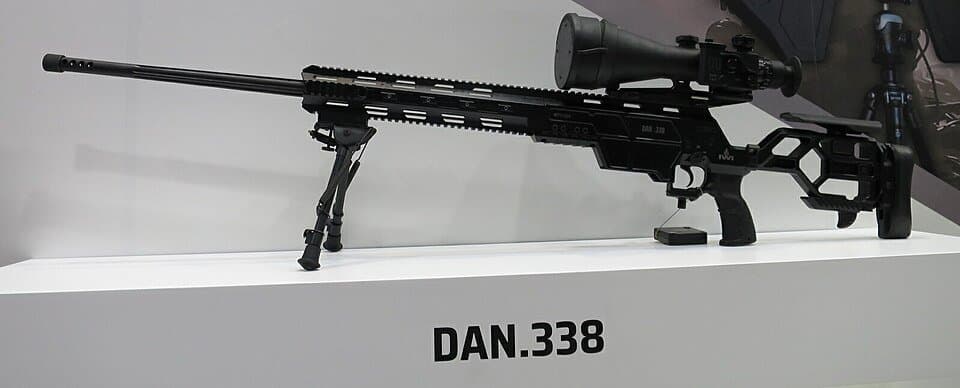

Credit
Mztourist · CC BY-SA 4.0 · Resized · CC BY-SA 4.0 · Source ↗ · Modified


Preparing your view.
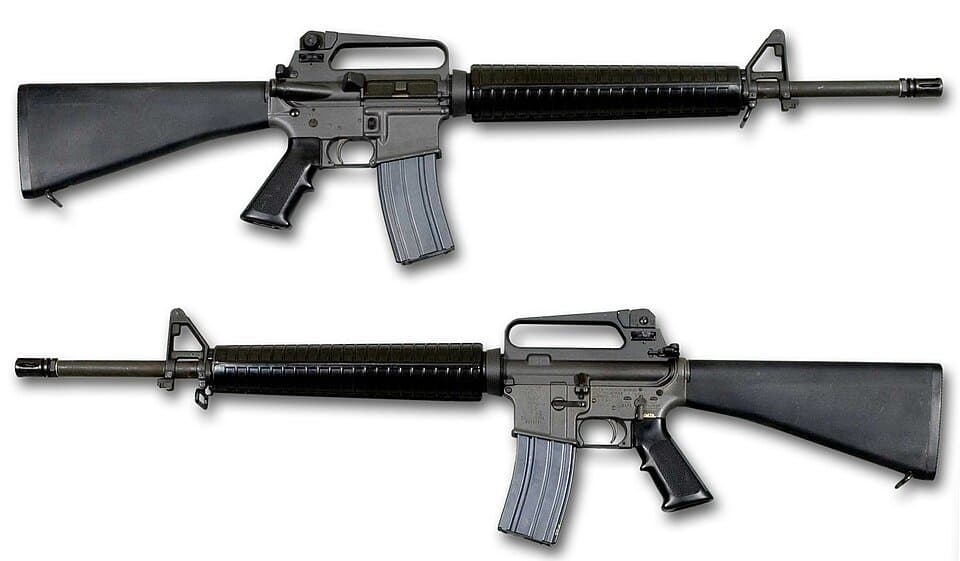

At a glance
IWI Danlarger figure on 1 of 1
M16 riflelarger figure on 0 of 1
Counts only measures both sources give with the same scope. A larger figure is not a better system.
Measured figures
Length
Single sourcestock folded
Single sourceConfiguration
| Specification | IWI Dan | M16 rifle |
|---|---|---|
| Type | Sniper rifle[source] | Assault rifle[source] |
| Place of origin | Israel[source] | United States[source] |
| Designer | Nehemia Sirkis[source] | Eugene Stoner ( AR-10 ) L. James Sullivan ( AR-15 )[source] |
| Manufacturer | Israel Weapon Industries[source] | Colt's Manufacturing Company FN Herstal General Motors ( Hydramatic Division) Harrington & Richardson Remington U.S. Ordnance Chartered Industries of Singapore Diemaco Elisco Tool Manufacturing Company Ministry of Defense Arsenal |
1,280 mm (50.4 in) 1,030 mm (40.6 in) stock folded[source]
M16A1
Single sourceM16A2
Single sourceM16A4
Single source38.81 in (986 mm) (M16A1) 39.63 in (1,007 mm) (M16A2) 39.37 in (1,000 mm) (M16A4)[source]
folding stock version
Single sourceMass
Single source5.9 kg (13.01 lb) 7.3 kg (16 lb) folding stock version[source]
M16A2 without magazine and sling
Single sourceM16A4
Single sourcecyclic sustained (M16A1)
Single sourcecyclic sustained (M16A2, M16A3)
Single sourcecyclic sustained (M16A4)
Single source700–800 rounds/min cyclic sustained (M16A1) 700–900 rounds/min cyclic sustained (M16A2, M16A3) 800 rounds/min cyclic sustained (M16A4)[source]
Bars compare reported quantities only. A larger figure does not make a system better; configurations and test conditions differ.
| Unit cost | $9,000[source] | — |
|---|
| Produced | 2014–present[source] | November 1963–present[source] |
|---|
| Cartridge | .338 Lapua Magnum[source] | 5.56×45mm NATO[source] |
|---|
| Action | Bolt-action[source] | Gas-operated , closed rotating bolt , Stoner bolt and carrier piston[source] |
|---|
| Feed system | 10-round detachable box magazine[source] | STANAG magazine 20-round detachable box magazine 30-round detachable box magazine 40-round detachable box magazine 60-round detachable box magazine Beta C-Mag 100-round drum magazine[source] |
|---|
| Sights | day or night optical sights back-up iron sights[source] | Iron sights : Rear: aperture; L-type flip Front: wing-protected post Various aiming optics[source] |
|---|
| In service | — | 1964–present[source] |
|---|
| Used by | — | See Users[source] |
|---|
| Wars | — | See Conflicts[source] |
|---|
| Designed | — | 1959[source] |
|---|
| No. built | — | ~8 million ~28 million AR-15–style rifles[source] |
|---|
| Variants | — | See List of Colt AR-15 and M16 rifle variants[source] |
|---|
| Role | — | family of assault rifles adapted[source] |
|---|
| Source measurement | — | The M16 rifle (officially designated Rifle, Caliber 5.56mm, M16 ) is a family of assault rifles adapted from the ArmaLite AR-15 rifle for the United States military . The original M16 rifle was a 5.56×45mm automatic rifle with a 20-round magazine .[source]M16 rifle · Lead; only the objects and conditions stated in this passage In 1983, the United States Marine Corps adopted the M16A2 rifle, and the US Army adopted it in 1986. The M16A2 fires the improved 5.56×45mm (M855/SS109) cartridge and has a newer adjustable rear sight, case deflector, heavy barrel, improved handguard , pistol grip, and buttstock , as well as a semi-auto and three-round burst fire selector. Adopted in July 1997, the M16A4 is the fourth generation of the M16 series. It is equipped with a removable carrying handle and quad Picatinny rail for mounting optics and other ancillary devices.[source]M16 rifle · Lead; only the objects and conditions stated in this passage The M16 has also been widely adopted by other armed forces around the world. Total worldwide production of M16s is approximately eight million, making it the most-produced firearm of its 5.56mm caliber. The US military has largely replaced the M16 in frontline combat units with a shorter and lighter version, the M4 carbine . In April 2022, the U.S. Army selected the SIG MCX SPEAR as the winner of the Next Generation Squad Weapon Program to replace the M16/M4. The new rifle is designated M7 .[source]M16 rifle · Lead; only the objects and conditions stated in this passage In 1928, a U.S. Army 'Caliber Board' conducted firing tests at Aberdeen Proving Ground and recommended transitioning to smaller caliber rounds, mentioning, in particular .27 in (6.86 mm) caliber . Largely in deference to tradition, this recommendation was ignored and the Army referred to the .30 in (7.62 mm) caliber as "full-sized" for the next 35 years. After World War II, the United States military started looking for a single automatic rifle to replace the M1 Garand , M1/M2 carbines , M1918 Browning automatic rifle , M3 "Grease Gun" and Thompson submachine gun . However, early experiments with select-fire versions of the M1 Garand proved disappointing. During the Korean War , the select-fire M2 carbine largely replaced the submachine gun in US service and became the most widely used carbine variant. However, combat experience suggested that the .30 carbine round was underpowered. American weapons designers concluded that an intermediate round was necessary, and recommended a small-caliber, high-velocity cartridge.[source]M16 rifle · History / Background; only the objects and conditions stated in this passage However, senior American commanders, having faced fanatical enemies and experienced major logistical problems during World War II and the Korean War , insisted that a single, powerful .30 caliber cartridge be developed, that could not only be used by the new automatic rifle but by the new general-purpose machine gun ( GPMG ) in concurrent development. This culminated in the development of the 7.62×51mm NATO cartridge.[source]M16 rifle · History / Background; only the objects and conditions stated in this passage Springfield Armory's T44E4 and heavier T44E5 were essentially updated versions of the M1 chambered for the new 7.62mm round, while Fabrique Nationale submitted their FN FAL as the T48 .[source]M16 rifle · History / Background; only the objects and conditions stated in this passage For a 7.62mm NATO rifle, the AR-10 was incredibly lightweight at only 6.85 lb (3.11 kg) empty.[source]M16 rifle · History / Background; only the objects and conditions stated in this passage As a result, the Army was forced to reconsider a 1957 request by General Willard G. Wyman , commander of the U.S. Continental Army Command (CONARC), to develop a . 223-inch caliber (5.56mm) select-fire rifle weighing 6 lb (2.7 kg) when loaded with a 20-round magazine. The 5.56mm round had to penetrate a standard U.S. helmet at 500 yards (460 meters) and retain a velocity over the speed of sound while matching or exceeding the wounding ability of the .30 carbine cartridge.[source]M16 rifle · History / Background; only the objects and conditions stated in this passage Advocates for the AR-15 in the Defense Advanced Research Projects Agency acquired 1,000 Air Force AR-15s and shipped them to be tested by the Army of the Republic of Vietnam (ARVN).[source]M16 rifle · History / Background; only the objects and conditions stated in this passage Despite its early failures the M16 proved to be a revolutionary design and stands as the longest continuously serving rifle in US military history. It has been adopted by many US allies and the 5.56×45mm NATO cartridge has become not only the NATO standard but "the standard assault-rifle cartridge in much of the world". It also led to the development of small-caliber high-velocity service rifles by every major army in the world. It is a benchmark against which other assault rifles are judged.[source]M16 rifle · History / Background; only the objects and conditions stated in this passage In July 1960, General Curtis LeMay was impressed by a demonstration of the ArmaLite AR-15. In the summer of 1961, General LeMay was promoted to U.S. Air Force chief of staff and requested 80,000 AR-15s. However, General Maxwell D. Taylor , chairman of the Joint Chiefs of Staff , advised President John F. Kennedy that having two different calibers within the military system at the same time would be problematic and the request was rejected. In October 1961, William Godel, a senior man at the Advanced Research Projects Agency , sent 10 AR-15s to South Vietnam. The reception was enthusiastic, and in 1962 another 1,000 AR-15s were sent. United States Army Special Forces personnel filed battlefield reports lavishly praising the AR-15 and the stopping power of the 5.56 mm cartridge and pressed for its adoption.[source]M16 rifle · History / Adoption; only the objects and conditions stated in this passage The damage caused by the 5.56 mm bullet was originally believed to be caused by "tumbling" due to the slow 1 turn in 14-inch (360 mm) rifling twist rate. However, any pointed lead core bullet will "tumble" after penetration into flesh, because the center of gravity is towards the rear of the bullet. The large wounds observed by soldiers in Vietnam were caused by bullet fragmentation created by a combination of the bullet's velocity and construction. These wounds were so devastating that the photographs remained classified into the 1980s.[source]M16 rifle · History / Adoption; only the objects and conditions stated in this passage After modifications (most notably, the charging handle was re-located from under the carrying handle like the AR-10, to the rear of the receiver), the newly redesigned rifle was renamed the Rifle, Caliber 5.56 mm, M16 . Inexplicably, the modification to the new M16 did not include a chrome-plated barrel. Meanwhile, the Army relented and recommended the adoption of the M16 for jungle warfare operations. However, the Army insisted on the inclusion of a forward assist to help push the bolt into battery if a cartridge failed to seat into the chamber. The Air Force, Colt, and Eugene Stoner believed that the addition of a forward assist was an unjustified expense. As a result, the design was split into two variants: the Air Force's M16 without the forward assist, and the XM16E1 with the forward assist for the other service branches.[source]M16 rifle · History / Adoption; only the objects and conditions stated in this passage In 1964, the Army was informed that DuPont could not mass-produce the IMR 4475 stick powder to the specifications demanded by the M16. Therefore, Olin Mathieson Company provided a high-performance ball propellant . While the Olin WC 846 powder achieved the desired 3,300 ft (1,000 m) per second muzzle velocity, it produced much more fouling, which quickly jammed the M16's action (unless the rifle was cleaned well and often).[source]M16 rifle · History / Adoption; only the objects and conditions stated in this passage The M16 and 5.56×45mm cartridge was tested and approved with the use of a DuPont IMR8208M extruded powder , which was switched to Olin Mathieson WC846 ball powder which produced much more fouling, which quickly jammed the action of the M16 (unless the gun was cleaned well and often).[source]M16 rifle · Reliability; only the objects and conditions stated in this passage After the introduction of the M4 carbine, it was found that the shorter barrel length of 14.5 inches also harms the reliability, as the gas port is located closer to the chamber than the gas port of the standard length M16 rifle: 7.5 inches instead of 13 inches. This affects the M4's timing and increases the amount of stress and heat on the critical components, thereby reducing reliability. In a 2002 assessment, the USMC found that the M4 malfunctioned three times more often than the M16A4 (the M4 failed 186 times for 69,000 rounds fired, while the M16A4 failed 61 times). Thereafter, the Army and Colt worked to make modifications to the M4s and M16A4s to address the problems found. In tests conducted in 2005 and 2006 the Army found that on average, the new M4s and M16s fired approximately 5,000 rounds between stoppages.[source]M16 rifle · Reliability; only the objects and conditions stated in this passage The CNA conducted surveys on 2,608 troops returning from combat in Iraq and Afghanistan over the past 12 months.[source]M16 rifle · Reliability; only the objects and conditions stated in this passage Only troops who had fired their weapons at enemy targets were allowed to participate. 1,188 troops were armed with M16A2 or A4 rifles, making up 46 percent of the survey. 75 percent of M16 users (891 troops) reported they were satisfied with the weapon. 60 percent (713 troops) were satisfied with handling qualities such as handguards, size, and weight.[source]M16 rifle · Reliability; only the objects and conditions stated in this passage Only 19 percent of M16 users (226 troops) reported a stoppage, while 80 percent of those that experienced a stoppage said it had little effect on their ability to clear the stoppage and re-engage their target.[source]M16 rifle · Reliability; only the objects and conditions stated in this passage Half of the M16 users experienced failures in their magazines to feed. 83 percent (986 troops) did not need their rifles repaired while in the theater. 71 percent (843 troops) were confident in the M16's reliability, defined as a level of soldier confidence their weapon will fire without malfunction, and 72 percent (855 troops) were confident in its durability, defined as a level of soldier confidence their weapon will not break or need repair.[source]M16 rifle · Reliability; only the objects and conditions stated in this passage While only 100 troops were asked, they engaged in daily fighting in Marja , including at least a dozen intense engagements in Helmand Province , where the ground is covered in fine powdered sand (called "moon dust" by troops) that can stick to firearms.[source]M16 rifle · Reliability; only the objects and conditions stated in this passage The M16 is a lightweight, 5.56 mm, air-cooled, gas-operated , magazine -fed assault rifle , with a rotating bolt . The M16's receivers are made of 7075 aluminum alloy , its barrel, bolt, and bolt carrier of steel, and its handguards, pistol grip, and buttstock of plastics.[source]M16 rifle · Design; only the objects and conditions stated in this passage The M16A1 was especially lightweight at 7.9 pounds (3.6 kg) with a loaded 30-round magazine. This was significantly less than the M14 that it replaced at 10.7 pounds (4.9 kg) with a loaded 20-round magazine. It is also lighter when compared to the AKM 's 8.3 pounds (3.8 kg) with a loaded 30-round magazine.[source]M16 rifle · Design; only the objects and conditions stated in this passage The M16A2 weighs 8.8 lb (4.0 kg) loaded with a 30-round magazine, because of the adoption of a thicker barrel profile. The thicker barrel is more resistant to damage when handled roughly and is also slower to overheat during sustained fire. Unlike a traditional "bull" barrel that is thick its entire length, the M16A2's barrel is only thick forward of the handguards. The barrel profile under the handguards remained the same as the M16A1 for compatibility with the M203 grenade launcher .[source]M16 rifle · Design; only the objects and conditions stated in this passage Early model M16 barrels had a rifling twist of four grooves, right-hand twist , one turn in 14 inches (1:355.6 mm or 64 calibers) bore—as it was the same rifling as used by the .222 Remington sporting cartridge. After finding out that under unfavorable conditions, military bullets could yaw in flight at long ranges, the rifling was soon altered. Later M16 models and the M16A1 had an improved rifling with six grooves, right-hand twist, one turn in 12 inches (1:304.8 mm or 54.8 calibers) for increased accuracy and was optimized to adequately stabilize the M193 ball and M196 tracer bullets. M16A2 and current models are optimized for firing the heavier NATO SS109 ball and long L110 tracer bullets and have six grooves, right-hand twist, one turn in 7 in (1:177.8 mm or 32 calibers).[source]M16 rifle · Design / Barrel; only the objects and conditions stated in this passage M193 ball and M196 tracer bullets may be fired in a rifle with a one turn in 7 in (1:177.8 mm or 32 calibers) twist barrel. NATO SS109 ball and L110 tracer bullets should only be used in emergency situations at ranges under 90 m (98 yd) with a one turn in 12 inches (1:304.8 mm or 54.8 calibers) twist, as this twist is insufficient to stabilize these projectiles. Weapons designed to adequately stabilize both the M193 or SS109 projectiles (like civilian market clones) usually have a six-groove, right-hand twist, one turn in 9 inches (1:228.6 mm or 41.1 calibers) or one turn in 8 inches (1:203.2 mm or 36.5 calibers) bore, although other and 1:7 inches twist rates are available as well.[source]M16 rifle · Design / Barrel; only the objects and conditions stated in this passage The M16's most distinctive ergonomic feature is the carrying handle and rear sight assembly on top of the receiver. This is a by-product of the original AR-10 design, where the carrying handle contained a rear sight that could be set for specific range settings and also served to protect the charging handle. The M16 carry handle also provided mounting groove interfaces and a hole at the bottom of the handle groove for mounting a Colt 3×20 telescopic sight featuring a Bullet Drop Compensation elevation adjustment knob for ranges from 100 to 500 yd (91 to 457 m). This concurs with the pre-M16A2 maximum effective range of 460 m (503 yd). The Colt 3×20 telescopic sight was factory adjusted to be parallax-free at 200 yd (183 m). In Delft, the Netherlands Artillerie-Inrichtingen produced a roughly similar 3×25 telescopic sight for the carrying handle mounting interfaces.[source]M16 rifle · Design / Sights; only the objects and conditions stated in this passage The M16 elevated iron sight line has a 19.75 in (502 mm) sight radius. As the M16 series rear sight, front sight and sighting in targets designs were modified over time and non-iron sight (optical) aiming devices and new service ammunition were introduced zeroing procedures changed.[source]M16 rifle · Design / Sights; only the objects and conditions stated in this passage The standard pre-M16A2 "Daylight Sight System" uses an AR-15-style L-type flip, two aperture rear sight featuring two combat settings: short-range 0 to 300 m (0 to 328 yd) and long-range 300 to 400 m (328 to 437 yd), marked 'L'. The pre-M16A2 "Daylight Sight System" short-range and long-range zeros are 250 and 375 m (273 and 410 yd) with M193 ammunition. The rear sight features a windage drum that can be adjusted during zeroing with about 1 MOA increments. The front sight is a tapered round post of approximately 0.0625 in (1.59 mm) diameter adjustable during zeroing in about 1 MOA increments. A cartridge or tool is required to (re)zero the sight line.[source]M16 rifle · Design / Sights; only the objects and conditions stated in this passage An alternative pre-M16A2 "Low Light Level Sight System", includes a front sight post with a weak light source provided by tritium radioluminescence in an embedded small glass vial and a two aperture rear sight consisting of a 2 mm (0.079 in) diameter aperture marked 'L' intended for normal use out to 460 m (503 yd) and a 7 mm (0.276 in) diameter large aperture for night firing. Regulation stipulates the radioluminescent front sight post must be replaced if more than 144 months (12 years) elapsed after manufacture. The "Low Light Level Sight System" elevation and windage adjustment increments are somewhat coarser compared to the "Daylight Sight System".[source]M16 rifle · Design / Sights; only the objects and conditions stated in this passage With the advent of the M16A2, a less simple fully adjustable rear sight was added, allowing the rear sight to be dialed in with an elevation wheel for specific range settings between 300 and 800 m (328 and 875 yd) in 100 m increments and to allow windage adjustments with a windage knob without the need of a cartridge or tool.[source]M16 rifle · Design / Sights; only the objects and conditions stated in this passage The unmarked approximately 0.070 in (1.78 mm) diameter aperture rear sight is for normal firing situations, zeroing and with the elevation knob for target distances up to 800 meters.[source]M16 rifle · Design / Sights; only the objects and conditions stated in this passage A new larger approximately 0.2 in (5.08 mm) diameter aperture, marked '0-2' and featuring a windage setting index mark, offers a larger field of view during battle conditions and is used as a ghost ring for quick target engagement and during limited visibility.[source]M16 rifle · Design / Sights; only the objects and conditions stated in this passage When the normal use rear aperture sight is zeroed at 300 m with SS109/M855 ammunition, first used in the M16A2, the '0-2' rear sight will be zeroed for 200 m.[source]M16 rifle · Design / Sights; only the objects and conditions stated in this passage The front sight post was widened to approximately 0.075 in (1.91 mm) diameter and became square and became adjustable during zeroing in about 1.2 MOA increments.[source]M16 rifle · Design / Sights; only the objects and conditions stated in this passage The M16 rifle is considered to be very accurate for a service rifle. Its light recoil, high-velocity and flat trajectory allow shooters to take headshots out to 300 meters. Newer M16s use the newer M855 cartridge increasing their effective range to 600 meters. They are more accurate than their predecessors and are capable of shooting 1–3-inch groups at 100 yards. "In Fallujah, Iraq , Marines with ACOG-equipped M16A4s created a stir by taking so many headshots that until the wounds were closely examined, some observers thought the insurgents had been executed." The newest M855A1 EPR cartridge is even more accurate and during testing "has shown that, on average, 95 percent of the rounds will hit within an 8 × 8-inch (20.3 × 20.3 cm) target at 600 meters".[source]M16 rifle · Design / Range and accuracy; only the objects and conditions stated in this passage The 5.56×45mm cartridge had several advantages over the 7.62×51mm NATO round used in the M14 rifle. It enabled each soldier to carry more ammunition and was easier to control during automatic or burst fire. The 5.56×45mm NATO cartridge can also produce massive wounding effects when the bullet impacts at high speed and yaws ("tumbles") in tissue leading to fragmentation and rapid transfer of energy.[source]M16 rifle · Design / Terminal ballistics; only the objects and conditions stated in this passage The original ammunition for the M16 was the 55-grain M193 cartridge. When fired from a 20 in (510 mm) barrel at ranges of up to 300 feet (100 m), the thin-jacketed lead-cored round traveled fast enough (above 2,900 ft/s (880 m/s)) that the force of striking a human body would cause the round to yaw (or tumble) and fragment into about a dozen pieces of various sizes thus created wounds that were out of proportion to its caliber. These wounds were so devastating that many considered the M16 to be an inhumane weapon. As the 5.56 mm round's velocity decreases, so does the number of fragments that it produces. The 5.56 mm round does not normally fragment at distances beyond 200 meters or at velocities below 2500 ft/s, and its lethality becomes largely dependent on shot placement.[source]M16 rifle · Design / Terminal ballistics; only the objects and conditions stated in this passage However, there have been repeated and consistent reports of the M855's inability to wound effectively (i.e., fragment) when fired from the short barreled M4 carbine (even at close ranges). The M4's 14.5-in. barrel length reduces muzzle velocity to about 2900 ft/s. This reduced wounding ability is one reason that, despite the Army's transition to short-barrel M4s, the Marine Corps has decided to continue using the M16A4 with its 20-inch barrel as the 5.56×45mm M855 is largely dependent upon high velocity in order to wound effectively.[source]M16 rifle · Design / Terminal ballistics; only the objects and conditions stated in this passage In 2003, the U.S. Army contended that the lack of lethality of the 5.56×45mm was more a matter of perception than fact. With good shot placement to the head and chest, the target was usually defeated without issue. The majority of failures were the result of hitting the target in non-vital areas such as extremities. However, a minority of failures occurred in spite of multiple hits to the chest. In 2006, a study found that 20% of soldiers using the M4 carbine wanted more lethality or stopping power. In June 2010, the U.S. Army announced it began shipping its new 5.56 mm, lead-free, M855A1 Enhanced Performance Round to active combat zones. This upgrade is designed to maximize performance of the 5.56×45mm round, to extend range, improve accuracy, increase penetration and to consistently fragment in soft-tissue when fired from not only standard length M16s, but also the short-barreled M4 carbines. The U.S. Army has been impressed with the new M855A1 EPR round. A 7.62 NATO M80A1 EPR variant was also developed.[source]M16 rifle · Design / Terminal ballistics; only the objects and conditions stated in this passage Production of the 30-round magazine started late 1967 but did not fully replace the 20-round magazine until the mid-1970s. Standard USGI aluminum 30-round M16 magazines weigh 0.24 lb (0.11 kg) empty and are 7.1 inches (18 cm) long. The newer plastic magazines are about a half-inch longer. The newer steel magazines are about 0.5-inch longer and four ounces heavier. The M16's magazine has become the unofficial NATO STANAG magazine and is currently used by many Western nations, in numerous weapon systems.[source]M16 rifle · Design / Magazines; only the objects and conditions stated in this passage The M16's Vortex Flash Hider weighs 3 ounces, is 2.25 inches long, and does not require a lock washer to attach to the barrel. It was developed in 1984 and is one of the earliest privately designed muzzle devices. The U.S. military uses the Vortex Flash Hider on M4 carbines and M16 rifles. A version of the Vortex has been adopted by the Canadian Military for the Colt Canada C8 CQB rifle. Other flash suppressors developed for the M16 include the Phantom Flash Suppressor by Yankee Hill Machine (YHM) and the KX-3 by Noveske Rifleworks .[source]M16 rifle · Design / Muzzle devices; only the objects and conditions stated in this passage All current M16-type rifles can mount under-barrel 40 mm grenade launchers, such as the M203 and M320 . Both use the same 40×46mm LV grenades as the older, stand-alone M79 grenade launcher . The M16 can also mount under-barrel 12 gauge shotguns such as KAC Masterkey or the M26 Modular Accessory Shotgun System .[source]M16 rifle · Design / Grenade launchers and shotguns; only the objects and conditions stated in this passage The M234 riot control launcher is an M16-series rifle attachment firing an M755 blank round . The M234 mounts on the muzzle, bayonet lug, and front sight post of the M16. It fires either the M734 64 mm kinetic riot control or the M742 64 mm CSI riot control ring airfoil projectiles. The latter produces a 4 to 5-foot tear gas cloud on impact. The main advantage to using ring airfoil projectiles is that their design does not allow them to be thrown back by rioters with any real effect. The M234 is no longer used by U.S. forces. It has been replaced by the M203 grenade launcher and nonlethal ammunition.[source]M16 rifle · Design / M234 launcher; only the objects and conditions stated in this passage The M16 is 44.25 inches (1,124 mm) long with an M7 bayonet attached. The M7 bayonet is based on earlier designs such as the M4 , M5 , & M6 bayonets, all of which are direct descendants of the M3 fighting knife and have spear-point blade with a half sharpened secondary edge. The newer M9 bayonet has a clip-point blade with saw teeth along the spine and can be used as a multi-purpose knife and wire-cutter when combined with its scabbard . The current USMC OKC-3S bayonet bears a resemblance to the Marines' iconic Ka-Bar fighting knife with serrations near the handle.[source]M16 rifle · Design / Bayonet; only the objects and conditions stated in this passage For use as an ad-hoc automatic rifle, the M16 and M16A1 could be equipped with the XM3 bipod, later standardized as the Bipod, M3 (1966) and Rifle Bipod M3 (1983). Weighing only 0.6 lb, the simple and non-adjustable bipod clamps to the barrel of the rifle to allow for supported fire.[source]M16 rifle · Design / Bipod; only the objects and conditions stated in this passage In March 1970, the U.S. recommended that all NATO forces adopt the 5.56×45mm cartridge.[source]M16 rifle · NATO standards; only the objects and conditions stated in this passage The U.S. offered the 5.56×45mm M193 round, but there were concerns about its penetration in the face of the wider introduction of body armor .[source]M16 rifle · NATO standards; only the objects and conditions stated in this passage In the end, the Belgian 5.56×45mm SS109 round was chosen ( STANAG 4172) in October 1980.[source]M16 rifle · NATO standards; only the objects and conditions stated in this passage The SS109 round was based on the U.S. cartridge but included a new stronger, heavier, 62-grain bullet design, with better long-range performance and improved penetration (specifically, to consistently penetrate the side of a steel helmet at 600 meters).[source]M16 rifle · NATO standards; only the objects and conditions stated in this passage Due to its design and lower muzzle velocity (about 3110 ft/s) the Belgian SS109 round is considered more humane because it is less likely to fragment than the U.S.[source]M16 rifle · NATO standards; only the objects and conditions stated in this passage The NATO 5.56×45mm standard ammunition produced for U.S. forces is designated M855 .[source]M16 rifle · NATO standards; only the objects and conditions stated in this passage In October 1980, shortly after NATO accepted the 5.56×45mm NATO rifle cartridge. Draft Standardization Agreement 4179 ( STANAG 4179 ) was proposed to allow NATO members to easily share rifle ammunition and magazines down to the individual soldier level. The magazine chosen to become the STANAG magazine was originally designed for the U.S. M16 rifle. Many NATO member nations, but not all, subsequently developed or purchased rifles with the ability to accept this type of magazine. However, the standard was never ratified and remains a 'Draft STANAG'.[source]M16 rifle · NATO standards; only the objects and conditions stated in this passage All current M16 type rifles are designed to fire STANAG 22 mm rifle grenades from their integral flash hiders without the use of an adapter. These 22 mm grenade types range from anti-tank rounds to simple finned tubes with a fragmentation hand grenade attached to the end. They come in the "standard" type which are propelled by a blank cartridge inserted into the chamber of the rifle. They also come in the "bullet trap" and "shoot through" types, as their names imply, they use live ammunition. The U.S. military does not generally use rifle grenades; however, they are used by other nations.[source]M16 rifle · NATO standards; only the objects and conditions stated in this passage This was the first M16 variant adopted operationally, originally by the U.S. Air Force. It was equipped with triangular handguards, buttstocks without a compartment for the storage of a cleaning kit, a three-pronged "duckbill" flash suppressor designed to preserve the shooter's night vision by disrupting the flash, full auto, and no forward assist. The M16 has a safe/semi/auto selective fire trigger group. Bolt carriers were originally chrome plated and slick-sided, lacking forward assist notches. Later, the chrome-plated carriers were dropped in favor of Army-issued notched and parkerized carriers, though the interior portion of the bolt carrier is still chrome-lined. The barrel rifling had a 1:12 (305 mm) twist rate to adequately stabilize the M193 ball and M196 tracer ammunition. The Air Force continued to operate these weapons until around 2001, at which time the Air Force converted all of its M16s to the M16A2 configuration.[source]M16 rifle · Variants / M16; only the objects and conditions stated in this passage The development of the M16A2 rifle was originally requested by the United States Marine Corps in 1979 as a result of combat experience in Vietnam with the M16A1. It was officially adopted by the Department of Defense as the "Rifle, 5.56 mm, M16A2" in 1983. The Marines were the first branch of the U.S. Armed Forces to adopt it, in the early/mid-1980s, with the United States Army following suit in 1986.[source]M16 rifle · Variants / M16A2; only the objects and conditions stated in this passage Modifications to the M16A2 were extensive. In addition to the then-new STANAG 4172 5.56×45mm NATO chambering and its accompanying rifling, the barrel was made with a greater thickness in front of the front sight post, ostensibly to resist bending in the field and increase rigidity under sustained fire. The rest of the barrel was maintained at the original thickness for backwards compatibility with the M203 grenade launcher assembly. The barrel rifling was revised to a faster 1:7 (178 mm) twist rate to adequately stabilize the new 5.56×45mm NATO SS109/M855 ball and L110/M856 tracer ammunition. The heavier longer SS109/M855 bullet reduced muzzle velocity from 3,260 ft/s (994 m/s), to about 3,110 ft/s (948 m/s)[source]M16 rifle · Variants / M16A2; only the objects and conditions stated in this passage A new adjustable rear sight was added, allowing the rear sight to be dialed in for specific range settings between 300 and 800 meters to take full advantage of the ballistic characteristics of the SS109/M855 rounds, and to allow windage adjustments without the need of a tool or cartridge. The flash suppressor was again modified, this time to be closed on the bottom, so the new birdcage-type muzzle device would not kick up dirt or snow when being fired from the prone position, and additionally act as an asymmetric recoil compensator to reduce muzzle climb .[source]M16 rifle · Variants / M16A2; only the objects and conditions stated in this passage The new buttstock became ten times stronger than the original due to advances in polymer technology since the early 1960s. Original M16 stocks were made from cellulose-impregnated phenolic resin; the newer M16A2 stocks were engineered from DuPont Zytel glass-filled thermoset polymers and became a replacement part for the preceding M16A1. The new buttstock was lengthened by 5 ⁄ 8 in (15.9 mm), and whilst the hinged trapdoor and storage compartment inside the stock was retained, the anti-slip texturing now covers the entire buttplate for better grip on the shoulder.[source]M16 rifle · Variants / M16A2; only the objects and conditions stated in this passage While the standard M16A2 (Model 645 in Colt nomenclature) features a three position safe/semi/three-round burst selective fire control group, there also exists a four position safe/semi/three-round burst/automatic selective trigger pack for the Model 708 version of the rifle named "M16A2 Enhanced", used by some international customers like the 32nd Marines Brigade of the Hellenic Army. It can be distinguished from the standard M16A2 by the presence of the enlarged fire selector lever, with a prominent triangular ridge and thumb dowel, as well as corresponding fire position markings on both sides of the receiver.[source]M16 rifle · Variants / M16A2; only the objects and conditions stated in this passage Adopted in July 1997, the M16A4 is the fourth generation of the M16 series. It is equipped with a removable carrying handle and Picatinny rail for mounting optics and other ancillary devices. The M16A4 rear aperture sights are adjustable from 300 m (330 yd) up to 600 m (660 yd), where the further similar M16A2 iron sights line can reach up to 800 m (870 yd). The introduction of the Picatinny rail required the use of a higher F-marked front sight base to raise the post. The FN M16A4, with safe/semi/three-round burst selective fire modes, became standard issue for the U.S. Marine Corps.[source]M16 rifle · Variants / M16A4; only the objects and conditions stated in this passage The XM177 had a shorter 10 in (254 mm) barrel and a telescoping metal stock, which made it substantially lighter and more compact.[source]M16 rifle · Derivatives / Colt Commando (XM177 & GAU-5); only the objects and conditions stated in this passage The final Air Force GAU-5/A and Army XM177E2 had an 11.5 in (292 mm) barrel with a longer flash/sound suppressor.[source]M16 rifle · Derivatives / Colt Commando (XM177 & GAU-5); only the objects and conditions stated in this passage The lengthening of the barrel was to support the attachment of Colt's own XM148 40 mm grenade launcher.[source]M16 rifle · Derivatives / Colt Commando (XM177 & GAU-5); only the objects and conditions stated in this passage Some USAF GAU-5A/As were later equipped with even longer 14.5-inch (370 mm) 1/12 rifled barrels as the two shorter versions were worn out.[source]M16 rifle · Derivatives / Colt Commando (XM177 & GAU-5); only the objects and conditions stated in this passage The 14.5-inch (370 mm) barrel allowed the use of MILES gear and for bayonets to be used with the sub-machine guns (as the Air Force described them).[source]M16 rifle · Derivatives / Colt Commando (XM177 & GAU-5); only the objects and conditions stated in this passage The M4 carbine was developed from various outgrowths of these designs, including a number of 14.5-inch (368 mm)-barreled A1 style carbines. The XM4 (Colt Model 720) started its trials in 1984, with a new 14.5 in (370 millimetres) "stepped" barrel, case deflector, M16A2 rear sight, and a new elliptical handguard. The weapon became type classified as the "Carbine, 5.56mm, M4" in 1991. Officially adopted as a replacement for the M3 "Grease Gun" (and the Beretta M9 and M16A2 for select troops) in 1994, it was used with great success in the Balkans and in more recent conflicts, including the Afghanistan and Iraq theaters. The M4 carbine has a three-round burst firing mode, while the M4A1 carbine has a fully automatic firing mode. Both have a Picatinny rail on the upper receiver, allowing the carry handle/rear sight assembly to be replaced with other sighting devices.[source]M16 rifle · Derivatives / M4 carbine; only the objects and conditions stated in this passage The M5 carbine system was developed by Colt as an improvement on the M4 carbine. It incorporates an ambidextrous lower receiver, low profile gas block, and floating rail. The M5 carbine has four possible barrel lengths: 10.3, 11.5, 14.5 and 16.1 inches. Other M5 variants and calibers are the: M5 SCW (Sub-compact weapon) (5.56×45mm); M5 300 ( .300 AAC Blackout ); M5 SMG (9×19mm); CMK (7.62×39mm); M7 Battle Rifle (7.62×51mm) and Designated Marksman and Semi-Automatic Sniper System (both 5.56×45mm).[source]M16 rifle · Derivatives / M5 carbine; only the objects and conditions stated in this passage The Diemaco C7 and C8 are a family of rifles developed concurrently with the M16A2. They are the standard issued rifle for the Canadian Armed Forces , manufactured by Diemaco (currently Colt Canada ). The C7 is a branch developed from the experimental M16A1E1. Like earlier M16s, it can be fired in either semi-automatic or automatic mode, instead of the burst function selected for the M16A2. The C7 also features the structural strengthening, improved handguards, and longer stock developed for the M16A2. Diemaco changed the trapdoor in the buttstock to make it easier to access and a spacer of 0.5 inches (13 mm) is available to adjust stock length to user preference, along with the addition of hammer-forged barrels. Unlike the American M16A2s, the Diemaco C7s utilize A1 style rear sights. The Canadians originally desired to use a heavy barrel profile instead.[source]M16 rifle · Derivatives / Diemaco C7 and C8; only the objects and conditions stated in this passage Most of the operating parts of the rifle were coated in Kal-Gard lubricant, a hole of 0.25 inches (6.4 mm) was drilled through the stock and buffer tube for drainage, and an O-ring was added to the end of the buffer assembly.[source]M16 rifle · Derivatives / Mk 4 Mod 0; only the objects and conditions stated in this passage The weapon could reportedly be carried to the depth of 200 feet (61 m) in water without damage.[source]M16 rifle · Derivatives / Mk 4 Mod 0; only the objects and conditions stated in this passage The KAC suppressor can be fully submerged and water will drain out in less than eight seconds.[source]M16 rifle · Derivatives / Mk 4 Mod 0; only the objects and conditions stated in this passage Developed to increase the effective range of soldiers in the designated marksman role, the U.S. Navy developed the Mk 12 Special Purpose Rifle (SPR). Configurations in service vary, but the core of the Mk 12 SPR is an 18" heavy barrel with muzzle brake and free float tube. This tube relieves pressure on the barrel caused by standard handguards and greatly increases the potential accuracy of the system. Also common are higher magnification optics ranging from the 6× power Trijicon ACOG to the Leupold Mark 4 Tactical rifle scopes. Firing Mk 262 Mod 0 ammunition with a 77gr Open tip Match bullet, the system has an official effective range of 600+ meters. However, published reports of confirmed kills beyond 800 m from Iraq and Afghanistan were not uncommon.[source]M16 rifle · Derivatives / Mk 12 Special Purpose Rifle; only the objects and conditions stated in this passage Israel was supplied with large numbers of M16A1 rifles by the US Government, many of which were shortened to make them more suitable for urban combat, storage in vehicles, and policing use by shortening them. The 20-inch M16A1 barrel was pruned back to just behind the gas port, while a new gas port was drilled to accommodate a carbine-length gas system as the front sight base was pinned in place. The barrel was also threaded for a standard M16A1 birdcage flash suppressor and the resulting barrel was just shy of 13-inch overall, and a CAR-15 type collapsible buttstock was fitted to replaced the fixed M16A1 fixed buttstock, thus they approximate the size of CAR-15 type carbines. The informal term "Mekut'zrar" translates to "sawed-off" or "shorty".[source]M16 rifle · Derivatives / Mekut'zrar; only the objects and conditions stated in this passage The rifle itself is offered in two variants: the S-5.56 A1 with a 19.9-inch barrel and 1:12 pitch rifling (1 turn in 305 mm), optimized for the use of the M193 Ball cartridge; and the S-5.56 A3 with a 20-inch barrel and a 1:7 pitch rifling (1 turn in 177, 8 mm), optimized for the use of the SS109 cartridge.[source]M16 rifle · Derivatives / Others; only the objects and conditions stated in this passage Ukraine has announced plans in January 2017 for Ukroboronservis and Aeroscraft to produce the M16 WAC47 , an accurized M4 variation that uses standard 7.62×39mm AK-47 cartridges.[source]M16 rifle · Derivatives / Others; only the objects and conditions stated in this passage The M16 is the most commonly manufactured 5.56×45mm rifle in the world. Currently, the M16 is in use by 15 NATO countries and more than 80 countries worldwide. Together, numerous companies in the United States, Canada, and China have produced more than eight million rifles of all variants. Approximately 90% are still in operation. The M16 replaced both the M14 rifle and M2 carbine as standard infantry rifle of the U.S. armed forces. Although, the M14 continues to see limited service, mostly in sniper , designated marksman , and ceremonial roles.[source]M16 rifle · Production and users; only the objects and conditions stated in this passage |
|---|
| Reported operators | — |
|
|---|
M16A4 loaded with 30 rounds and sling
Single sourceUnloaded M16A1
Single sourceUnloaded: 6.37 lb (2.89 kg) (M16A1) 7.5 lb (3.40 kg) (M16A2 without magazine and sling) 7.5 lb (3.40 kg) (M16A4) 8.81 lb (4.00 kg) (M16A4 loaded with 30 rounds and sling)[source]